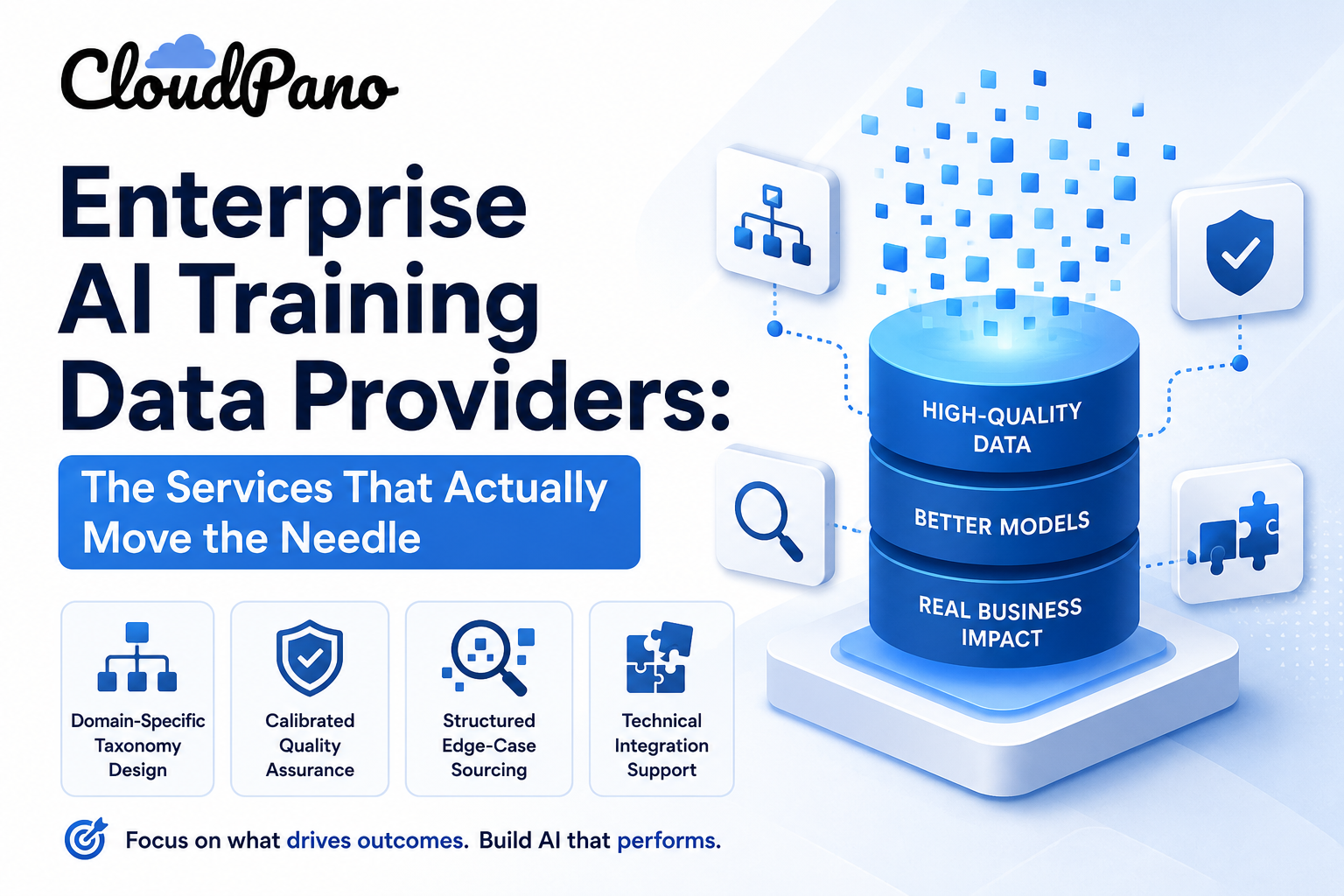
Enterprise AI Training Data Providers: The Services That Actually Move the Needle
Cloudpano
July 24, 2026
•
5 min read
Share this post
Enterprise AI Training Data Providers: The Services That Actually Move the Needle
Every enterprise AI training data provider proposal reads like a long menu: labeling, QA, security certifications, dedicated account management, tooling integration, reporting dashboards. Somewhere in enterprise AI training data provider evaluations, teams tend to weigh every line item equally — and that's usually the wrong instinct.
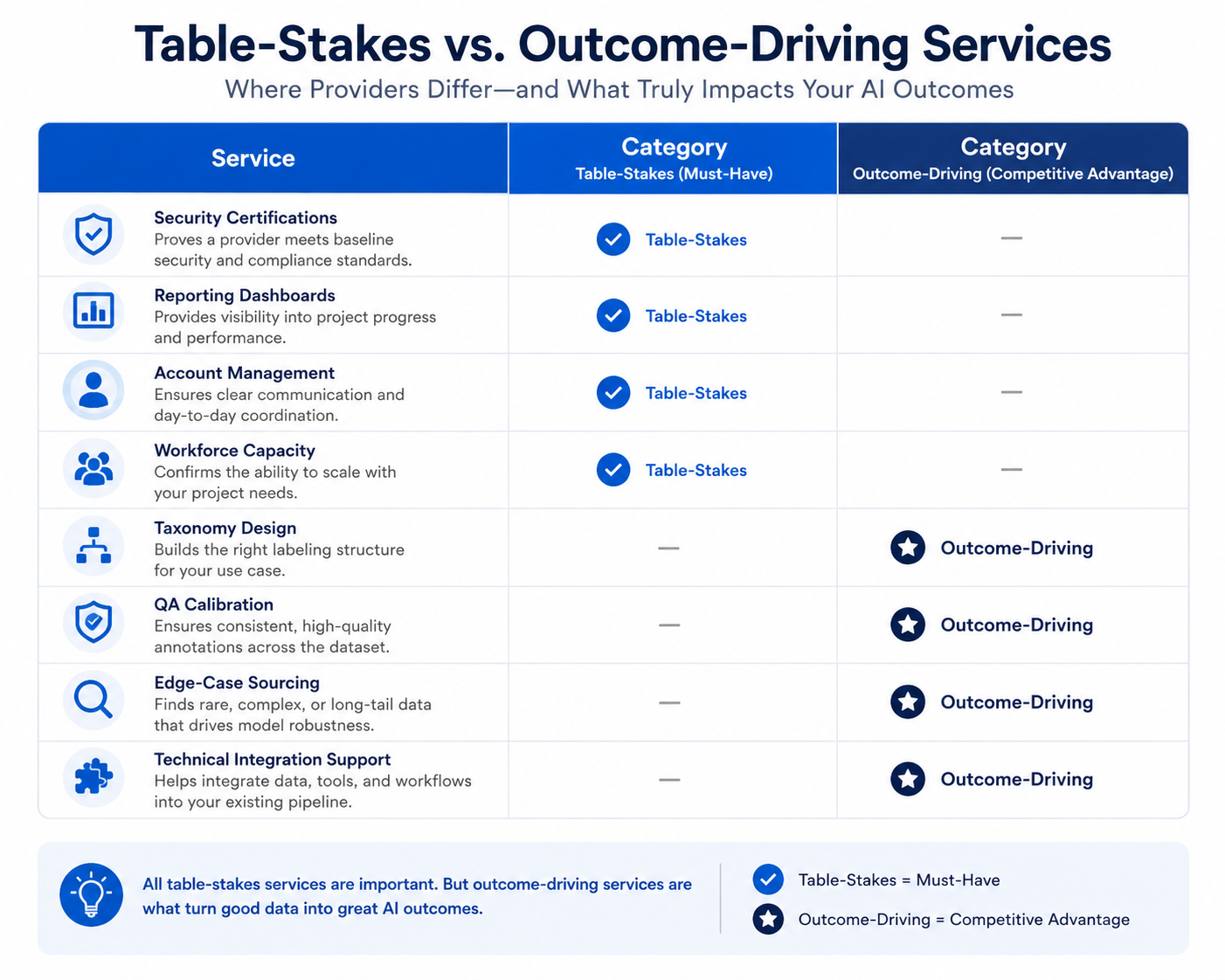
Some services on that list are genuinely table stakes: nearly every credible provider offers them, and they don't meaningfully differentiate outcomes. Others are the specific services that actually correlate with whether a model performs well or not. Knowing which is which changes how you evaluate and negotiate.
Why It Matters
Treating every service on a provider's menu as equally important spreads evaluation attention thin, right when a small number of specific capabilities matter far more than the rest. Google Research's "Data Cascades" study documented how the data-quality issues that most directly hurt models trace back to specific, identifiable gaps — not to a general absence of services, but to particular process failures (Sambasivan et al., Google Research).
NIST's AI Risk Management Framework similarly treats data quality as a specific, measurable property, not a generic checkbox — reinforcing that evaluating provider services should focus on the capabilities that produce measurable quality outcomes, not a broad feature count (NIST AI RMF).
Getting the prioritization right matters more given how quickly enterprise AI programs move. Stanford HAI's AI Index has tracked the accelerating pace of enterprise deployment (Stanford HAI, AI Index Report), leaving less time to discover, mid-project, that the services you prioritized in evaluation weren't the ones that actually mattered.
How It Works
Table-stakes services are the ones nearly every credible enterprise provider now offers: basic security certifications, standard reporting dashboards, a named account contact, and general workforce capacity. These matter — a provider missing them is a red flag — but having them doesn't differentiate one credible provider from another.
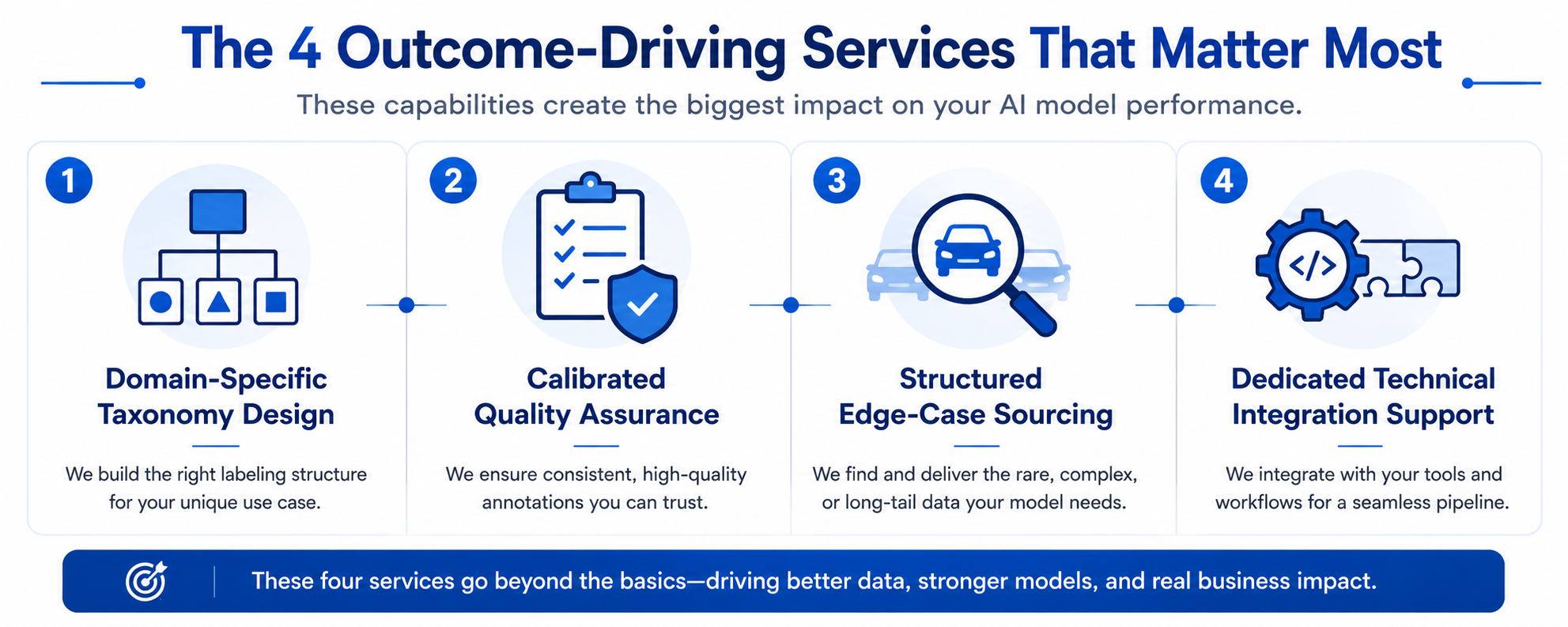
Outcome-driving services are the smaller set of capabilities that most directly affect whether your specific project succeeds:
Domain-specific taxonomy design. A provider that helps refine your labeling taxonomy for your actual task, rather than applying a generic template, catches ambiguity before it becomes inconsistent training data.
Calibrated quality assurance. QA processes tuned to your task's specific failure modes — not a generic accuracy check — catch the errors that matter most for your model's objective.
Structured edge-case sourcing. The ability to deliberately identify and fill gaps in rare or underrepresented scenarios, rather than relying on whatever data naturally arrives.
Dedicated technical integration support. Help fitting delivered data into your specific training pipeline format, reducing friction between delivery and actual use.
Understanding how these workflows operate at this level — table stakes versus outcome-driving — is what separates a productive provider evaluation from one that gets lost comparing feature lists.
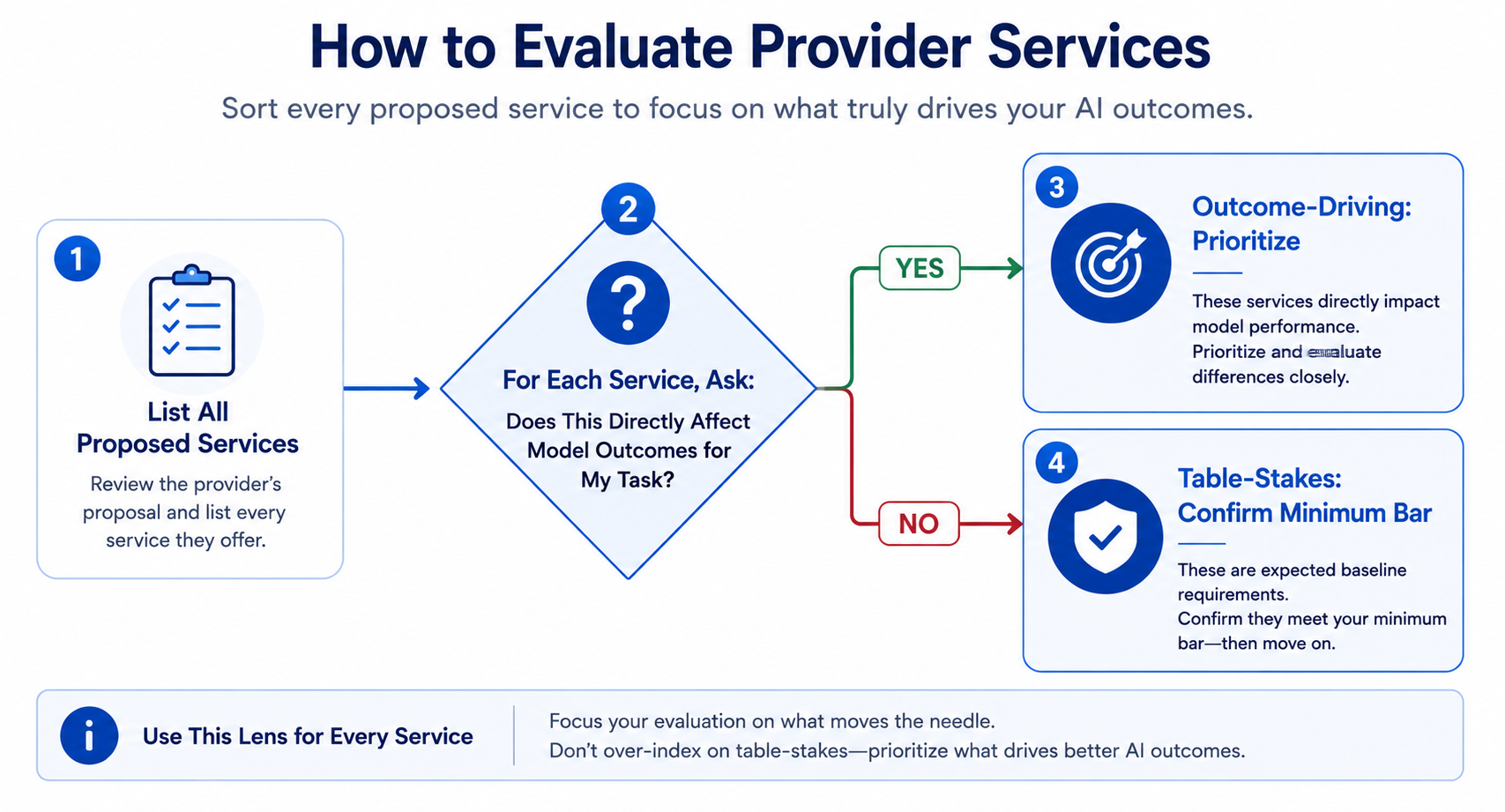
Step-by-Step Workflow for Prioritizing Services
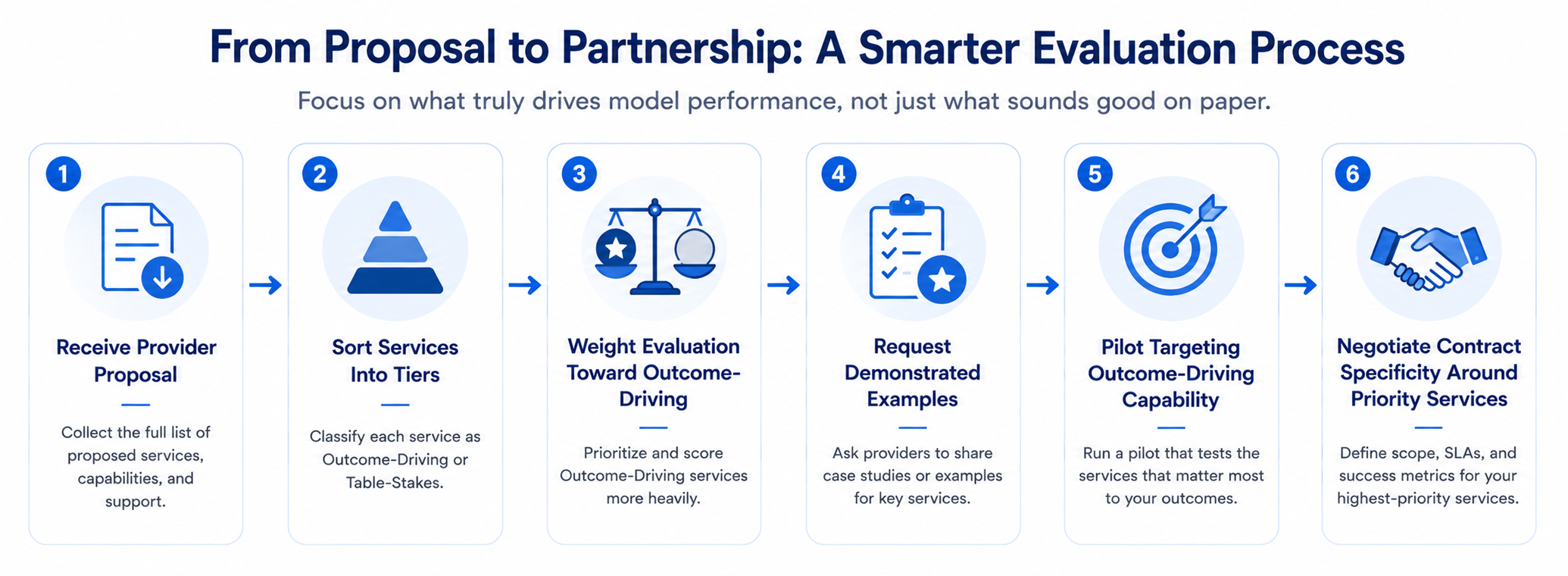
List every service in a provider's proposal. Get the full menu on the table before deciding what matters.
Sort each service into table-stakes or outcome-driving. Use your project's specific risk and complexity profile to judge which category each falls into.
Weight your evaluation criteria toward outcome-driving services. Spend the majority of your diligence time verifying these, not confirming table-stakes items are present.
Ask providers to demonstrate outcome-driving capabilities directly. Request examples of taxonomy refinement, calibrated QA design, or edge-case sourcing from comparable past projects.
Confirm table-stakes services meet a minimum bar and move on. Don't let extensive discussion of standard features crowd out time needed for the services that matter more.
Pilot specifically to test outcome-driving capability. Structure your pilot to surface whether taxonomy help, QA calibration, and edge-case sourcing actually work as described, not just whether basic labeling accuracy is acceptable.
Negotiate contract terms around the outcome-driving services. Written commitments should cover the specific capabilities that matter most, not just generic quality guarantees.
Industry Use Cases
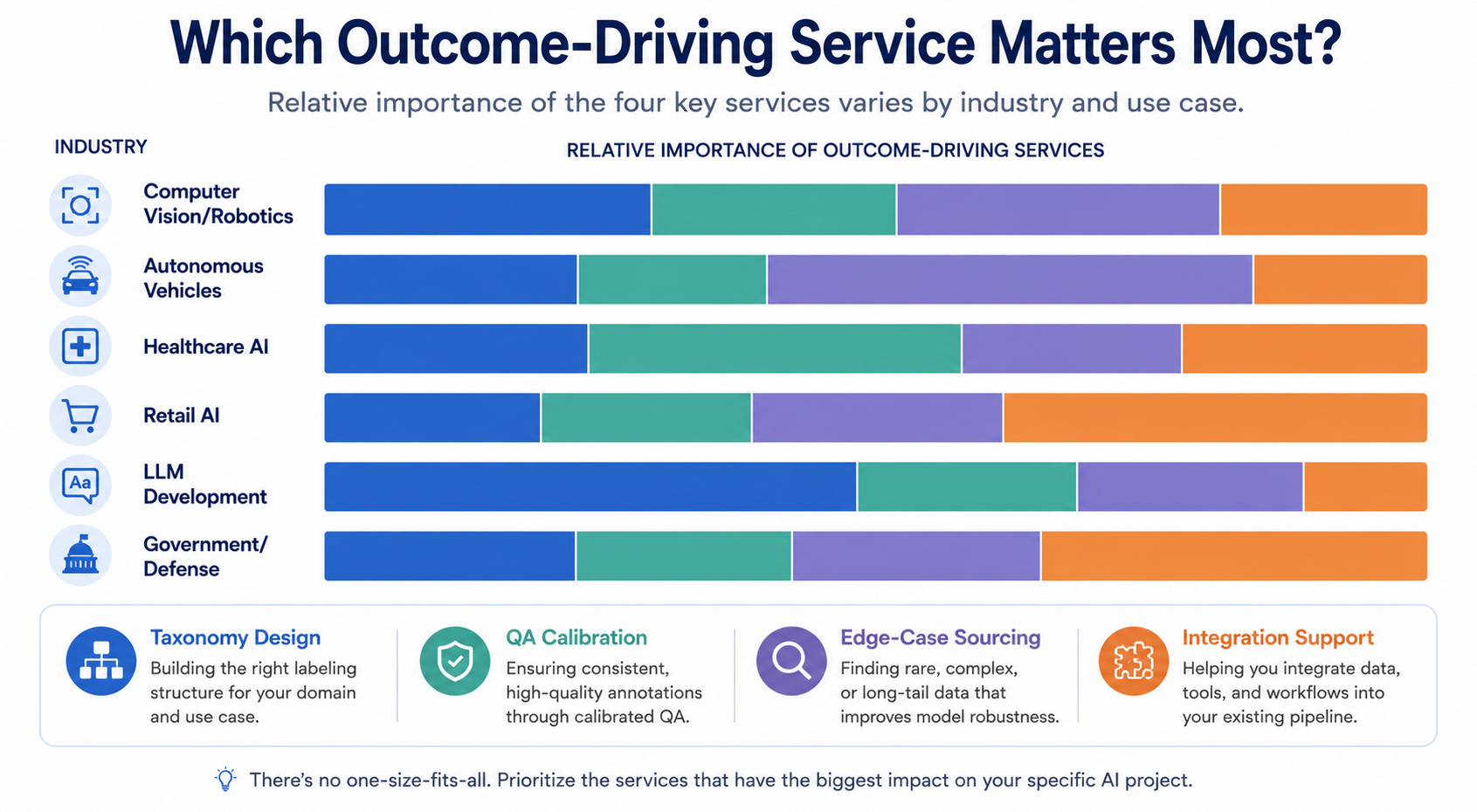
Computer vision / robotics: Structured edge-case sourcing is often the single most outcome-driving service, given how much model performance depends on rare object configurations and environments.
Autonomous vehicles: Calibrated quality assurance for safety-critical scenario labeling typically matters more than general workforce scale or standard reporting features.
Healthcare AI: Domain-specific taxonomy design, built with genuine clinical input, is often the differentiating service, more so than general security certifications alone.
Retail AI: Dedicated technical integration support tends to matter more here, given high-volume, fast-moving catalogs where pipeline friction compounds quickly.
LLM developers: Calibrated QA for nuanced preference and safety labeling is typically the most outcome-driving service, more than general workforce size.
Government & defense: Security and compliance services shift from table-stakes to genuinely outcome-driving here, given clearance and data residency requirements that directly gate project feasibility.
Benefits of Prioritizing the Right Services
More focused evaluation. Concentrating diligence on the services that actually matter produces a faster, more decisive vendor comparison.
Better negotiating outcomes. Knowing which services deserve the strongest contractual commitments avoids over-negotiating table-stakes items while under-specifying what really matters.
Reduced risk of a costly mismatch. A provider strong on table-stakes features but weak on outcome-driving capability is easy to miss without this prioritization.
Clearer internal justification. Being specific about which services drive outcomes makes it easier to explain a provider recommendation to stakeholders focused on cost.
Common Mistakes
Weighting every service in a proposal equally. Spending as much evaluation time on standard reporting dashboards as on taxonomy design or edge-case sourcing capability.
Mistaking a long feature list for genuine differentiation. Assuming a provider offering more services overall is automatically stronger on the ones that matter most for your project.
Not asking for concrete demonstration of outcome-driving services. Accepting a general claim of "we help refine your taxonomy" without seeing how that's actually done.
Under-specifying outcome-driving services in the contract. Writing detailed terms around table-stakes items (security, reporting) while leaving taxonomy or QA calibration commitments vague.
Piloting only on basic labeling accuracy. Missing the chance to test whether a provider's outcome-driving services actually function as described during the one phase built for verification.
Assuming outcome-driving services are the same across every project. Applying a fixed priority list without adjusting for your specific industry, data type, or risk profile.
Best Practices
Sort every service in a proposal into table-stakes or outcome-driving before starting a detailed evaluation.
Concentrate evaluation and negotiation effort on outcome-driving services specific to your project.
Ask for concrete, demonstrated examples of taxonomy design, QA calibration, and edge-case sourcing rather than general claims.
Structure your pilot specifically to test outcome-driving capability, not just baseline labeling accuracy.
Write contract terms with the strongest specificity around outcome-driving services, not just table-stakes items.
Adjust which services count as outcome-driving based on your specific industry and risk profile, rather than applying a fixed list universally. McKinsey's research on generative AI adoption notes that data readiness — including how precisely organizations identify which specific capabilities actually affect their model outcomes — remains one of the most consistently underestimated factors in AI project results (McKinsey, "The economic potential of generative AI").
FAQ
What services do most enterprise AI training data providers offer as standard?
Basic security certifications, standard reporting dashboards, a named account contact, and general workforce capacity are typically table-stakes across most credible providers.
Which provider services actually correlate with better model outcomes?
Domain-specific taxonomy design, quality assurance calibrated to your task's specific failure modes, structured edge-case sourcing, and dedicated technical integration support tend to matter most.
How do I evaluate whether a provider's taxonomy design service is genuinely useful?
Ask for concrete examples from comparable past projects showing how they identified and resolved ambiguity in a taxonomy, rather than accepting a general claim that they offer taxonomy support.
Should custom AI datasets require different service priorities than off-the-shelf labeling?
Yes. Custom AI datasets often depend more heavily on structured edge-case sourcing and domain-specific taxonomy design, since there's no existing dataset template to fall back on.
No. Workforce size affects throughput, but quality outcomes correlate more closely with calibrated QA processes and domain expertise than with raw headcount alone.
How should I structure a pilot to test outcome-driving services specifically?
Include tasks that specifically exercise taxonomy refinement, QA calibration on ambiguous cases, and edge-case handling, rather than only measuring baseline labeling accuracy on straightforward items.
Do outcome-driving services change depending on industry?
Yes. For example, security and compliance services shift from table-stakes to genuinely outcome-driving in government and defense contexts, while they matter less differentially in lower-stakes retail applications.
Conclusion
Not every service on an enterprise AI training data provider's proposal deserves equal attention. Table-stakes services matter as a baseline check, but the services that actually move a project's outcomes — domain-specific taxonomy design, calibrated quality assurance, structured edge-case sourcing, and technical integration support — deserve the majority of your evaluation, negotiation, and pilot-testing effort.
Create an interactive virtual showroom and engage affluent digital buyers with live 360º video calls, all through the CloudPano mobile app for a complete automotive sales solution.
Create 2D and 3D floor plans with measurements in 4 minutes or less, all from your phone. Download the Floor Plan Scanner app and get your first scan free.
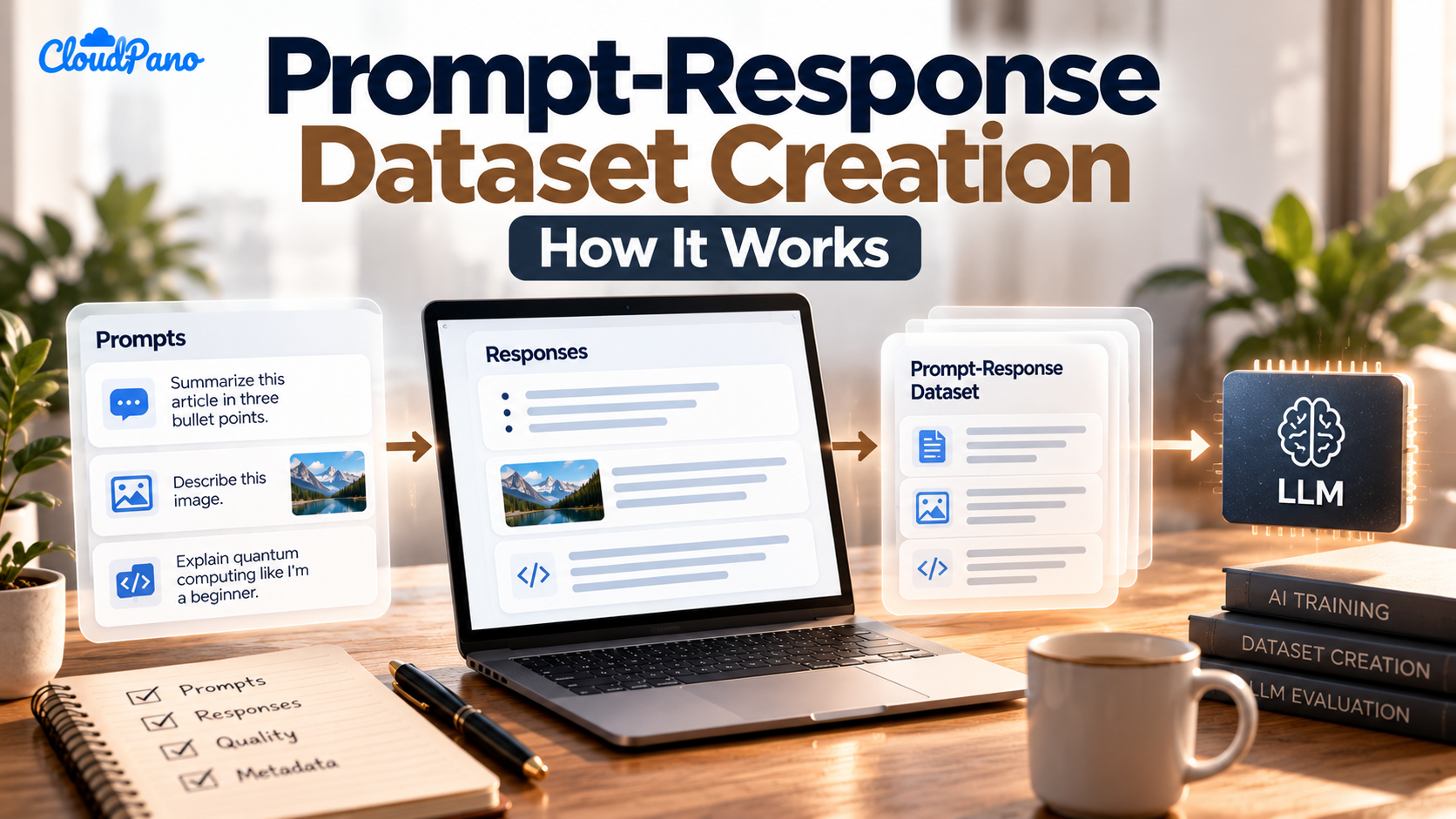
Explore how prompt response dataset creation works, from designing diverse prompts and generating high-quality responses to human review, quality assurance, and dataset evaluation. This guide also explains how prompt-response data supports supervised fine-tuning, instruction following, and reliable LLM evaluation.
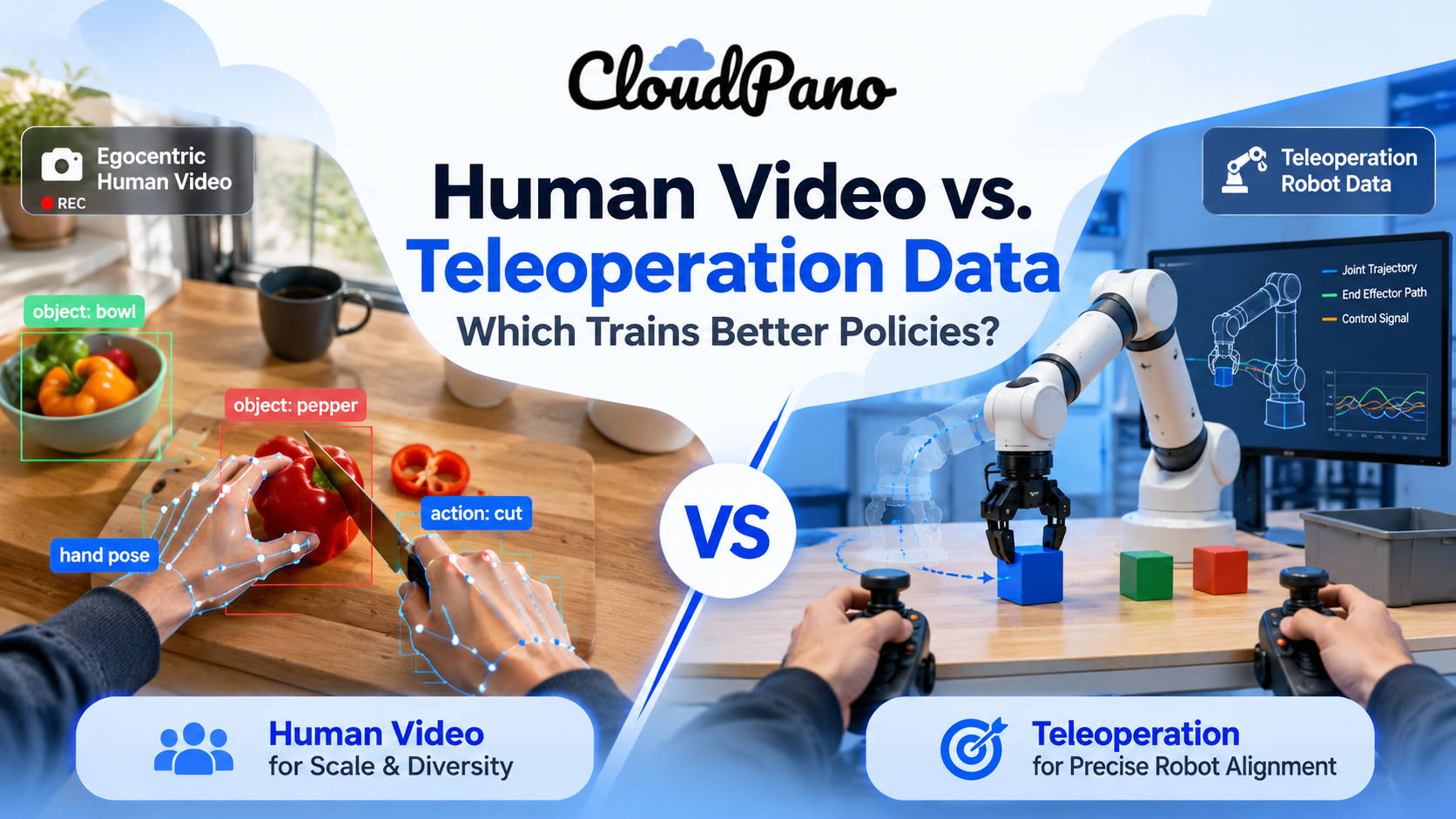
Robotics teams are debating whether to scale teleoperation or human video to train robot policies. This guide explains how each data type works, what research from 2024 to 2026 actually found, and why the strongest results now combine both sources.
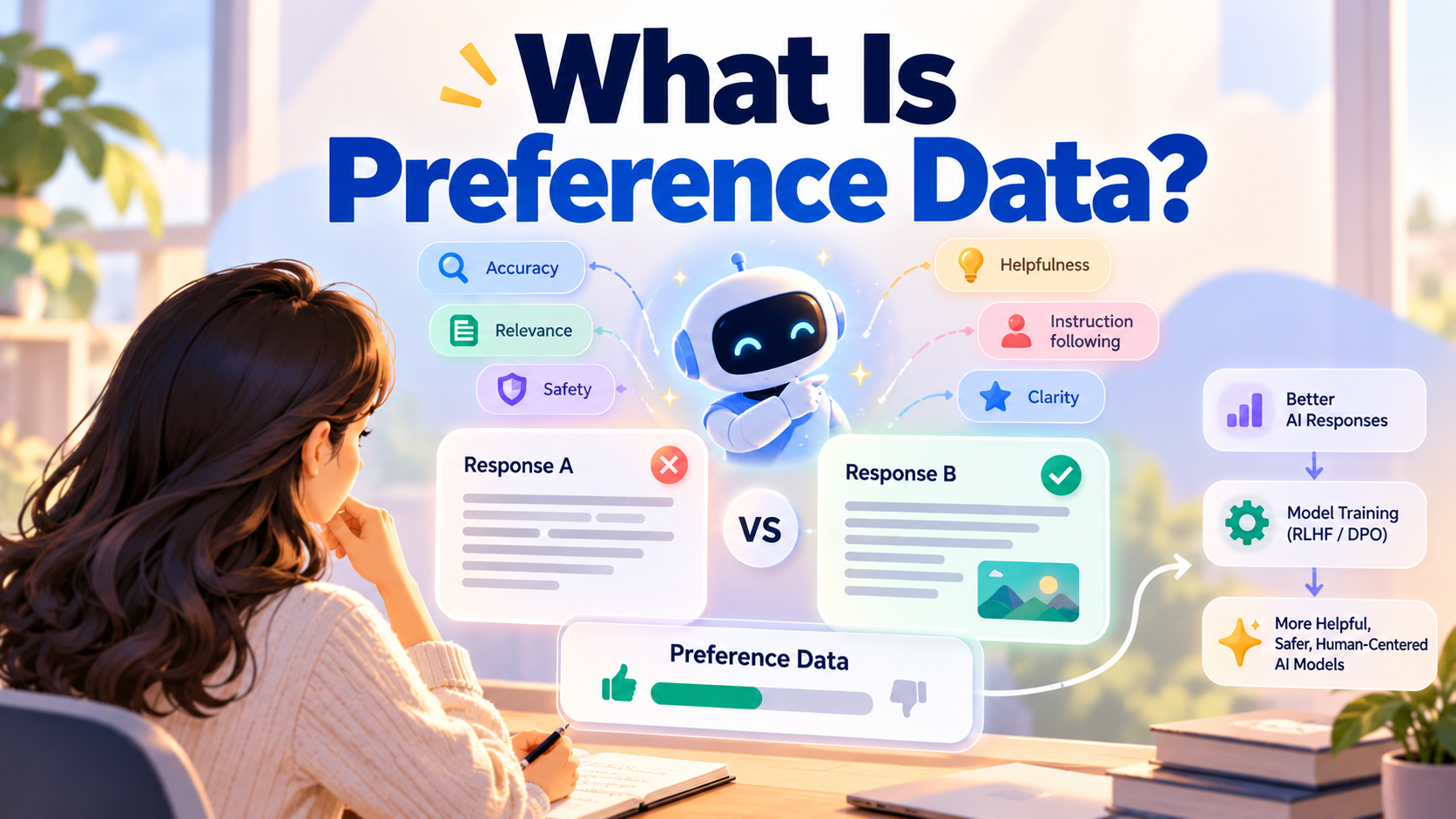
Preference data captures which AI responses people prefer based on accuracy, helpfulness, relevance, safety, and instruction following. Explore how preference data for RLHF supports reward modeling, DPO, LLM evaluation, and the development of more reliable AI systems.


.png)




.png)

.png)





.svg)


.svg)