


.png)


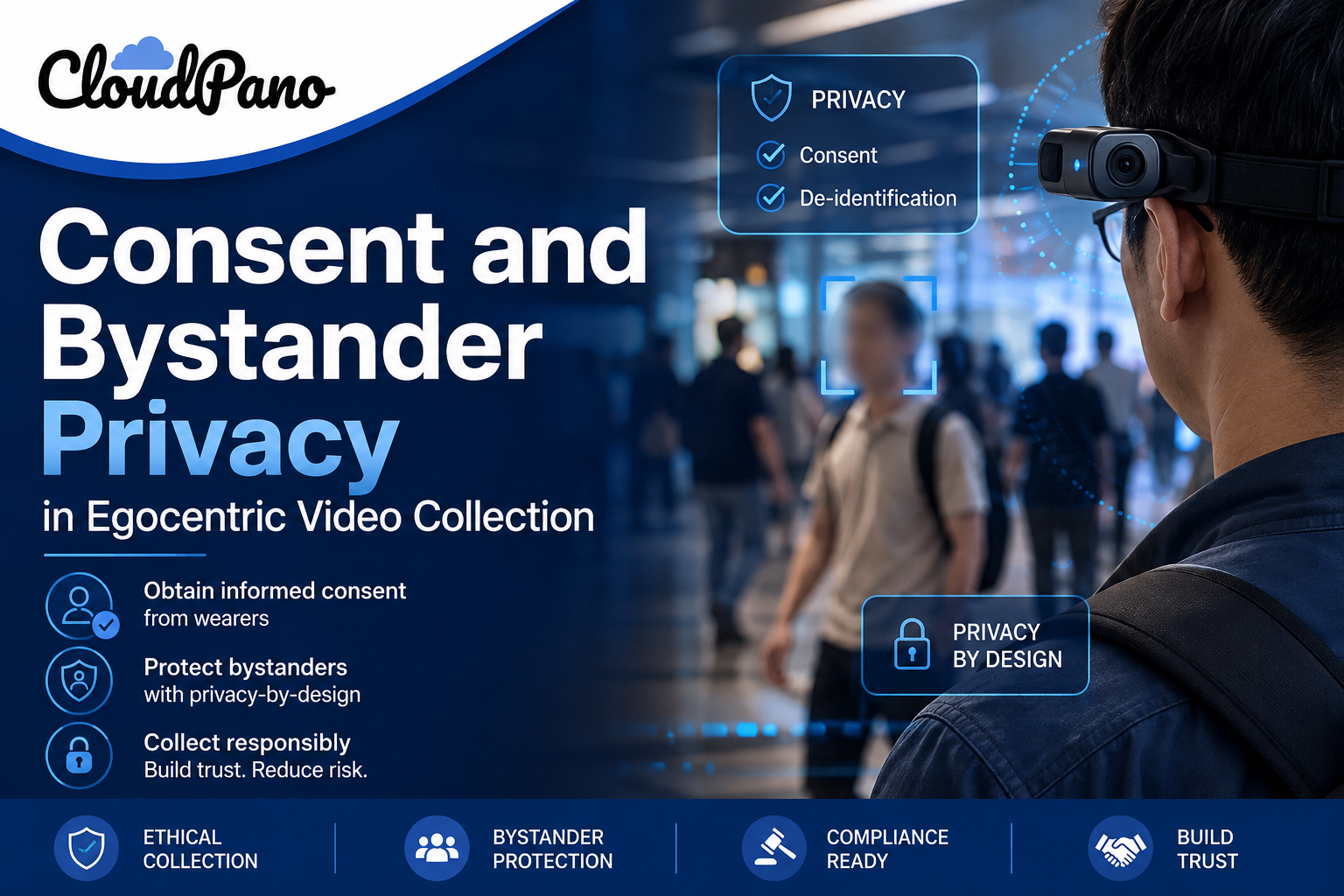
A wearer who's agreed to participate in a data collection study is only half the consent picture. Egocentric video privacy also has to account for everyone else who ends up in frame — coworkers, customers, family members, strangers on the street — none of whom explicitly agreed to be recorded, simply because they happened to be near someone wearing a camera.
Bystander Consent Wearable Camera planning gets overlooked far more often than wearer consent, even though bystanders are recorded just as directly and often have no practical way to opt out of appearing in footage they never agreed to be part of.
A collection effort that only addresses wearer consent creates real exposure once bystander footage becomes part of a dataset, since privacy expectations and applicable regulations don't disappear simply because someone wasn't the intended subject of a recording. Google Research's "Data Cascades" study documented how unaddressed issues introduced early in a data pipeline compound into larger problems later (Sambasivan et al., Google Research), and bystander privacy left unaddressed at the collection stage is exactly this kind of gap.
NIST's AI Risk Management Framework treats privacy risk management as a core component of trustworthy AI, directly relevant to First-Person Recording Ethics needing deliberate consideration of everyone captured on camera, not just the participant who agreed to wear it (NIST AI RMF).
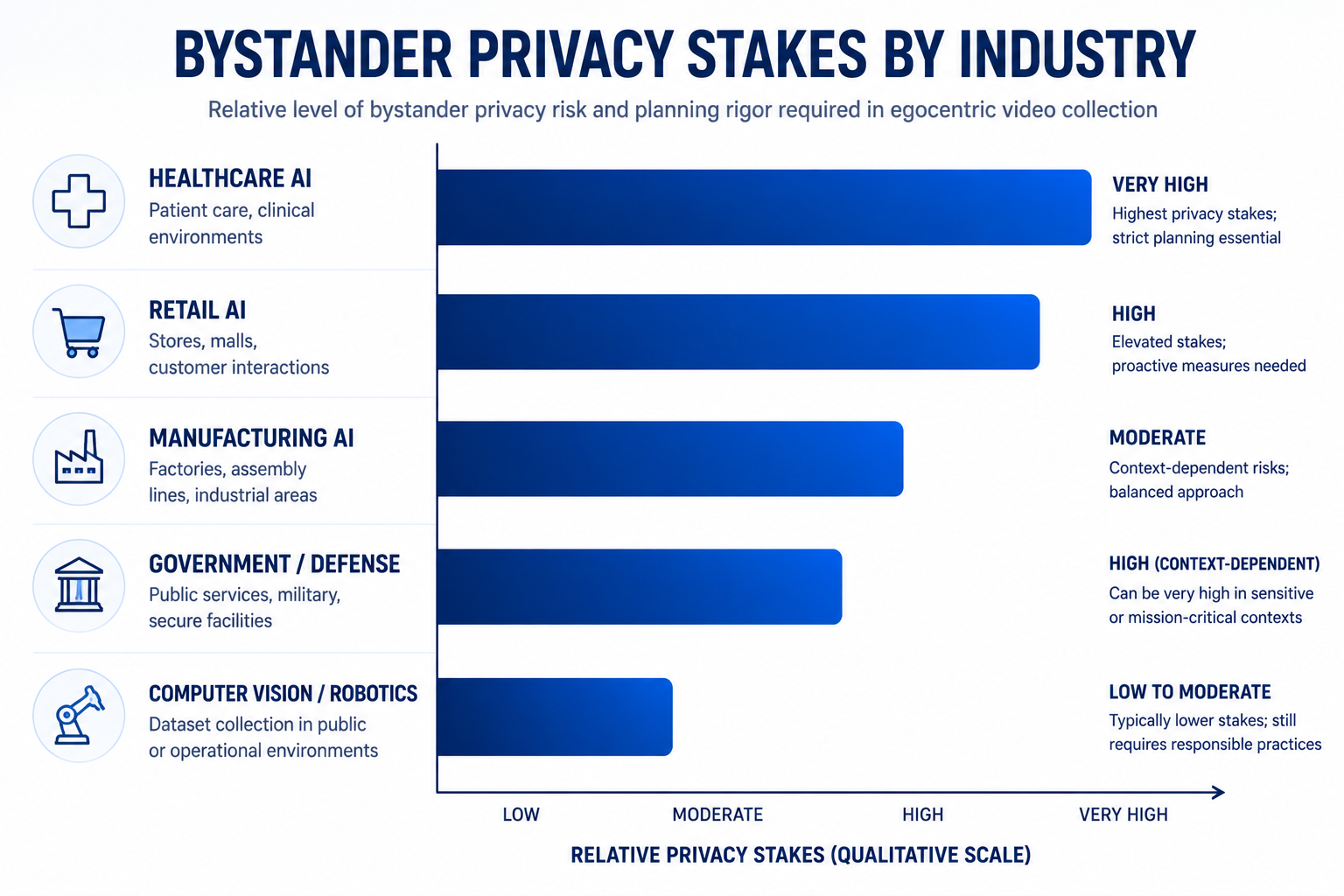
The stakes rise as wearable data collection becomes more common in shared and public spaces. Stanford HAI's AI Index has tracked growing interest in activity recognition research relying on egocentric data collected in real-world environments (Stanford HAI, AI Index Report), and bystander privacy gaps discovered after a large collection effort are considerably harder to remedy than ones addressed during study design.
Privacy in POV Data Collection generally requires deliberate planning across a few specific areas.

Notice and transparency at the point of collection. Where practical, informing people in a recording environment that data collection is taking place, rather than relying solely on the wearer's own consent as covering everyone present.
De-identification of bystander footage. Applying face blurring, masking, or other de-identification techniques to bystanders who appear in footage, distinct from the wearer, who has typically consented to being identifiable.

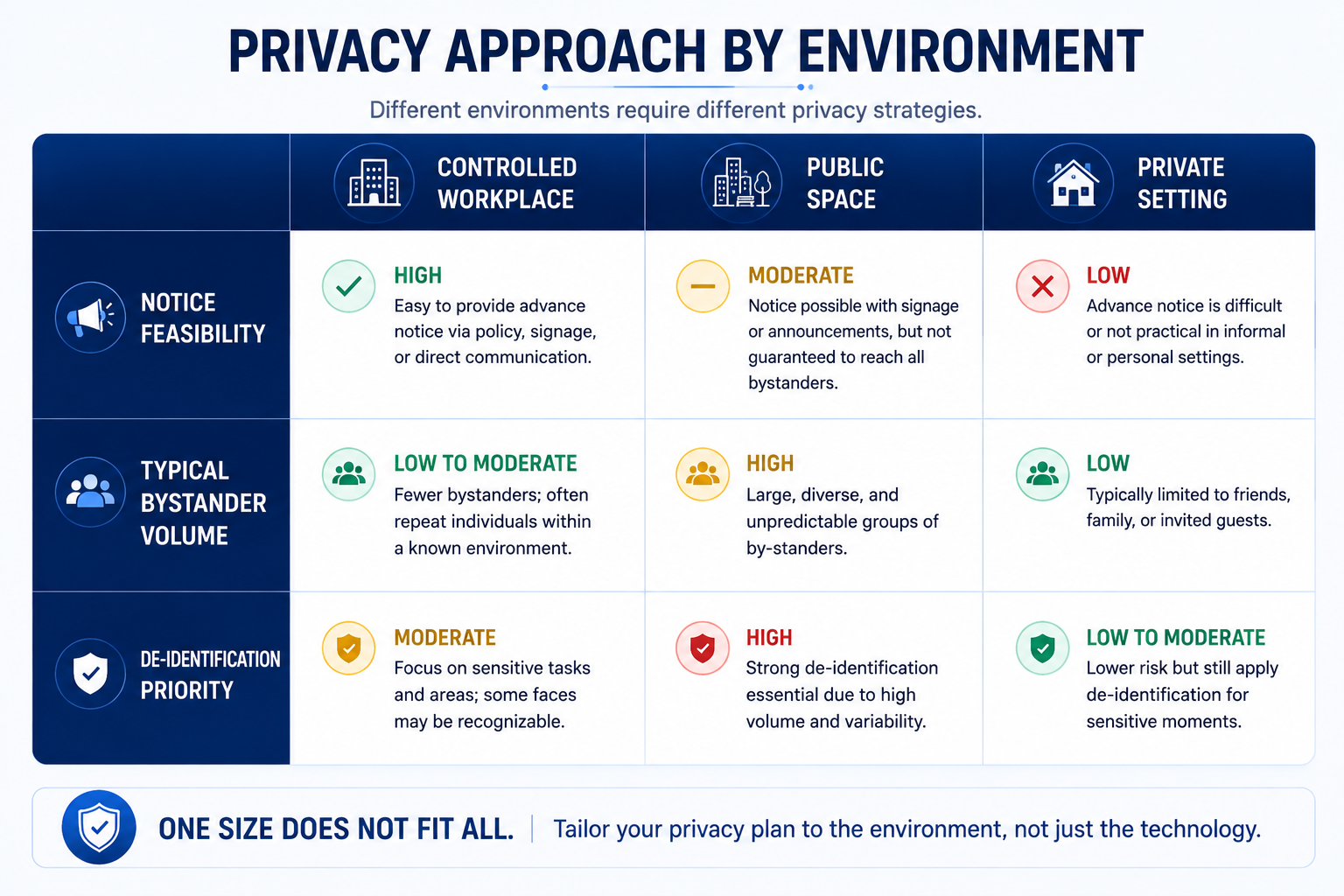
Location and context sensitivity. Recognizing that consent and privacy expectations differ meaningfully between a controlled workplace setting, a public space, and a private home, requiring different approaches to each.
Data retention and access limits for bystander-inclusive footage. Applying more conservative retention and access policies to footage that includes non-consenting bystanders than might apply to fully consented, controlled recordings.
Understanding how these workflows operate as requiring dedicated bystander consideration — not an assumption that wearer consent covers everyone captured — is what separates responsible egocentric collection from a collection effort that creates real, unaddressed privacy exposure.

No. Bystander privacy is a distinct consideration from wearer consent, since bystanders haven't agreed to being recorded simply because they were near a participant wearing a camera.
Applying techniques like face blurring or masking to individuals captured incidentally in footage who aren't the study participant, distinct from the wearer, who has typically consented to appearing identifiably.
Public spaces, private homes, and workplaces each carry different privacy expectations and notice feasibility, requiring collection plans tailored to the specific environment rather than one uniform approach.
Where practically feasible, yes. Providing notice, such as workplace signage or advance briefing, is a meaningful part of responsible bystander privacy practice, even when full individual consent isn't obtainable.
Practices for avoiding unnecessary capture of sensitive bystander situations where reasonably possible, alongside general awareness of the privacy considerations their recording activity involves.
Footage including non-consenting bystanders typically warrants more conservative retention and access limits than fully consented recordings, reflecting the different privacy interests at stake.
A clear record of the notice mechanisms, de-identification measures, and retention policies applied to a given collection effort, supporting later review if privacy questions arise.
Egocentric video privacy requires treating bystander consideration as its own deliberate planning area, not an extension of wearer consent. Notice mechanisms, de-identification, context-appropriate handling, and clear documentation are what separate egocentric collection that respects the people incidentally captured from a collection effort that creates unaddressed privacy exposure. Building this into study design from the start is considerably easier than remediating it after collection has already occurred.


Compact, ready to go anywhere
Interchangeable lens that’s upgradeable
Dual 1-inch sensors for improved clarity and low light performance
Dynamic range and 6K 360° capture
360° photo resolution at 21MP

8K 360° video recording for ultra-detailed visuals.
4K single-lens mode for traditional wide-angle shots.
Invisible selfie stick effect for drone-like perspectives.
2.5-inch touchscreen with Gorilla Glass protection.
Waterproof up to 33ft for underwater shooting.

360° photo resolution in 23MP
Slim design at 24 mm thick
Built-in image stabilization for smooth video capture.
Internal 19GB storage for photo and video storage.
Wireless connectivity for remote control and sharing.

60MP 360° still images for high-resolution photography.
5.7K 360° video recording at 30fps.
2.25-inch touchscreen for intuitive control.
USB Type-C port for fast charging and data transfer.
MicroSD card slot for expandable storage.
.png)

.png)

Try it free. No credit card required. Instant set-up.






.svg)


.svg)