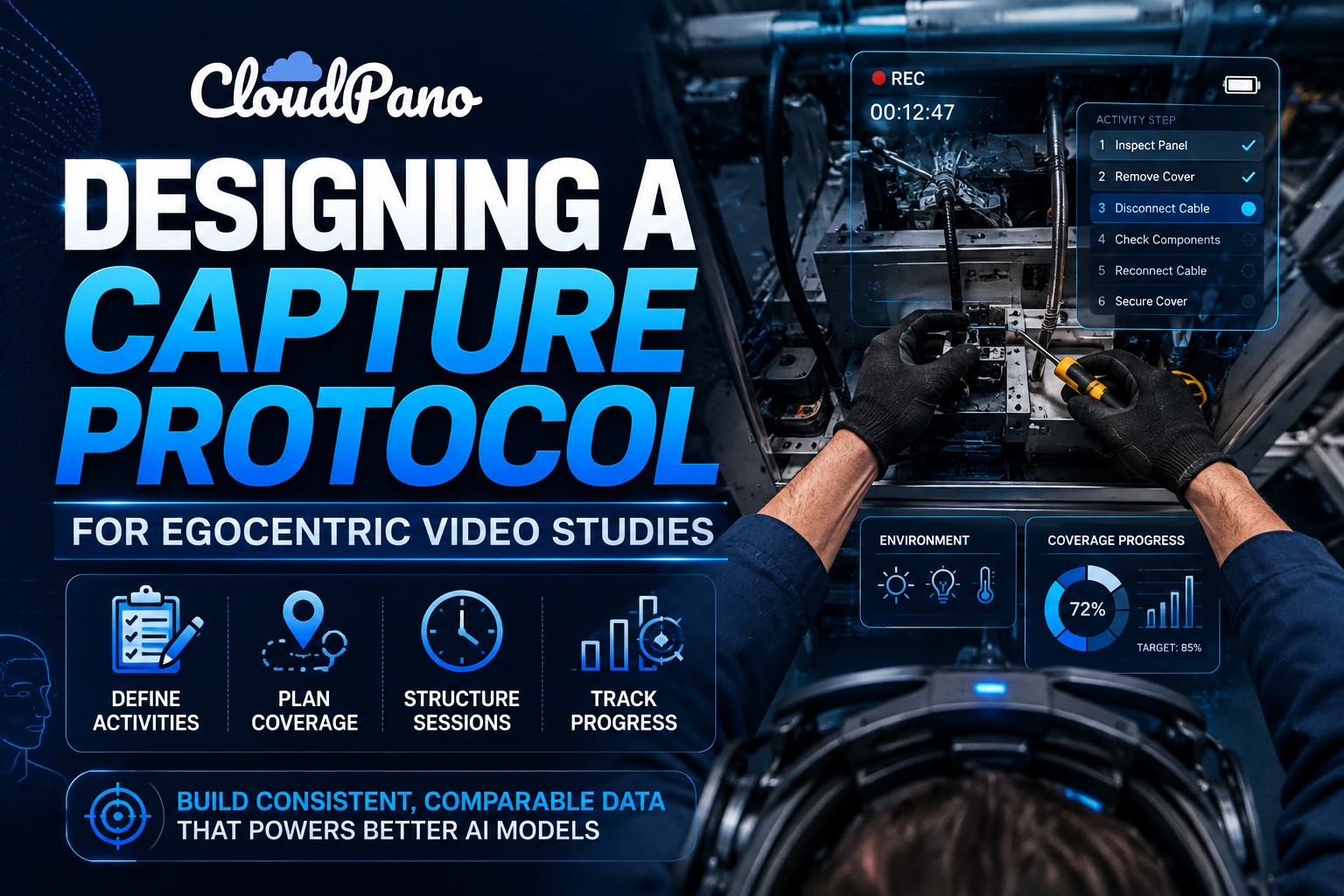
Designing a Capture Protocol for Egocentric Video Studies

Cloudpano
August 2, 2026
5 min read
Share this post

Designing a Capture Protocol for Egocentric Video Studies

Good hardware pointed at the right activity for an unstructured amount of time still doesn't guarantee useful data. Egocentric video capture protocol design is what actually determines whether a collection effort produces consistent, task-relevant footage or an inconsistent pile of recordings missing exactly the scenarios a model needs.

First-Person Data Collection Design requires treating protocol as its own deliberate discipline — scripting which activities get recorded, in what environments, for how long, and with what coverage targets — rather than assuming a general instruction to "go record some activity" will produce usable data.

Why It Matters

A protocol gap doesn't announce itself during collection — it shows up later as a specific scenario or condition missing from the dataset, discovered only when annotation or model training reveals the coverage hole. Google Research's "Data Cascades" study documented how such gaps introduced early in a pipeline compound into larger, harder-to-diagnose problems as a project progresses (Sambasivan et al., Google Research), and protocol design sits about as early in an egocentric collection pipeline as a decision gets.

NIST's AI Risk Management Framework treats data representativeness and fitness for the intended task as foundational to trustworthy AI, directly relevant to Activity Capture Study Design needing deliberate coverage planning rather than open-ended recording that may not represent the conditions a model will actually encounter (NIST AI RMF).

The stakes rise given how much egocentric vision research and deployment has expanded. Stanford HAI's AI Index has tracked growing interest in activity recognition and wearable sensing applications (Stanford HAI, AI Index Report), and a protocol gap discovered after a large collection effort is considerably more expensive to correct than one caught during initial study design.

How It Works

A working Wearable Camera Study Methodology generally addresses a few specific design elements.
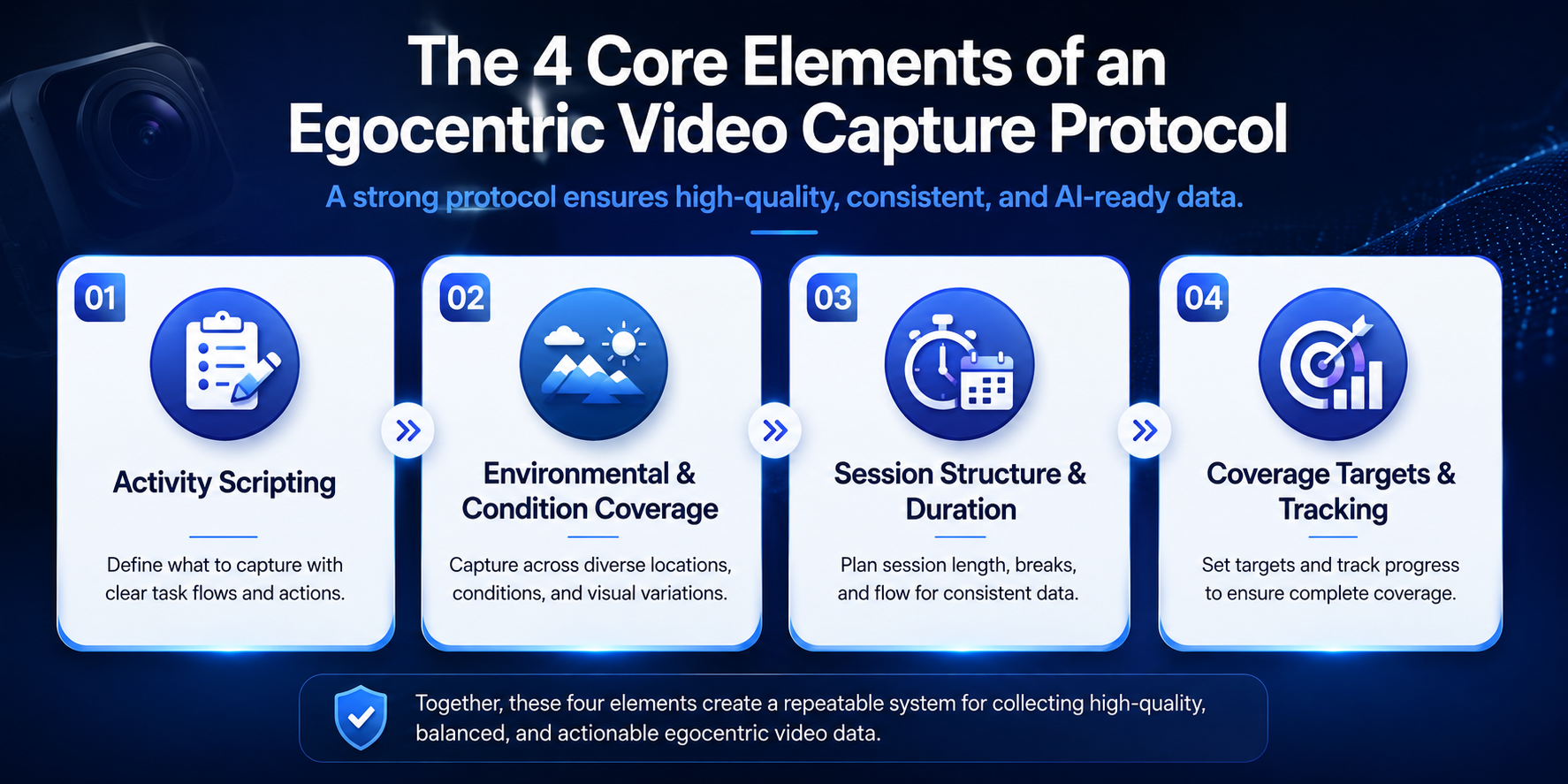
Infographic of four core elements of an egocentric video capture protocol

Activity scripting. Defining the specific tasks or behaviors to be captured — not a vague instruction like "do your normal routine," but concrete, repeatable activity definitions that produce comparable footage across sessions and participants.
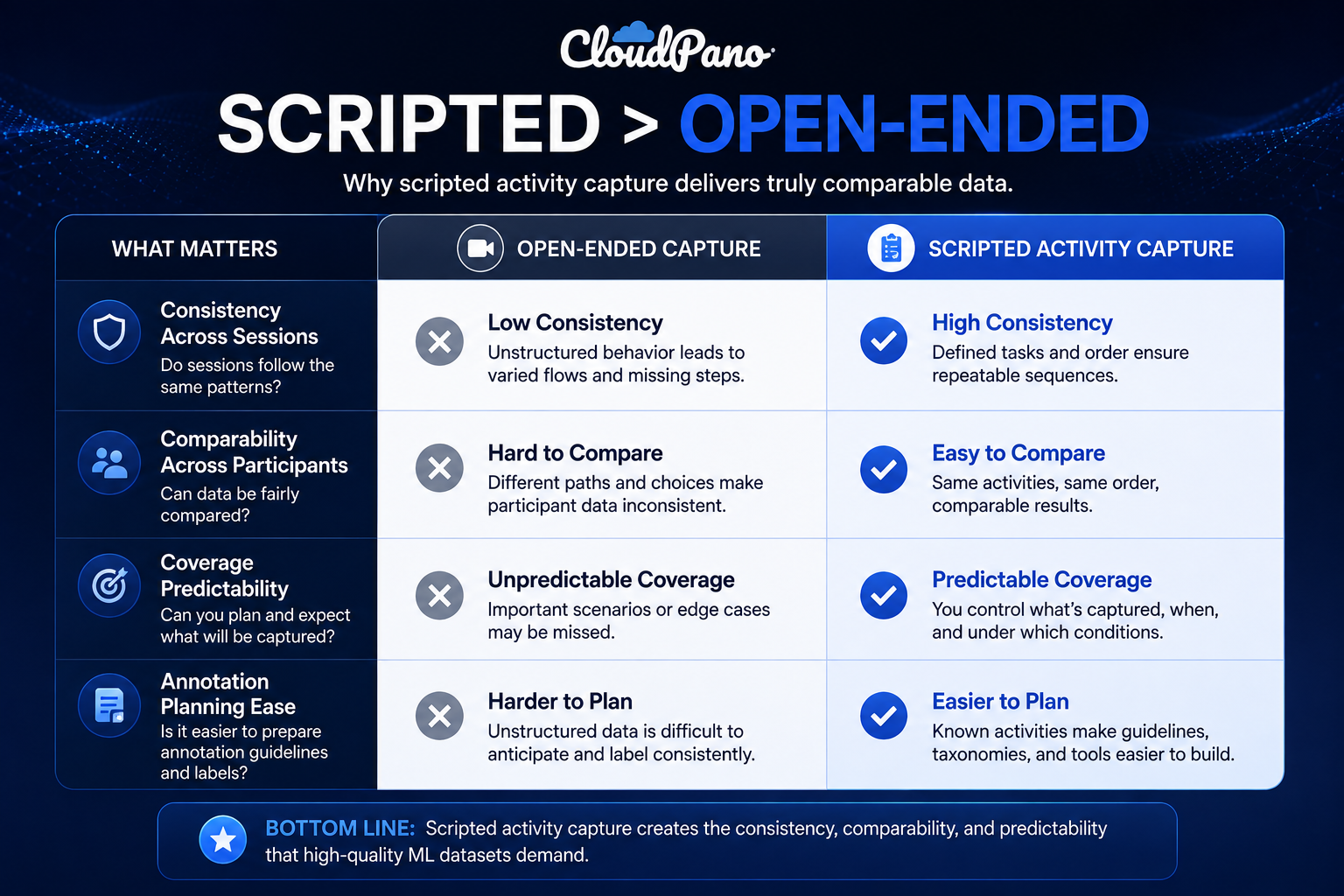
Comparison table of scripted vs open-ended egocentric activity capture

Environmental and condition coverage. Planning deliberately for the range of lighting, location, and situational variation a deployed model will actually need to handle, rather than capturing convenient conditions only.

Session structure and duration. Specifying how long each recording session runs and how sessions are broken into meaningful segments, avoiding both overly short sessions that miss context and overly long ones that produce unmanageable, undifferentiated footage.

Coverage targets and tracking. Setting explicit targets for how much footage is needed across each activity type, condition, and participant, and tracking progress against those targets during collection rather than only after the fact.
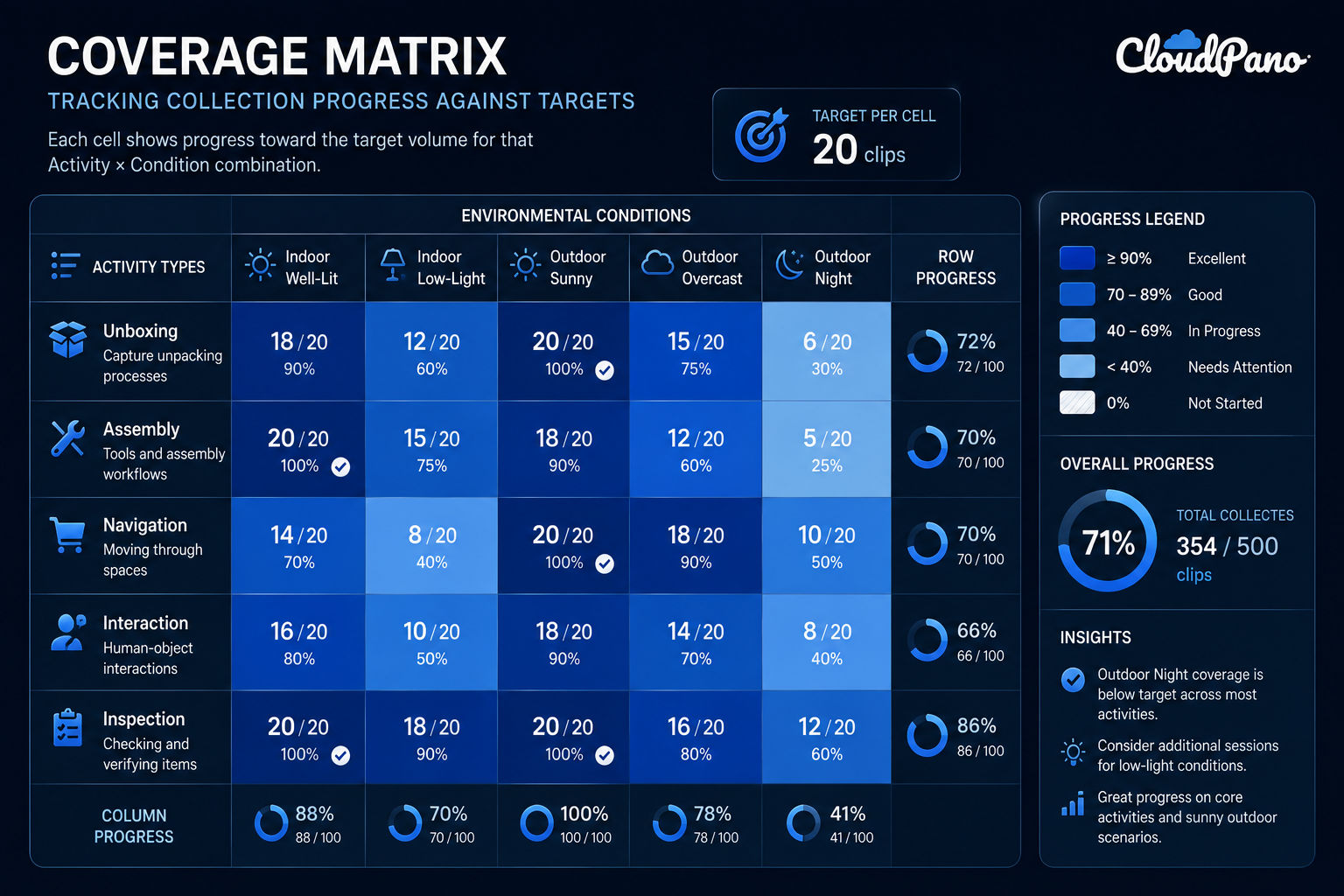
Illustration of a coverage matrix tracking egocentric video capture progress

Understanding how these workflows operate as a deliberate study design exercise — closer to a research protocol than a casual filming session — is what actually produces footage a model can reliably learn from.
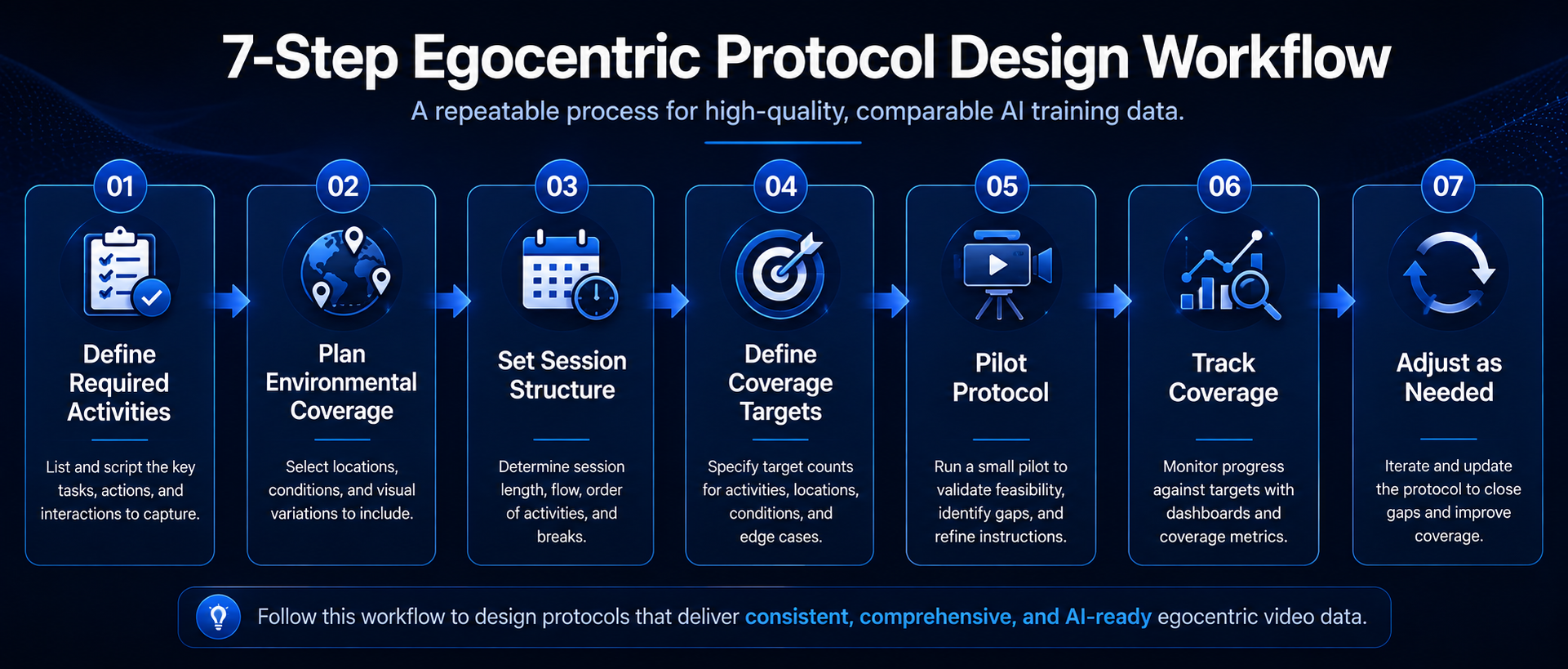
Step-by-Step Workflow

Flowchart for designing an egocentric video capture protocol for AI training data
  1. Define the specific activities your model task needs represented. Translate the model's actual requirement into concrete, scriptable activity definitions.
  2. Plan environmental and condition coverage deliberately. Identify the range of lighting, location, and situational variation the collection needs to include.
  3. Set session structure and duration guidelines. Specify how long sessions run and how they're segmented into meaningful units.
  4. Define explicit coverage targets before collection begins. Establish how much footage is needed per activity, condition, and participant.
  5. Pilot the protocol on a small sample before full-scale collection. Confirm the scripted activities and coverage plan actually produce usable, representative footage.
  6. Track coverage against targets throughout collection. Monitor progress in real time rather than discovering gaps only once collection has concluded.
  7. Adjust the protocol if gaps or new requirements emerge. Treat the protocol as a living document that can be refined as collection reveals what's actually needed.

Industry Use Cases

Bar chart showing emphasis on egocentric capture protocol design by industry
  • Computer vision / robotics: Activity scripting for manipulation or navigation tasks needs to capture the specific range of object types and environments a robot will actually encounter.
  • Healthcare AI: Capture protocols for clinical or rehabilitation applications often require carefully scripted procedural steps to ensure consistency across participants and sessions.
  • Manufacturing AI: Protocol design for assembly or inspection tasks benefits from scripting specific process steps consistently across different workers and shifts.
  • Retail AI: Activity capture in this domain often centers on scripted customer interaction scenarios rather than open-ended shadowing of daily work.
  • Government & defense: Protocol design in this sector often layers formal documentation and security review requirements on top of standard activity and coverage planning.
  • Autonomous vehicles: This specific first-person study design approach has limited direct application, since vehicle-mounted data collection follows different protocol considerations entirely.

Benefits

  • Consistent, comparable footage across sessions. Scripted activities produce data that's actually comparable across participants and collection sessions, rather than incidentally similar.
  • Deliberate coverage of conditions a model will actually face. Planning environmental variation upfront avoids a dataset skewed toward convenient collection conditions only.
  • Fewer costly gaps discovered late. Explicit coverage targets, tracked during collection, catch missing scenarios before the collection effort concludes.
  • More efficient use of collection time and budget. A structured protocol avoids wasted effort on redundant footage while ensuring genuinely needed scenarios get captured.
  • Easier downstream annotation planning. Well-structured, scripted footage is easier to plan annotation work around than inconsistent, open-ended recordings.
  • Clearer communication across a distributed collection team. A written protocol gives multiple collectors or sites a shared reference, reducing the drift that happens when each person interprets "capture the activity" differently.
  • A defensible basis for later dataset documentation. A documented protocol supports provenance and methodology records that matter if a dataset's composition or coverage is questioned later.

Common Mistakes

  • Relying on vague or open-ended activity instructions. Producing footage that varies unpredictably across participants rather than the comparable data a scripted protocol provides.
  • Not planning for environmental and condition variation. Capturing only convenient lighting and location conditions, leaving the dataset unrepresentative of real deployment scenarios.
  • Setting no explicit coverage targets. Discovering only after collection concludes that specific activities or conditions were significantly underrepresented.
  • Choosing session lengths without considering downstream usability. Recording sessions too short to capture full context, or too long to reasonably annotate and structure afterward.
  • Skipping a pilot of the protocol itself. Committing to full-scale collection without first confirming the scripted activities and coverage plan actually work in practice.
  • Treating the protocol as fixed once collection begins. Not adjusting the plan when early collection reveals gaps or unanticipated requirements.

Best Practices

  • Translate the model's actual requirement into concrete, scriptable activity definitions rather than vague general instructions.
  • Plan environmental and condition coverage deliberately, matching the range a deployed model will actually need to handle.
  • Set explicit coverage targets before collection begins, and track progress against them throughout.
  • Pilot the protocol on a small sample before committing to full-scale collection.
  • Structure session length and segmentation with downstream annotation and usability in mind.
  • Treat the protocol as adjustable, refining it as early collection reveals gaps or new requirements.

FAQ

What does an egocentric video capture protocol actually define?

The specific activities to be recorded, environmental and condition coverage targets, session structure and duration, and explicit coverage tracking, rather than leaving collection open-ended.

Why does activity scripting matter for first-person data collection design?

Because vague instructions produce footage that varies unpredictably across sessions and participants, while concrete, scriptable activity definitions produce comparable, task-relevant data.

How much environmental variation should an activity capture study design include?

Enough to represent the range of lighting, location, and situational conditions a deployed model will actually encounter, planned deliberately rather than limited to whatever's convenient to capture.

What are coverage targets in a wearable camera study methodology?

Explicit goals for how much footage is needed across each activity type, condition, and participant, set before collection begins and tracked throughout to catch gaps early.

Should a capture protocol be piloted before full-scale collection?

Yes. A small-scale pilot confirms scripted activities and the coverage plan actually produce usable, representative footage before committing to the cost of full deployment.

Can a capture protocol be adjusted once collection has started?

Yes, and it often should be. Treating the protocol as a living document lets a team refine activity scripting or coverage targets as early collection reveals gaps or unanticipated needs.

How does session structure affect downstream annotation of egocentric video?

Well-structured, appropriately segmented sessions are easier to plan annotation work around than sessions that are either too short to capture full context or too long to manage efficiently.

Conclusion

A well-designed egocentric video capture protocol is what actually separates a collection effort that produces reliable, task-relevant footage from one that produces an inconsistent pile of recordings with unpredictable gaps. Activity scripting, deliberate environmental coverage, structured sessions, and tracked coverage targets are what turn egocentric data collection into a genuine research protocol rather than casual filming.

🚀 Your All‑In‑One Virtual Experience Stack
🎬
PhotoAIVideo
Turn photos into scroll‑stopping AI videos.
Get Started →
🏡
Pictastic
Instantly stage listings with AI.
Try Staging →
🌀
CloudPano
Create stunning 360° tours in minutes.
Launch Tour →
💰
VirtualTourProfit
Build a profitable virtual tour business.
Learn More →
🤝
CloudPano Reseller
Resell AI visual software without building it.
Become a Reseller →
🚗
Auto CloudPano
Sell more vehicles with 360° experiences.
Explore Auto →
🏗️
AI Floor Plan Builder
Generate detailed floor plans with AI.
Build Now →
📐
3D Measure
Capture accurate floor plans & 3D measurements.
Measure Now →
🧠
AI Training Data
Custom AI training data services.
Learn More →
Share this post
Cloudpano

Choose The Right 360° Camera

Insta360 ONE RS 1-Inch 360 Edition

  • Compact, ready to go anywhere

  • Interchangeable lens that’s upgradeable

  • Dual 1-inch sensors for improved clarity and low light performance

  • Dynamic range and 6K 360° capture

  • 360° photo resolution at 21MP

Learn More

Insta360 X4

  • 8K 360° video recording for ultra-detailed visuals.

  • 4K single-lens mode for traditional wide-angle shots.

  • Invisible selfie stick effect for drone-like perspectives.

  • 2.5-inch touchscreen with Gorilla Glass protection.

  • Waterproof up to 33ft for underwater shooting.

Learn More

Ricoh Theta Z1

  • 360° photo resolution in 23MP

  • Slim design at 24 mm thick

  • Built-in image stabilization for smooth video capture.

  • Internal 19GB storage for photo and video storage.

  • Wireless connectivity for remote control and sharing.

Learn More

Ricoh Theta X

  • 60MP 360° still images for high-resolution photography.

  • 5.7K 360° video recording at 30fps.

  • 2.25-inch touchscreen for intuitive control.

  • USB Type-C port for fast charging and data transfer.

  • MicroSD card slot for expandable storage.

Learn More
Property Marketing
Allows potential buyers to explore properties in detail from anywhere, enhancing the real estate marketing process.
Automotive Spins
Create an interactive virtual showroom and engage affluent digital buyers with live 360º video calls, all through the CloudPano mobile app for a complete automotive sales solution.
Interactive Floor Plans
Create 2D and 3D floor plans with measurements in 4 minutes or less, all from your phone. Download the Floor Plan Scanner app and get your first scan free.

360 Virtual Tours With CloudPano.com. Get Started Today.

Try it free. No credit card required. Instant set-up.

Try it free
Latest posts

See our other posts

Interviews, tips, guides, industry best practices, and news.

Multi-Sensor Egocentric Capture: Syncing Camera, IMU, and Eye Tracking

Multi-sensor egocentric capture combines video with additional data streams like IMU motion data and eye tracking, each adding information a single camera can't provide on its own. The core challenge isn't collecting each stream — it's synchronizing and fusing them accurately enough that a model can use them together as one coherent dataset.
Read post

Camera-to-Body Calibration for Egocentric Video Systems

Egocentric camera calibration establishes the precise spatial relationship between a wearable camera and the wearer's body or joints, which downstream tasks like pose estimation and interaction modeling depend on. Without accurate calibration, a system can't reliably translate what the camera sees into an accurate understanding of body position or movement.
Read post

Designing a Capture Protocol for Egocentric Video Studies

An egocentric video capture protocol defines the specific activities, environments, session structure, and coverage targets a first-person data collection effort needs to record, rather than relying on open-ended filming. A structured protocol produces consistent, task-relevant footage; unstructured recording tends to leave coverage gaps that only surface during annotation or training.
Read post