


.png)


Recording a person performing a task from a first-person viewpoint looks like a straightforward way to generate robot training data. Egocentric capture for robot learning runs into a specific, well-known problem right away: a human hand and a robot gripper don't move the same way, don't have the same degrees of freedom, and don't occupy the same physical space relative to the task — a challenge commonly called the embodiment gap.
First-Person Demonstration Data that ignores this gap can look perfectly usable while actually transferring poorly to a robot, since the specific joint angles, grip mechanics, and physical constraints that make a human demonstration work don't map directly onto a robot's different physical form.
Demonstration data collected without addressing the embodiment gap doesn't fail obviously during collection — it fails later, when a robot trained on that data struggles to translate human movement patterns into its own physically different motion capabilities. Google Research's "Data Cascades" study documented how such issues introduced early in a data pipeline compound into larger, harder-to-diagnose problems once a model has already been trained (Sambasivan et al., Google Research), and embodiment mismatch is exactly this kind of foundational gap.
NIST's AI Risk Management Framework treats data fitness for the intended task as foundational to trustworthy AI, directly relevant to Wearable Camera Imitation Learning needing demonstration data specifically designed to transfer to a robot's actual physical capabilities, not simply recorded human activity (NIST AI RMF).
The stakes rise as imitation learning becomes a more established approach to robot training. Stanford HAI's AI Index has tracked growing research interest in learning-from-demonstration methods for robotics (Stanford HAI, AI Index Report), and embodiment gap issues at scale can quietly undermine the value of an entire demonstration collection effort.
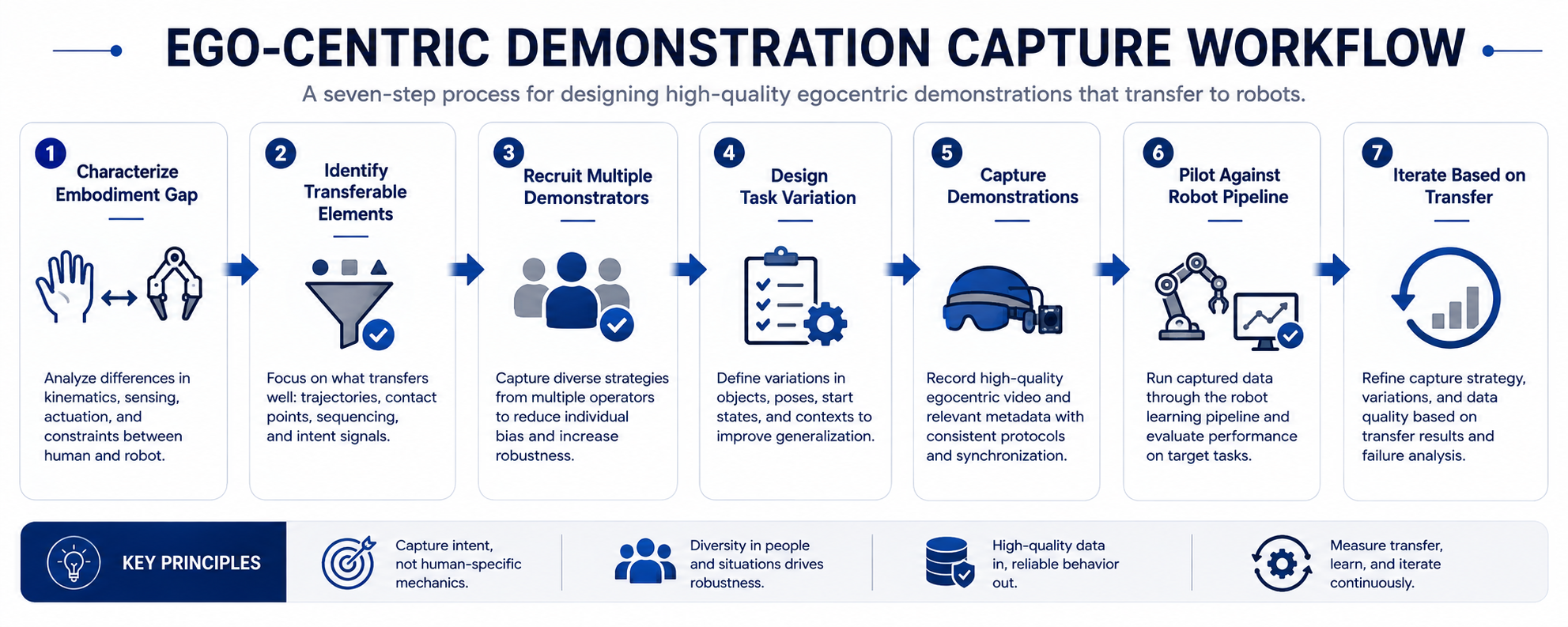
POV Data for Robotics Training generally requires addressing a few specific challenges related to the embodiment gap and demonstration design.
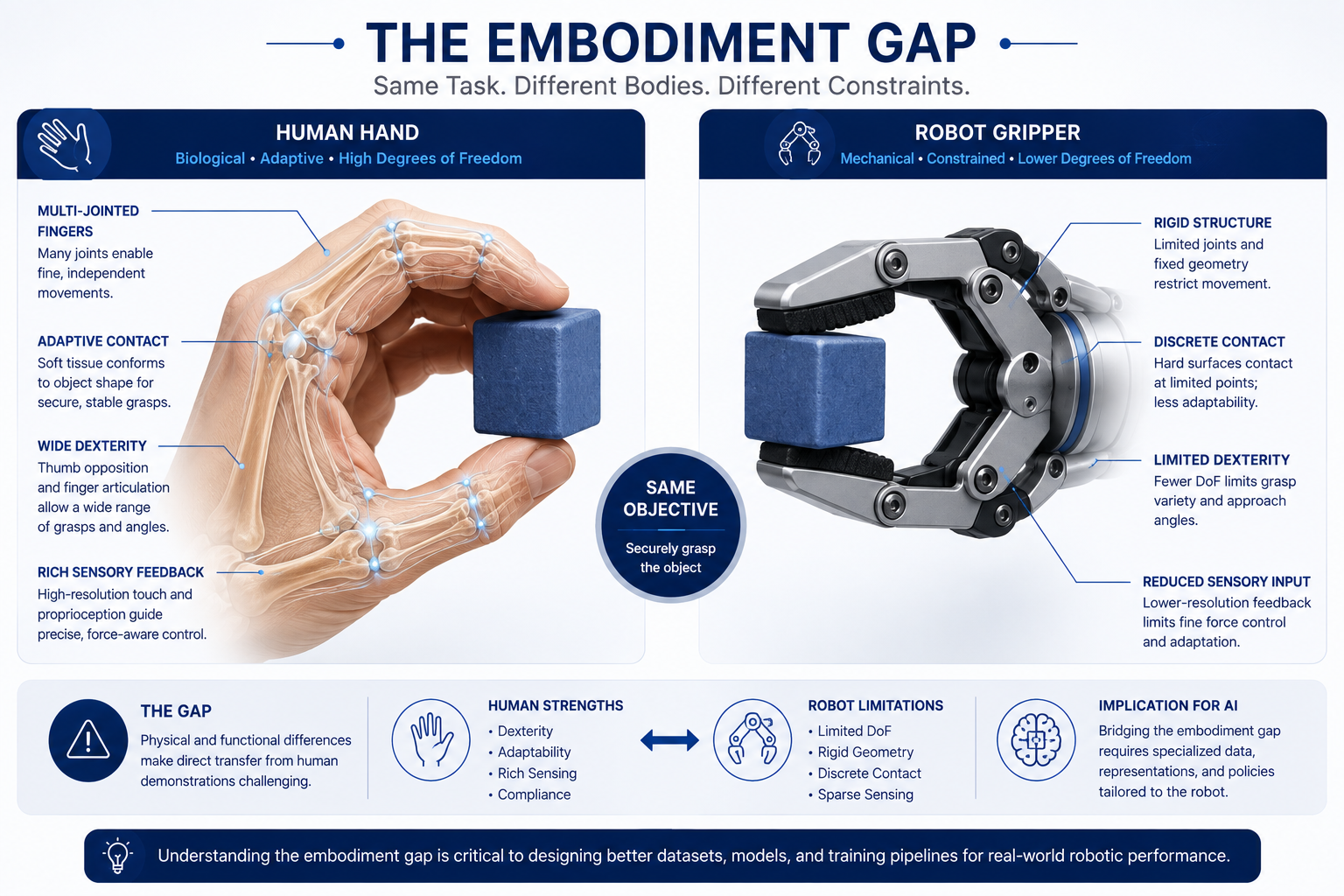
Understanding the specific embodiment differences relevant to your robot. Identifying exactly how a human hand or body differs from the target robot's grippers, joints, and degrees of freedom, since this determines what aspects of a demonstration will and won't transfer directly.
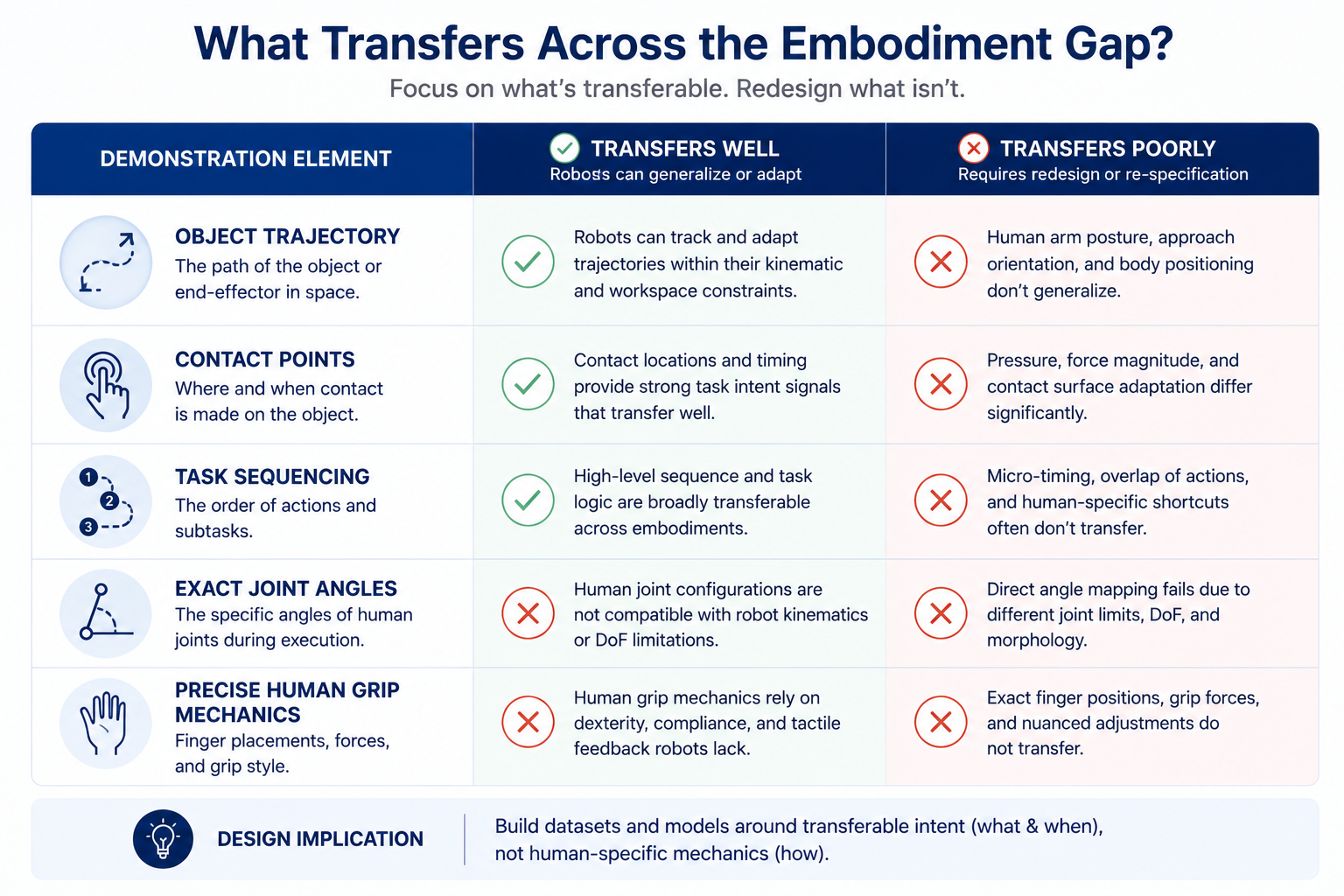
Designing demonstrations around transferable elements. Focusing capture on the aspects of a task — object trajectory, contact points, sequencing — that translate across the embodiment gap more reliably than exact joint-level human movement.
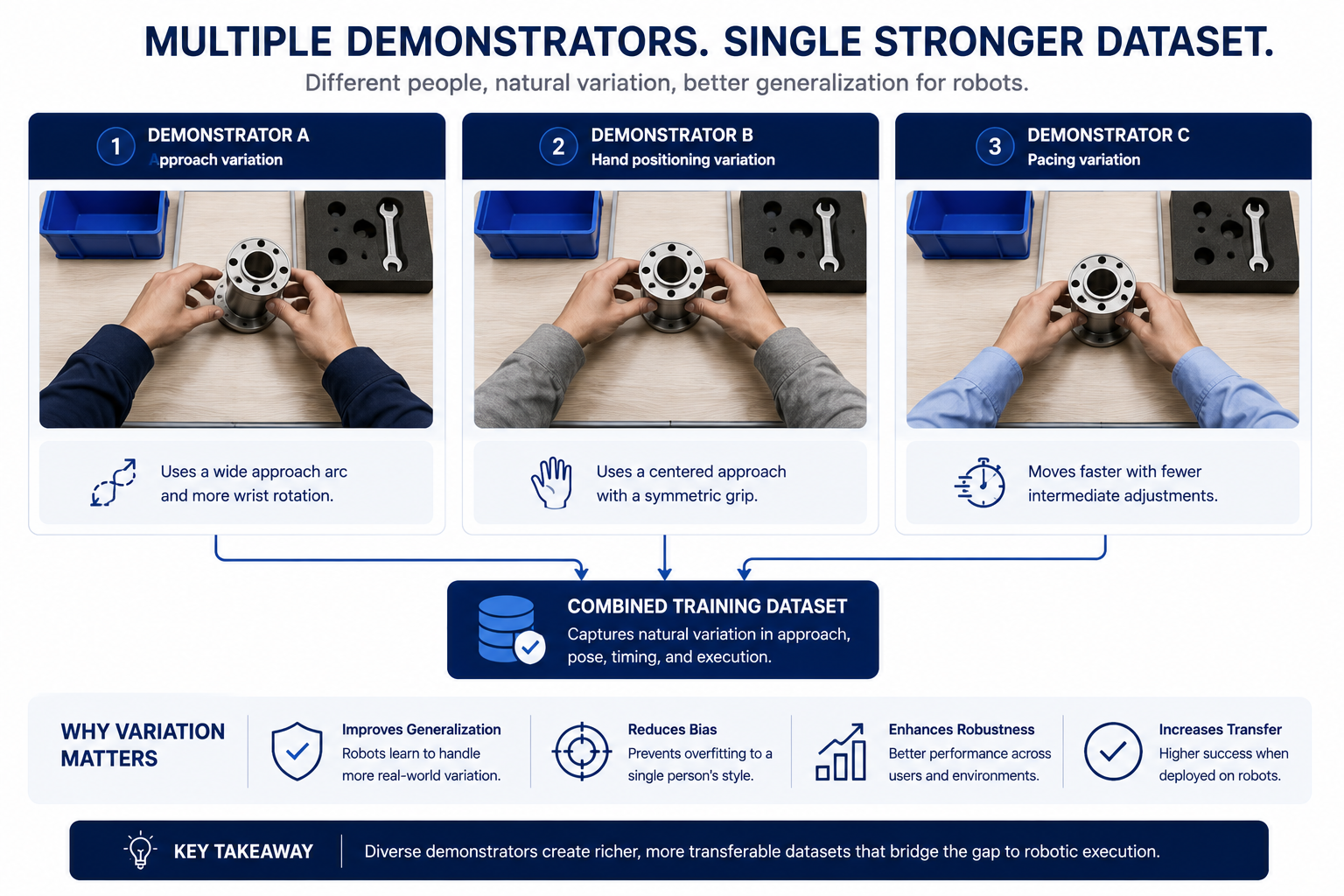
Demonstrator selection and variation. Using multiple demonstrators with natural variation in how they perform a task, rather than a single demonstrator's specific movement style, to avoid a robot learning overly narrow, non-generalizable patterns.
Task and environment variation. Capturing demonstrations across a range of object positions, environmental conditions, and task variations relevant to how the robot will actually need to perform, not just one controlled scenario repeated identically.
Understanding how these workflows operate as addressing a genuine physical transfer problem — not simply recording a person doing a task — is what determines whether egocentric demonstration data actually helps a robot learn, or produces training data that looks reasonable but doesn't transfer.
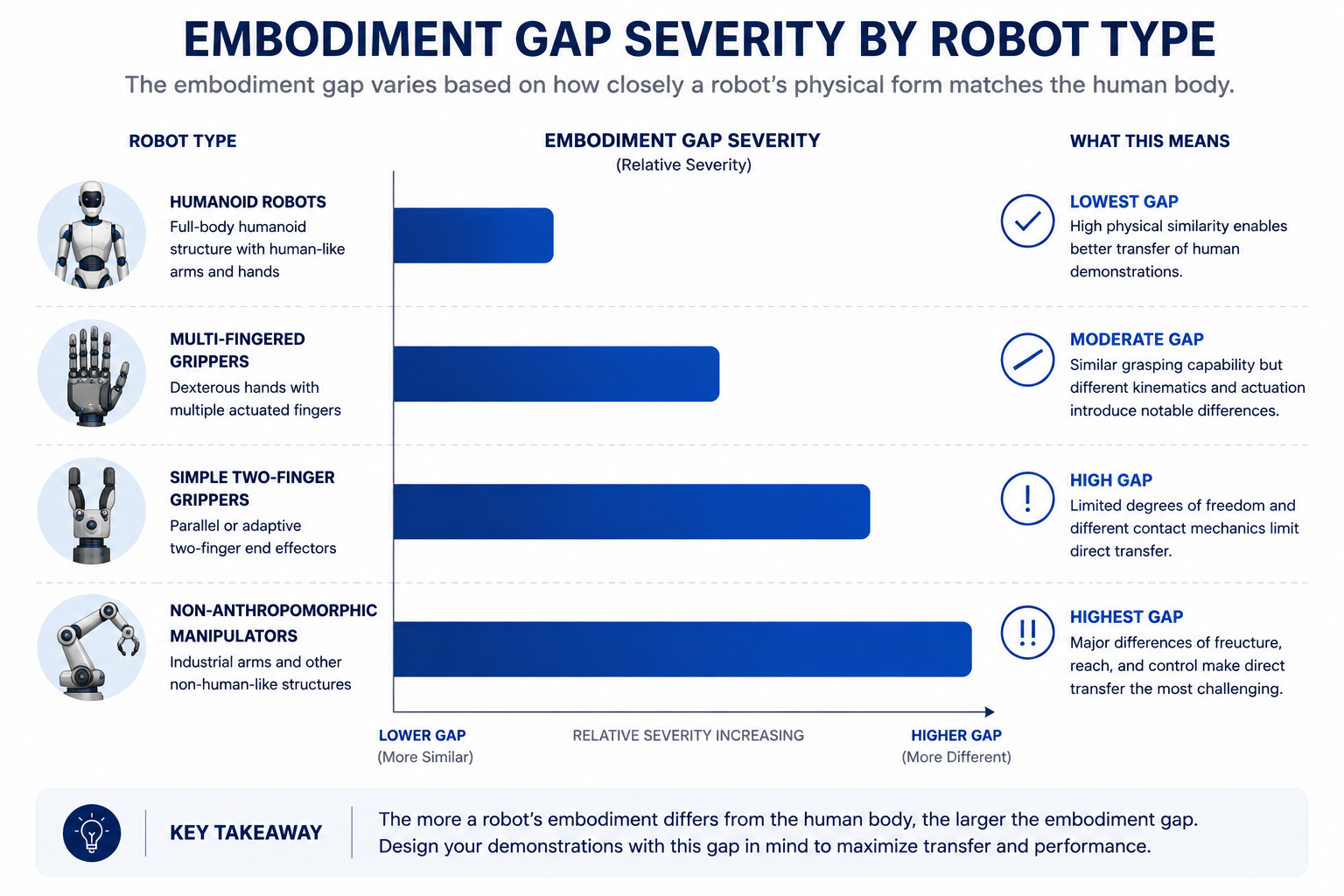
The fundamental difference between a human demonstrator's body, joints, and degrees of freedom and a robot's physical form, which means human movement doesn't automatically translate into usable robot motion data.
Because a robot's grippers, joints, and physical constraints differ from a human's, meaning specific human movement patterns often don't transfer directly without deliberate demonstration design addressing that gap.
Object-centric information like trajectory, contact points, and task sequencing generally transfers more reliably than exact human joint-level movement, since these elements are less tied to human-specific physical mechanics.
Because relying on a single demonstrator risks producing training data that reflects one person's specific movement style rather than generalizable task patterns a robot can learn broadly from.
Enough to represent the range of conditions the robot will actually need to handle in deployment, planned deliberately rather than limited to a single repeated scenario.
Yes. Piloting demonstration data against real robot learning catches embodiment gap and transfer issues before a full-scale collection effort is complete, when problems are much more expensive to address.
It's most directly associated with manipulation tasks given the hand-object interaction detail involved, though the underlying principles apply to other robot learning tasks involving human demonstration more broadly.
Egocentric capture for robot learning only produces genuinely useful training data when the embodiment gap between human demonstrators and robots is addressed directly — through deliberate focus on transferable task elements, demonstrator variation, and task and environment coverage matched to real deployment conditions. Piloting demonstration data against the actual robot learning pipeline, rather than assuming recorded human activity will simply transfer, is what separates a collection effort that produces genuine robot capability from one that produces plausible-looking footage that doesn't actually teach the robot what it needs to learn.


Compact, ready to go anywhere
Interchangeable lens that’s upgradeable
Dual 1-inch sensors for improved clarity and low light performance
Dynamic range and 6K 360° capture
360° photo resolution at 21MP

8K 360° video recording for ultra-detailed visuals.
4K single-lens mode for traditional wide-angle shots.
Invisible selfie stick effect for drone-like perspectives.
2.5-inch touchscreen with Gorilla Glass protection.
Waterproof up to 33ft for underwater shooting.

360° photo resolution in 23MP
Slim design at 24 mm thick
Built-in image stabilization for smooth video capture.
Internal 19GB storage for photo and video storage.
Wireless connectivity for remote control and sharing.

60MP 360° still images for high-resolution photography.
5.7K 360° video recording at 30fps.
2.25-inch touchscreen for intuitive control.
USB Type-C port for fast charging and data transfer.
MicroSD card slot for expandable storage.
.png)

.png)

Try it free. No credit card required. Instant set-up.






.svg)


.svg)