


.png)


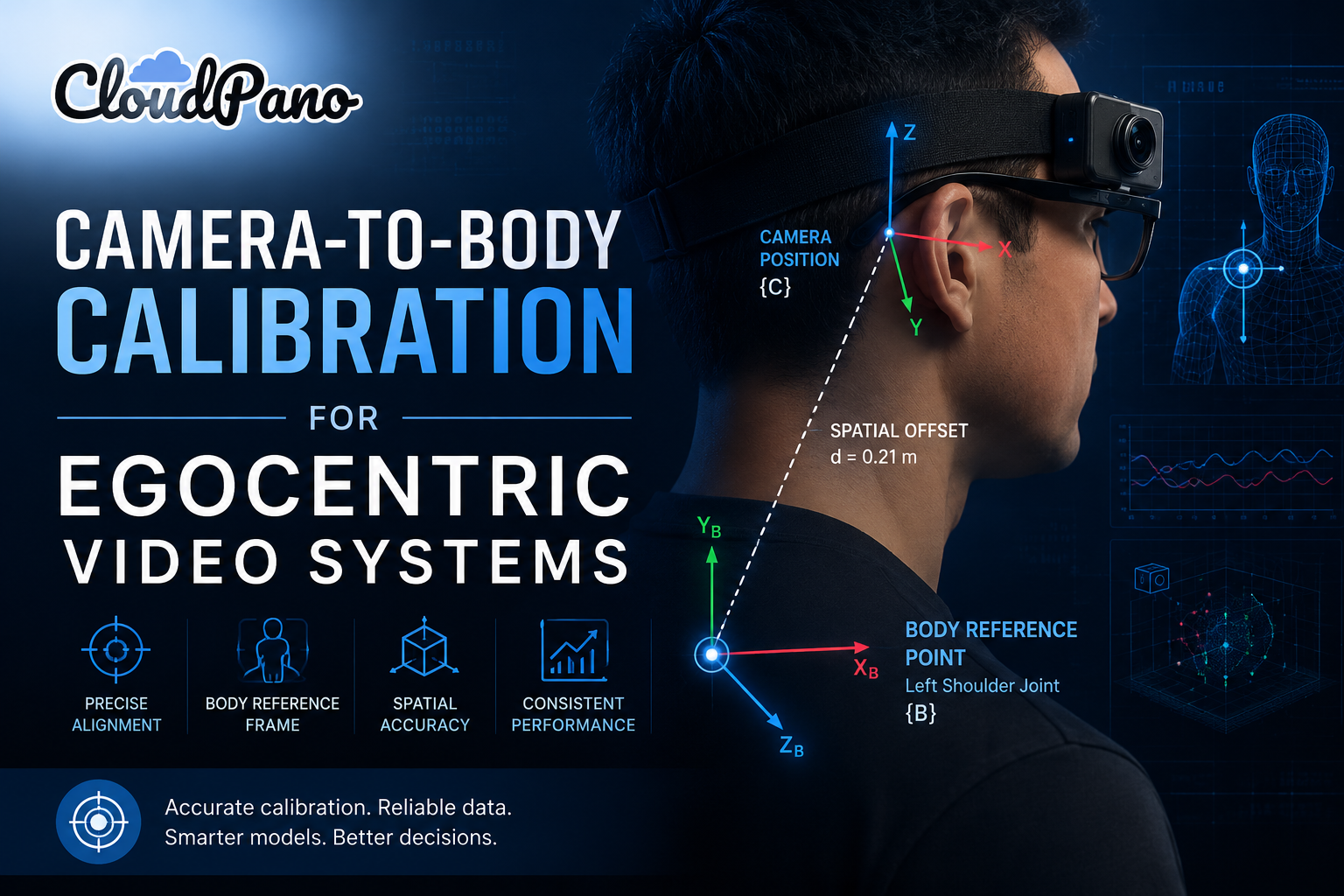
Mounting a camera to a person's body and knowing precisely where that camera sits relative to the body's joints and reference points are two different problems. Egocentric camera calibration addresses the second one — establishing the exact spatial relationship a downstream system needs to translate what the camera sees into an accurate understanding of body position, orientation, and movement.
Wearable Sensor Calibration matters because a camera's raw video feed alone doesn't tell a system where the wearer's hands, joints, or gaze direction actually are relative to what's visible in frame. That translation depends entirely on knowing the camera's precise spatial relationship to the body, which has to be established deliberately, not assumed from how the camera happens to be mounted.
Uncalibrated or poorly calibrated camera-to-body relationships don't produce an obviously broken system — they produce subtly inaccurate pose and interaction estimates that can be difficult to detect until a downstream task's performance is systematically worse than expected. Google Research's "Data Cascades" study documented how such data quality issues compound as they propagate through a pipeline, becoming much harder to trace back to their source once a model has already learned from miscalibrated data (Sambasivan et al., Google Research).
NIST's AI Risk Management Framework treats data fitness for the intended task as foundational to trustworthy AI, directly relevant to First-Person Camera Alignment needing to be established accurately, since it directly determines whether spatial data derived from egocentric video is actually usable for the task it's meant to support (NIST AI RMF).
The stakes rise as egocentric systems are used for increasingly precision-dependent tasks. Stanford HAI's AI Index has tracked growing interest in activity recognition and human-robot interaction research relying on egocentric data (Stanford HAI, AI Index Report), and calibration errors in these contexts can quietly degrade exactly the spatial precision these applications depend on.
Body-Mounted Camera Setup calibration generally addresses a few specific technical requirements.
Establishing a reference coordinate frame. Defining a consistent spatial reference point — typically anchored to the body or a specific joint — against which the camera's position and orientation can be measured.
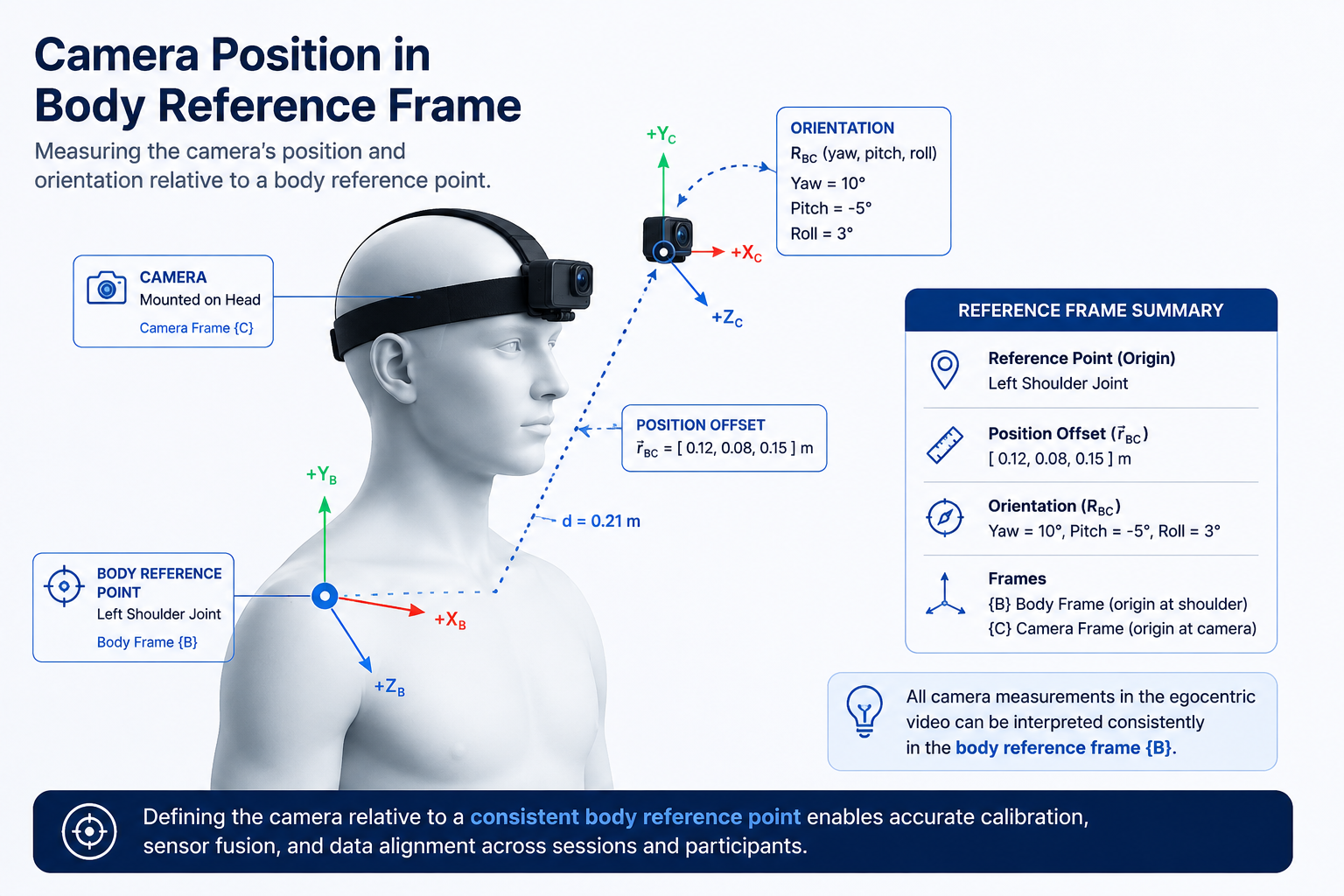
Determining camera position and orientation relative to that frame. Measuring or computing exactly where the camera sits and how it's oriented relative to the established reference, often called the extrinsic calibration.
Accounting for mounting variability across sessions or wearers. A camera mounted slightly differently each time it's put on, or worn by different people with different body proportions, introduces variation that calibration needs to address consistently.
Validating calibration accuracy before relying on it. Confirming the established spatial relationship actually holds up against a known reference or test scenario, rather than assuming a calibration procedure produced an accurate result.
Understanding how these workflows operate as establishing a precise, verifiable spatial relationship — not just physically attaching a camera securely — is what actually determines whether downstream pose or interaction estimates derived from egocentric video are trustworthy.
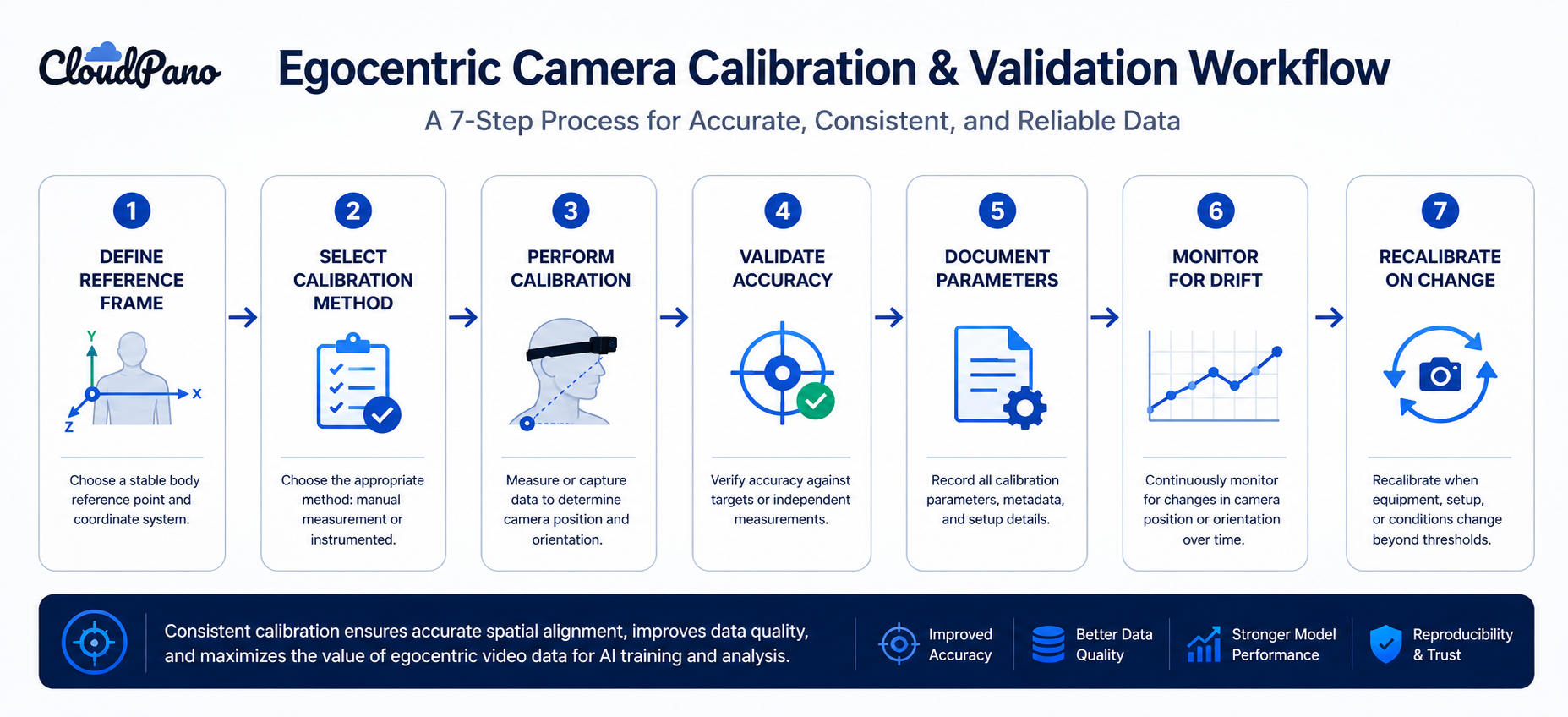
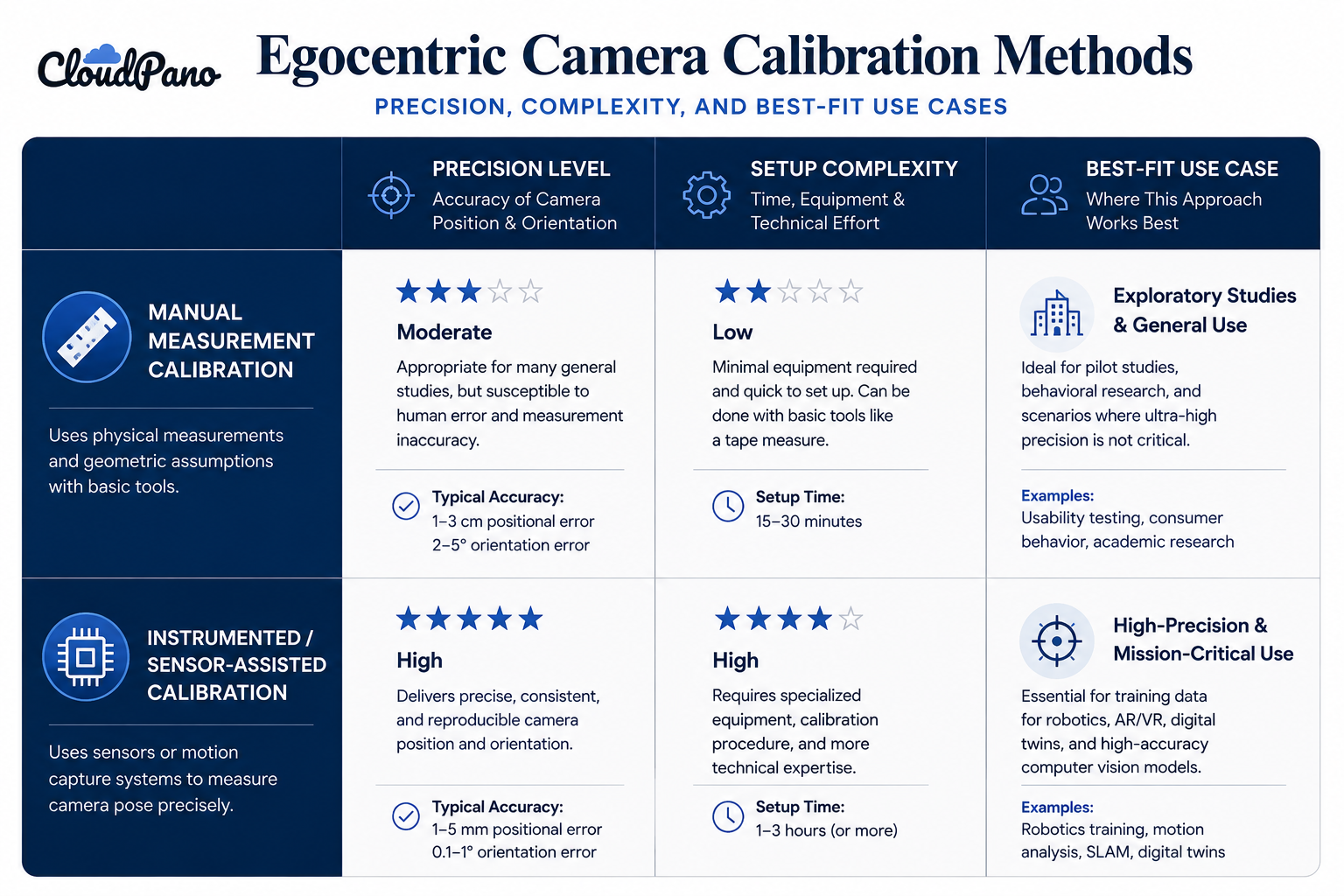
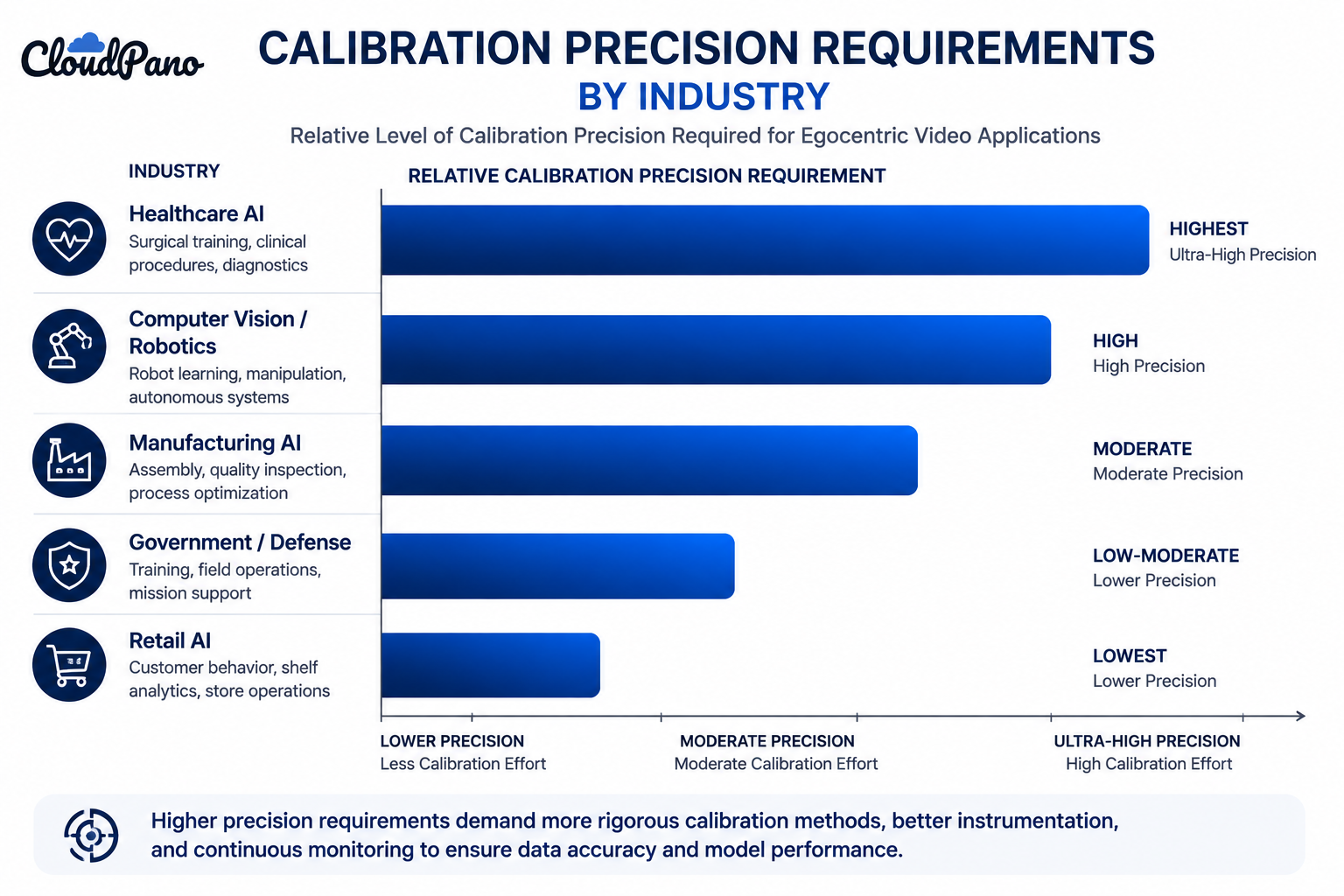
The process of establishing an accurate spatial relationship between a wearable camera and the wearer's body or joints, which downstream tasks like pose estimation and interaction modeling depend on.
Because secure mounting doesn't establish the precise spatial measurements — position and orientation relative to a reference frame — that downstream spatial analysis actually requires.
Generally yes, since mounting position can vary slightly each time a camera is put on, and different wearers have different body proportions that affect the accurate calibration relationship.
By testing the established calibration against a known reference or test scenario to confirm it produces accurate spatial results before relying on it for actual data collection.
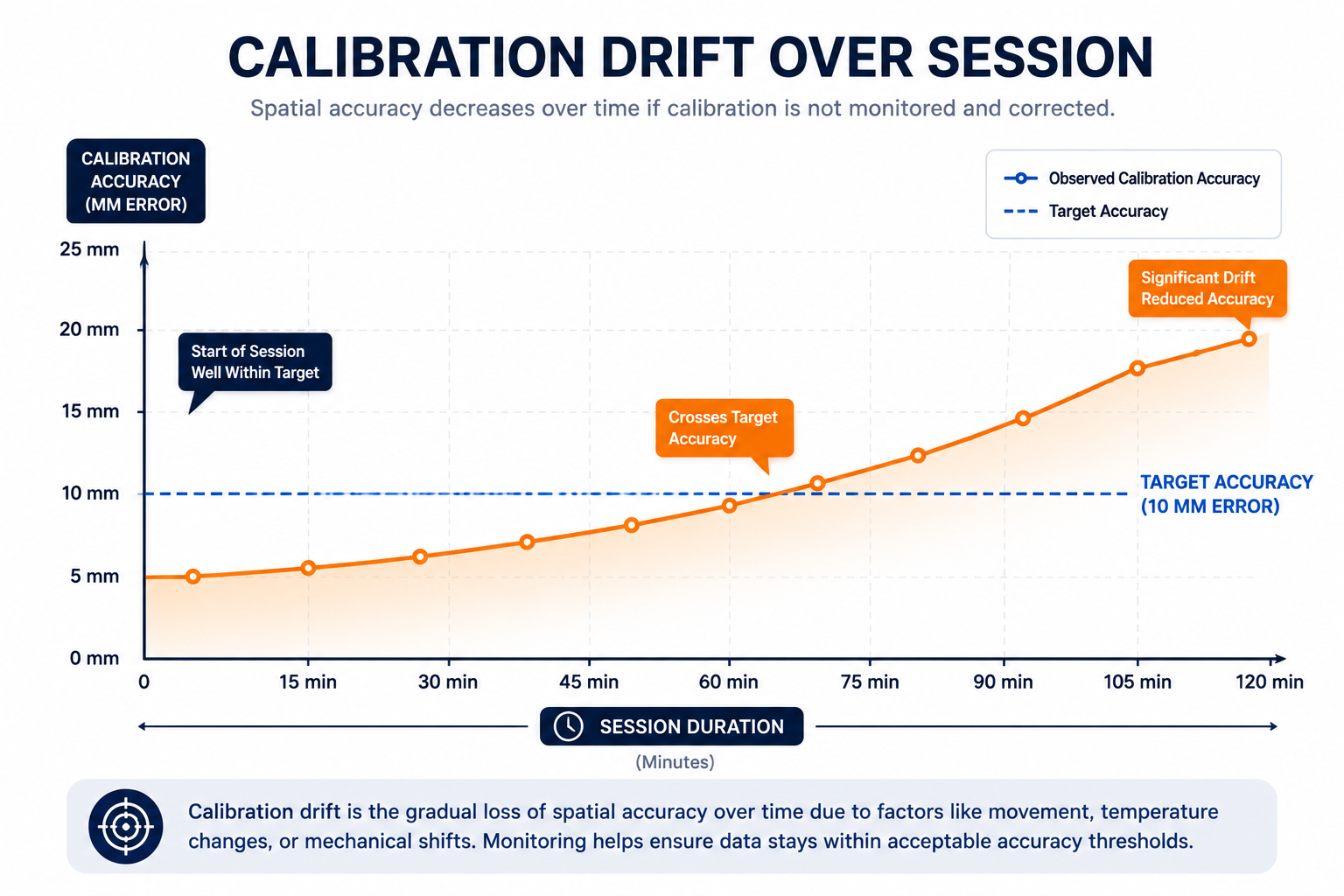
Uncorrected drift can introduce increasing spatial inaccuracy over the course of a session, which is why monitoring for drift during extended recordings matters, not just calibrating once at the start.
Yes. Head-mounted, chest-mounted, and other positions each establish a different spatial relationship to relevant body reference points, requiring calibration approaches suited to that specific mounting.
Alongside the collected data itself, tied to the specific session, since different sessions may have different calibration results depending on mounting and wearer variation.
Egocentric camera calibration is a distinct technical requirement from simply mounting a camera to a body — it establishes the precise spatial relationship downstream pose estimation and interaction modeling tasks actually depend on. Treating calibration as a repeatable, validated procedure tied to each specific setup, rather than a one-time assumption, is what keeps egocentric spatial data reliable across sessions and wearers.


Compact, ready to go anywhere
Interchangeable lens that’s upgradeable
Dual 1-inch sensors for improved clarity and low light performance
Dynamic range and 6K 360° capture
360° photo resolution at 21MP

8K 360° video recording for ultra-detailed visuals.
4K single-lens mode for traditional wide-angle shots.
Invisible selfie stick effect for drone-like perspectives.
2.5-inch touchscreen with Gorilla Glass protection.
Waterproof up to 33ft for underwater shooting.

360° photo resolution in 23MP
Slim design at 24 mm thick
Built-in image stabilization for smooth video capture.
Internal 19GB storage for photo and video storage.
Wireless connectivity for remote control and sharing.

60MP 360° still images for high-resolution photography.
5.7K 360° video recording at 30fps.
2.25-inch touchscreen for intuitive control.
USB Type-C port for fast charging and data transfer.
MicroSD card slot for expandable storage.
.png)

.png)

Try it free. No credit card required. Instant set-up.







.svg)


.svg)