


.png)


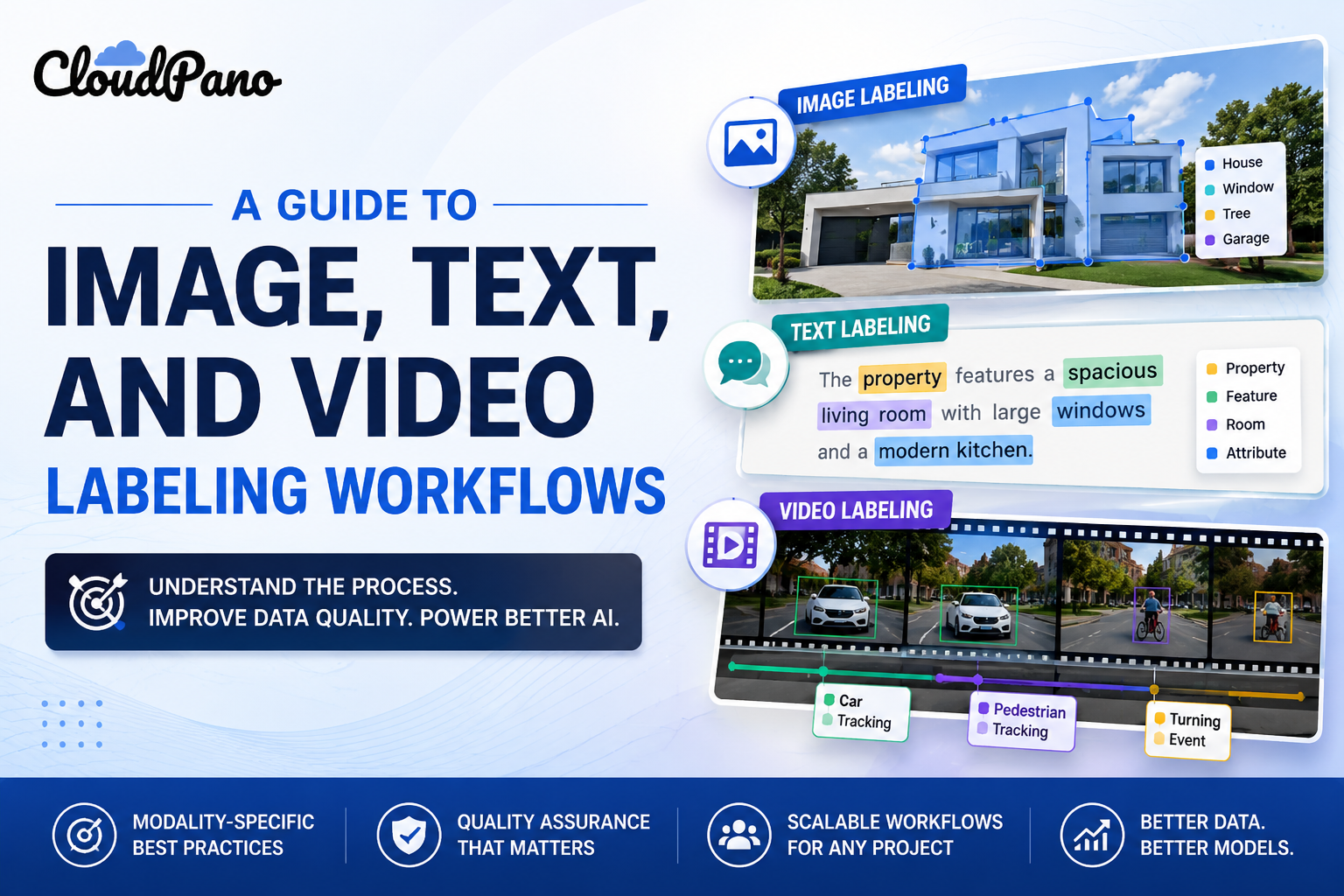
Most teams start with a single data labeling workflow guide they picked up from a computer vision project, then try to apply the same steps to a text classification task or a video tracking dataset. It usually doesn't fit cleanly.
Image, text, and video data each carry different sources of ambiguity, require different annotator skills, and break in different ways when quality assurance is weak. A workflow that treats all three the same tends to underperform on at least one of them.
The cost of a mismatched workflow isn't obvious until a model underperforms in a way nobody can trace back to its source. Google Research's "Data Cascades" study documented how small, unaddressed data preparation issues compound over time into expensive, hard-to-diagnose production failures — a pattern that shows up differently depending on data modality (Sambasivan et al., Google Research).
NIST's AI Risk Management Framework treats data quality and provenance as foundational to trustworthy AI, and a workflow that doesn't account for how image, text, and video data actually differ makes that foundation harder to build correctly (NIST AI RMF).
The pressure to move fast compounds this. Stanford HAI's AI Index has tracked how quickly organizations are deploying models from research into production (Stanford HAI, AI Index Report), which means a labeling workflow built for the wrong modality often surfaces its weaknesses right when a team can least afford the delay.
Each modality's annotation workflow shares a common backbone — taxonomy, tooling, workforce, QA — but the details of each step diverge meaningfully. Understanding how these workflows operate for your specific data type matters more than following a single generic process.
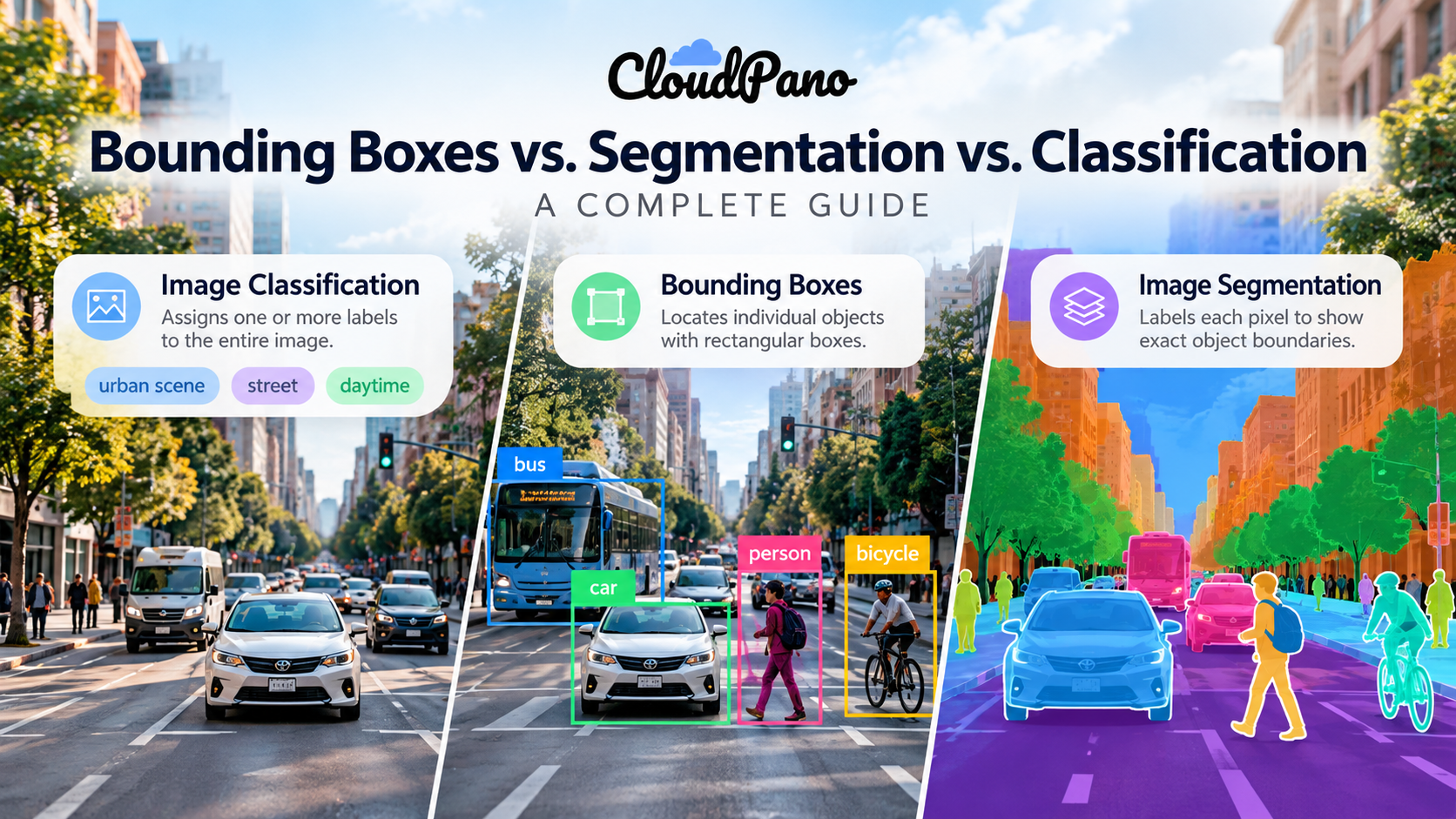
Image labeling workflows center on spatial techniques: bounding boxes, semantic segmentation, polygon annotation, and keypoint tagging. Ambiguity here usually comes from occlusion, unusual angles, or boundary placement disagreement between annotators.
Text labeling workflows center on classification, sentiment tagging, named entity recognition, and intent labeling. Ambiguity here usually comes from subjective judgment calls — sarcasm, context-dependent meaning, or overlapping categories.
Video labeling workflows center on frame-by-frame object tracking, temporal event tagging, and action recognition across sequences. Ambiguity here usually comes from tracking consistency across frames and defining exact start/end points for events.
Training data preparation for each modality also differs in what "clean" data looks like going in — image data preparation often involves resolution and format standardization, text preparation involves handling encoding and noise removal, and video preparation involves frame extraction and sampling rate decisions before annotation even begins.
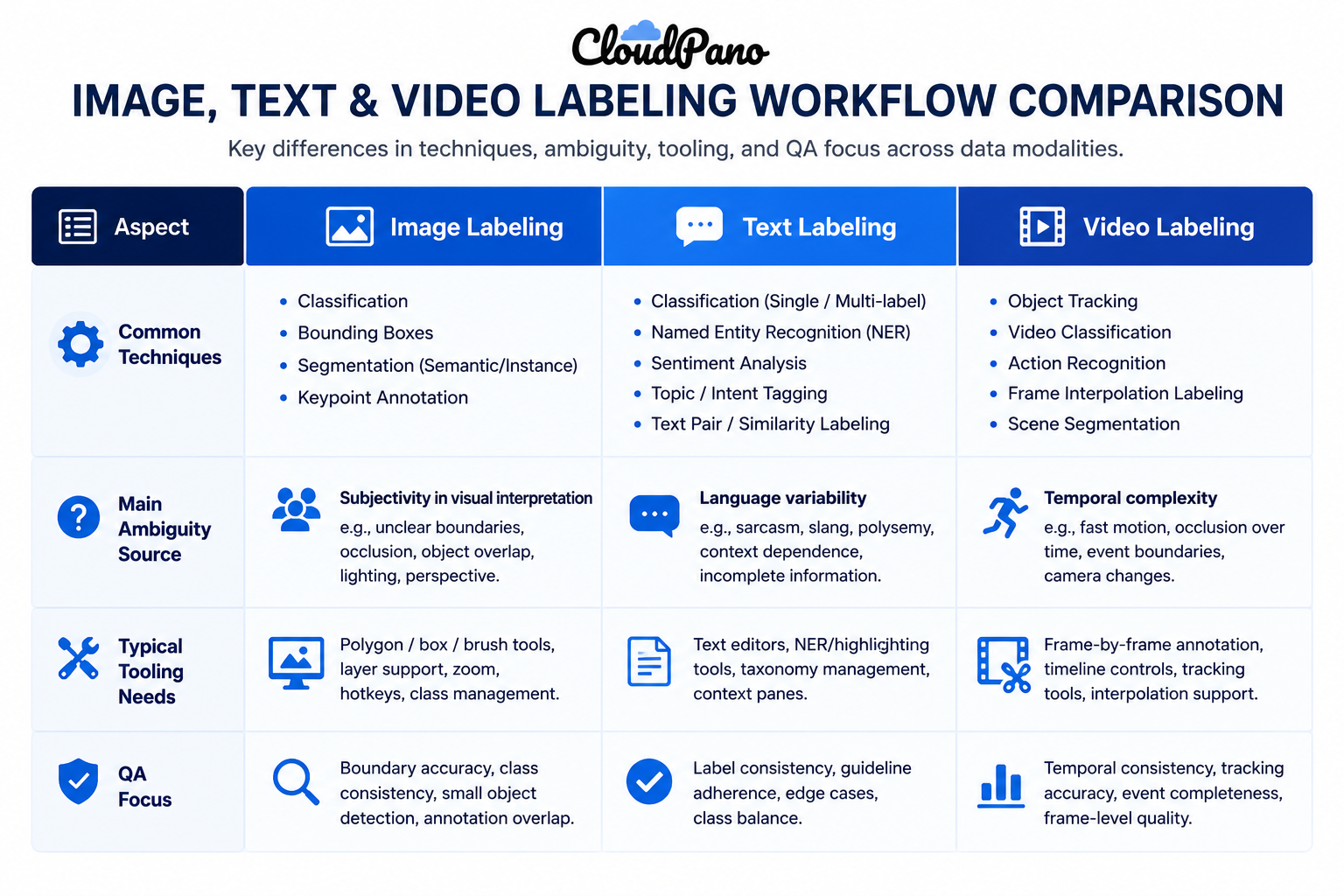
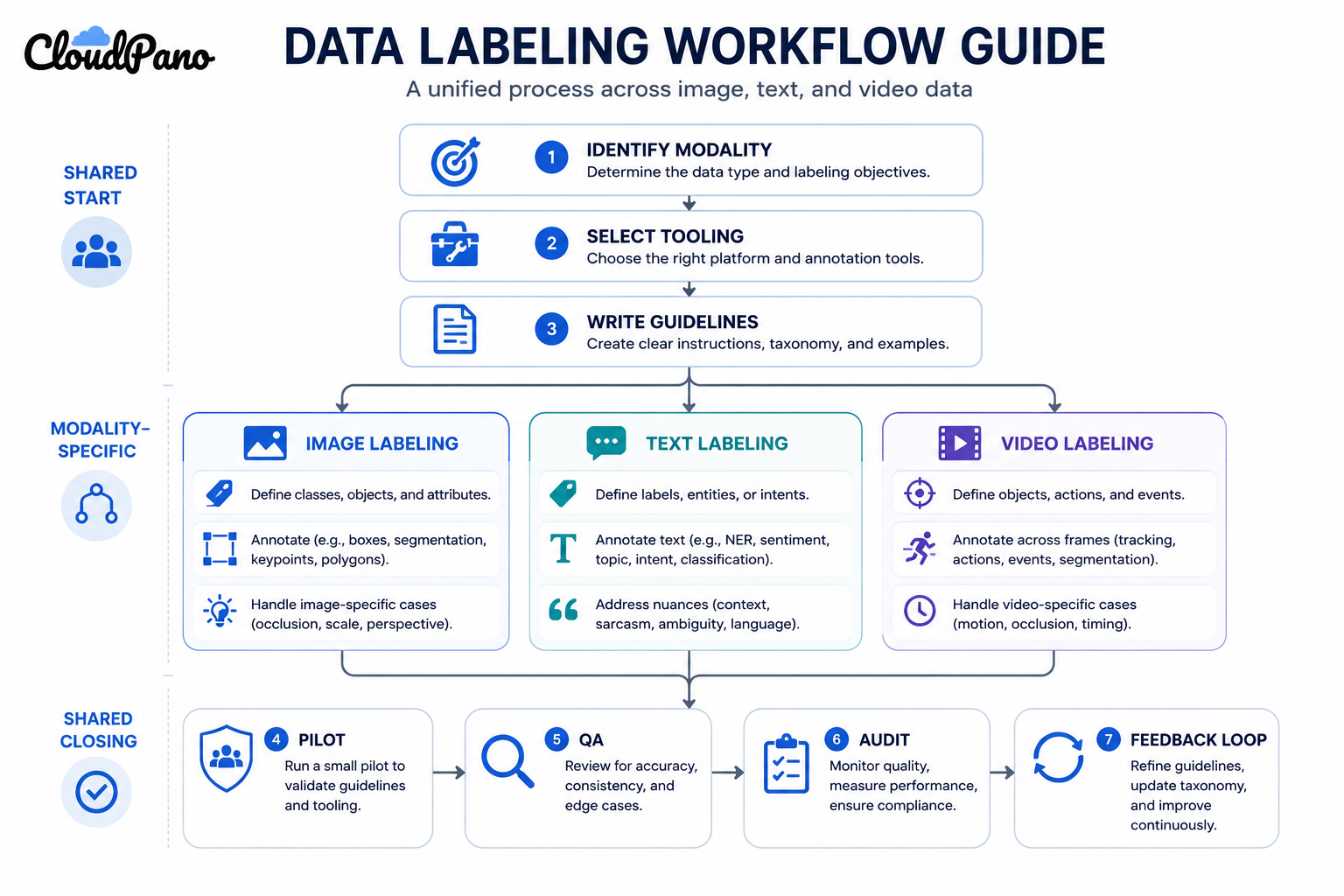
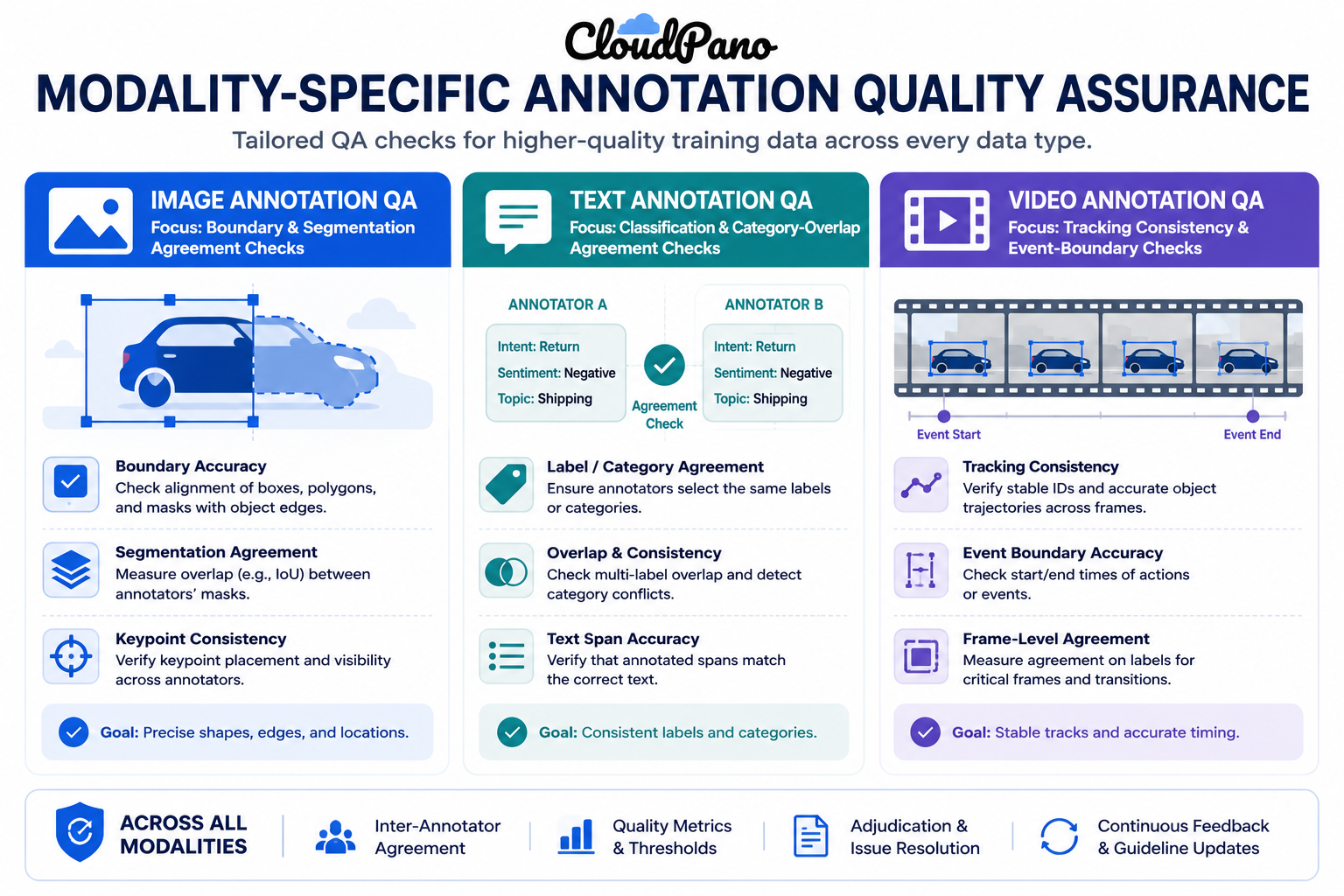
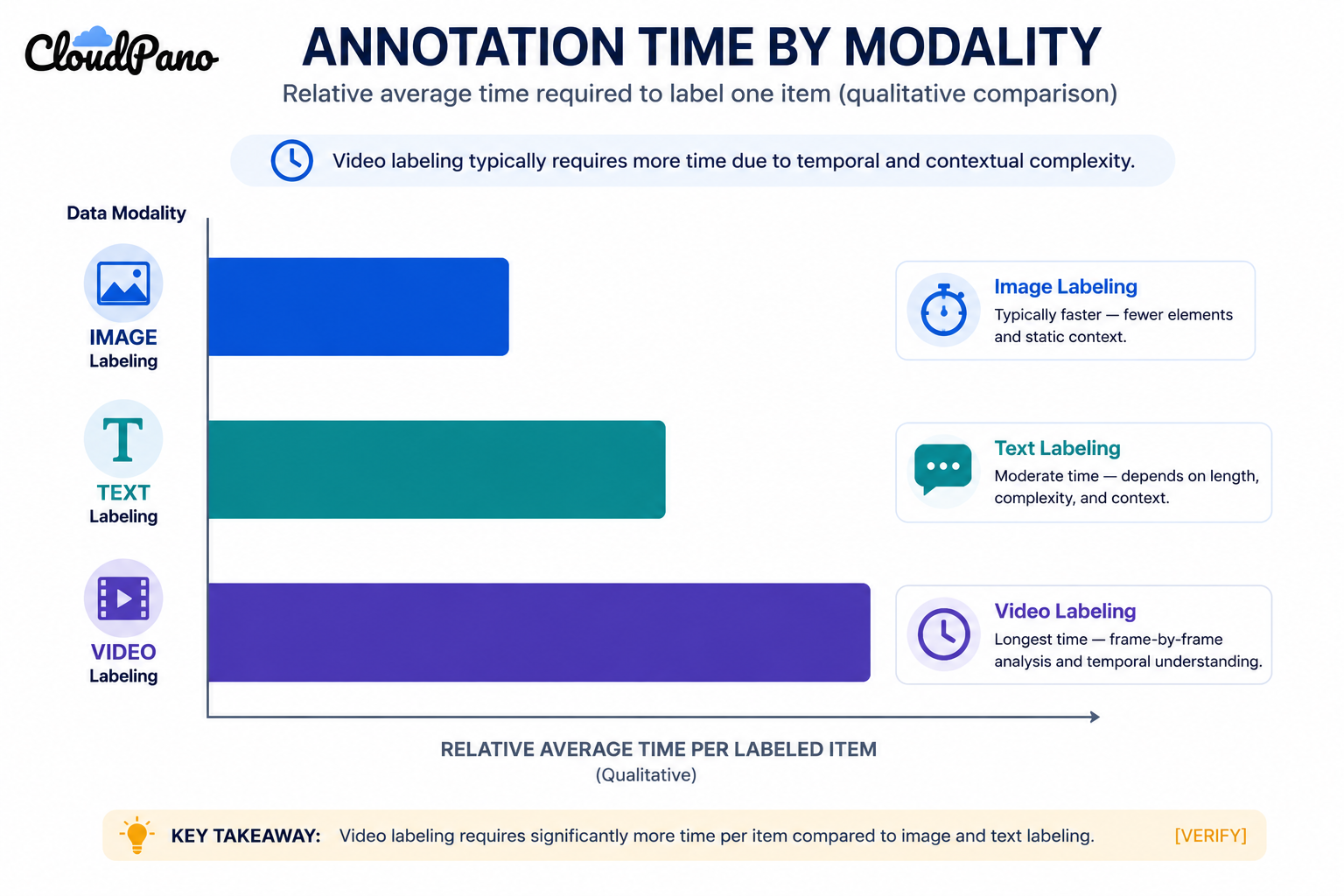
Image labeling centers on spatial techniques like bounding boxes and segmentation, text labeling centers on classification and entity tagging, and video labeling centers on frame-by-frame tracking and temporal event tagging — each with different tooling and quality assurance needs.
Video labeling is typically the most time-intensive per unit of data, since it often requires frame-by-frame annotation and tracking consistency across sequences rather than a single judgment per item.
Usually, yes. Most annotation platforms specialize in one or two modalities, so evaluate tooling based on your specific data type rather than assuming one platform handles all three equally well.
Image QA typically focuses on boundary and segmentation agreement, text QA focuses on classification and category-overlap agreement, and video QA focuses on tracking consistency and event-boundary agreement across frames.
It's the cleaning and standardization work done before annotation begins — resolution and format standardization for images, encoding and noise cleanup for text, and frame extraction and sampling decisions for video.
Some can, but each modality requires distinct training, and specialization tends to produce higher accuracy than expecting one workforce to handle all three equally well.
Start by identifying your data's modality and its specific ambiguity sources, then select tooling, guidelines, and quality assurance methods built for that modality rather than reusing a workflow designed for a different data type.

A data labeling workflow guide is only useful if it accounts for how differently image, text, and video data actually behave. The teams that get the most reliable training data out of their pipelines are the ones that build tooling, guidelines, and quality assurance around the specific modality they're working with, not a single generic process stretched across all three.


Compact, ready to go anywhere
Interchangeable lens that’s upgradeable
Dual 1-inch sensors for improved clarity and low light performance
Dynamic range and 6K 360° capture
360° photo resolution at 21MP

8K 360° video recording for ultra-detailed visuals.
4K single-lens mode for traditional wide-angle shots.
Invisible selfie stick effect for drone-like perspectives.
2.5-inch touchscreen with Gorilla Glass protection.
Waterproof up to 33ft for underwater shooting.

360° photo resolution in 23MP
Slim design at 24 mm thick
Built-in image stabilization for smooth video capture.
Internal 19GB storage for photo and video storage.
Wireless connectivity for remote control and sharing.

60MP 360° still images for high-resolution photography.
5.7K 360° video recording at 30fps.
2.25-inch touchscreen for intuitive control.
USB Type-C port for fast charging and data transfer.
MicroSD card slot for expandable storage.
.png)

.png)

Try it free. No credit card required. Instant set-up.






.svg)


.svg)