How Data Labeling Services Improve AI Model Accuracy and Reduce Training Costs
Cloudpano
July 20, 2026
•
5 min read
Share this post
How Data Labeling for AI Shapes Model Accuracy — and Training Costs
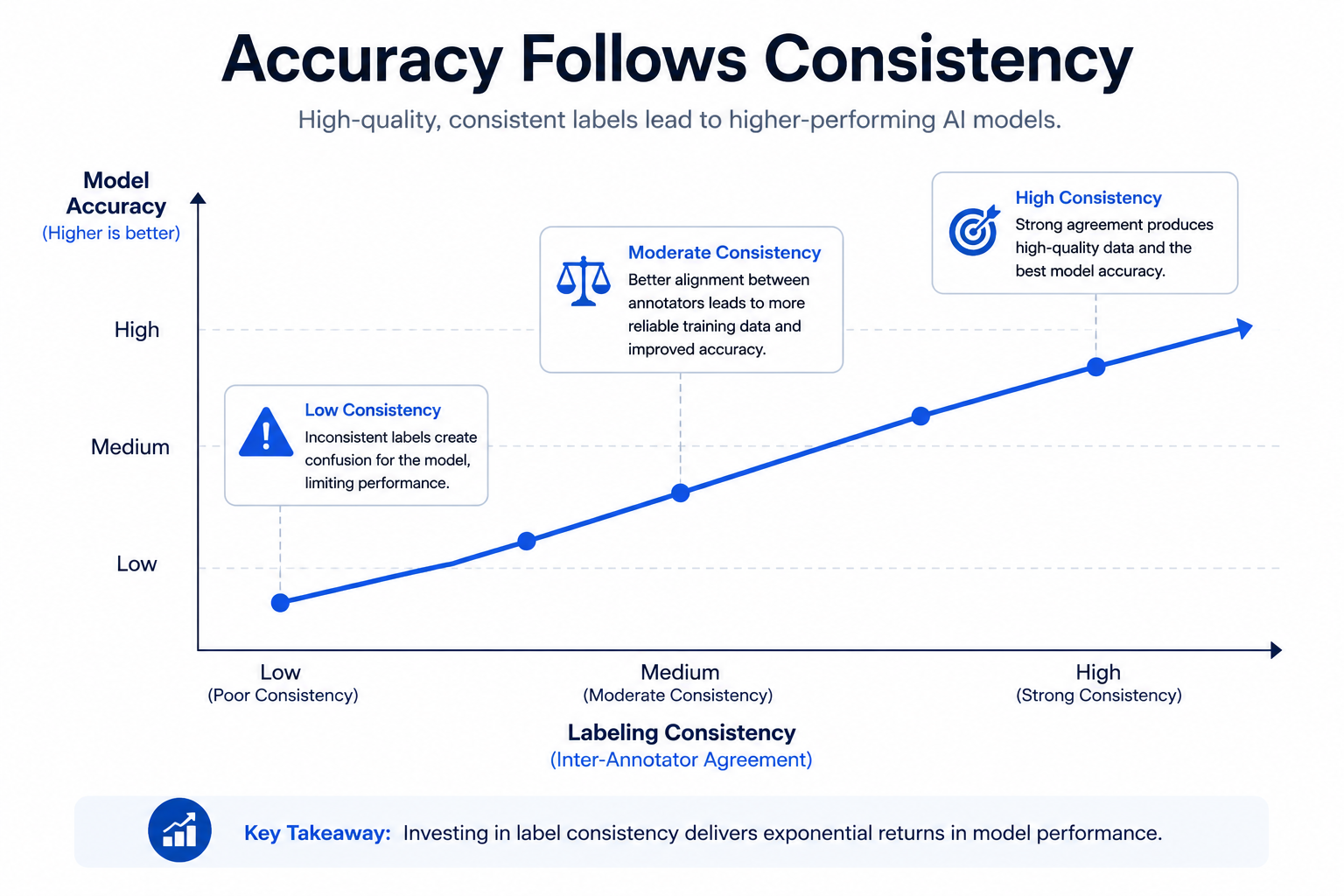
Data labeling for AI is often budgeted as a fixed line item, separate from the accuracy targets a model is expected to hit. That separation doesn't reflect how the two actually relate — labeling quality is one of the most direct levers on model accuracy available, often more direct than architecture tuning.
Teams that treat labeling purely as a cost to minimize tend to pay for it twice: once in the labeling budget, and again in additional training cycles, debugging time, or a model that simply underperforms its potential ceiling.
Why It Matters
A model's accuracy is capped by what its training data actually teaches it, and inconsistent or incorrect labels don't just add noise — they actively teach the wrong pattern with the same apparent confidence a correct label would carry. Google Research's "Data Cascades" study documented how small, unaddressed data issues compound into significant downstream problems that are difficult to trace back to their source (Sambasivan et al., Google Research).
NIST's AI Risk Management Framework treats data quality as foundational to trustworthy and reliable AI systems, reinforcing that labeling quality isn't separate from model performance evaluation — it's an input to it (NIST AI RMF).
The cost angle matters just as much as accuracy. Stanford HAI's AI Index has tracked the accelerating pace of enterprise AI deployment (Stanford HAI, AI Index Report), and teams operating on tight timelines often can't afford the retraining cycles that low-quality labeling tends to trigger.
How It Works
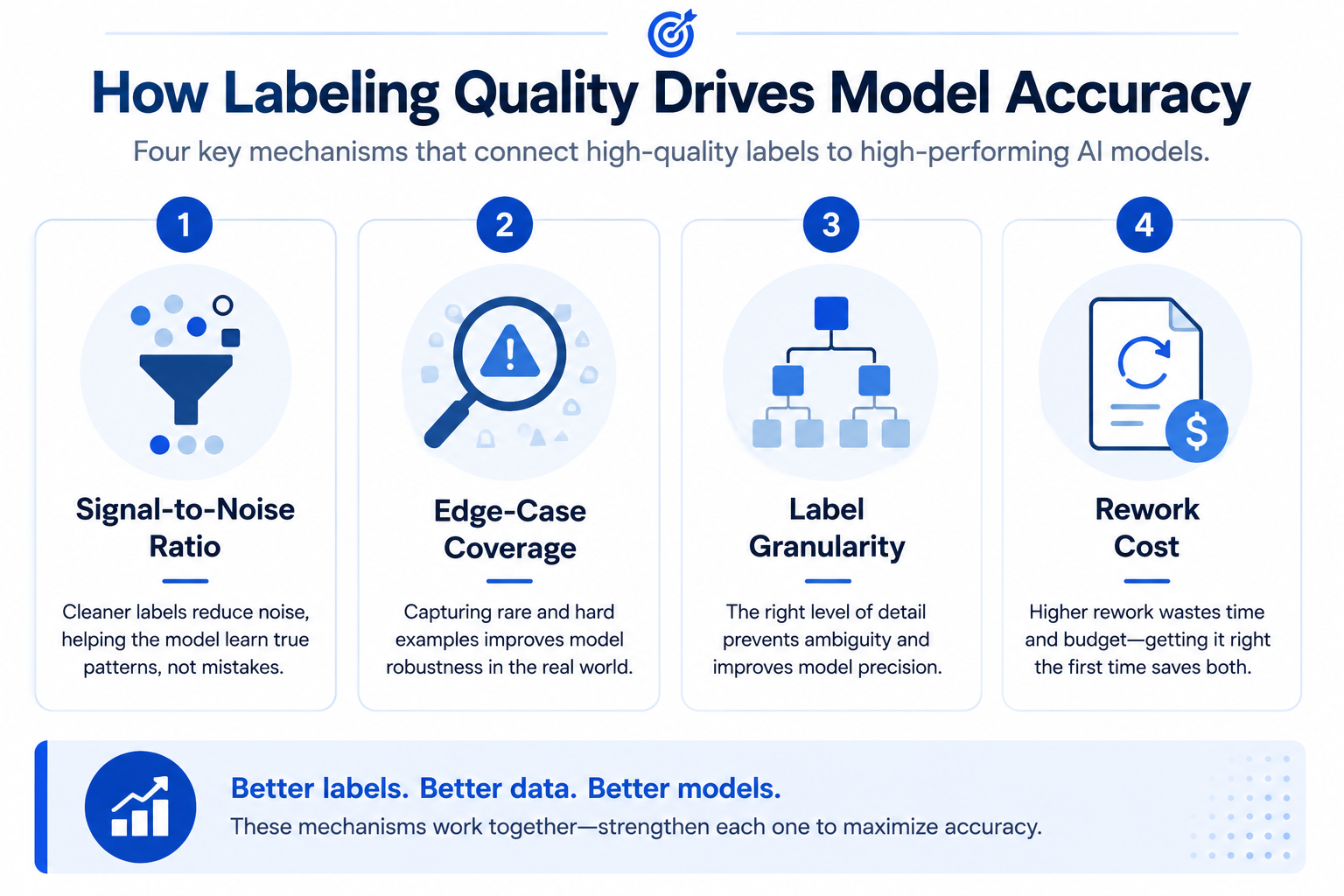
Labeling affects accuracy and cost through a few specific, traceable mechanisms — and understanding how these workflows operate at this level of detail is what separates labeling decisions that improve accuracy from ones that just add expense.
Signal-to-noise ratio. Consistent, correct labels give a model a clean signal to learn from. Inconsistent labels introduce noise that the model has to somehow average out, which typically shows up as lower accuracy on exactly the cases where the labels were least consistent.
Edge-case coverage. Models trained on data that skips rare or ambiguous cases tend to perform well on average metrics while failing unpredictably on the edge cases that matter most in production.
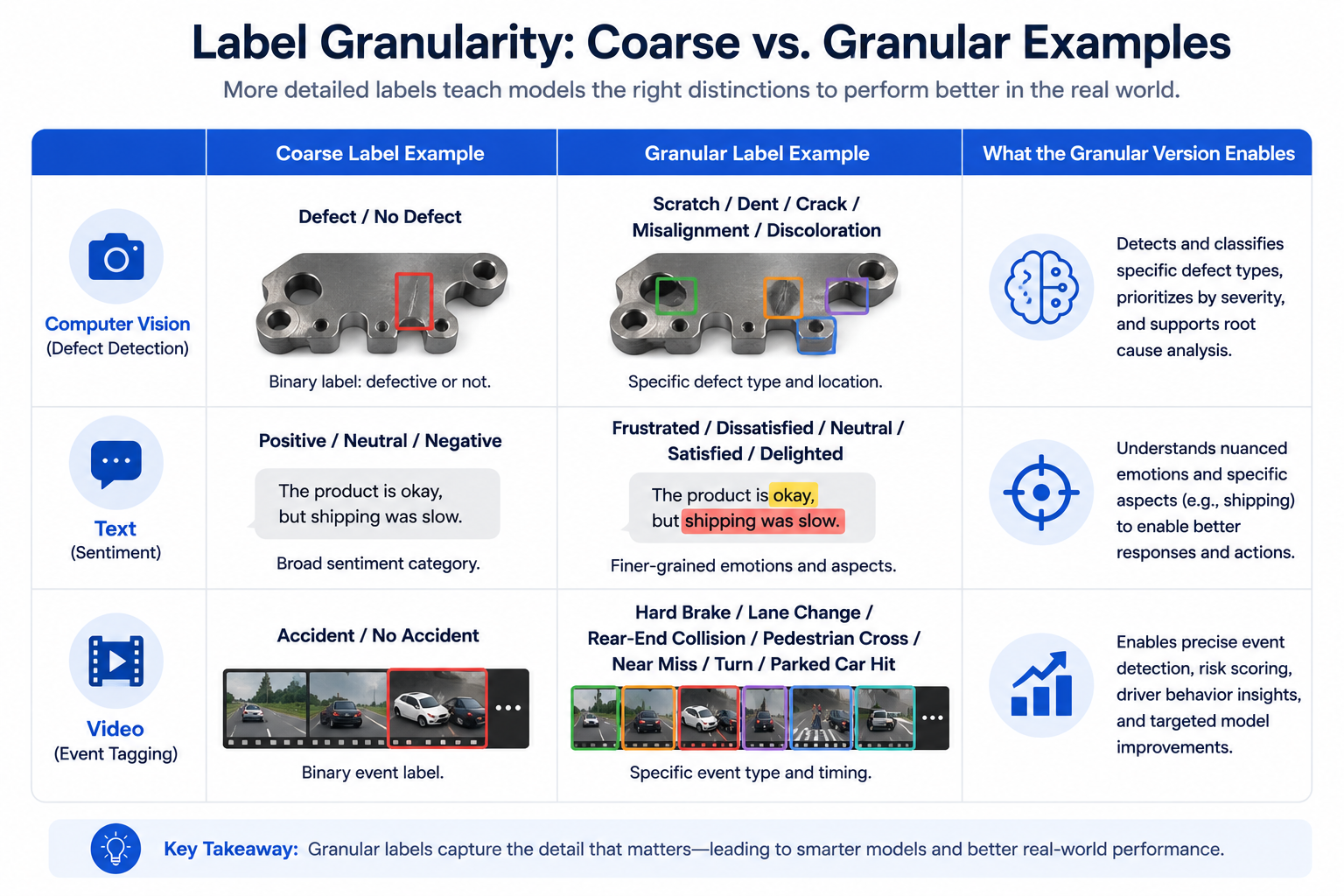
Label granularity. Overly coarse labels (a single "defect" category, for example) give a model less to learn from than more granular labels (defect type, location, severity) when the downstream task actually needs that detail.
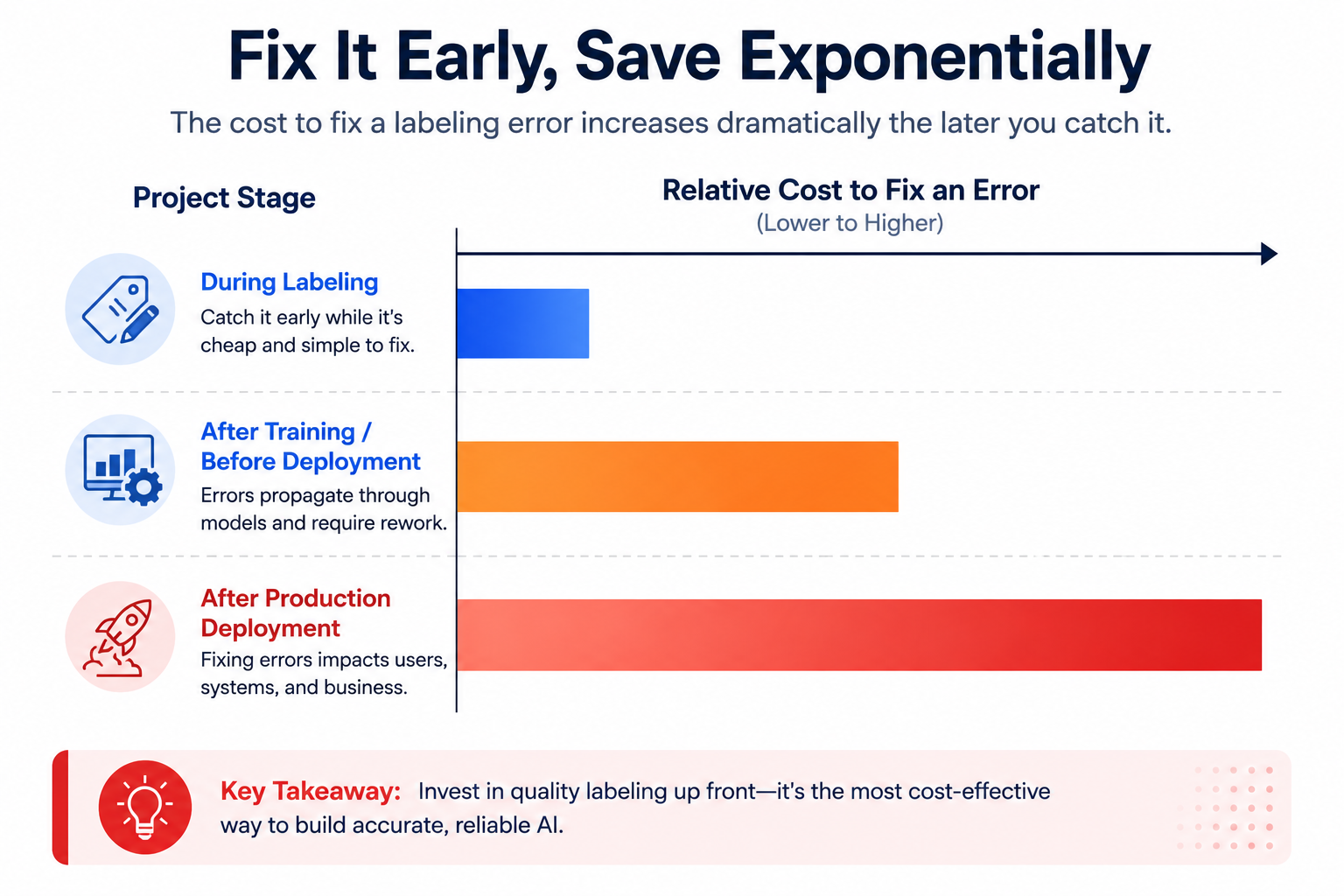
Rework cost. Labeling errors caught after training require a full retraining cycle to fix, while errors caught during labeling require only a correction pass — a cost difference that compounds significantly at scale.
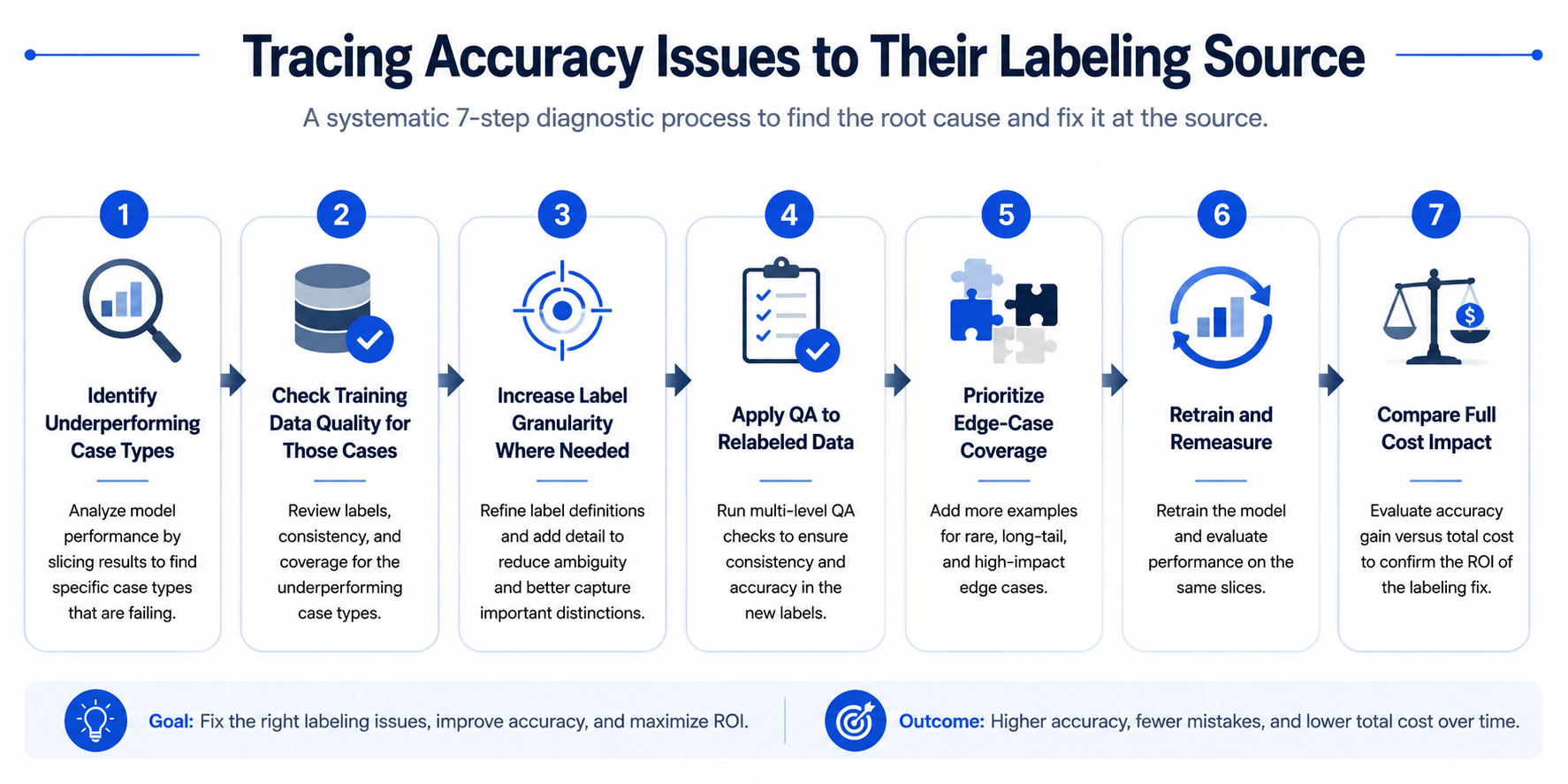
Step-by-Step Workflow to Improve Accuracy Through Better Labeling
Identify where your model currently underperforms. Trace accuracy gaps to specific case types before assuming the fix is architectural.
Check whether those case types were consistently labeled. Compare training data quality specifically for the underperforming categories, not just the dataset as a whole.
Increase label granularity where the task actually requires it. Add detail to labels only where it maps to something the model needs to predict, not as a blanket policy.
Build in annotation quality assurance from the start of any relabeling effort. Gold-standard test sets and inter-annotator agreement tracking catch inconsistency before it reaches training.
Prioritize edge-case coverage deliberately. Don't rely on random sampling alone to surface rare cases — actively seek them out for inclusion in the training set.
Retrain and measure accuracy on the specific case types you targeted. Confirm the labeling improvement actually moved the metric you were trying to fix.
Calculate the full cost comparison. Weigh the cost of improved labeling against the cost of the retraining cycles it prevents, not just the labeling line item alone.
Industry Use Cases
Computer vision / robotics: Label granularity directly affects accuracy on defect detection and object classification tasks, where a coarse label often can't support the precision a downstream application needs.
Autonomous vehicles: Edge-case coverage is directly tied to safety-relevant accuracy — rare scenarios that are underrepresented in labeled data are exactly where model failures carry the highest cost.
Healthcare AI: Annotation quality assurance on diagnostic labels has a direct, measurable relationship to model accuracy in a domain where false negatives and false positives both carry serious consequences.
Retail AI: Consistent labeling at high volume affects accuracy on product categorization and recommendation tasks, where inconsistency compounds across a large catalog even if each individual error is minor.
LLM developers: Preference labeling consistency directly shapes how well a model's outputs align with intended behavior, making annotation quality assurance central to accuracy on subjective tasks.
Government & defense: Labeling accuracy on classification-sensitive data has downstream implications well beyond model performance metrics, tying directly into compliance and audit requirements.
Benefits of Connecting Labeling Decisions to Accuracy Outcomes
More targeted labeling investment. Understanding which practices actually move accuracy lets teams spend on the labeling improvements that matter most rather than uniformly increasing quality across the board.
Fewer costly retraining cycles. Catching labeling errors before training is consistently cheaper than discovering them through a model's production performance.
More accurate cost forecasting. Factoring in the accuracy-cost relationship gives a more complete picture of a project's real total cost than labeling budget alone.
Faster root-cause diagnosis. When accuracy issues arise, a team that understands the labeling-accuracy link can trace the problem faster than one treating the two as unrelated.
Better-calibrated quality investment. Teams learn where annotation quality assurance actually pays for itself in accuracy terms, rather than applying it uniformly regardless of task sensitivity.
Common Mistakes
Cutting labeling costs without measuring the accuracy impact. Reducing annotator training or QA rigor to save budget without tracking whether accuracy actually held steady.
Assuming more labeled data always beats better-labeled data. Adding volume without addressing consistency issues often produces diminishing or even negative accuracy returns.
Treating all labels as equally important to accuracy. Applying the same QA rigor uniformly instead of focusing extra scrutiny on the labels that most affect the model's actual task.
Not tracing accuracy problems back to specific labeling issues. Debugging a model performance issue purely through architecture or hyperparameter changes without checking the training data first.
Ignoring edge-case coverage in favor of average-case accuracy. Optimizing for overall accuracy metrics while ignoring the rare cases where failures carry the highest real-world cost.
Skipping the full cost comparison. Evaluating labeling cost in isolation instead of weighing it against the cost of the retraining cycles poor labeling quality tends to require.
Best Practices
Trace model accuracy issues back to specific labeling categories before assuming an architectural fix is needed.
Match label granularity to what the downstream task actually requires, rather than defaulting to the coarsest or most detailed option available.
Build annotation quality assurance in proportion to how much a given label type affects the model's core accuracy objective.
Prioritize deliberate edge-case coverage rather than relying on random sampling to surface rare but important cases.
Calculate the full cost picture — labeling investment against retraining and debugging costs it prevents — rather than evaluating labeling spend in isolation.
Treat labeling quality as an ongoing lever on accuracy, not a one-time investment made before training begins. McKinsey's research on generative AI adoption notes that data readiness — including how directly organizations connect training data quality to actual model performance outcomes — remains a consistently underestimated factor in AI project returns (McKinsey, "The economic potential of generative AI").
FAQ
How does data labeling for AI affect model accuracy?
A model can only learn distinctions its training data captured correctly, so inconsistent or incorrect labels directly cap accuracy by teaching the wrong pattern with the same apparent confidence a correct label would carry.
Does more labeled data always improve AI model accuracy?
Not necessarily. Adding volume without addressing labeling consistency can produce diminishing or even negative returns, since inconsistent labels introduce noise that more data doesn't automatically resolve.
What is label granularity, and why does it matter for accuracy?
Label granularity refers to how much detail a label captures — a coarse label like "defect present" gives a model less to learn from than a granular one specifying defect type and severity, when the downstream task actually needs that detail.
How does annotation quality assurance reduce training costs?
By catching labeling errors before training, annotation quality assurance avoids the far more expensive retraining cycles required to fix accuracy problems that trace back to inconsistent or incorrect labels discovered after the fact.
Can poor labeling quality be fixed after a model is already trained?
Only by relabeling the affected data and retraining, which is significantly more expensive and time-consuming than catching the same errors during the original labeling process.
How much does labeling quality actually affect AI model accuracy in practice?
The relationship is well-documented directionally, though the exact magnitude varies significantly by task and data type; [VERIFY] before citing a specific accuracy improvement percentage tied to a labeling quality change.
Should I prioritize labeling volume or labeling quality for better model accuracy?
Quality generally has a more direct effect on accuracy than raw volume, since inconsistent labels can actively degrade a model's learning even as the dataset grows larger.
Conclusion
Data labeling for AI isn't a cost center separate from model accuracy — it's one of the most direct levers a team has on it. The teams that connect labeling decisions explicitly to accuracy outcomes make more targeted investments, catch problems earlier, and avoid paying twice: once in the labeling budget, and again in retraining costs that better labeling would have prevented.
Create an interactive virtual showroom and engage affluent digital buyers with live 360º video calls, all through the CloudPano mobile app for a complete automotive sales solution.
Create 2D and 3D floor plans with measurements in 4 minutes or less, all from your phone. Download the Floor Plan Scanner app and get your first scan free.
Building a custom computer vision dataset takes more than collecting images and adding labels. Learn how to define annotation requirements, gather representative visual data, maintain labeling quality, and prepare reliable datasets for AI model training.
Bounding boxes, segmentation, and classification are three essential computer vision annotation methods, but they serve different purposes. Discover how each works, where it performs best, and how to choose the right annotation approach for accurate, scalable AI training data.
Home robots and vision models need video from real homes, yet the best-known indoor datasets cover a few dozen kitchens or a few hundred people. This guide explains why home footage is scarce, what public datasets offer, and how custom in-home collection works.


.png)





.png)

.png)








.svg)


.svg)