


.png)


Comparing cloudpano vs matterport pricing by just lining up the two numbers side by side is a natural first instinct, but it's also the fastest way to make a decision you'll regret in six months. Price alone tells you what you'll pay. It doesn't tell you what you're getting for that money, whether your specific usage pattern fits the plan cleanly, or whether you'll be quietly pushed into a higher tier the moment your business grows even slightly. Value is a different question than price, and this article is about that difference specifically.
A lower monthly number looks appealing on a spreadsheet, but it only represents good value if the plan actually covers what your business needs without hidden gaps. A slightly higher-priced plan that includes features you'd otherwise pay extra for, or that scales more predictably as you grow, can easily work out cheaper — and less stressful — over a year than the "cheaper" option on paper.
This is the core problem with treating any matterport pricing comparison as a simple numbers exercise. The real comparison has to account for what's included at each tier, how the platform behaves once you exceed a limit, and how your specific usage pattern maps onto each vendor's assumptions about a "typical" customer.
Both platforms structure pricing around tiers, but the underlying logic behind those tiers differs in ways that matter more than the number itself.

Matterport's tiers have traditionally scaled with the number of active spaces hosted, with storage and bandwidth factored into which tier you need. This tends to work cleanly for businesses with a small, stable library, but creates a steady upward pressure on cost for businesses producing tours regularly, since older tours generally continue counting against your footprint.
Cloudpano pricing has generally been structured to bundle more generously at each tier, with fewer situations where a modest increase in usage forces a full tier jump. This doesn't necessarily mean every tier is cheaper in isolation — it means the relationship between usage and cost tends to be more linear and predictable, which matters more to growing businesses than the sticker price of an entry-level tier.
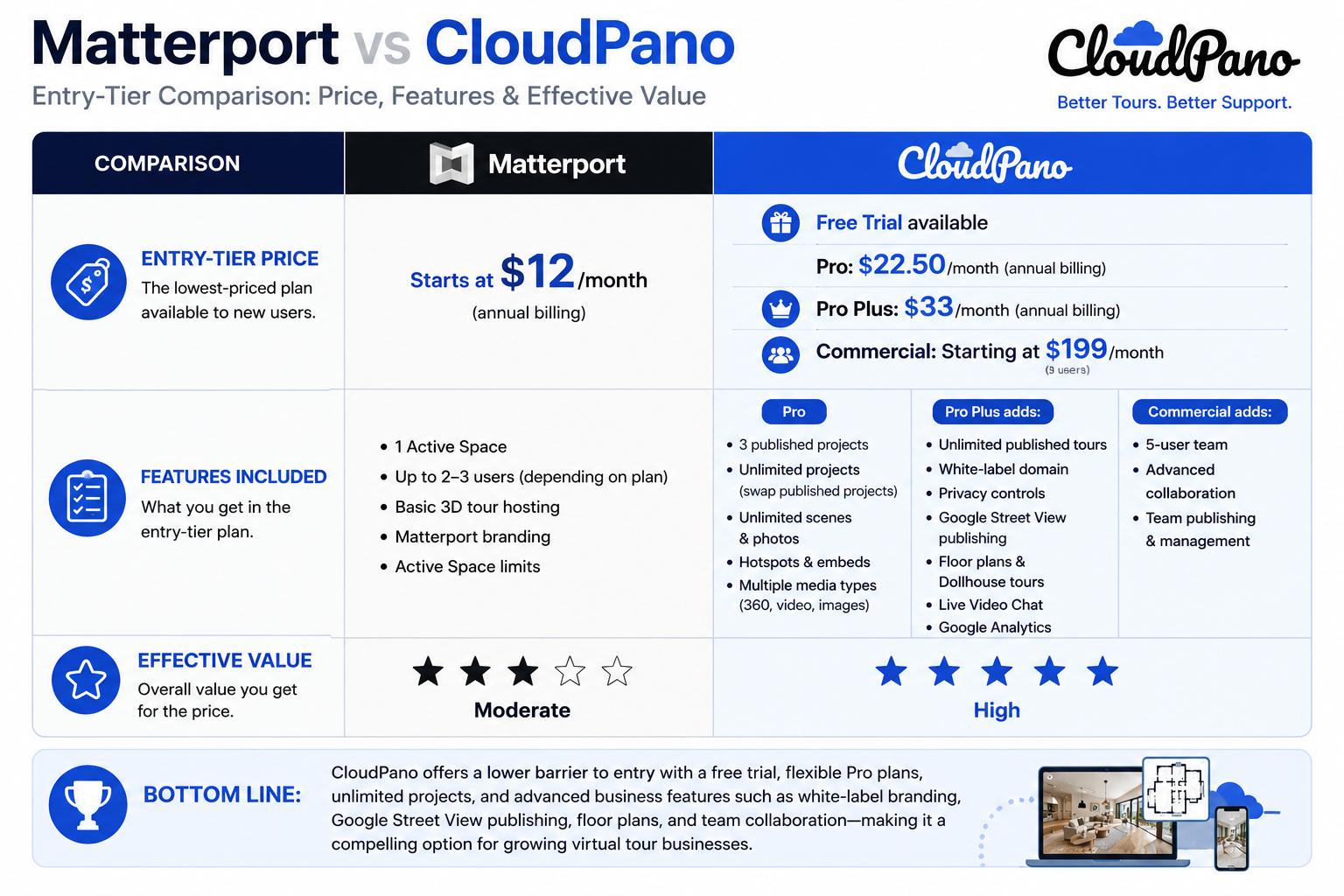
A more useful way to frame virtual tour software cost is to ask what you're paying per unit of actual usefulness — not per month, but per tour hosted, per team member added, per feature you actually use regularly. Two plans priced identically on paper can represent very different value once you map your actual usage against what's included.
A short, practical way to do this: list the features and usage levels your business actually needs (not aspirational ones), then check what tier on each platform covers that list completely, without needing an add-on or upgrade. The price of that tier — not the advertised entry-level price — is the number worth comparing.
This kind of comparison is discussed in more depth from a feature-inclusion angle in our related article on what's bundled versus billed separately, which is worth reading alongside this one if hidden feature costs are part of your concern.
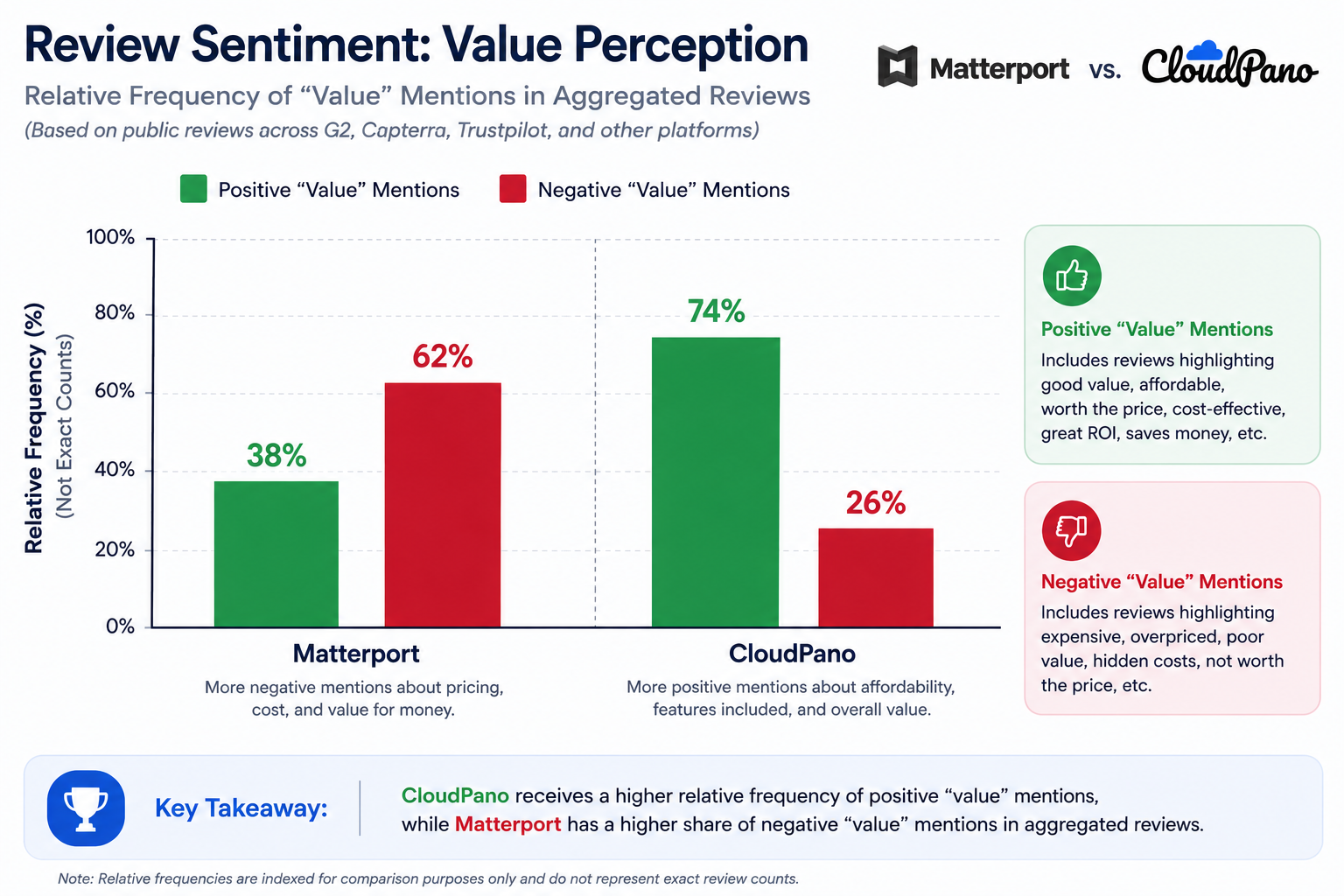
Independent reviews are useful here specifically because reviewers rarely evaluate price in isolation — they tend to comment on whether they felt they got their money's worth, which is a more honest proxy for value than a price comparison alone.
On G2's virtual tour software category page, a recurring theme in Matterport reviews is a sense of "paying more over time for the same output," particularly among reviewers managing a growing tour library. CloudPano reviews on the same page more frequently mention feeling like their tier included what they actually needed without frequent upsells.
Capterra's virtual tour software listings show a similar pattern when filtered specifically for reviews that mention "value" or "worth it" rather than price alone — worth checking directly rather than relying on any single summary, including this one.
Part of why a fair matterport pricing comparison is genuinely difficult is that pricing pages are designed to be skimmed, not studied. Tier names, feature bullet points, and asterisked footnotes are laid out to make a quick decision easy, not to make an accurate one. This isn't necessarily deceptive — it's just how pricing pages are built across most SaaS categories — but it does mean the burden falls on the buyer to slow down and read past the headline number.
The same applies when evaluating cloudpano pricing against any competitor: the entry-tier price is designed to be memorable and comparison-friendly, but it rarely represents what a business with real, ongoing tour production will actually pay once usage exceeds a starter-level assumption. Reading the tier immediately above the entry level — the one most growing businesses actually land in within the first year — tends to be a far more honest basis for comparison than the headline number both companies lead with.
This is also why virtual tour software cost comparisons that only cite a single "starting at" figure from each vendor are frequently misleading, even when accurately quoted — they're comparing two different companies' most optimistic-case scenario, not two realistic outcomes for the same type of business.
"Isn't the cheaper plan just objectively the better deal?"
Only if it actually covers what you need without gaps. A cheaper plan that forces an upgrade the moment you add a second team member, or exceed a storage threshold you didn't anticipate, isn't actually cheaper — it's a deferred cost. The honest comparison has to account for your realistic usage over the next year, not just your current footprint today.
"What if my usage changes and neither plan fits perfectly anymore?"
This is worth expecting rather than avoiding — most businesses' needs shift over time, and revisiting this comparison periodically is reasonable. The goal isn't finding a plan that's permanently perfect, it's finding the one that's the best fit for your current and near-term realistic usage, checked again down the line if your business changes significantly.

Rather than trusting a single comparison article's framing, including this one, run your own value check:
Community discussions on r/realtors are also worth a skim for candid, specific accounts of which tier actually covered a given agency's needs without surprise upgrades.
The cheapest plan and the best-value plan are frequently two different things, and the only way to tell them apart is to map your actual usage against what each tier genuinely includes — not just the number on the pricing page. Matterport's tier structure tends to create steady upward cost pressure as a tour library grows. CloudPano has generally aimed for a more linear, predictable relationship between usage and cost, though it's worth verifying against your specific needs rather than taking that as a blanket guarantee.
If getting real value for your money matters more to you than the lowest possible entry price, it's worth running the value check above before your next renewal decision, and testing a CloudPano trial with your own content to see how the fit compares directly. This kind of direct testing, using your own realistic tour volume rather than a demo account, tends to surface value differences far faster than reading another comparison article ever could — including this one. If storage and bandwidth specifics are your main concern, our dedicated hosting cost comparison covers that ground in more depth.


Compact, ready to go anywhere
Interchangeable lens that’s upgradeable
Dual 1-inch sensors for improved clarity and low light performance
Dynamic range and 6K 360° capture
360° photo resolution at 21MP

8K 360° video recording for ultra-detailed visuals.
4K single-lens mode for traditional wide-angle shots.
Invisible selfie stick effect for drone-like perspectives.
2.5-inch touchscreen with Gorilla Glass protection.
Waterproof up to 33ft for underwater shooting.

360° photo resolution in 23MP
Slim design at 24 mm thick
Built-in image stabilization for smooth video capture.
Internal 19GB storage for photo and video storage.
Wireless connectivity for remote control and sharing.

60MP 360° still images for high-resolution photography.
5.7K 360° video recording at 30fps.
2.25-inch touchscreen for intuitive control.
USB Type-C port for fast charging and data transfer.
MicroSD card slot for expandable storage.
.png)

.png)

Try it free. No credit card required. Instant set-up.







.svg)


.svg)