


.png)


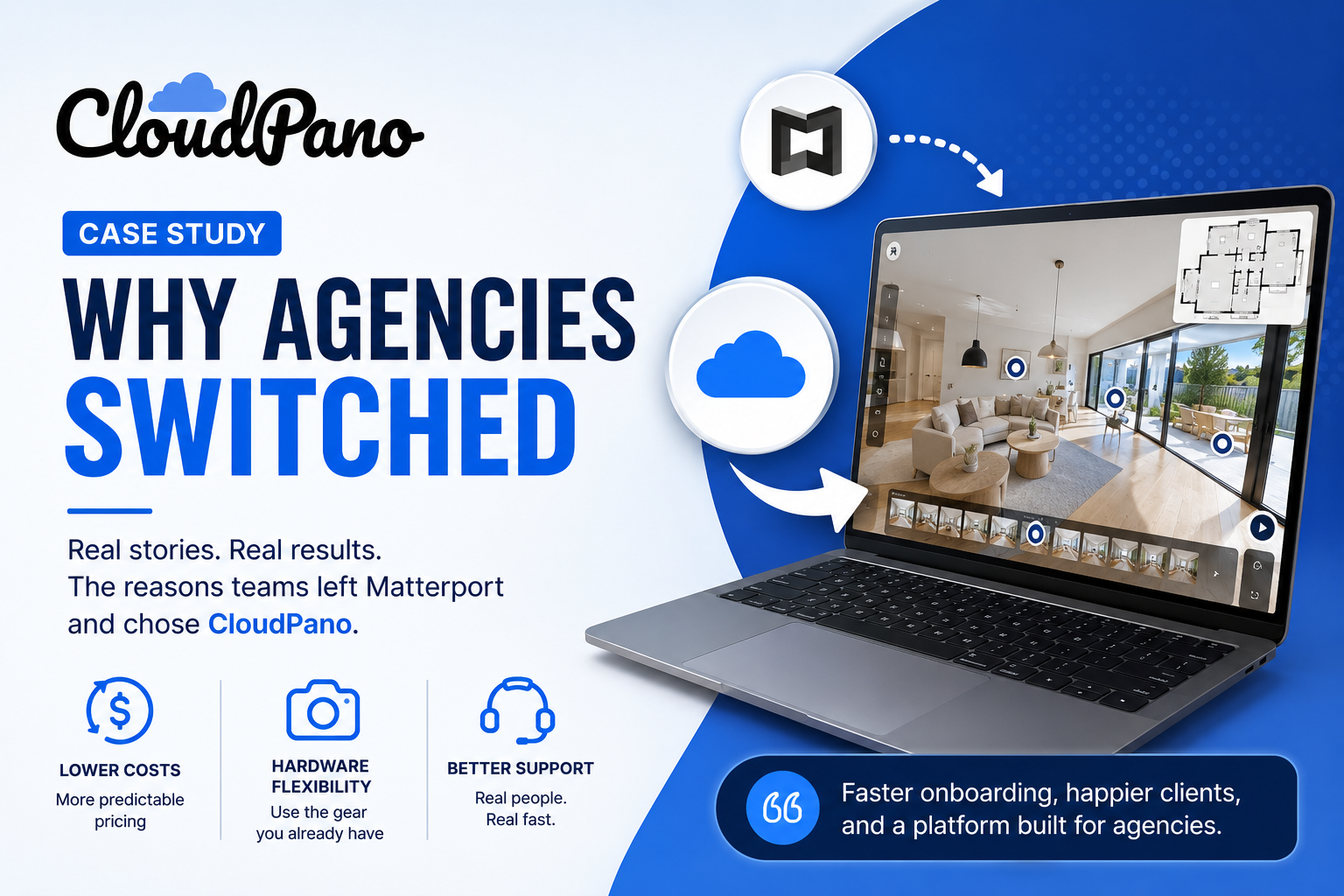
Reading a features-and-pricing comparison is useful, but it only gets you so far. At some point, the more convincing question isn't "what does the spec sheet say" — it's "what actually happened when a real agency made this switch." This cloudpano case study looks at the pattern behind why agencies move away from their existing virtual tour platform, drawing on the kinds of reasons that show up repeatedly across independent reviews and agency discussions, rather than a single hand-picked anecdote.
To be direct about the framing here: rather than naming specific agencies, this article draws on the recurring pattern found across many agencies' publicly shared experiences — the kind of story that repeats often enough to be a signal, not a fluke.
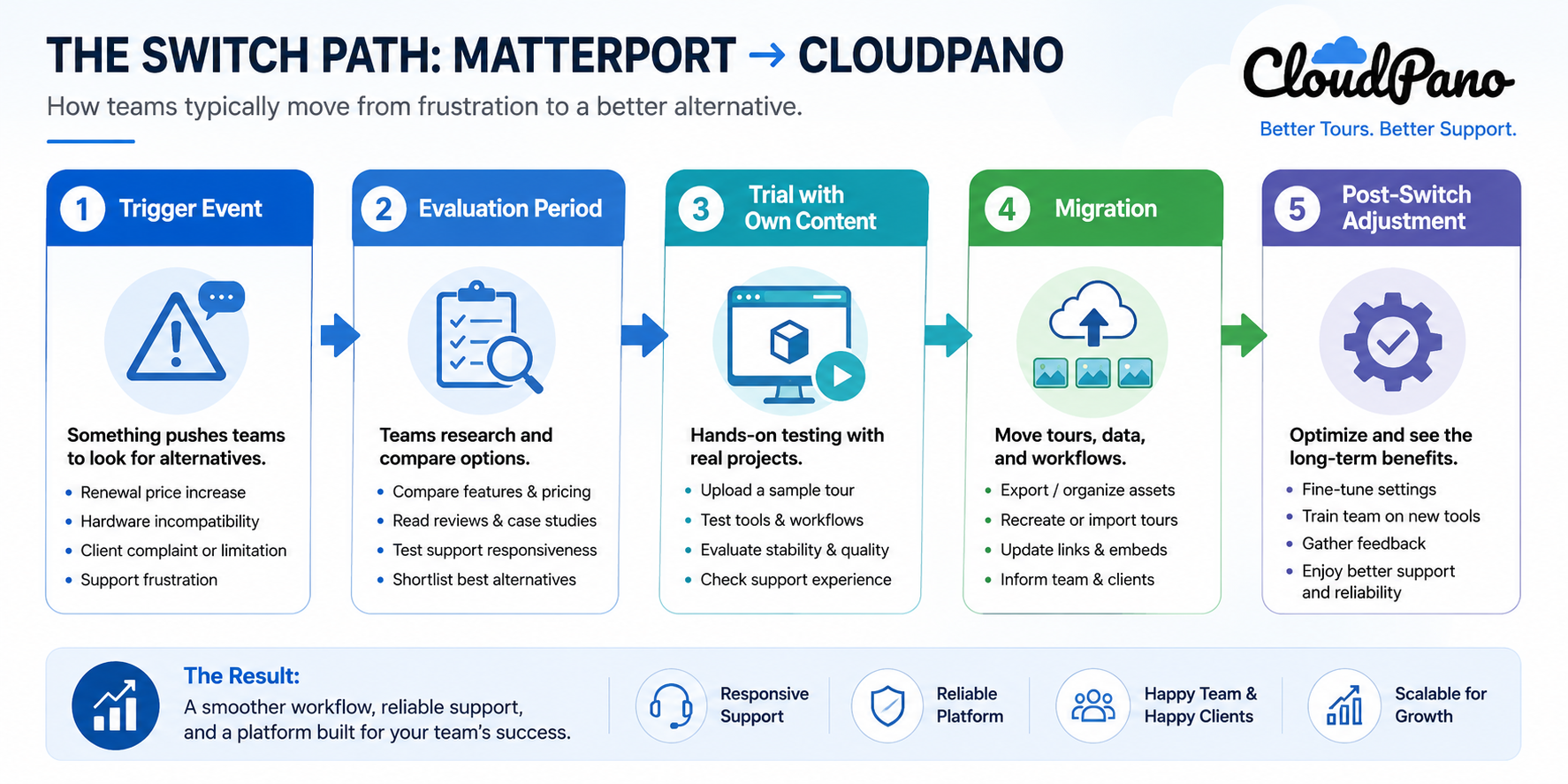
Agencies rarely switch platforms on a whim. Almost universally, the decision follows a specific trigger — a renewal notice with a higher price than expected, a new hire whose camera equipment isn't compatible with the current platform, or a client complaint about how slowly a tour loads. These triggers matter because they explain why now, not just why CloudPano.
Across agency-focused discussion threads on r/realtors, the most commonly cited trigger is cost predictability breaking down as an agency's tour library grows — the same pattern discussed in our pricing comparison, but experienced firsthand rather than read about abstractly.
Consider a composite, illustrative scenario based on patterns common to mid-sized residential brokerages: an agency with several agents, each producing a handful of real estate virtual tours monthly, reaches a point where their existing plan tier no longer comfortably covers their combined output. Rather than accepting an automatic upgrade to the next tier, the agency evaluates alternatives — and the deciding factors tend to cluster around three things: predictable per-agent cost, compatibility with the mix of cameras different agents already own, and whether client-facing tour links remain stable through the transition.
This is a common enough matterport switch story across agency communities that it's worth treating as a pattern rather than an outlier: the switch is rarely driven by a single dramatic failure, and much more often by an accumulation of small frictions that eventually outweigh the inertia of staying put.

Rather than a single storyline, it's more useful to look at the recurring reasons agencies give, since these repeat across many independent accounts:
Cost predictability at scale. As covered in our pricing deep-dive, cost structures that penalize a growing tour library rather than current usage tend to be the single most cited frustration among growing agencies.
Hardware flexibility across a team. Agencies with multiple agents rarely standardize on identical camera equipment. A platform that accommodates a wider range of hardware avoids forcing every agent onto the same gear.
Client-facing reliability. Tours embedded on active listings need to stay live and load quickly regardless of internal account changes — agencies are understandably cautious about anything that risks disrupting a client-facing link mid-listing.

On G2's virtual tour software category page, a recurring cloudpano customer review theme among real estate users is that the switch itself was less disruptive than anticipated — the bigger hesitation was usually the anticipated hassle, not the actual experience once undertaken.
Capterra's virtual tour software listings show a similar pattern when filtered for real estate-specific reviews: agencies frequently cite ease of onboarding a new team as a positive surprise relative to their expectations going in.
Real estate is one of the heaviest-use categories for virtual tour platforms, which means it's also where switching patterns show up most visibly. Agencies producing real estate virtual tours at volume feel cost and hardware friction faster than a business producing an occasional tour once a quarter — a single mismatched pricing tier gets multiplied across every listing an agency handles, not just one.
This also explains why real estate-specific reviews tend to be more detailed and more candid than reviews from other industries: agents and brokers are comparing notes constantly, whether in office meetings, regional associations, or online communities, which means a frustrating matterport switch story from one agent often reaches several others well before it ever reaches a public review site. By the time a pattern shows up in aggregated reviews, it has usually already circulated informally within the industry for a while.
Beyond the trigger and the transition itself, it's worth understanding what actually changes day to day once an agency has moved. The most commonly reported operational shift isn't dramatic — it's a reduction in the small administrative friction that accumulates around account management: fewer support tickets about unexpected charges, less time spent tracking which agent is nearing a seat or storage limit, and more predictable monthly budgeting for the office manager or owner handling software costs.
None of this shows up as a single headline benefit, which is part of why it's easy to underestimate before switching and easy to notice only in hindsight, once the friction is gone. A recurring cloudpano customer review pattern reflects exactly this: less about a single standout feature and more about the absence of a recurring annoyance.
"Our agency has already invested time building workflows around our current platform — is switching really worth relearning everything?"

This is the most reasonable hesitation, and it deserves a direct answer: some relearning is unavoidable, but it's usually concentrated in a short onboarding period rather than an ongoing tax on productivity. Most agencies describe the adjustment period as measured in days, not months, particularly for core tasks like uploading and publishing a tour.
"What if our clients notice or are confused by the change?"
Client-facing tours can generally be migrated with stable links, meaning most clients never notice a platform change happened at all unless it's pointed out to them. This is worth confirming directly as part of a migration plan rather than assuming either outcome.
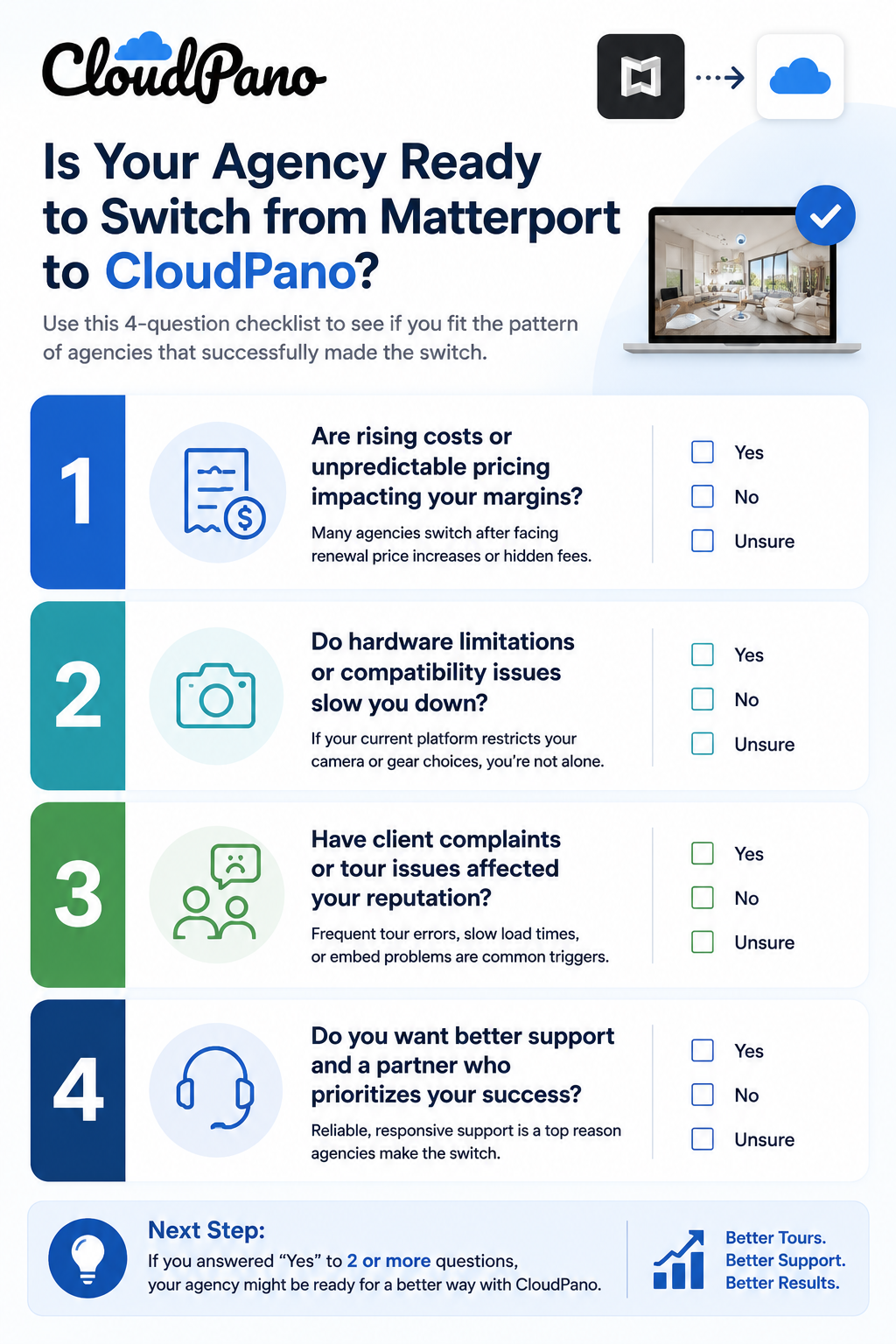
Rather than assuming your agency's situation matches the pattern above, check it against your own specifics:
If two or more of these resonate, it's a reasonable signal that your agency fits the pattern common among agencies that have already made the switch. None of these four questions require outside data to answer — they're specific enough that most agency owners or office managers can honestly assess them in a single sitting, which is itself part of why this decision doesn't need to be as drawn-out as it often ends up being.
The decision to switch virtual tour platforms rarely comes from a single dramatic problem — it comes from an accumulation of smaller frictions around cost, hardware flexibility, and client-facing reliability that eventually outweigh the comfort of staying put. Agencies that have made this move consistently describe the actual transition as smoother than they expected going in, even when the decision itself took a while to reach.
This gap between anticipated hassle and actual experience is worth sitting with for a moment, because it's the single biggest reason agencies delay a switch longer than they probably should. Inertia is a powerful force, and it's easy to mistake "we haven't gotten around to it" for "it would be too disruptive to do." The two are not the same thing, and agencies that eventually make the switch are usually the first to say so afterward.
If any of the trigger points above sound familiar, it's worth running a CloudPano trial with your own team's content before your next renewal decision, rather than assuming the switch would be more disruptive than it typically is. And if cost is the main factor weighing on your decision, our pricing deep-dive breaks down exactly how that tends to play out as an agency scales.


Compact, ready to go anywhere
Interchangeable lens that’s upgradeable
Dual 1-inch sensors for improved clarity and low light performance
Dynamic range and 6K 360° capture
360° photo resolution at 21MP

8K 360° video recording for ultra-detailed visuals.
4K single-lens mode for traditional wide-angle shots.
Invisible selfie stick effect for drone-like perspectives.
2.5-inch touchscreen with Gorilla Glass protection.
Waterproof up to 33ft for underwater shooting.

360° photo resolution in 23MP
Slim design at 24 mm thick
Built-in image stabilization for smooth video capture.
Internal 19GB storage for photo and video storage.
Wireless connectivity for remote control and sharing.

60MP 360° still images for high-resolution photography.
5.7K 360° video recording at 30fps.
2.25-inch touchscreen for intuitive control.
USB Type-C port for fast charging and data transfer.
MicroSD card slot for expandable storage.
.png)

.png)

Try it free. No credit card required. Instant set-up.






.svg)


.svg)