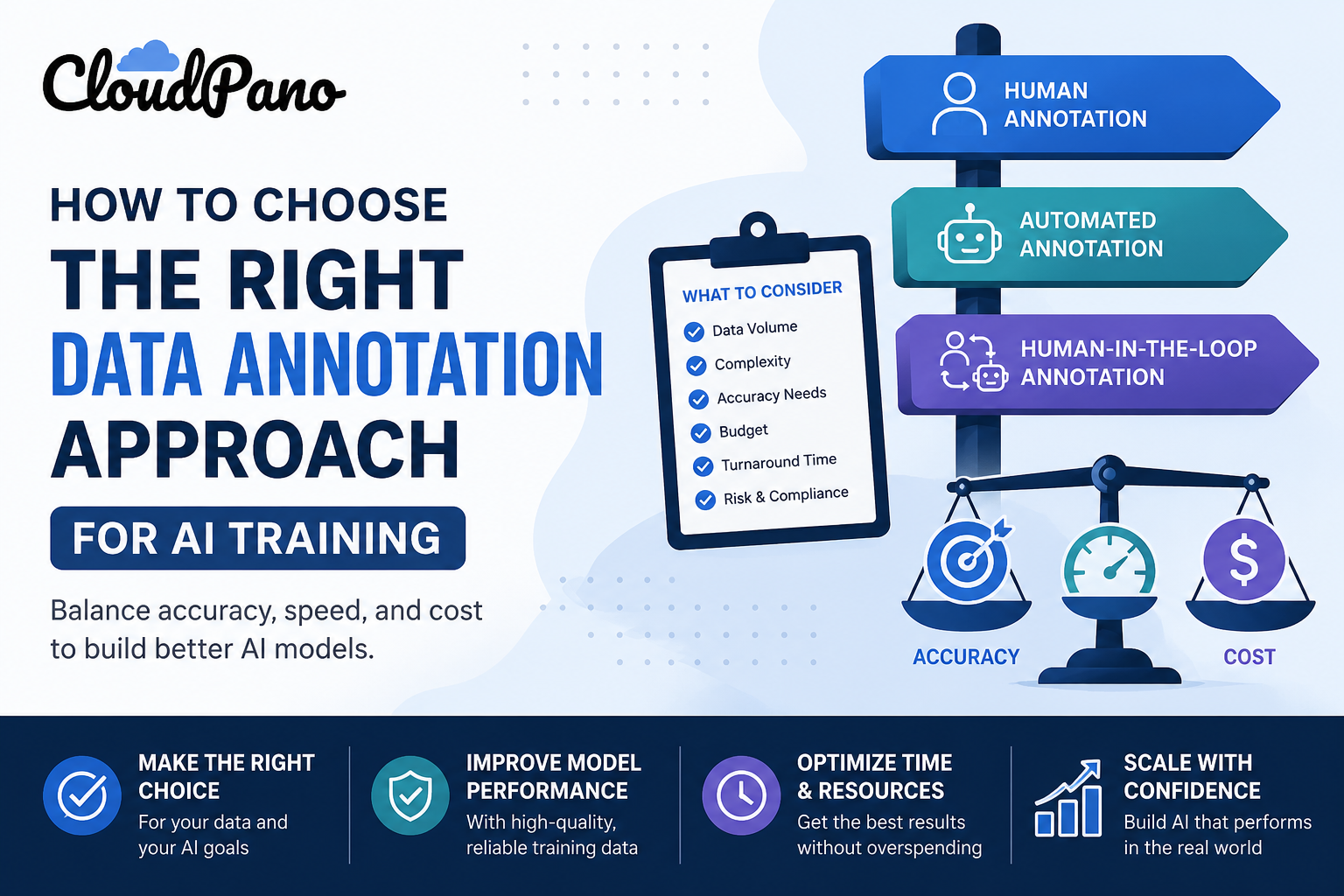
How to Choose the Right Data Annotation Approach for AI Training

Cloudpano
July 18, 2026
5 min read
Share this post

Human vs Automated Data Annotation: How to Choose the Right Approach for AI Training

Every AI team eventually hits the same wall: the model is only as good as the labels it learned from. That's when the human vs automated data annotation decision stops being theoretical and starts affecting budget, timeline, and — if you get it wrong — model reliability in production.

This isn't a question with one right answer. A retail recommendation engine and an autonomous vehicle perception stack have wildly different tolerance for labeling error, and that difference should drive how you annotate, not a generic best practice.

Why It Matters

Annotation quality is the ceiling on model quality. A model can't learn a distinction its training labels never captured, and it will confidently repeat whatever mistakes are baked into the data. Google Research's widely cited "Data Cascades" study documented how small, unaddressed problems in data collection and labeling compound downstream, often surfacing only after a model is deployed and the fix becomes far more expensive (Sambasivan et al., Google Research).

The cost of getting this wrong isn't hypothetical for regulated or safety-critical applications. NIST's AI Risk Management Framework specifically calls out data quality and representativeness as a core input to trustworthy AI, not an afterthought to be handled after the model is built (NIST AI RMF).

There's also a speed dimension. Stanford HAI's AI Index has tracked the accelerating pace at which organizations are moving models from research into production (Stanford HAI, AI Index Report), which means annotation pipelines increasingly need to keep pace with iteration cycles that used to take months and now take weeks. That pressure is exactly what pushes teams toward automated labeling — and exactly why it's worth understanding where automation quietly introduces risk.

How It Works

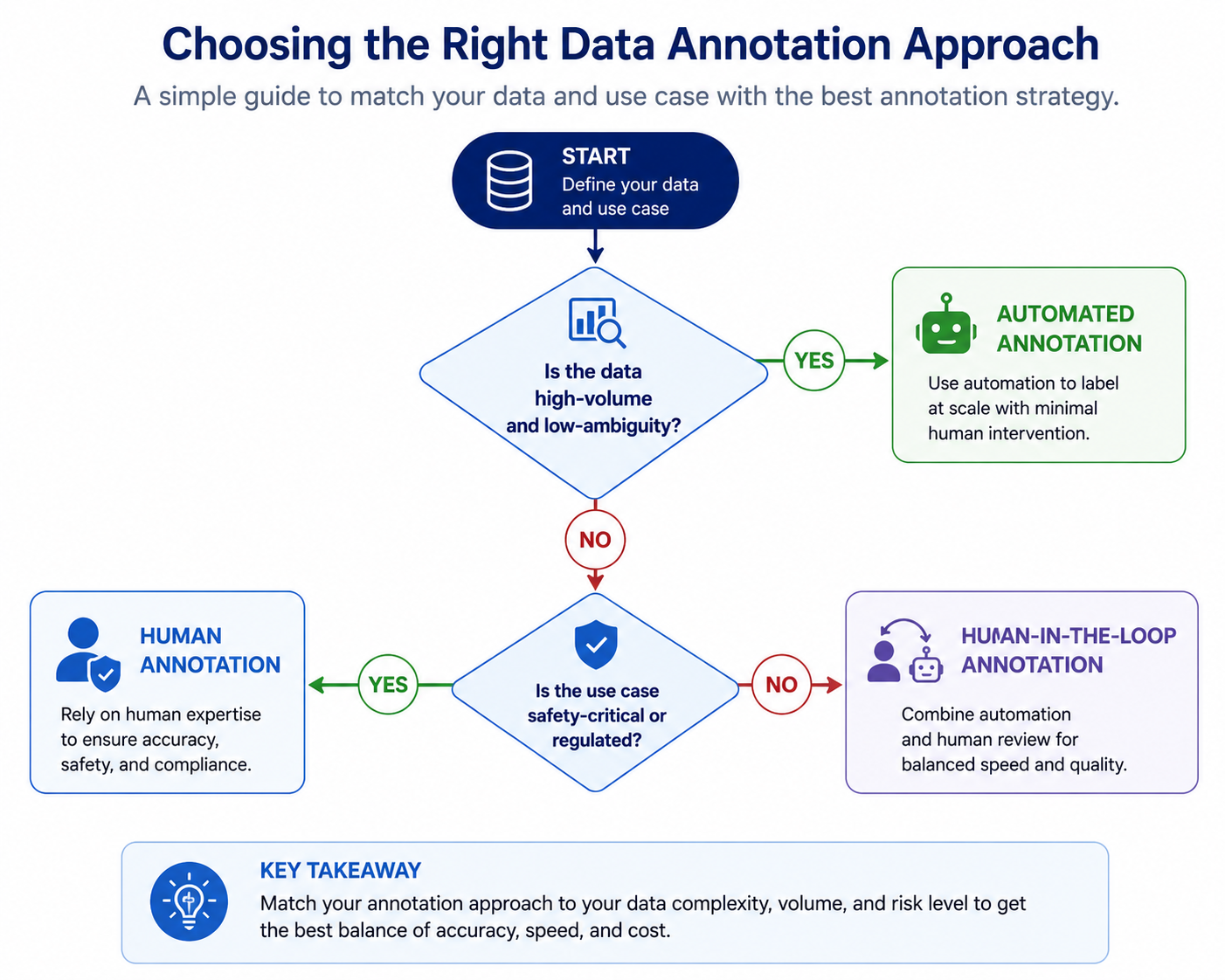
Human annotation relies on trained people — often domain specialists for technical or regulated data — applying judgment to each item: drawing bounding boxes, tagging intent in a support ticket, transcribing speech, or flagging edge cases a guideline didn't anticipate. It's slower and more expensive per item, but it handles ambiguity, context, and rare cases that rules-based or model-based systems tend to miss.
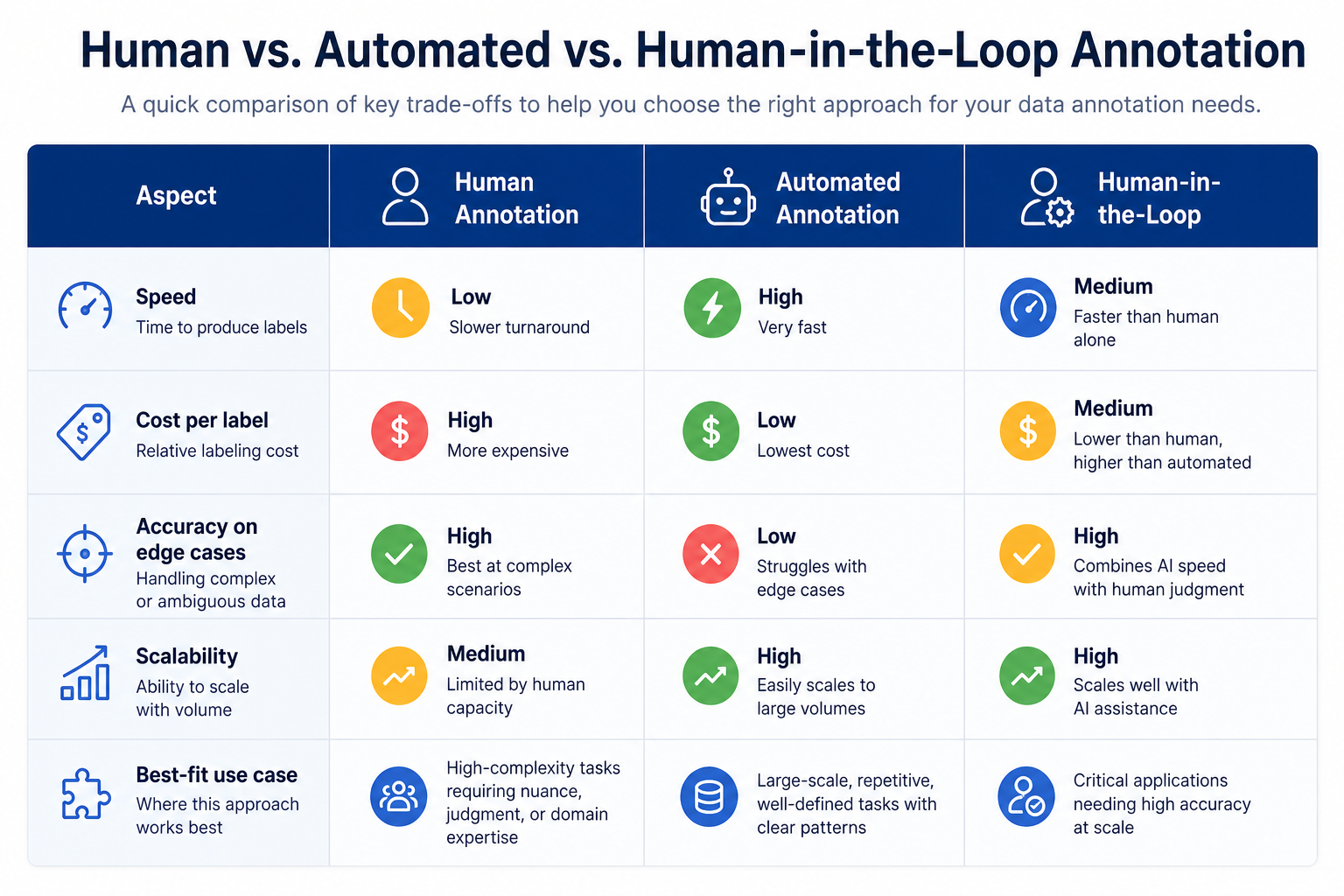
Automated annotation uses models — sometimes a smaller pre-trained model, sometimes the same architecture being trained — to generate labels directly or to pre-label data that a human then reviews. It's fast and cheap at scale, but it inherits and can amplify whatever biases or blind spots exist in the model doing the labeling.

Human-in-the-loop annotation sits between the two: automation handles the bulk of straightforward cases, and human reviewers focus their time on the ambiguous, low-confidence, or high-stakes items the system flags. This is the model most mature AI teams converge on, not because it's a compromise, but because it routes human judgment to where it actually changes outcomes.
Step-by-Step Workflow

  1. Define the labeling taxonomy and edge cases. Write guidelines specific enough that two different annotators — human or automated — would label the same item the same way.
  2. Pilot on a small, representative sample. Run both human and automated annotation on the same subset to measure agreement and surface where they diverge.
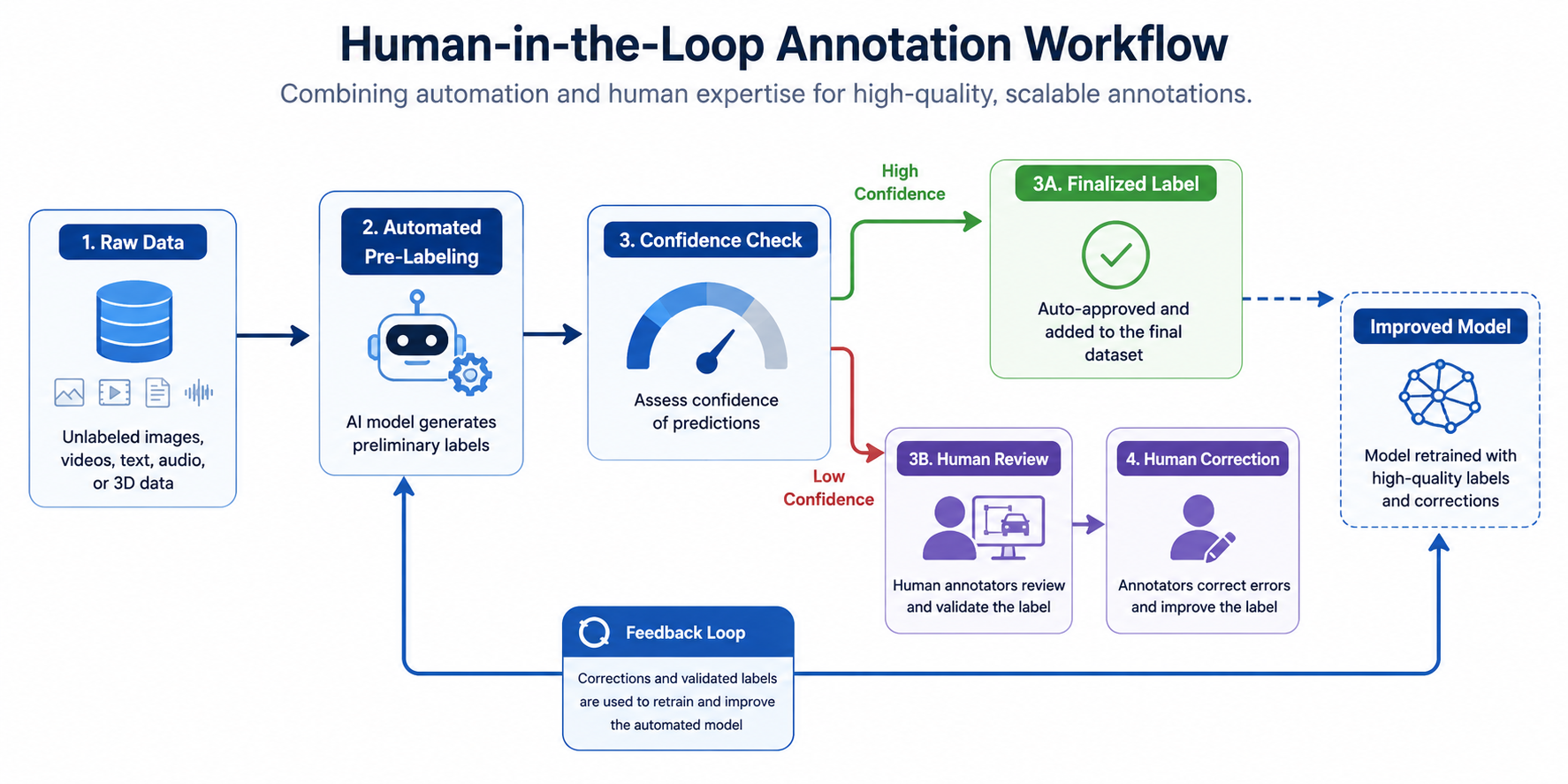
  3. Set a confidence threshold for automation. Items the automated system labels with high confidence move forward; low-confidence items route to human reviewers.
  4. Route ambiguous and edge-case data to human annotators. This is where human-in-the-loop annotation earns its cost — on the 10-20% of data that's actually hard.
  5. Run inter-annotator agreement checks. Measure consistency across human reviewers, not just against the automated baseline, to catch guideline problems early.
  6. Audit a rolling sample post-labeling. Spot-check completed batches on a schedule, not just at the start of a project.
  7. Feed corrections back into the automated model. Every human correction is training signal — use it to improve the pre-labeling model over time, tightening the loop.
Diagram of human-in-the-loop annotation workflow from data to model feedback

Industry Use Cases

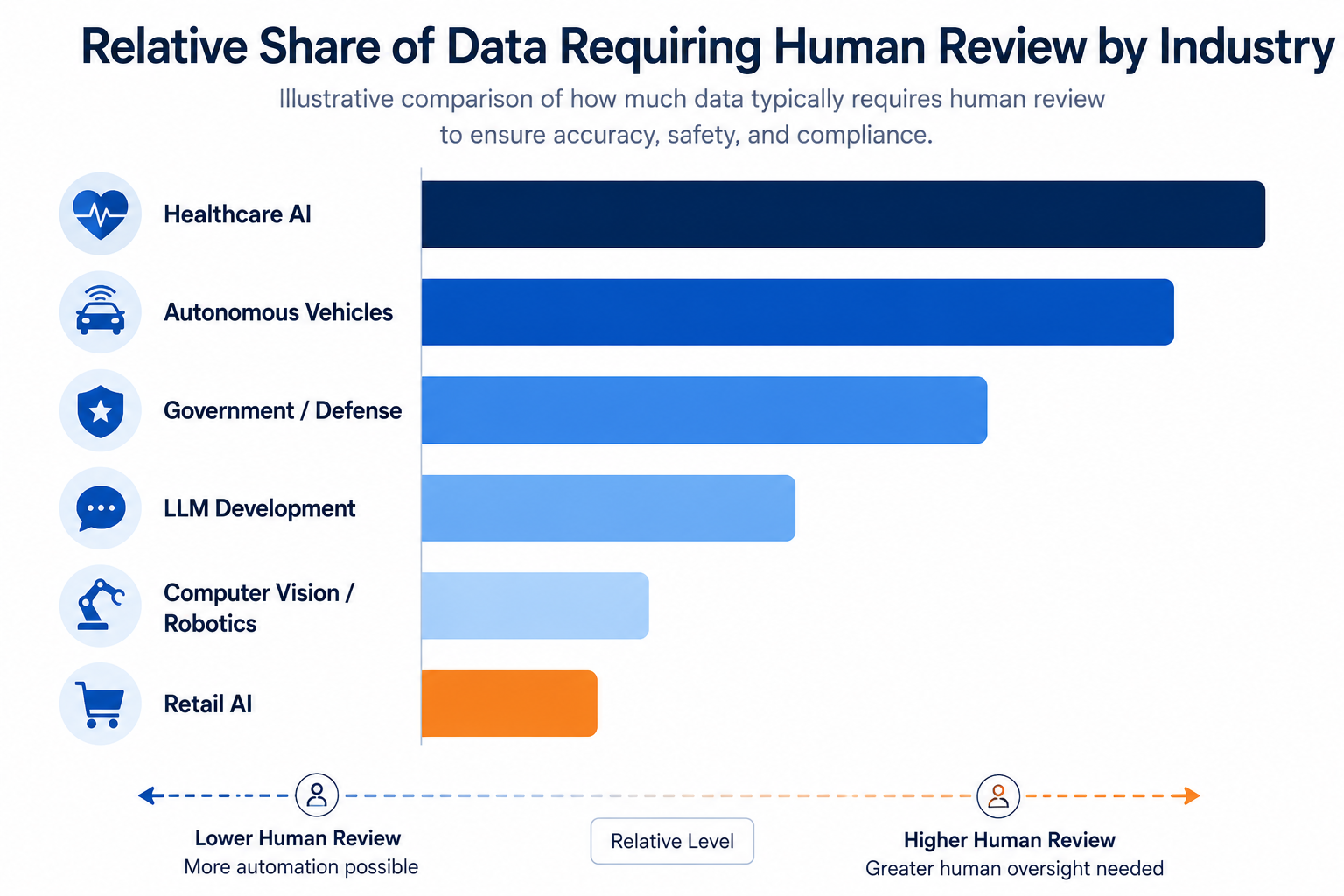
  • Computer vision / robotics: Automated pre-labeling of routine object detection, with human annotators handling occlusion, unusual lighting, or novel object classes.
  • Autonomous vehicles: Human review is typically mandatory for edge-case scenarios (unusual pedestrian behavior, construction zones, sensor conflicts) where annotation accuracy has direct safety implications.
  • Healthcare AI: Domain-expert human annotation (radiologists, clinicians) for diagnostic imaging and clinical text, where automated labeling alone carries regulatory and liability risk.
  • Retail AI: Automated annotation dominates for product categorization and catalog tagging at scale, with human review reserved for ambiguous or high-value SKUs.
  • LLM development: Human-in-the-loop annotation for preference data, safety labeling, and instruction-following examples — areas where automated labeling can't easily judge nuance or intent.
  • Government & defense: Strict human oversight requirements for classification-sensitive or mission-critical labeling, often layered with formal audit trails.

Benefits

Human annotation delivers:

  • Higher accuracy on ambiguous, novel, or context-dependent data
  • Domain expertise that catches errors automated systems don't know to look for
  • Defensibility — a documented human decision trail matters in regulated industries

Automated annotation delivers:

  • Throughput that scales to millions of items without proportional cost increase
  • Consistency on repetitive, well-defined labeling tasks
  • Faster iteration cycles when retraining models frequently

Human-in-the-loop annotation delivers:
  • Most of automation's speed with most of human annotation's accuracy
  • A feedback mechanism that improves the automated component over time
  • Flexibility to shift the human/automation ratio as a project matures

Common Mistakes

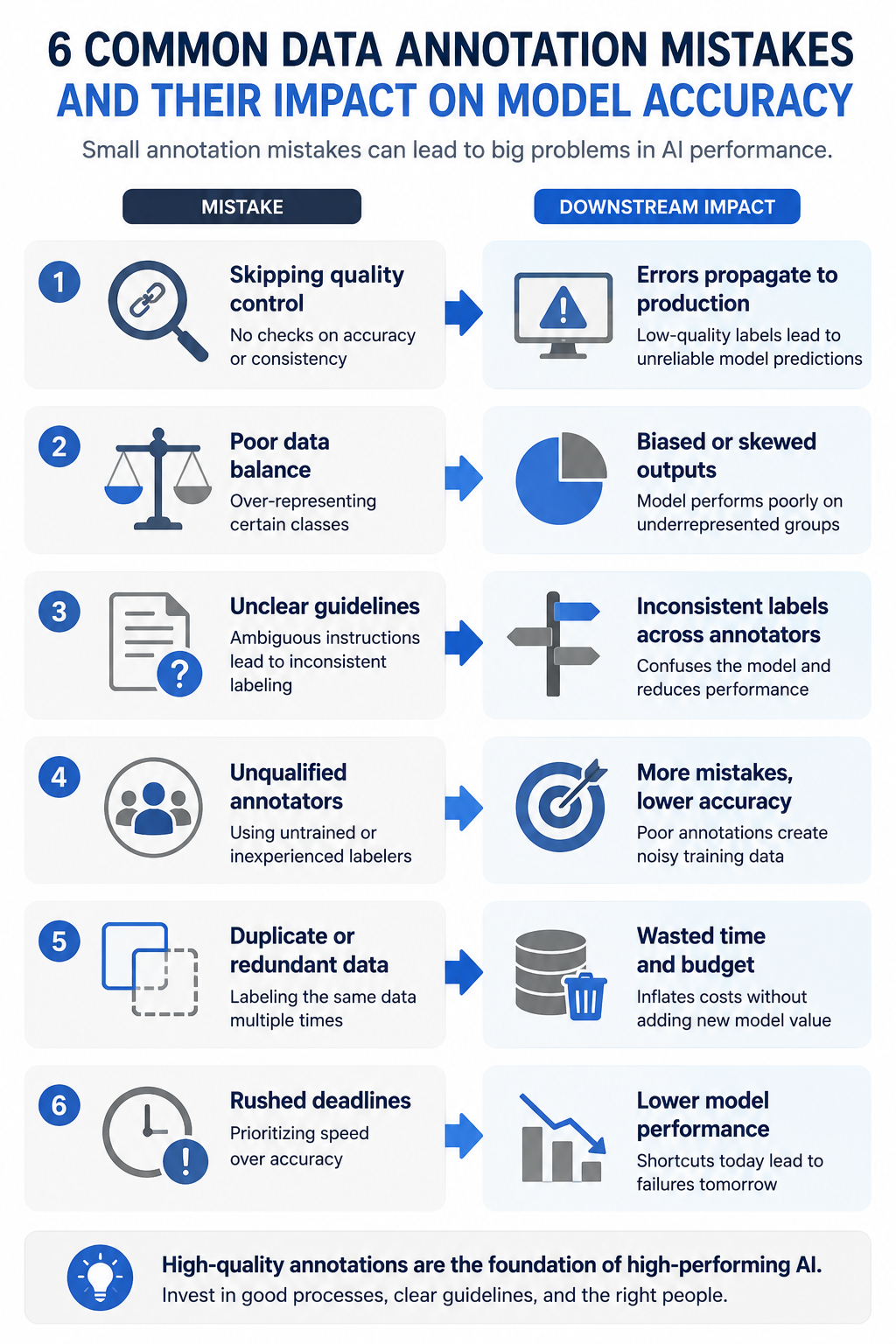
  • Automating too early. Deploying automated labeling before you've established what "correct" looks like through a human-annotated baseline.
  • Treating annotation guidelines as a one-time document. Guidelines that aren't revised as edge cases surface lead to silently inconsistent labels.
  • Skipping inter-annotator agreement checks. Without measuring agreement between human annotators, you can't tell if a labeling problem is a guideline issue or an annotator issue.
  • Assuming automated labels don't need auditing. Automated systems fail silently and consistently, which makes their errors easy to miss without a sampling audit.
  • Underinvesting in domain expertise for specialized data. Generalist annotators mislabeling clinical, legal, or technical data is a recurring cause of downstream model failure.
  • Ignoring class imbalance introduced by automation. Automated systems tend to over-label the common cases and under-label the rare ones, which quietly erodes model performance on exactly the cases that matter most.

Best Practices

  • Start every new annotation project with a human-labeled gold-standard sample before introducing automation.
  • Build a confidence-based routing system rather than a fixed human/automation split.
  • Revisit annotation guidelines every time a new edge case is discovered, and version them.
  • Track annotation accuracy and inter-annotator agreement as ongoing metrics, not one-time QA gates.
  • Keep a documented audit trail — this matters for regulated industries and for debugging model failures after the fact.
  • Treat annotation as an iterative pipeline, not a one-off data prep step. McKinsey's research on generative AI adoption notes that data readiness — not model architecture — is consistently the bottleneck organizations underestimate (McKinsey, "The economic potential of generative AI").

FAQ

What's the main difference between human and automated data annotation?

Human annotation relies on people applying judgment to each item, which handles ambiguity and context well but is slower and costlier. Automated annotation uses models to generate or pre-generate labels, which scales fast but can inherit the labeling model's blind spots.

Is human-in-the-loop annotation more expensive than fully automated annotation?

It costs more than pure automation but less than full manual labeling, since human review is targeted at the subset of data flagged as low-confidence or ambiguous rather than applied uniformly.

Which industries need human annotation the most?

Healthcare, autonomous vehicles, and government/defense typically require the most human oversight, since annotation accuracy in these fields has direct safety, regulatory, or liability consequences.

Can automated data labeling fully replace human annotators?

For narrow, well-defined, high-volume tasks with low ambiguity, largely yes. For anything involving nuance, novel edge cases, or high-stakes decisions, no automated system reliably matches human judgment today.

How do you measure annotation accuracy?

Common methods include inter-annotator agreement (comparing labels from multiple independent annotators on the same data), gold-standard comparison sets, and rolling post-labeling audits on random samples.

What is human-in-the-loop annotation, exactly?

It's a hybrid workflow where an automated system handles routine labeling and routes low-confidence or ambiguous items to human reviewers, whose corrections then feed back into improving the automated component.

How much data actually needs human review versus automation?

This varies by domain and by how mature the automated system is, but most teams find a meaningful minority of data — often the hardest cases — accounts for a disproportionate share of model errors, which is why routing matters more than a fixed split.
Conclusion

The choice between human vs automated data annotation was never really binary — it's a routing problem. Automation should carry the volume; human judgment should carry the ambiguity, the edge cases, and the decisions where being wrong actually costs something. Teams that treat annotation as a static, one-time step tend to discover the gap in their data only after it shows up as a gap in their model's behavior.

🚀 Your All‑In‑One Virtual Experience Stack
🎬
PhotoAIVideo
Turn photos into scroll‑stopping AI videos.
Get Started →
🏡
Pictastic
Instantly stage listings with AI.
Try Staging →
🌀
CloudPano
Create stunning 360° tours in minutes.
Launch Tour →
💰
VirtualTourProfit
Build a profitable virtual tour business.
Learn More →
🤝
CloudPano Reseller
Resell AI visual software without building it.
Become a Reseller →
🚗
Auto CloudPano
Sell more vehicles with 360° experiences.
Explore Auto →
🖼️
AutoBackgrounding
Replace backgrounds instantly with AI precision.
Try it Now →
📐
3D Measure
Capture accurate floor plans & 3D measurements.
Measure Now →
🧠
AI Training Data
Custom AI training data services.
Learn More →
Share this post
Cloudpano

Choose The Right 360° Camera

Insta360 ONE RS 1-Inch 360 Edition

  • Compact, ready to go anywhere

  • Interchangeable lens that’s upgradeable

  • Dual 1-inch sensors for improved clarity and low light performance

  • Dynamic range and 6K 360° capture

  • 360° photo resolution at 21MP

Learn More

Insta360 X4

  • 8K 360° video recording for ultra-detailed visuals.

  • 4K single-lens mode for traditional wide-angle shots.

  • Invisible selfie stick effect for drone-like perspectives.

  • 2.5-inch touchscreen with Gorilla Glass protection.

  • Waterproof up to 33ft for underwater shooting.

Learn More

Ricoh Theta Z1

  • 360° photo resolution in 23MP

  • Slim design at 24 mm thick

  • Built-in image stabilization for smooth video capture.

  • Internal 19GB storage for photo and video storage.

  • Wireless connectivity for remote control and sharing.

Learn More

Ricoh Theta X

  • 60MP 360° still images for high-resolution photography.

  • 5.7K 360° video recording at 30fps.

  • 2.25-inch touchscreen for intuitive control.

  • USB Type-C port for fast charging and data transfer.

  • MicroSD card slot for expandable storage.

Learn More
Property Marketing
Allows potential buyers to explore properties in detail from anywhere, enhancing the real estate marketing process.
Automotive Spins
Create an interactive virtual showroom and engage affluent digital buyers with live 360º video calls, all through the CloudPano mobile app for a complete automotive sales solution.
Interactive Floor Plans
Create 2D and 3D floor plans with measurements in 4 minutes or less, all from your phone. Download the Floor Plan Scanner app and get your first scan free.

360 Virtual Tours With CloudPano.com. Get Started Today.

Try it free. No credit card required. Instant set-up.

Try it free
Latest posts

See our other posts

Interviews, tips, guides, industry best practices, and news.

In-House vs. Outsourced Data Annotation: Cost, Control, and Scalability Compared

In-house vs outsourced data labeling comes down to trade-offs between control and scale. In-house data annotation offers tighter oversight and faster iteration for small, sensitive, or highly specialized datasets, while outsourced data labeling services offer lower fixed costs and faster scaling for high-volume projects, provided vendor quality is verified upfront.
Read post

Data Annotation Quality Assurance: How to Improve Accuracy and Consistency

Data annotation quality assurance is the set of processes used to measure, catch, and correct labeling errors before training data reaches a model. It combines inter-annotator agreement checks, gold-standard test sets, consensus labeling, and rolling audits — used together, not individually, to ensure data annotation quality holds steady at scale.
Read post

How to Choose a Data Annotation Company: 10 Factors Enterprise Teams Should Evaluate

To choose a data annotation company, evaluate domain expertise, annotation quality assurance processes, data security certifications, workforce management, tooling flexibility, and scalability. Request a paid pilot on your actual data before signing a contract — proposals and case studies show intent, but a pilot is the only reliable data annotation vendor evaluation method.
Read post