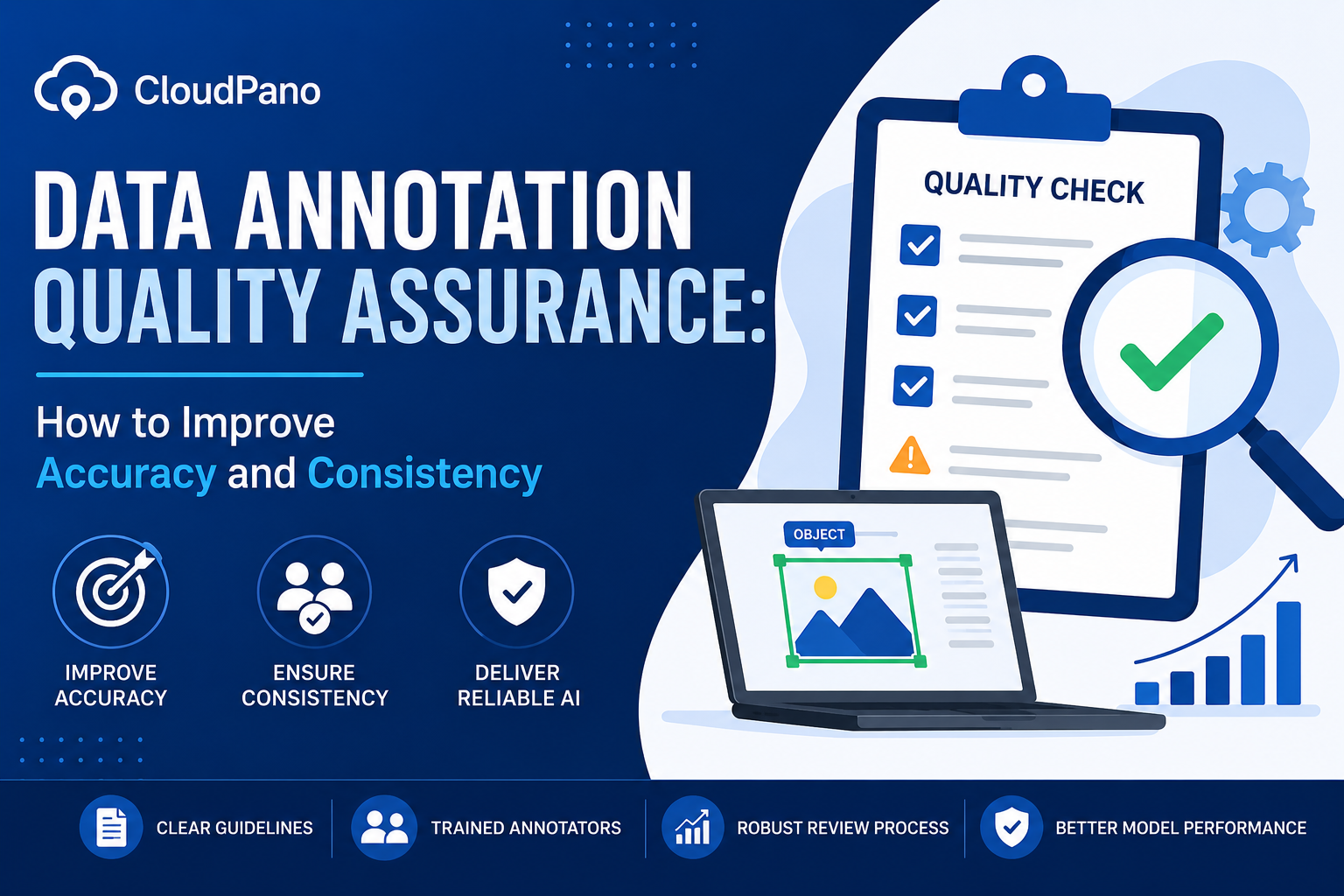
Data Annotation Quality Assurance: How to Improve Accuracy and Consistency
Cloudpano
July 18, 2026
•
5 min read
Share this post
Data Annotation Quality Assurance: How to Improve Accuracy and Consistency
Most teams don't think about data annotation quality assurance until a model is already underperforming in ways nobody can explain. By then, the labeling errors are baked into a dataset that's expensive to re-audit and even more expensive to relabel.
That's backwards. Data annotation QA isn't a cleanup step — it's a continuous process that should run alongside labeling from day one, not get bolted on after a model starts misbehaving in production.
Why It Matters
A model can't learn a distinction its labels never captured correctly, and inconsistent labels teach it the wrong distinction with just as much confidence as a correct one would. Google Research's "Data Cascades" study documented exactly this pattern — small, unaddressed data quality issues compounding silently until they surface as expensive, hard-to-trace production failures (Sambasivan et al., Google Research).
NIST's AI Risk Management Framework treats data quality as foundational to trustworthy AI, not a downstream concern to revisit after deployment — which means annotation QA is effectively a risk-management function, not just a data-cleaning task (NIST AI RMF).
The pressure to skip rigorous QA is real, too. Stanford HAI's AI Index has tracked how quickly organizations are moving models from research into production (Stanford HAI, AI Index Report), and that pace makes it tempting to treat QA as a step you can shortcut when a deadline is close. It's usually the shortcut that costs the most later.
How It Works
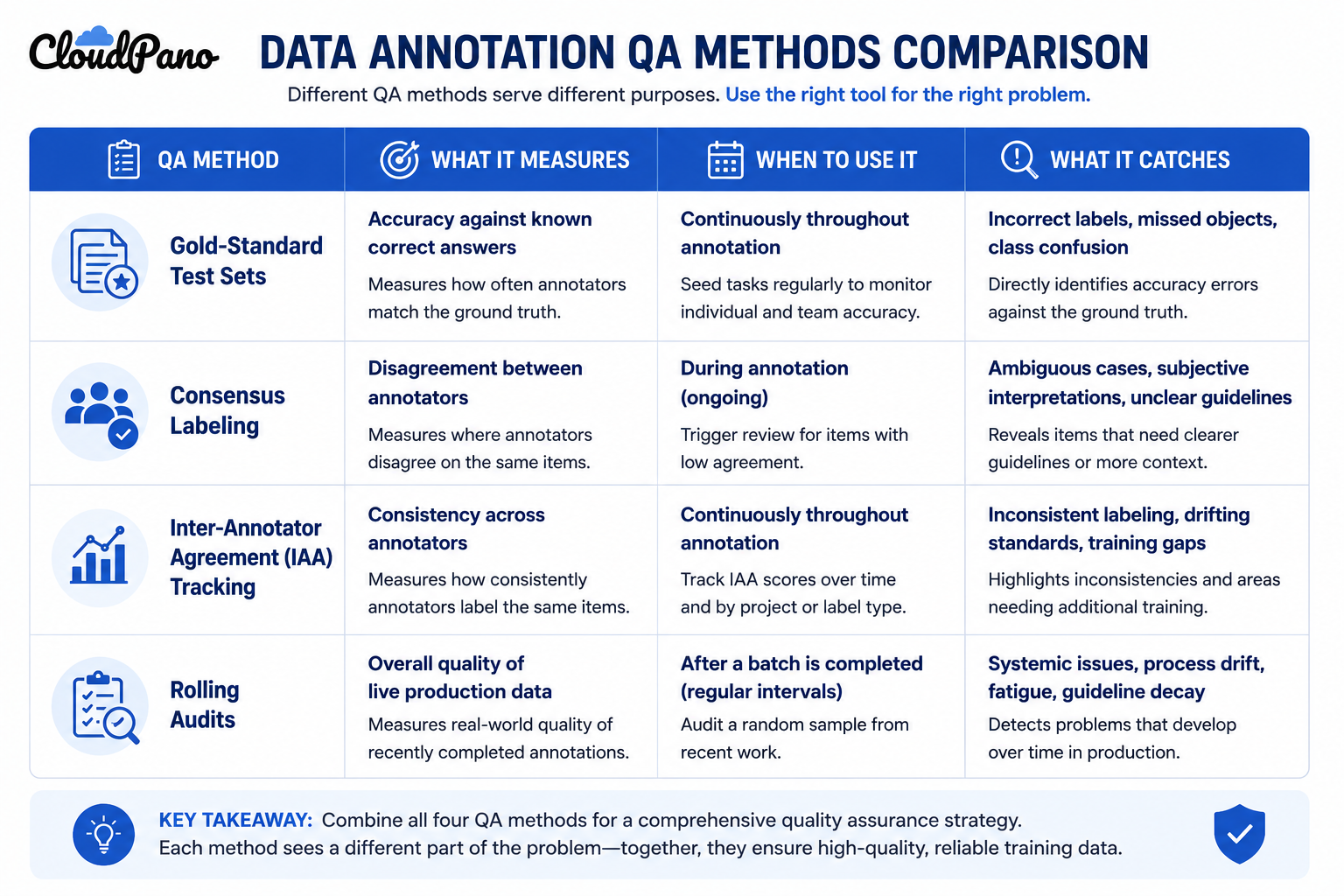
Data annotation quality assurance isn't one technique — it's a layered system, and understanding how these workflows operate makes it easier to diagnose where your own pipeline is weak.
Gold-standard test sets: A small set of expert-labeled, verified-correct examples mixed into annotator workloads without their knowledge, used to measure individual and team accuracy against a known-correct baseline.
Consensus labeling: Multiple annotators label the same item independently, and disagreements get flagged for review rather than resolved by whichever label happened to come in first.
Inter-annotator agreement (IAA) tracking: A statistical measure of how consistently different annotators label the same data, used to catch guideline ambiguity before it becomes a systemic labeling error.
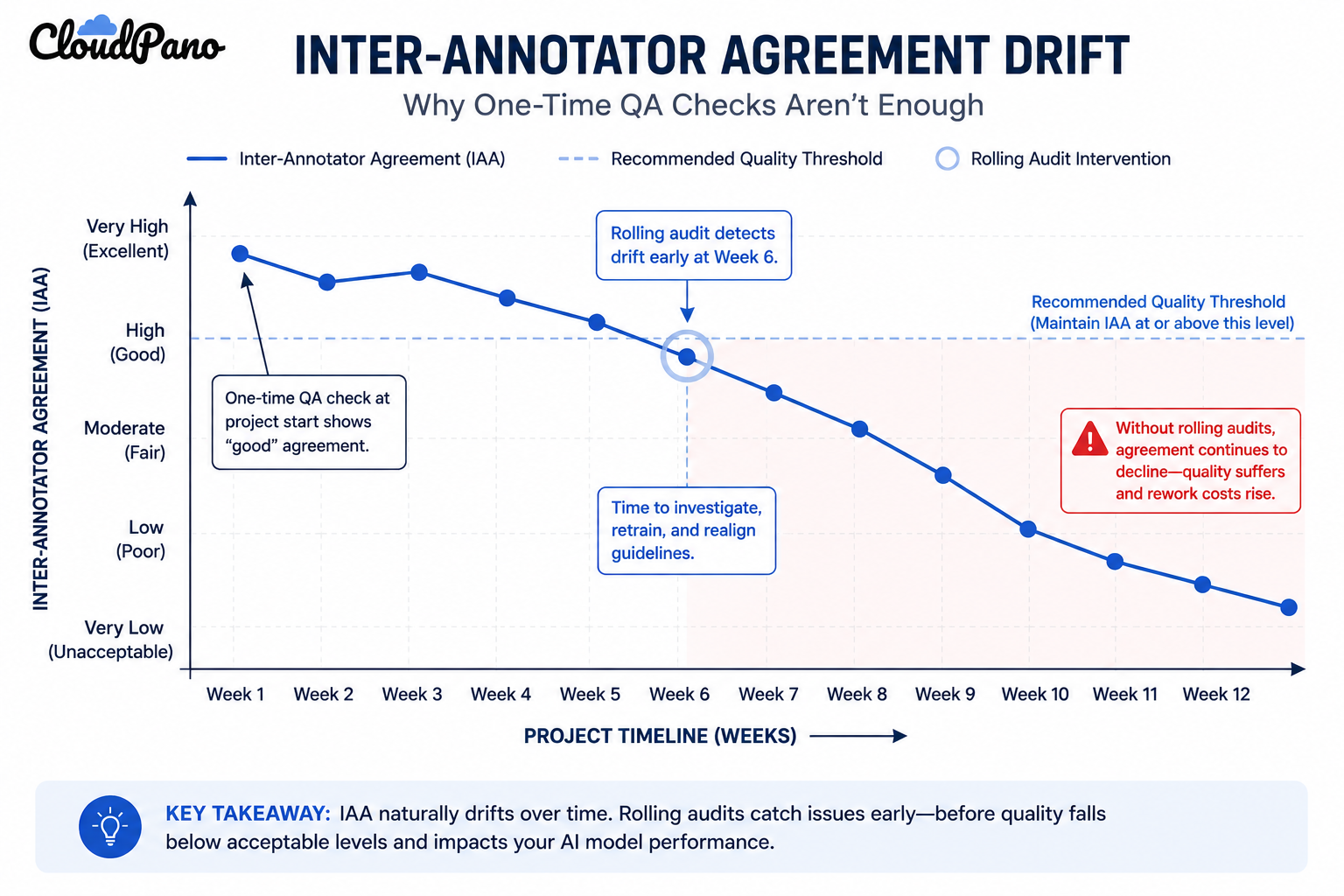
Rolling audits: Random post-labeling sampling on a fixed schedule, not just at project kickoff, to catch quality drift that happens as annotators fatigue or guidelines evolve.
Step-by-Step Workflow
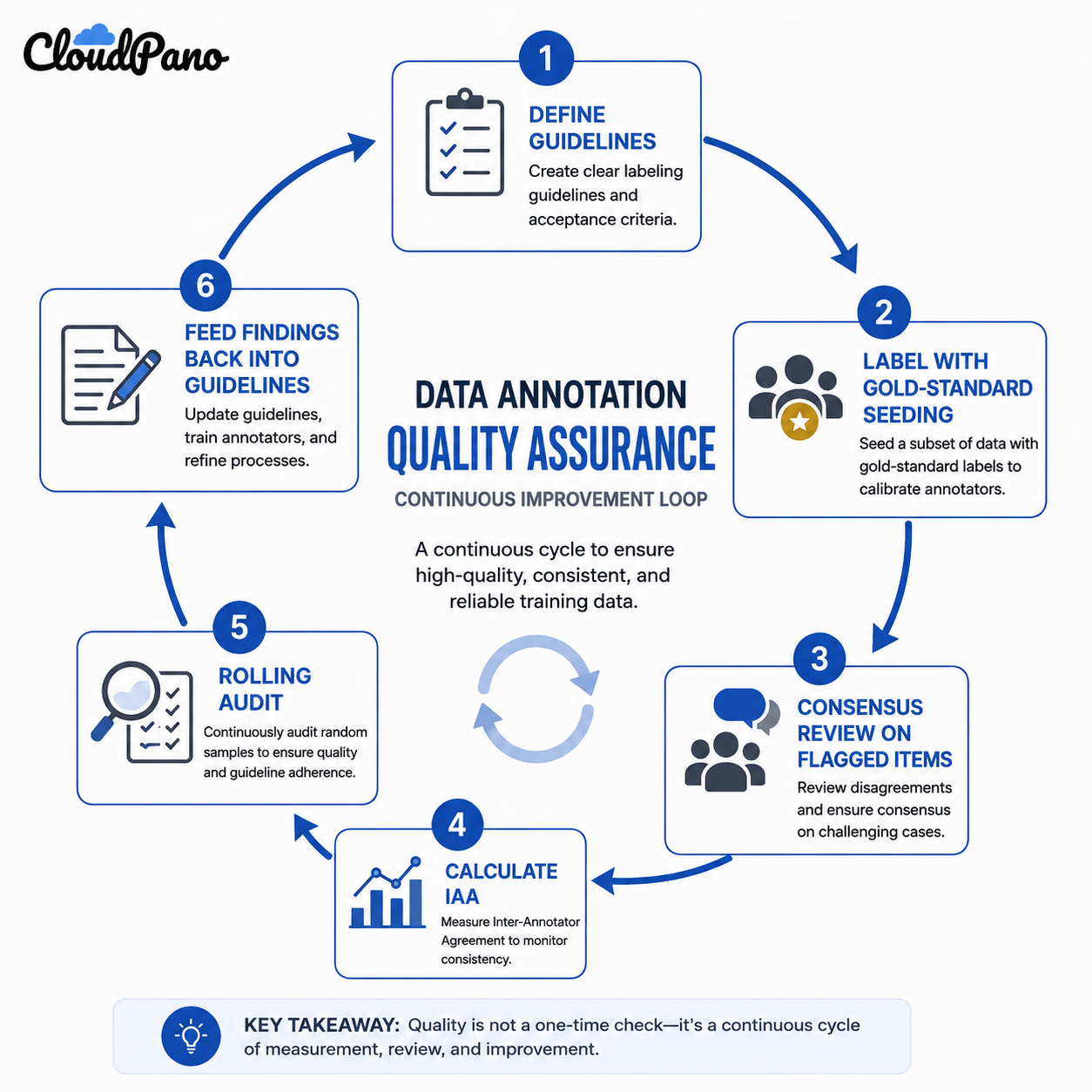
Define what "correct" means before labeling starts. Write annotation guidelines specific enough that ambiguity is the exception, not the norm.
Build a gold-standard test set. Have your most experienced reviewers label a representative sample and lock it as the accuracy baseline.
Seed gold-standard items into the live workload. Annotators shouldn't know which items are being used to measure them.
Run consensus labeling on a subset. Route a portion of the data — especially anything flagged as ambiguous — through multiple independent annotators.
Calculate inter-annotator agreement regularly. Track it per annotator and per label category, not just as one aggregate project-wide number.
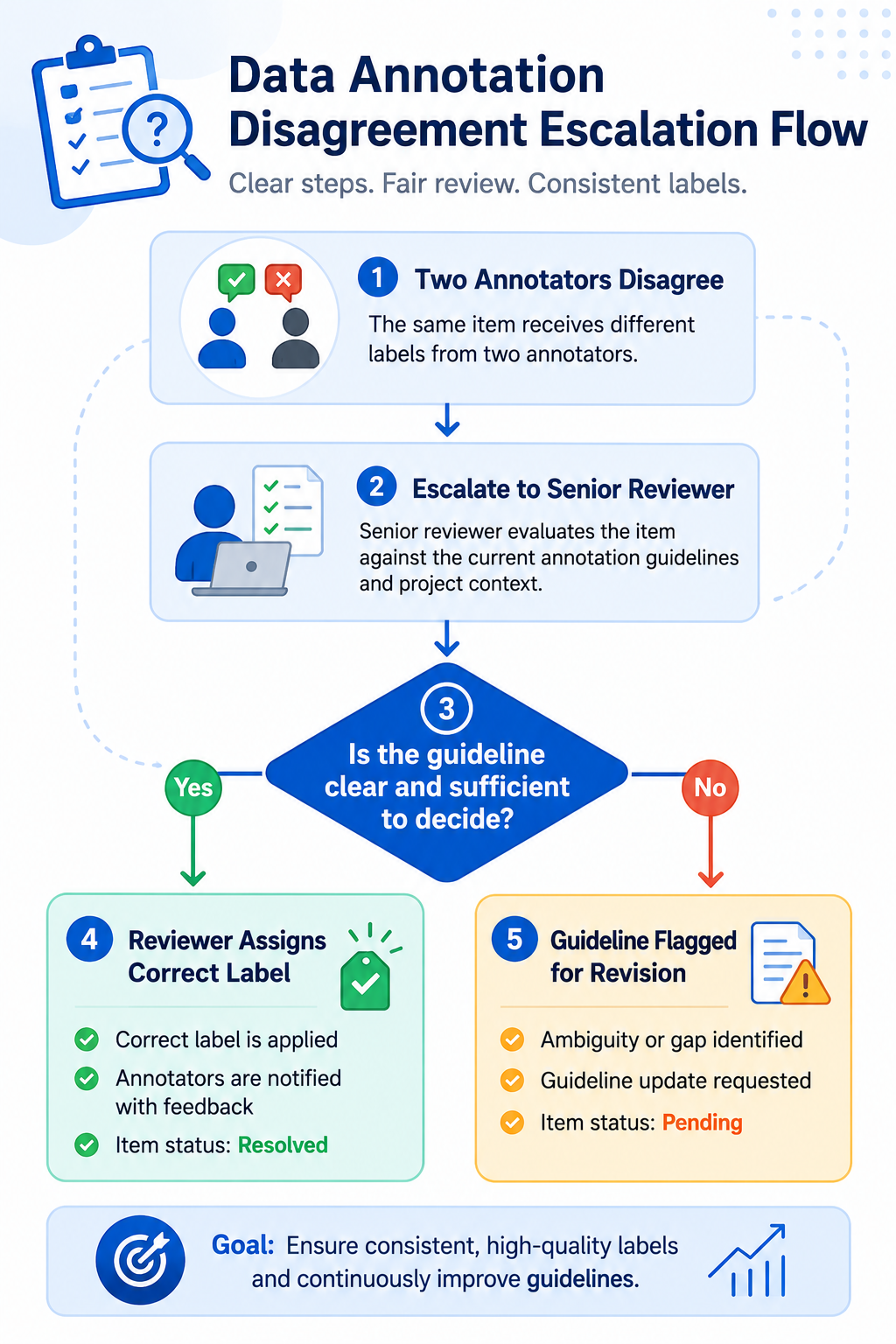
Escalate disagreements to a senior reviewer. Don't let the loudest or fastest annotator's label win by default.
Run rolling audits on a fixed schedule. Sample completed batches weekly or per-milestone, not only once at the end of the project.
Feed QA findings back into guidelines. Every recurring disagreement is a sign the guidelines — not the annotators — need revision.
Industry Use Cases
Computer vision / robotics: Consensus labeling on bounding boxes and segmentation masks, where boundary placement disagreement is common and directly affects model precision.
Autonomous vehicles: Multi-pass review with mandatory escalation for safety-critical scenarios — a single annotator's judgment is rarely considered sufficient here.
Healthcare AI: Gold-standard sets built by clinical experts, since annotation accuracy on diagnostic imaging or clinical text carries direct regulatory and patient-safety implications.
Retail AI: Rolling audits at scale to catch drift in high-volume product categorization, where errors are individually low-stakes but compound across large catalogs.
LLM development: Inter-annotator agreement tracking on preference and safety labeling, where subjective judgment calls make consistency especially hard to maintain.
Government & defense: Documented, auditable QA trails required for classification-sensitive labeling, often layered with formal sign-off processes.
Benefits
Fewer downstream model failures. Catching labeling errors before training prevents the far more expensive process of tracing a production failure back to a bad label.
Faster root-cause diagnosis. When a model underperforms, having IAA and audit data lets you rule annotation in or out quickly instead of guessing.
More defensible AI systems. A documented QA trail matters for regulated industries and for internal accountability when a model's behavior is questioned.
Better guideline quality over time. A QA feedback loop turns recurring disagreements into concrete guideline improvements instead of repeated annotator confusion.
Confidence to scale. Once QA processes are proven at pilot volume, you can scale labeling volume without scaling risk proportionally.
Clearer vendor or team accountability. When QA metrics are tracked per annotator or per vendor, it becomes far easier to identify exactly where a quality problem originated instead of treating an entire dataset as suspect.
Better return on annotation spend. Catching and correcting errors during labeling is consistently cheaper than discovering them after a model is trained, evaluated, and already scheduled for deployment.
Common Mistakes
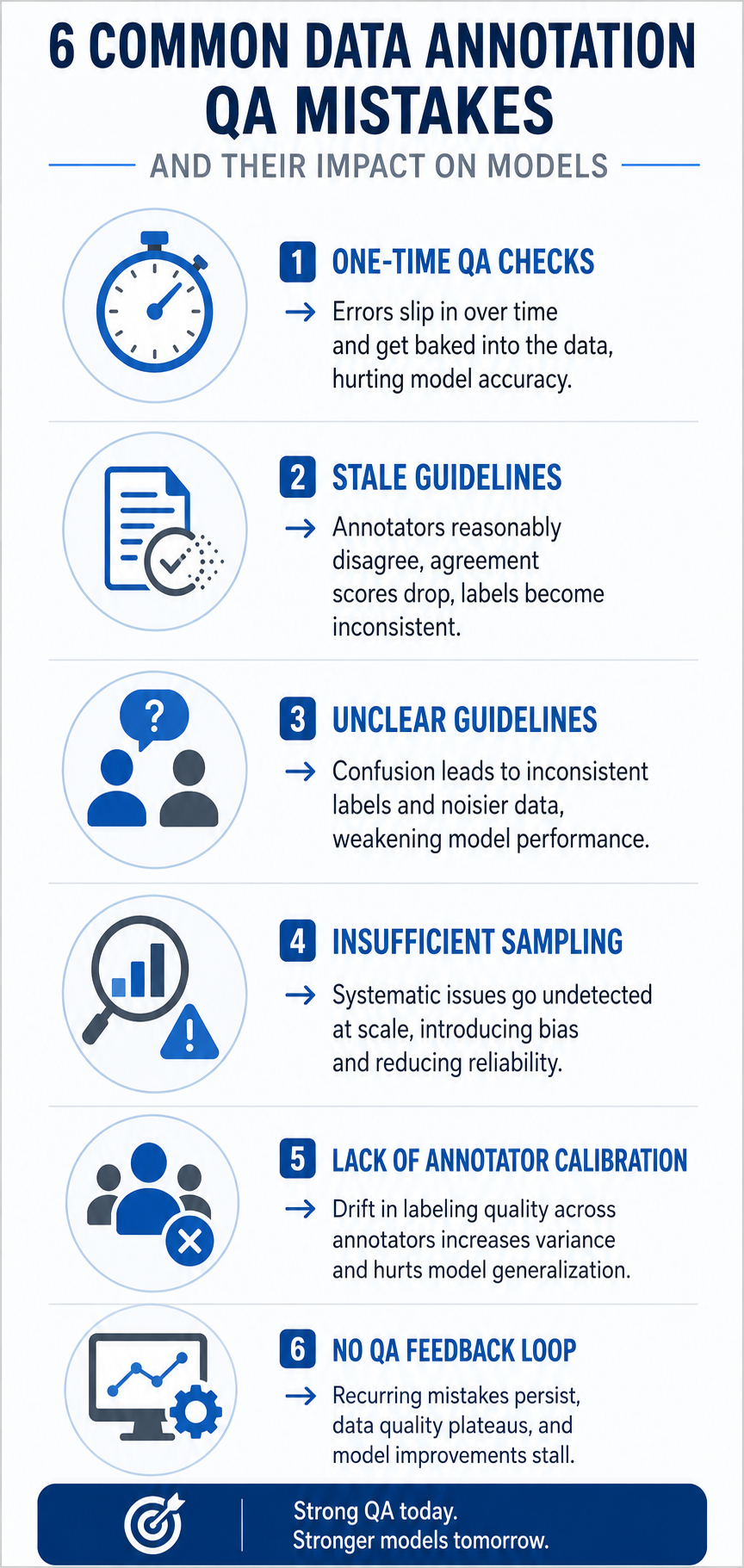
Treating QA as a one-time gate. Running quality checks only at project kickoff misses drift that accumulates as the project runs.
Measuring agreement in aggregate only. A healthy overall IAA score can hide a specific label category or specific annotator with a serious consistency problem.
Letting annotation guidelines go stale. Guidelines that aren't revised as edge cases surface lead to annotators reasonably disagreeing because the rules themselves are ambiguous.
Skipping gold-standard seeding. Auditing only after full batches are complete is far slower and more expensive than catching errors in real time.
Resolving disagreements arbitrarily. Defaulting to majority vote or first-submitted label without review turns disagreement data into wasted signal.
Assuming automated pre-labeling doesn't need the same QA rigor. Automated labels fail silently and consistently, which makes them just as important to audit as human-labeled data — arguably more so.
Best Practices
Build gold-standard test sets before labeling starts, not after quality concerns arise.
Track inter-annotator agreement per label category and per annotator, reviewed on a regular cadence.
Route disagreements to a defined escalation path with a senior reviewer, not an automatic tiebreaker rule.
Schedule rolling audits throughout the project, not only as a final QA gate.
Version annotation guidelines and document why each revision was made, so the reasoning isn't lost when the team changes.
Apply the same audit rigor to automated or pre-labeled data as to human-labeled data. McKinsey's research on generative AI adoption notes that data readiness — including ongoing quality validation — is consistently underestimated relative to model architecture as the real bottleneck to AI performance (McKinsey, "The economic potential of generative AI").
FAQ
What is data annotation quality assurance?
It's the set of processes — gold-standard testing, consensus labeling, inter-annotator agreement tracking, and rolling audits — used to measure and maintain the accuracy of labeled training data before it reaches a model.
How do you measure data annotation quality?
The most common methods are inter-annotator agreement (comparing independent labels on the same data), gold-standard comparison against expert-verified examples, and rolling post-labeling audits on random samples.
What's the difference between data annotation QA and general data cleaning?
Data cleaning typically addresses formatting, duplication, or missing values in raw data, while annotation QA specifically measures and corrects the accuracy and consistency of the labels applied to that data.
How often should annotation quality be audited?
On a fixed rolling schedule throughout a project — weekly or per-milestone — rather than only at kickoff or only at project completion, since quality can drift as a project runs.
Does automated or pre-labeled data need quality assurance too?
Yes. Automated labels fail silently and consistently, so they need the same auditing rigor as human-labeled data, if not more, since errors can propagate at scale before anyone notices.
How to ensure data annotation quality when guidelines are ambiguous?
Treat recurring annotator disagreement as a signal to revise the guideline, not a signal to correct the annotator — most persistent QA problems trace back to unclear or outdated instructions.
Conclusion
Data annotation quality assurance works best as a continuous discipline built into the labeling process, not a final check applied after the fact. The teams that catch problems early are the ones measuring agreement, auditing on a schedule, and treating every disagreement as information rather than noise.
Create an interactive virtual showroom and engage affluent digital buyers with live 360º video calls, all through the CloudPano mobile app for a complete automotive sales solution.
Create 2D and 3D floor plans with measurements in 4 minutes or less, all from your phone. Download the Floor Plan Scanner app and get your first scan free.
Home robots and vision models need video from real homes, yet the best-known indoor datasets cover a few dozen kitchens or a few hundred people. This guide explains why home footage is scarce, what public datasets offer, and how custom in-home collection works.
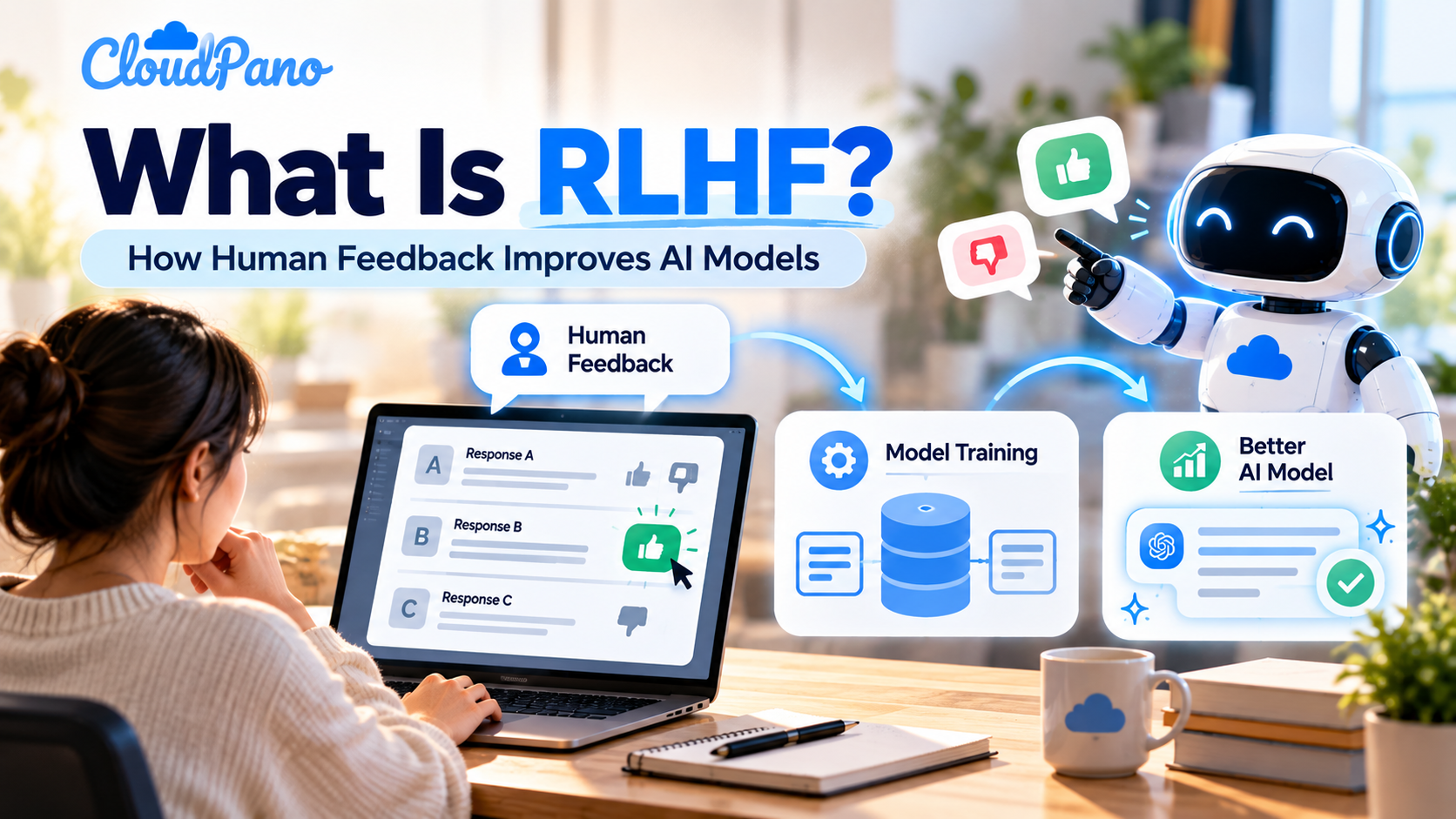
Learn how Reinforcement Learning from Human Feedback (RLHF) helps improve AI models through human preferences, response rankings, reward modeling, and evaluation. Explore how RLHF services support better instruction following, helpfulness, safety, and overall LLM performance.
Explore 47 open egocentric and robotics datasets for AI, computer vision, embodied AI, and robot learning. This guide compares each dataset’s primary focus and license or access terms to help researchers identify suitable training data and understand what to verify before commercial use.


.png)




.png)

.png)







.svg)


.svg)