


.png)


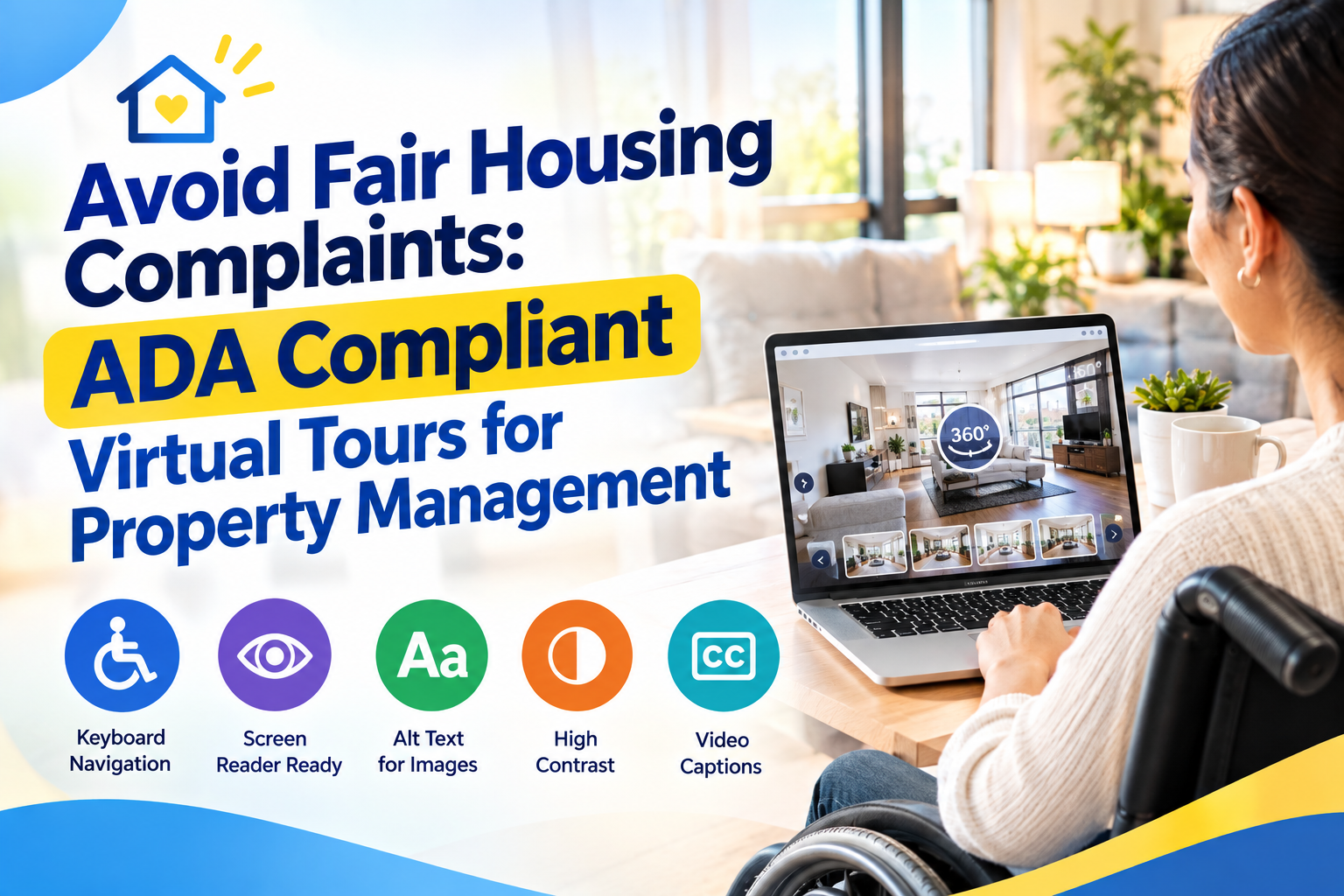
Property managers can make virtual tours more accessible by supporting keyboard navigation, screen readers, descriptive alt text, captions, sufficient color contrast, and clear, predictable navigation. Building accessibility checks into the publishing workflow can help provide renters with disabilities more equal access to property information and reduce potential fair housing concerns.
Virtual tours have quickly become a standard part of how property management companies market vacant units. They save time, reduce unnecessary in-person showings, and let prospective renters explore a property on their own schedule. But there's a growing issue many property managers haven't fully considered: if your virtual tour isn't accessible, it could expose your company to fair housing complaints — even if that was never your intention.
This is where the concept of an ADA compliant virtual tour for property management becomes essential. It's not just about digital accessibility in a general sense — for property managers specifically, it intersects directly with fair housing law, which governs how rental properties must be marketed and made available to prospective tenants.
In this guide, we'll walk through why accessibility and fair housing overlap, what actually makes a virtual tour ADA compliant, and practical steps your team can take to reduce risk while reaching more renters. 🔑
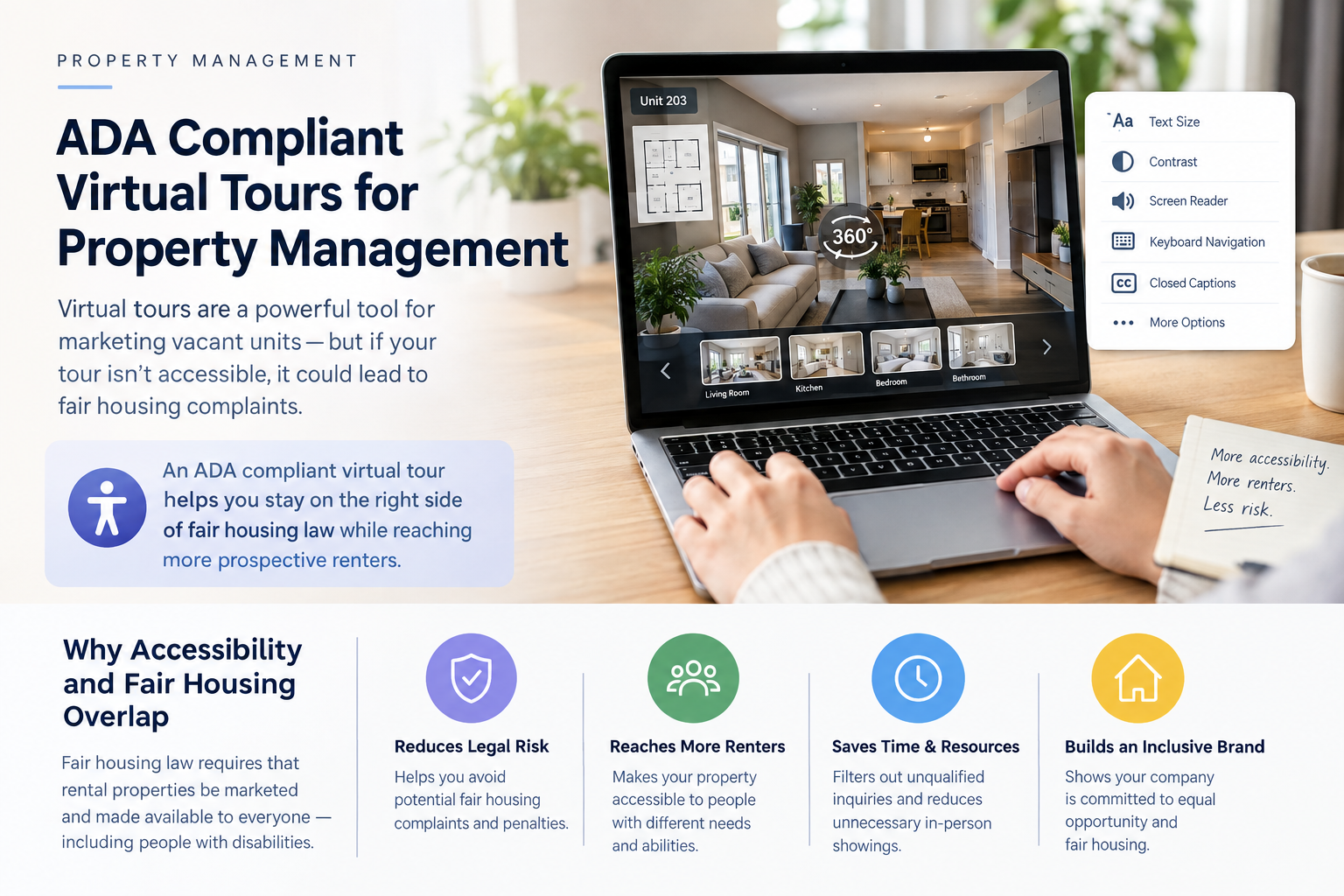
The Fair Housing Act (FHA) prohibits discrimination in housing based on protected characteristics, including disability. While the FHA is a separate law from the Americans with Disabilities Act (ADA), the two frequently overlap in practice — especially when it comes to how properties are marketed online.
If a prospective renter with a visual impairment can't navigate your virtual tour because it isn't screen-reader friendly, or a renter who relies on keyboard navigation can't move through your rooms and hotspots, they've effectively been denied equal access to information about the property. That's the exact kind of barrier fair housing law is designed to prevent.
This means an inaccessible virtual tour isn't just an accessibility oversight — it can be interpreted as a fair housing issue, particularly if a prospective tenant can demonstrate they were unable to fully evaluate a property because of it. 🚫
Many property management companies assume fair housing compliance only applies to things like application criteria, advertising language, or in-person interactions. Digital marketing tools like virtual tours are often treated as neutral, purely visual content — not something that carries legal risk.
In reality, as virtual tours have become a primary (and sometimes only) way renters evaluate a unit before applying, they've become subject to the same accessibility expectations as any other part of the leasing process.
An ADA compliant virtual tour for property management generally includes a specific set of features designed to remove barriers for renters with different needs.
Prospective renters should be able to move through every room, hotspot, and menu option using only a keyboard. If a mouse or touchscreen is required to complete the tour, users with certain motor impairments are effectively locked out. ⌨️
Screen readers rely on properly structured code — including ARIA labels and semantic HTML — to describe buttons, navigation elements, and content aloud. Without this structure, a visually impaired renter using a screen reader may not be able to understand what's on the screen at all.
Every image and interactive hotspot should include clear, descriptive alt text. Instead of a vague label, a well-written description might read "Primary bedroom with large window, carpet flooring, and walk-in closet." This benefits both accessibility tools and search engine indexing. 📝
If your tour includes narration or an embedded walkthrough video, captions should be available for renters who are deaf or hard of hearing.
Text overlays, floor plan labels, and navigation buttons need enough contrast to be readable for renters with low vision or color blindness.
A confusing or inconsistent navigation structure creates friction for every user, but it's especially problematic for renters using assistive technology. Clear starting points and consistent controls make tours easier for everyone to follow. 🧭
Before assuming your tours are compliant, it's worth doing a simple internal review. Try navigating a tour using only your keyboard, or turn on a screen reader to see how it announces content. If either process breaks down or feels confusing, that's a sign accessibility improvements are needed.

Rather than trying to build accessibility features from scratch, look for virtual tour platforms that already support alt text fields, keyboard navigation, and screen reader compatibility. This significantly reduces the technical burden on your team.
Fair housing compliance isn't just a legal or technical issue — it's also a training issue. Make sure the people creating and publishing virtual tours understand why accessibility matters and know how to use whatever accessibility features your tour platform provides.
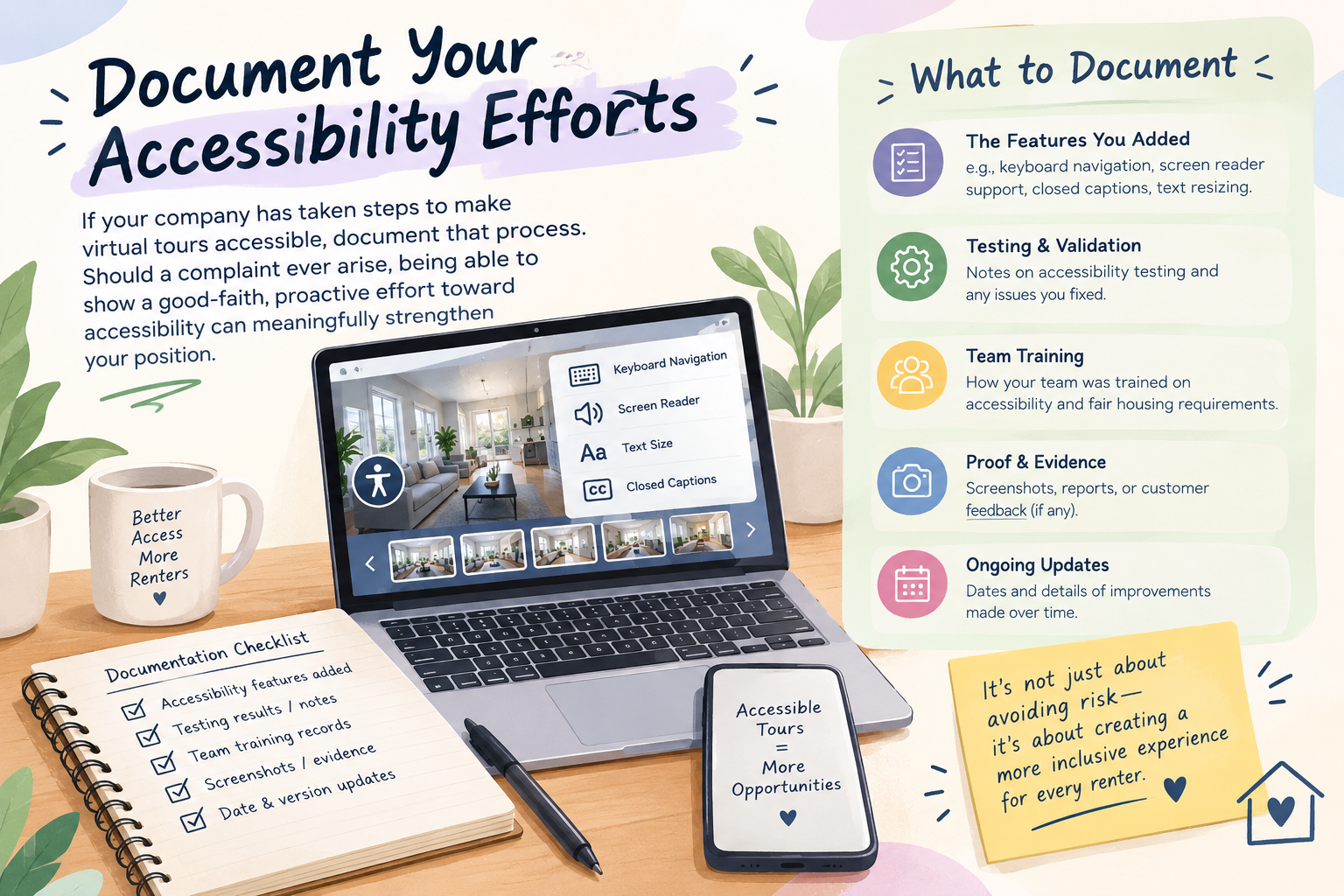
If your company has taken steps to make virtual tours accessible, document that process. Should a complaint ever arise, being able to show a good-faith, proactive effort toward accessibility can meaningfully strengthen your position.
Fair housing law applies to the entire rental process, not just the final decision to approve or deny an applicant. Marketing materials — including virtual tours — are part of that process and can be scrutinized just like any other stage.
Most accessibility features run invisibly in the background for users who don't need them. Adding alt text, ARIA labels, and keyboard navigation doesn't change the visual design of your tour — it simply makes it usable for a wider audience.
Complaints related to accessibility and fair housing have affected property managers of all sizes, not just large national firms. Any company marketing rental units online can be subject to scrutiny, regardless of portfolio size.
It's easy to think about this topic purely through the lens of avoiding complaints, but there's a broader business case as well. According to the CDC, roughly one in four adults in the U.S. lives with some form of disability. For property managers, that represents a meaningful share of the rental market — one that an inaccessible virtual tour effectively excludes.
An ADA compliant virtual tour for property management isn't just a defensive measure. It's a way to reach more prospective renters, reduce unnecessary in-person showings for renters who've already been able to fully evaluate a unit online, and demonstrate a genuine commitment to equal access. 🤝
If you're managing multiple properties and aren't sure where your current virtual tours stand, here's a simple starting checklist:
Making virtual tours accessible works best when it's treated as an ongoing part of your leasing process, not a one-time fix. Here's how a few forward-thinking property management teams are approaching it. 🛠️
When evaluating virtual tour providers or photography vendors, add accessibility questions to your vetting process. Ask directly whether their platform supports alt text, keyboard navigation, and screen reader compatibility. Making this a standard question signals to vendors that accessibility is a priority, not an afterthought.
Rather than relying on individual staff members to remember every accessibility detail, create a short checklist that's part of your standard listing publication process — similar to how you might already check for accurate square footage or correct pricing before a unit goes live.
Units that have been on the market for a while, or model unit tours that get reused across multiple properties, are easy to overlook. Set a recurring reminder to review older virtual tours against your accessibility checklist, especially if they were created before your team started prioritizing this issue.
Accessibility guidelines and fair housing interpretations continue to evolve as more legal cases address digital marketing tools directly. Staying loosely informed — through industry associations, legal counsel, or your virtual tour provider's own updates — helps ensure your approach doesn't quietly fall out of date. 📅
Accessibility isn't just a risk-avoidance strategy — it's increasingly a marker of a well-run, forward-thinking property management operation. Renters and their families notice when a company has clearly put thought into making its marketing usable for everyone, and that impression can carry weight well beyond a single listing.
Property managers who build accessibility into their standard operating procedures also tend to find it easier to scale. Instead of scrambling to address a complaint or an audit after the fact, accessibility becomes just another quality standard baked into how listings are created and published from day one.
As virtual tours become a standard part of the rental leasing process, accessibility is no longer optional — it's an extension of fair housing obligations that property managers are expected to uphold. An ADA compliant virtual tour for property management helps protect your company from potential complaints while genuinely expanding the pool of renters who can access and evaluate your listings.
Rather than treating accessibility as an afterthought, building it into your virtual tour strategy from the start is a straightforward way to reduce risk, reach more renters, and demonstrate that your company takes equal access seriously. 🏠✨
An accessible virtual tour typically supports keyboard navigation, screen readers, descriptive text for meaningful visual content, sufficient color contrast, captions for relevant audio or video, and a logical navigation structure.
Virtual tours can be an important part of how prospective renters evaluate properties. Accessibility helps ensure renters with disabilities can access property information and participate more fully in the leasing process.
Property managers can test keyboard-only navigation, review the tour with a screen reader, check descriptive text for images and interactive elements, verify color contrast, and confirm that relevant audio or video content includes captions.
Yes. Property managers can ask potential providers whether their platforms support keyboard navigation, screen readers, descriptive labels or alt text, captions, and other accessibility features before selecting a platform.
Yes. Features such as clear navigation, captions, descriptive labels, and readable text can improve usability for a broader range of prospective renters and viewing situations.


Compact, ready to go anywhere
Interchangeable lens that’s upgradeable
Dual 1-inch sensors for improved clarity and low light performance
Dynamic range and 6K 360° capture
360° photo resolution at 21MP

8K 360° video recording for ultra-detailed visuals.
4K single-lens mode for traditional wide-angle shots.
Invisible selfie stick effect for drone-like perspectives.
2.5-inch touchscreen with Gorilla Glass protection.
Waterproof up to 33ft for underwater shooting.

360° photo resolution in 23MP
Slim design at 24 mm thick
Built-in image stabilization for smooth video capture.
Internal 19GB storage for photo and video storage.
Wireless connectivity for remote control and sharing.

60MP 360° still images for high-resolution photography.
5.7K 360° video recording at 30fps.
2.25-inch touchscreen for intuitive control.
USB Type-C port for fast charging and data transfer.
MicroSD card slot for expandable storage.
.png)

.png)

Try it free. No credit card required. Instant set-up.





.svg)


.svg)