How to Ensure Annotation Consistency Across Large CV Datasets

Cloudpano
August 1, 2026
5 min read
Share this post

How to Ensure Annotation Consistency Across Large Computer Vision Datasets

A small pilot team of three annotators can stay consistent through informal communication and shared intuition. Fifty annotators working across a large dataset cannot — and annotation consistency computer vision projects need at that scale requires specific, measurable methods, not just hiring careful people and hoping standards hold.

Computer Vision Data Labeling at scale fails quietly on this exact point more often than it fails on obvious annotator error. Two annotators can each produce a defensible, reasonable-looking bounding box or segmentation boundary for the same object and still disagree meaningfully enough to introduce noise a model has to somehow average out.

Why It Matters

Annotation inconsistency doesn't show up as an obvious dataset problem — it shows up later as a model with unexpectedly high variance on cases similar to where annotator agreement was actually weakest. Google Research's "Data Cascades" study documented how such subtle, unaddressed inconsistency compounds as it moves through a training pipeline, becoming much harder to trace back to its source once a model has already been trained on it (Sambasivan et al., Google Research).

NIST's AI Risk Management Framework treats data quality and consistency as a property that needs active measurement, not an assumption that holds simply because a workforce was carefully selected — directly relevant to how Robotics Data Annotation and other high-stakes computer vision projects need to treat consistency as an ongoing metric, not a one-time hiring decision (NIST AI RMF).

The stakes compound as datasets scale. Stanford HAI's AI Index has tracked the growing volume of data being labeled for computer vision applications across industries (Stanford HAI, AI Index Report), and inconsistency that seems minor at pilot scale can affect a proportionally large share of a much bigger dataset once a project grows.

How It Works

Maintaining consistency across Robot Vision Training Data and other large computer vision datasets relies on a few specific, measurable methods.
IoU-based agreement scoring. Intersection-over-Union measures how much two annotators' bounding boxes or segmentation masks overlap for the same object, giving a concrete, comparable number instead of a subjective sense of "close enough."
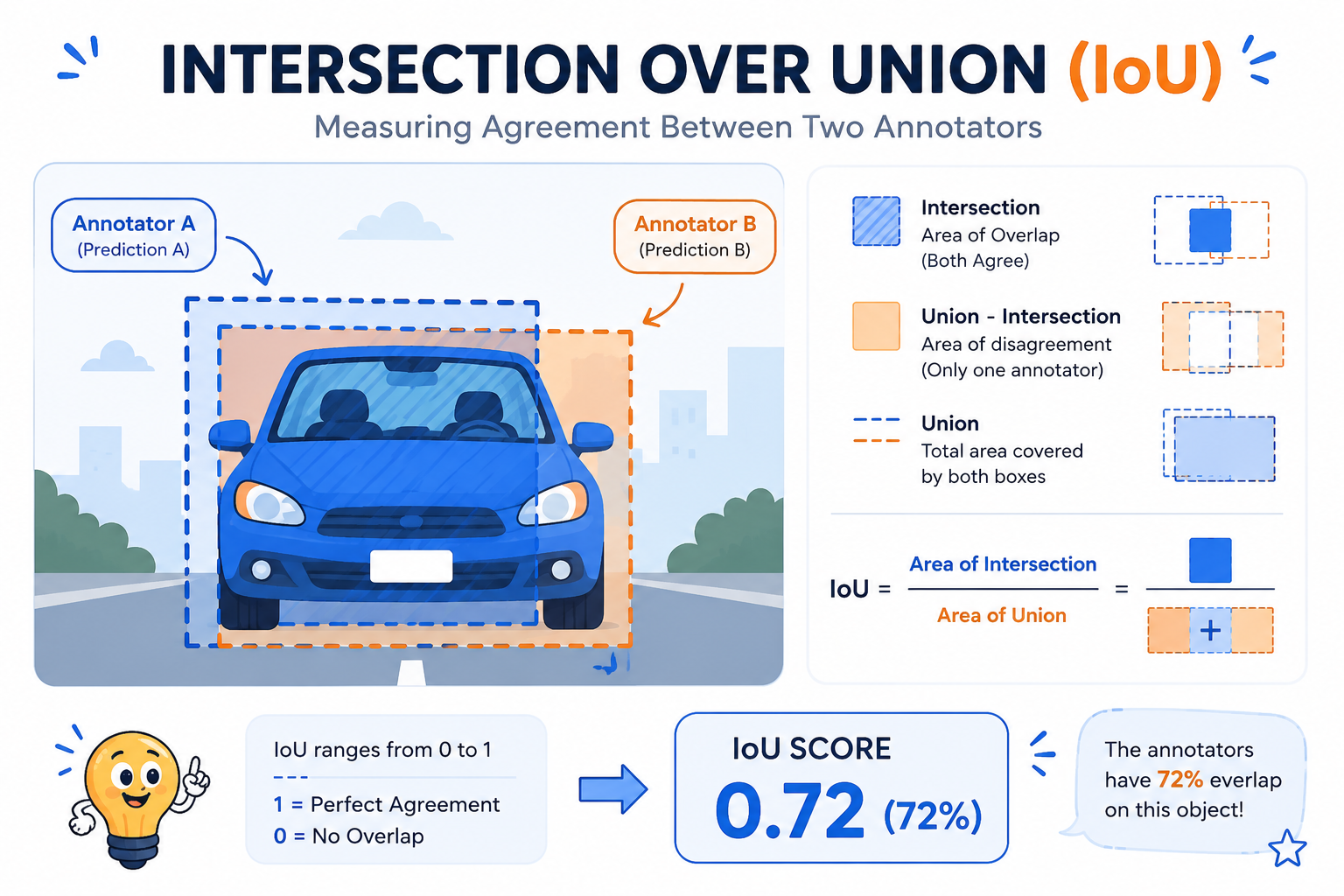
Illustration of IoU agreement scoring between two annotators in computer vision

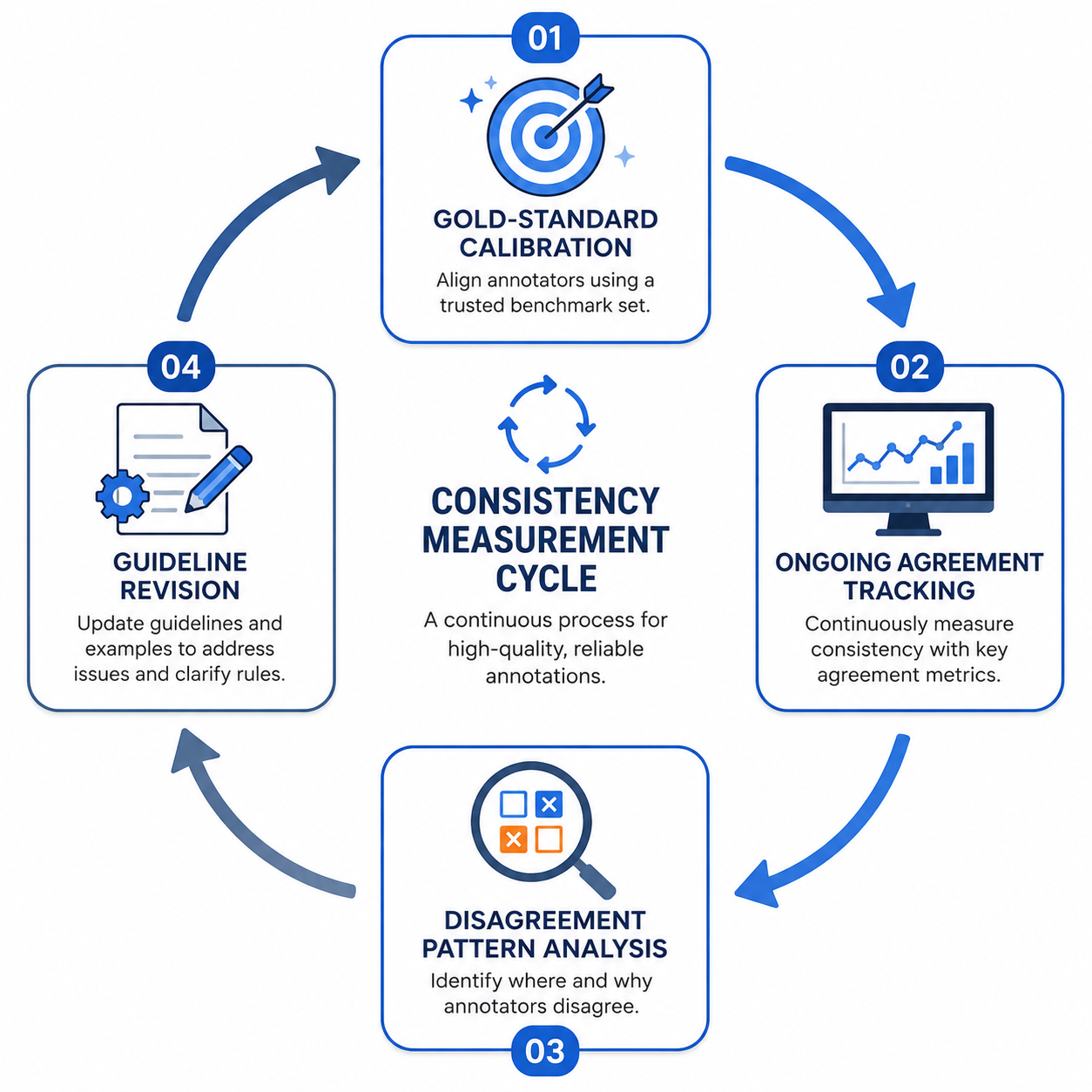
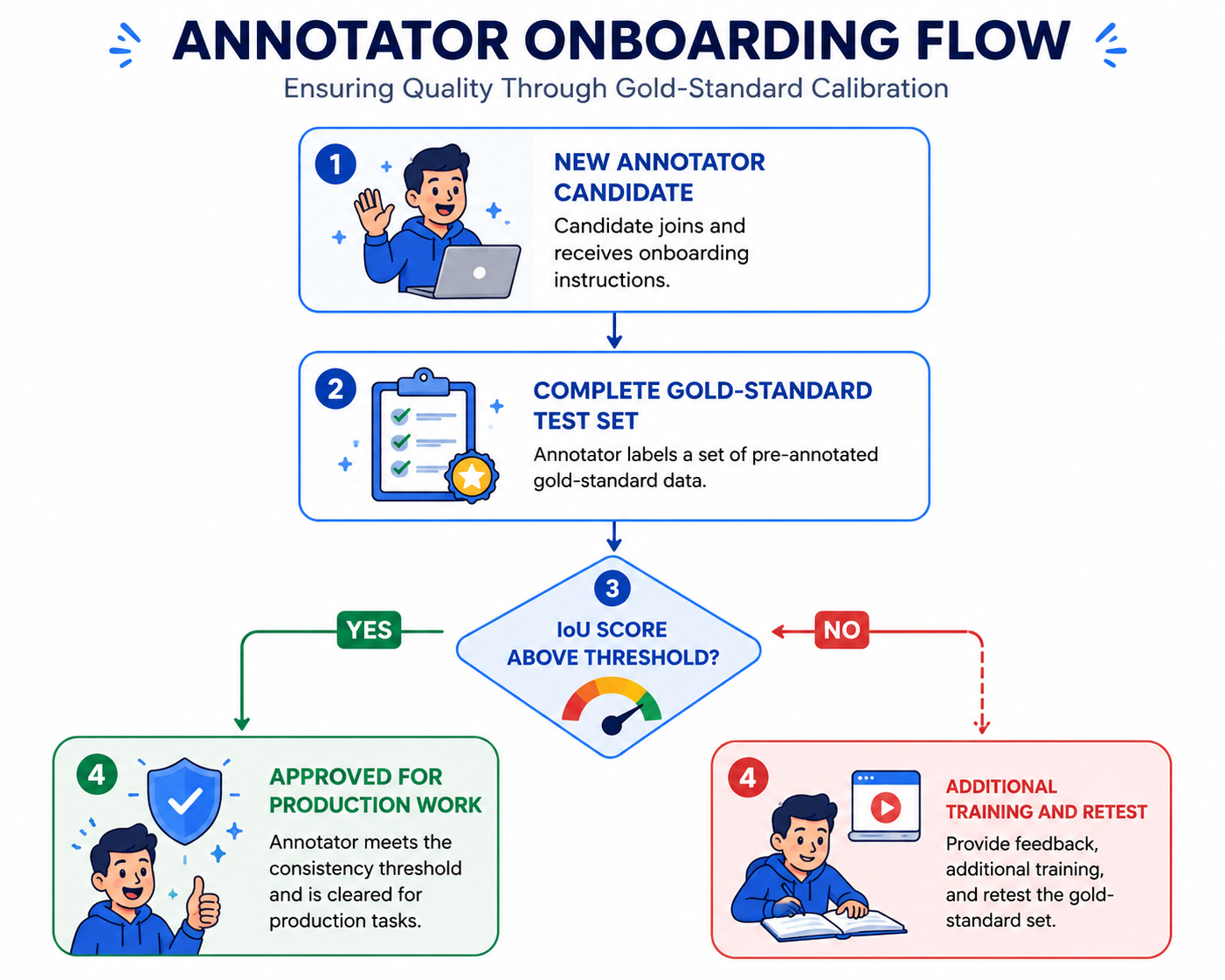
Gold-standard calibration sets. A small set of expert-verified, known-correct annotations used to test new annotators before they contribute to production data, and to periodically retest the existing pool.

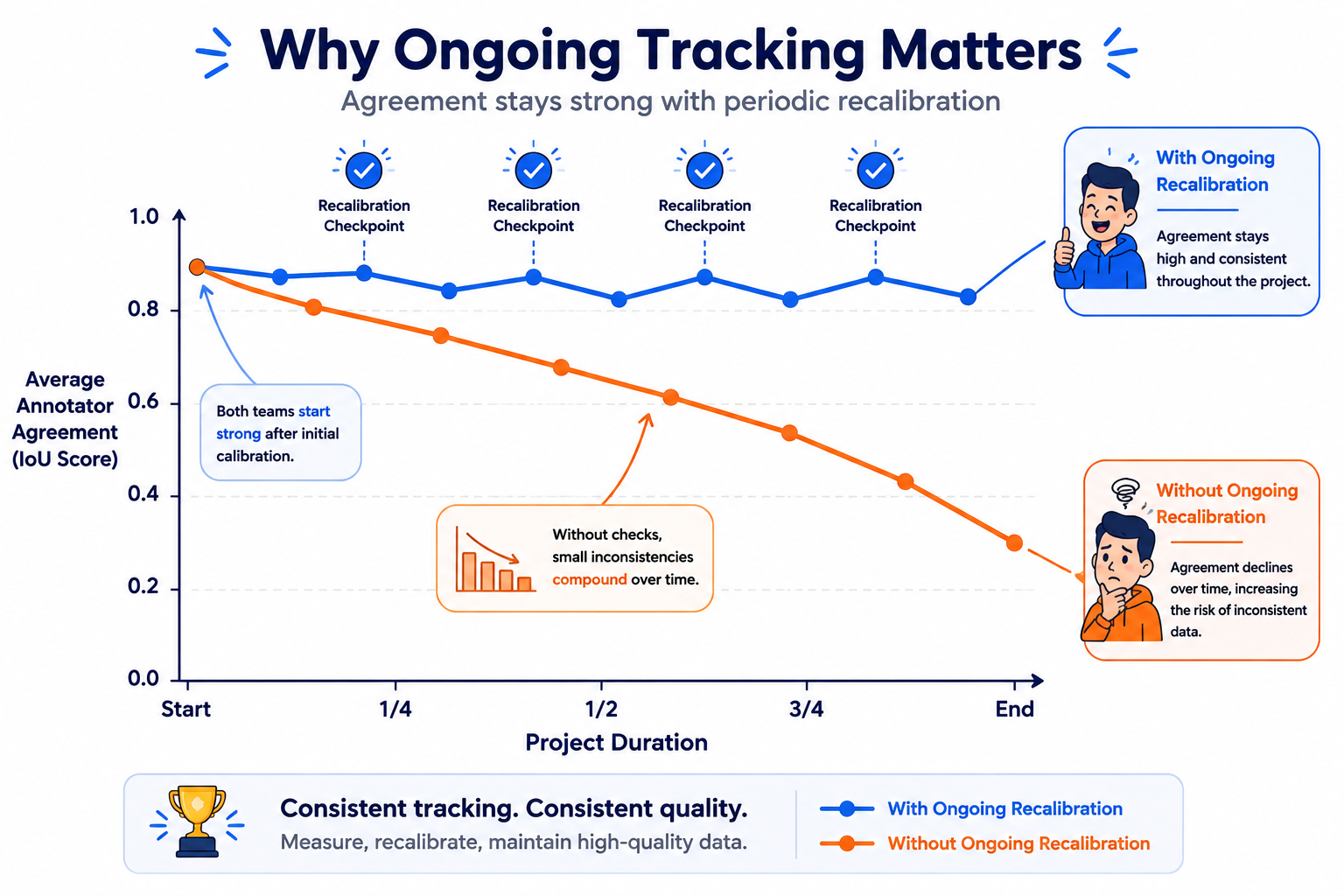
Ongoing agreement tracking, not just onboarding checks. Consistency measured only when someone joins misses drift that develops over the course of a long project, as fatigue, guideline ambiguity, or workforce turnover gradually shift standards.

Guideline revision triggered by disagreement patterns. Recurring disagreement on a specific object type or edge case is a signal the guideline itself needs clarification, not just a signal to retrain the annotator.

Understanding how these workflows operate as a measurement discipline — not an assumption based on annotator quality alone — is what actually keeps a large computer vision dataset consistent as it scales past what informal team communication can manage.
Step-by-Step Workflow

  • Build a gold-standard test set before scaling your annotator pool. Have expert reviewers establish known-correct annotations for a representative sample of your actual data.
  • Test new annotators against that gold-standard set before production work. Confirm their IoU agreement with the known-correct annotations meets your defined threshold.
Flowchart for onboarding a new annotator against a gold-standard consistency test
  • Set a specific IoU threshold appropriate to your task's precision requirements. A threshold that's too loose lets meaningful inconsistency through; one that's too strict rejects reasonable annotator variation.
  • Run periodic re-calibration checks across your full annotator pool. Don't rely solely on onboarding tests — recheck regularly to catch drift that develops over time.
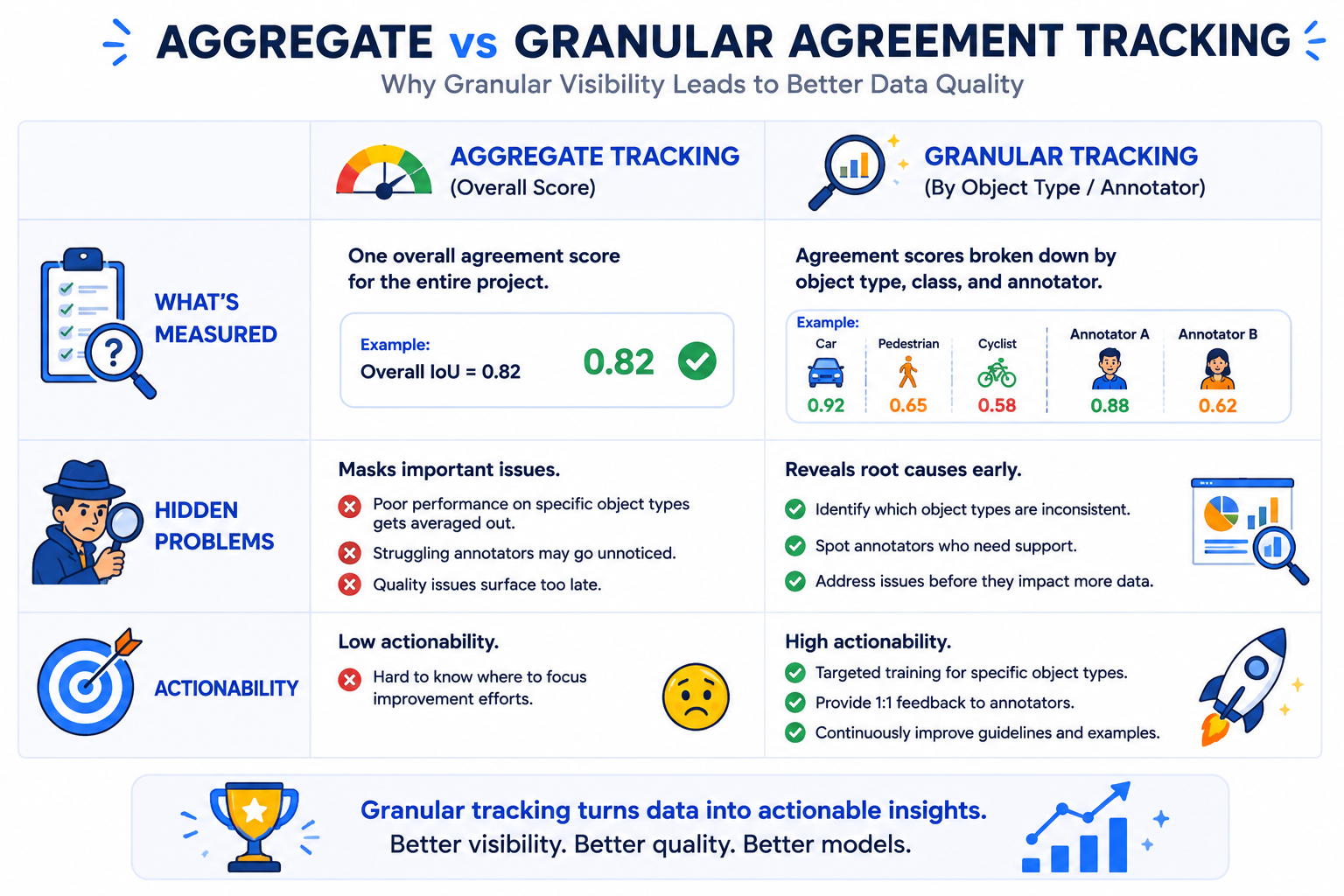
  • Track agreement scores by object type and by individual annotator. Aggregate scores can hide a specific category or specific person's consistency problem.
  • Investigate recurring disagreement patterns for guideline gaps. If multiple annotators consistently disagree on a specific edge case, treat that as a guideline clarity issue.
  • Feed guideline revisions back to the full annotator pool with clear communication. Ensure updates actually reach and get applied by everyone, not just newly onboarded annotators.

Industry Use Cases

  • Computer vision / robotics: Consistency at scale matters heavily here, given the volume of bounding box and segmentation data typically required for production-grade detection models.
  • Autonomous vehicles: Agreement scoring on safety-critical object categories carries particular weight, since inconsistent annotation on rare scenarios directly affects model reliability on those same cases.
  • Healthcare AI: Gold-standard calibration against expert-verified annotations is especially important for diagnostic imaging, where consistency directly relates to clinical accuracy.
  • Retail AI: High-volume product detection projects benefit from IoU-based consistency checks to catch drift across large annotator pools working through extensive catalogs.
  • Manufacturing AI: Defect detection annotation requires tight consistency, since inconsistent boundary marking directly affects a model's ability to reliably classify defect severity.
  • Government & defense: Consistency documentation often carries formal audit requirements, making measurable agreement tracking as much a compliance need as a quality one.

Benefits

  • Measurable, not assumed, quality control. IoU-based agreement scoring replaces subjective judgment about annotator quality with a concrete, comparable metric.
  • Earlier detection of drift. Ongoing agreement tracking catches consistency degradation before it accumulates across a large portion of the dataset.
  • More targeted guideline improvement. Identifying which specific object types or edge cases produce disagreement focuses guideline revisions where they actually matter.
  • Reduced model variance from label noise. A more consistent dataset gives a model a cleaner signal to learn from, reducing unexplained variance in downstream performance.
  • Scalable quality assurance. A measurement-based consistency process scales to a large annotator pool in a way that informal team communication and trust cannot.

Common Mistakes

  • Relying on annotator quality alone without measuring agreement. Assuming careful hiring is sufficient without an ongoing, measurable consistency check.
  • Testing consistency only at onboarding. Missing drift that develops over the course of a long project as guidelines are forgotten or fatigue sets in.
Line graph showing annotator agreement decline without ongoing consistency checks
  • Setting an IoU threshold without task-specific calibration. Applying a generic agreement threshold rather than one appropriate to the specific precision your task requires.
  • Tracking only aggregate agreement scores. Missing that a healthy overall number can hide a serious consistency problem in a specific category or with a specific annotator.
Comparison table of aggregate vs granular annotation agreement tracking
  • Correcting individual annotators without addressing guideline gaps. Treating a recurring disagreement pattern as an individual performance issue rather than a signal the guideline itself is ambiguous.
  • Not confirming guideline updates actually reach the full pool. Assuming a revised guideline document alone changes behavior without verifying annotators actually apply it consistently.

Best Practices

  • Build a gold-standard test set before scaling your annotator pool, and use it for both onboarding and ongoing recalibration.
  • Set IoU or other agreement thresholds calibrated to your specific task's precision requirements, not a generic default.
  • Track agreement scores by object type and by individual annotator, not just as one aggregate project-wide number.
  • Investigate recurring disagreement patterns as guideline clarity issues before assuming they're individual annotator problems.
  • Confirm guideline revisions are actually understood and applied across the full annotator pool, not just documented.
  • Treat consistency as an ongoing measurement discipline throughout a project's lifecycle, not a one-time onboarding gate.

FAQ

What is IoU-based agreement scoring in computer vision annotation?

Intersection-over-Union measures how much two annotators' bounding boxes or segmentation masks overlap for the same object, providing a concrete numerical measure of agreement rather than a subjective judgment call.

How do you build a gold-standard test set for annotation consistency?

Have expert reviewers establish known-correct annotations on a representative sample of your actual data, which then serves as a reference standard for testing both new and existing annotators.

How often should annotation consistency be checked across a large project?

On an ongoing basis, not just at onboarding, since drift can develop over time from guideline ambiguity, annotator fatigue, or workforce turnover that a one-time check would miss.

Why does aggregate agreement scoring sometimes hide real consistency problems?

Because a healthy overall agreement number can mask a specific object category or individual annotator with a serious consistency issue, which only becomes visible when scores are tracked at a more granular level.

Should recurring annotator disagreement be treated as an individual performance issue?

Not automatically. Recurring disagreement on a specific object type or edge case often signals that the underlying guideline is ambiguous, which requires a guideline fix rather than just correcting the individual annotator.

What IoU threshold should I use for consistency checks?

This depends on your specific task's precision requirements, so it's best calibrated against your own gold-standard test set rather than applying a generic threshold across all projects.

Does consistency matter more for some computer vision annotation types than others?

Yes. Tasks requiring precise boundaries, like segmentation for diagnostic imaging or defect detection, generally need tighter consistency standards than tasks where approximate location is sufficient.

Conclusion

Annotation consistency computer vision projects achieve at scale isn't a matter of trusting careful annotators — it's a matter of measuring agreement continuously, calibrating against a gold standard, and treating recurring disagreement as a signal to fix guidelines rather than individuals. Building this measurement discipline in before scaling an annotator pool is what keeps a large dataset's quality from quietly drifting as the project grows.

🚀 Your All‑In‑One Virtual Experience Stack
🎬
PhotoAIVideo
Turn photos into scroll‑stopping AI videos.
Get Started →
🏡
Pictastic
Instantly stage listings with AI.
Try Staging →
🌀
CloudPano
Create stunning 360° tours in minutes.
Launch Tour →
💰
VirtualTourProfit
Build a profitable virtual tour business.
Learn More →
🤝
CloudPano Reseller
Resell AI visual software without building it.
Become a Reseller →
🚗
Auto CloudPano
Sell more vehicles with 360° experiences.
Explore Auto →
🏗️
AI Floor Plan Builder
Generate detailed floor plans with AI.
Build Now →
📐
3D Measure
Capture accurate floor plans & 3D measurements.
Measure Now →
🧠
AI Training Data
Custom AI training data services.
Learn More →
Share this post
Cloudpano

Choose The Right 360° Camera

Insta360 ONE RS 1-Inch 360 Edition

  • Compact, ready to go anywhere

  • Interchangeable lens that’s upgradeable

  • Dual 1-inch sensors for improved clarity and low light performance

  • Dynamic range and 6K 360° capture

  • 360° photo resolution at 21MP

Learn More

Insta360 X4

  • 8K 360° video recording for ultra-detailed visuals.

  • 4K single-lens mode for traditional wide-angle shots.

  • Invisible selfie stick effect for drone-like perspectives.

  • 2.5-inch touchscreen with Gorilla Glass protection.

  • Waterproof up to 33ft for underwater shooting.

Learn More

Ricoh Theta Z1

  • 360° photo resolution in 23MP

  • Slim design at 24 mm thick

  • Built-in image stabilization for smooth video capture.

  • Internal 19GB storage for photo and video storage.

  • Wireless connectivity for remote control and sharing.

Learn More

Ricoh Theta X

  • 60MP 360° still images for high-resolution photography.

  • 5.7K 360° video recording at 30fps.

  • 2.25-inch touchscreen for intuitive control.

  • USB Type-C port for fast charging and data transfer.

  • MicroSD card slot for expandable storage.

Learn More
Property Marketing
Allows potential buyers to explore properties in detail from anywhere, enhancing the real estate marketing process.
Automotive Spins
Create an interactive virtual showroom and engage affluent digital buyers with live 360º video calls, all through the CloudPano mobile app for a complete automotive sales solution.
Interactive Floor Plans
Create 2D and 3D floor plans with measurements in 4 minutes or less, all from your phone. Download the Floor Plan Scanner app and get your first scan free.

360 Virtual Tours With CloudPano.com. Get Started Today.

Try it free. No credit card required. Instant set-up.

Try it free
Latest posts

See our other posts

Interviews, tips, guides, industry best practices, and news.

Video Annotation Services: Tracking, Temporal Events, and Frame Sampling

Video annotation services apply labels across sequences of frames, not just individual images — tracking a consistent object identity over time, marking temporal event boundaries, and recognizing actions across a sequence. This requires different tooling and quality assurance than static image annotation, since consistency across frames is the core added challenge.
Read post

LLM Training Data Collection: Sourcing, Licensing, and Filtering at Scale

LLM training data collection involves sourcing large volumes of text, confirming usage rights, removing duplicate or near-duplicate content, and filtering for quality and harmful material before the data is usable for pretraining. Each stage addresses a specific risk — legal exposure, wasted training compute, or degraded model behavior — that raw text collection alone doesn't solve.
Read post

How to Ensure Annotation Consistency Across Large CV Datasets

Annotation consistency computer vision teams achieve at scale relies on measurable methods — IoU-based overlap scoring to compare annotator boundaries, gold-standard test sets for calibration, and ongoing agreement tracking across the full annotator pool. Consistency isn't a matter of trusting good annotators; it's a matter of measuring and correcting drift continuously.
Read post