How AI Training Data Becomes Production-Ready: A Step-by-Step Workflow

Cloudpano
July 24, 2026
5 min read
Share this post

How AI Training Data Becomes Production-Ready: A Step-by-Step Workflow

Ask most teams what an AI training data workflow involves, and they'll describe labeling. That's one stage of a longer sequence — raw data has to be collected, cleaned, deduplicated, and standardized before annotation even starts, and skipping those earlier stages is one of the most common reasons a labeling project runs into unexpected complexity.

Data preparation for AI isn't a formality before the "real work" of annotation begins. It's the stage that determines whether labeling goes smoothly or turns into a slog of edge cases, duplicate items, and inconsistent formats that should have been caught earlier.

Why It Matters

Data problems introduced early in a pipeline don't stay contained to that stage — they propagate forward, showing up as labeling inconsistency, wasted annotator time, or downstream model issues that are hard to trace back to a preparation gap. Google Research's "Data Cascades" study documented exactly this pattern, showing how unresolved issues early in data work compound into expensive problems later in a model's lifecycle (Sambasivan et al., Google Research).

NIST's AI Risk Management Framework treats data quality as a property that needs to be managed across the full data lifecycle, not just at the annotation stage, reinforcing that a machine learning data pipeline should be evaluated end to end rather than judged solely on labeling accuracy (NIST AI RMF).

The pressure to move quickly makes skipping preparation stages tempting. Stanford HAI's AI Index has tracked how rapidly organizations are pushing models into production (Stanford HAI, AI Index Report), and cutting corners on preparation to save time upfront tends to cost more time later, once inconsistency surfaces during or after labeling.

How It Works

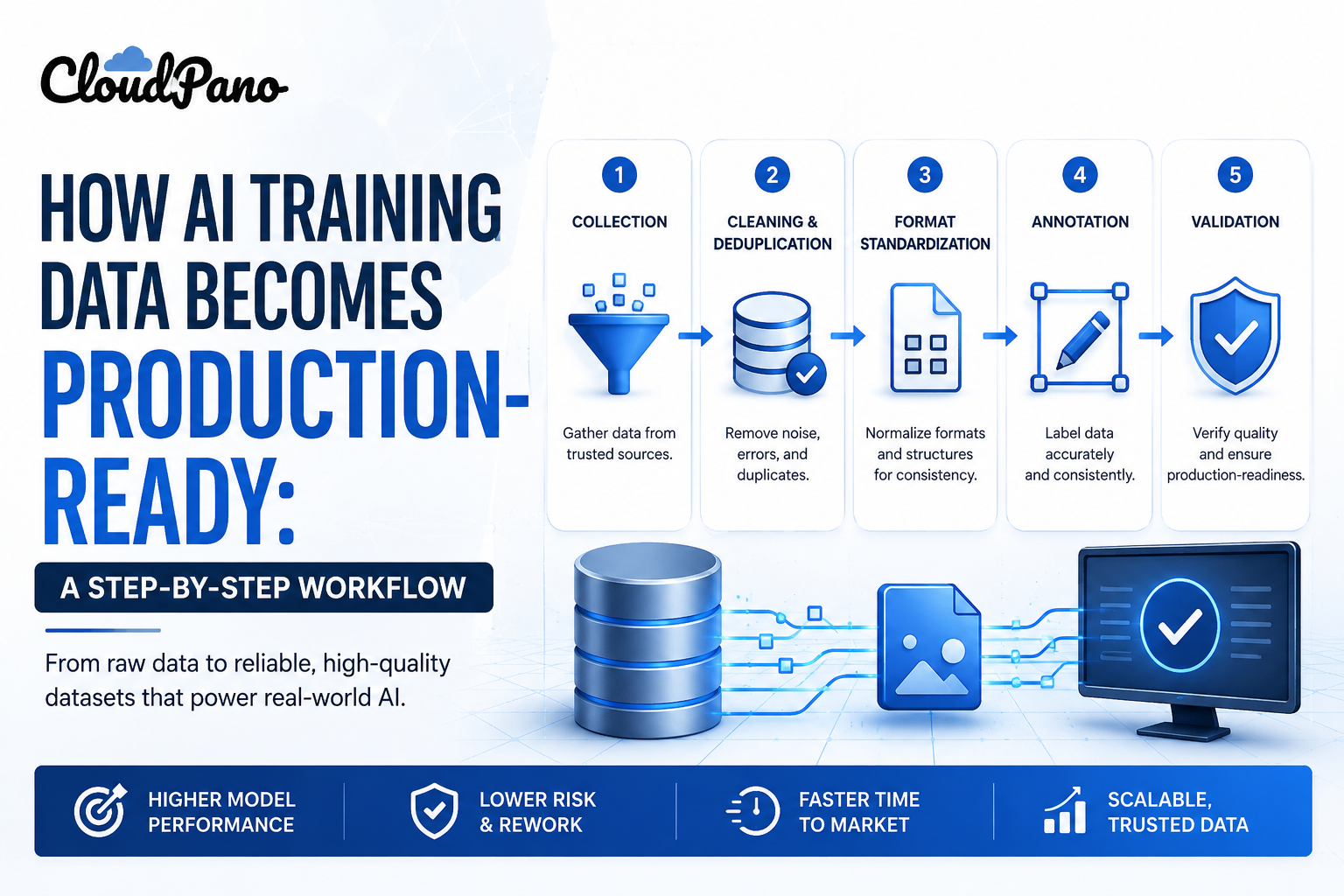
A complete AI dataset creation process moves through five connected stages, each of which shapes what the next stage has to work with.
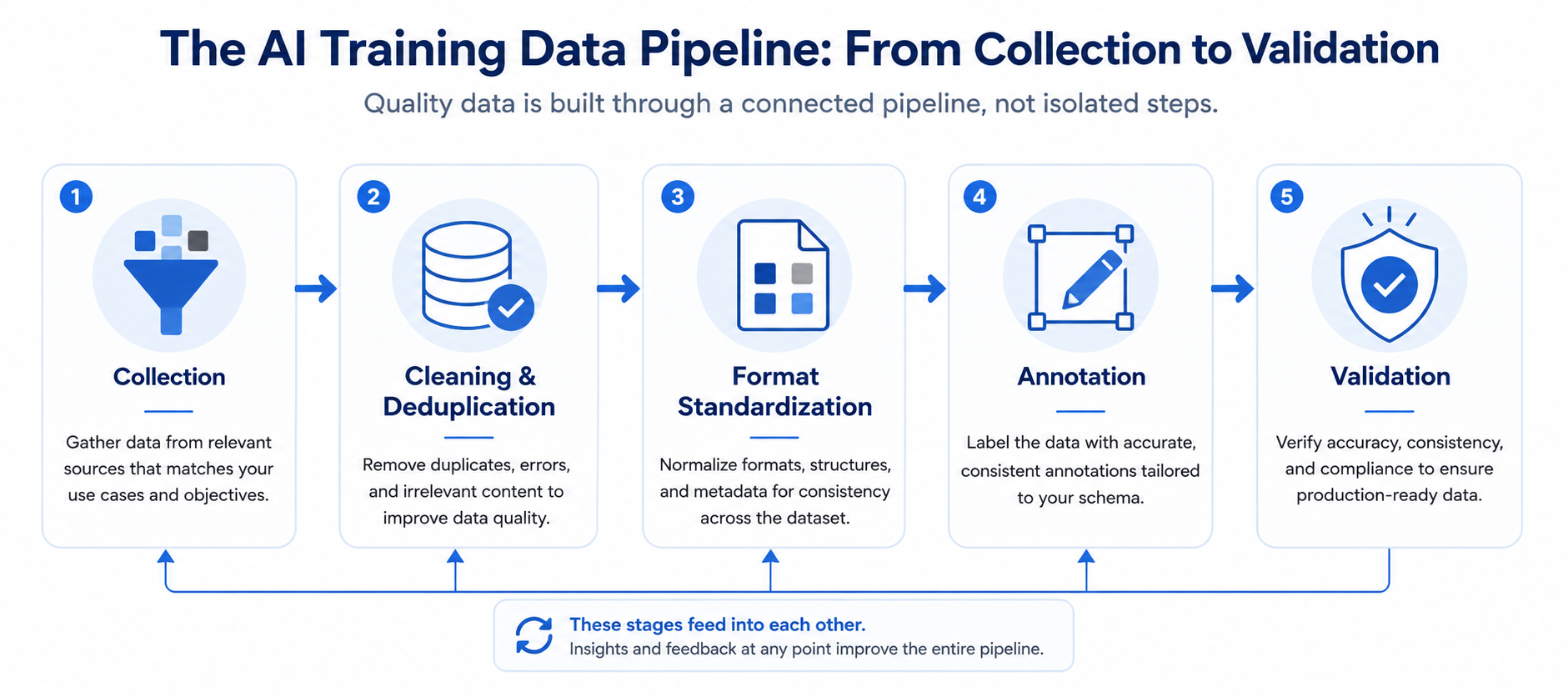
 Diagram of the five-stage AI training data workflow from collection to validation

Collection. Gathering raw data — whether sourced, licensed, or captured directly — that represents the scenarios a model actually needs to learn.

Cleaning and deduplication. Removing corrupted files, duplicate or near-duplicate items, and irrelevant data that would otherwise waste annotator time or skew the dataset's balance.

Format standardization. Converting data into consistent formats, resolutions, or structures so annotators and tooling can work with it uniformly rather than handling exceptions case by case.
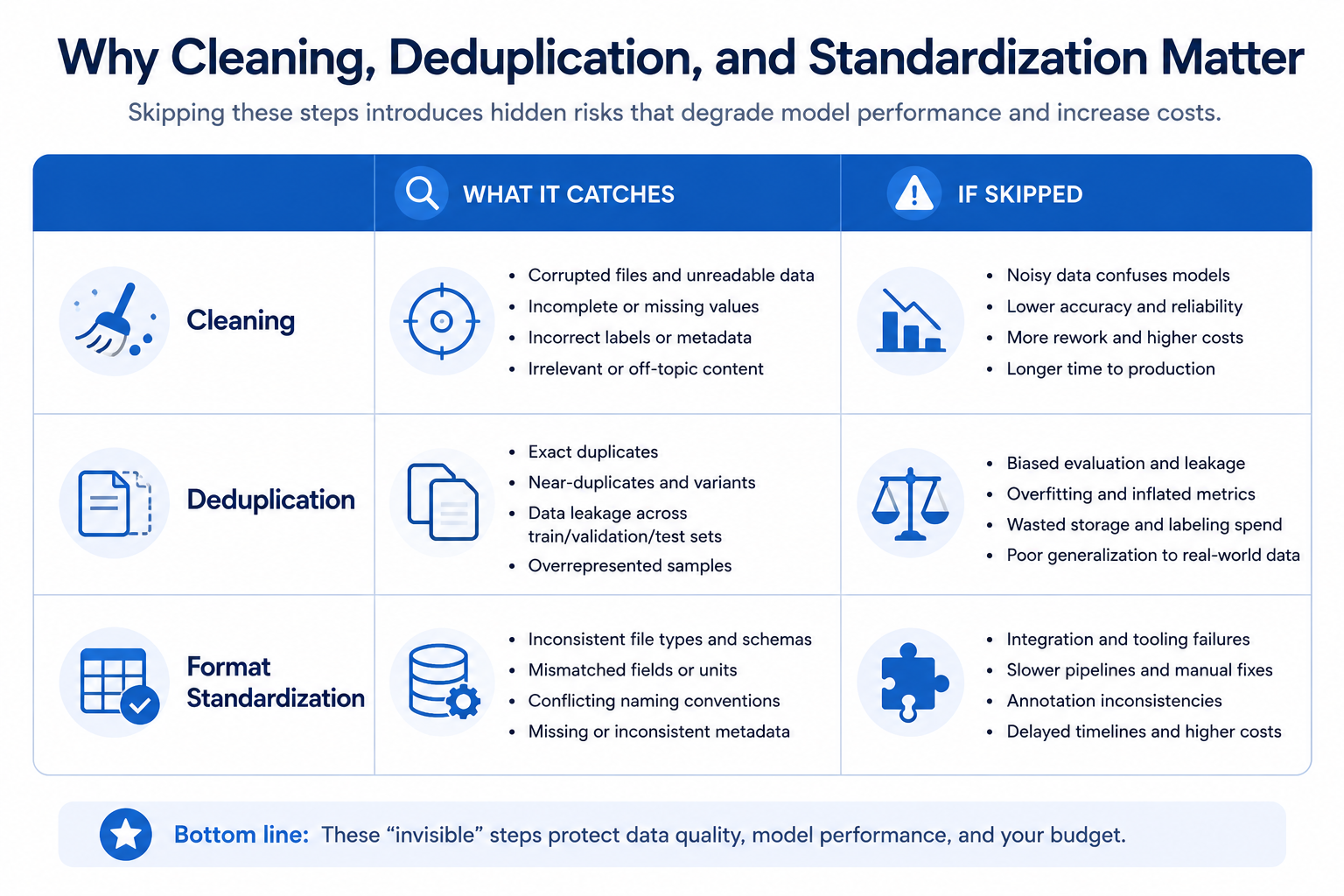
Comparison table of what each data preparation stage catches before AI annotation

Annotation. Applying the labels, tags, or structure the model needs to learn from, using guidelines built for the specific data and task.

Validation. Confirming the finished dataset meets quality and completeness requirements before it's considered production-ready and handed off to training.

Understanding how these workflows operate as five connected stages — not annotation in isolation — is what separates a training data pipeline that runs smoothly from one that hits repeated friction at the labeling stage because earlier problems were never addressed.
Step-by-Step Workflow

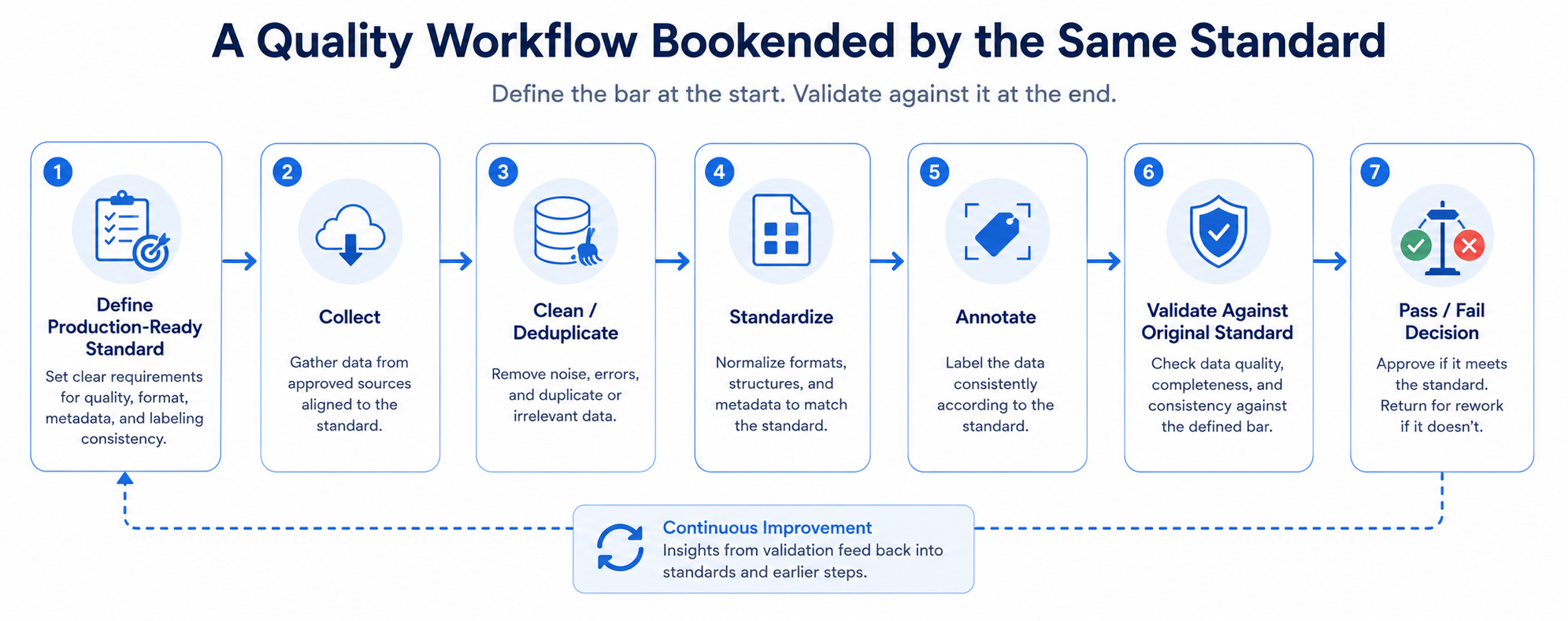
Flowchart of defining and validating a production-ready standard in the AI training data workflow
  1. Define what "production-ready" means for your specific model. Establish the format, structure, and quality bar the final dataset needs to meet before starting any collection work.
  2. Collect raw data against that definition. Source, license, or capture data that actually represents your model's target scenarios, not just whatever is easiest to obtain.
  3. Clean and deduplicate before annotation begins. Remove corrupted, duplicate, or irrelevant items so annotators aren't spending time on data that shouldn't be in the dataset at all.
  4. Standardize formats across the full dataset. Resolve inconsistencies in resolution, encoding, or structure so the annotation stage doesn't have to handle exceptions constantly.
  5. Write annotation guidelines informed by what preparation revealed. Use insights from the cleaning stage — common edge cases, ambiguous data types — to make guidelines more specific from the start.
  6. Annotate according to those guidelines, with quality assurance built in. Apply labeling with the same rigor regardless of which stage of the workflow it follows.
  7. Validate the finished dataset against your original production-ready definition. Confirm the dataset actually meets the bar set in step one before treating it as ready for training.

Industry Use Cases

  • Computer vision / robotics: Format standardization (resolution, file type, metadata) is often the most time-intensive preparation stage, given the variety of sources image and video data typically come from.
  • Autonomous vehicles: Cleaning and deduplication matter significantly for sensor data, where redundant or corrupted frames from continuous recording need to be filtered before annotation.
  • Healthcare AI: Data preparation often includes de-identification and compliance-driven cleaning steps that are as critical as annotation itself, given regulatory requirements.
  • Retail AI: Deduplication is especially important for product data pipelines, where near-duplicate listings or images can otherwise skew a dataset's balance.
  • LLM developers: Text cleaning — removing noise, near-duplicate content, and formatting inconsistencies — is a substantial preparation stage before any annotation work begins.
  • Government & defense: Data preparation frequently includes classification review and access control steps that need to happen before data reaches any annotation workforce.

Benefits

  • Smoother annotation. A properly prepared dataset reduces the ambiguous edge cases and formatting inconsistencies that otherwise slow down and complicate the labeling stage.
  • Higher-quality final datasets. Addressing data quality issues at the preparation stage prevents them from being masked or compounded by inconsistent annotation later.
  • Reduced rework. Catching duplicate, corrupted, or irrelevant data before annotation avoids wasting annotator time and having to correct downstream issues afterward.
  • More accurate project timelines. Accounting for preparation as its own substantial stage, rather than assuming annotation is the only real work, produces more realistic project scoping.
  • A more defensible dataset overall. A documented preparation process supports better governance and provenance tracking across the full AI training data workflow.

Common Mistakes

Infographic of common signs that AI training data preparation was skipped or rushed
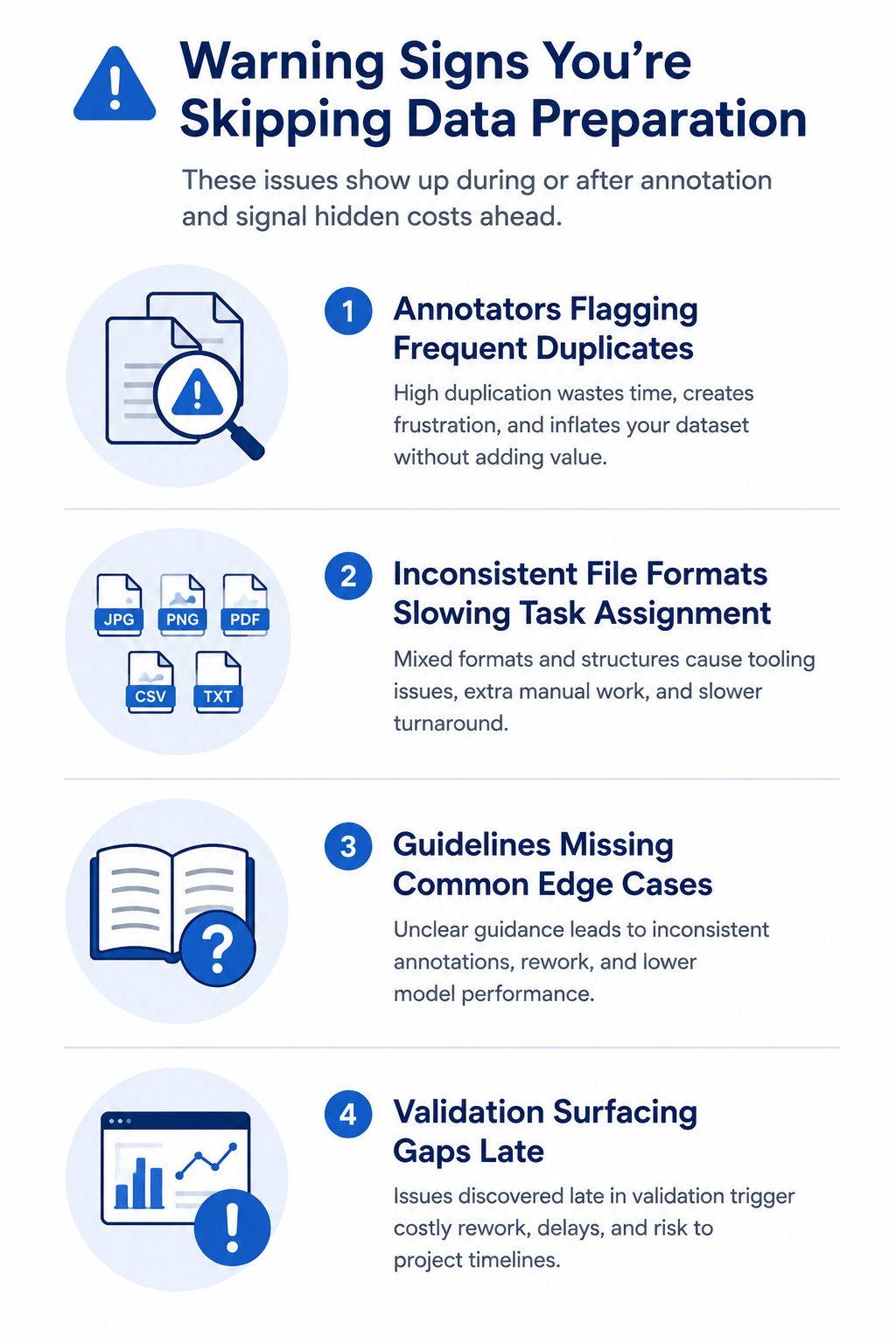
  • Treating annotation as the only real stage of the workflow. Underinvesting in collection, cleaning, and standardization, then being surprised when labeling takes longer or produces inconsistent results.
  • Skipping deduplication before annotation. Letting near-duplicate items into the labeling stage, wasting annotator time and potentially skewing the final dataset's balance.
  • Not standardizing formats before annotation begins. Forcing annotators or tooling to handle exceptions constantly, which slows work and introduces inconsistency.
  • Writing annotation guidelines before completing data preparation. Missing the chance to inform guidelines with edge cases and patterns that preparation would have surfaced.
  • Not defining "production-ready" before starting the workflow. Working without a clear target for validation, making it unclear when the dataset is actually finished.
  • Validating only against annotation accuracy, not the full production-ready definition. Missing gaps in completeness, format, or coverage that don't show up in a pure labeling accuracy check.

Best Practices

  • Define what "production-ready" means for your specific model before starting collection, and validate against that definition at the end.
  • Treat cleaning, deduplication, and format standardization as substantial stages in their own right, not a quick pass before the "real work."
  • Let insights from data preparation inform and sharpen annotation guidelines, rather than writing guidelines in isolation from what preparation reveals.
  • Apply the same quality assurance rigor across the full workflow, not just at the annotation stage.
  • Document each stage of the pipeline for governance and provenance purposes, not just the final labeled output.
  • Revisit your AI training data workflow as data sources or model requirements change, rather than assuming a process built for one project applies unchanged to the next. McKinsey's research on generative AI adoption notes that data readiness — including how thoroughly organizations prepare data before annotation — remains a consistently underestimated factor in AI project outcomes (McKinsey, "The economic potential of generative AI").

FAQ

What does a complete AI training data workflow include?

Collection, cleaning and deduplication, format standardization, annotation, and validation — not just the labeling stage, which is often only one part of the full sequence.

Why does data preparation for AI matter if the data will be labeled anyway?

Preparation catches duplicate, corrupted, or inconsistently formatted data before it reaches annotators, preventing wasted labeling time and inconsistency that would otherwise be harder to fix later.

What's the difference between data preparation and data annotation?

Data preparation makes raw data clean, consistent, and ready to be worked with; annotation applies the actual labels, tags, or structure a model needs to learn from that prepared data.

How long should data preparation take relative to annotation in an AI dataset creation project?

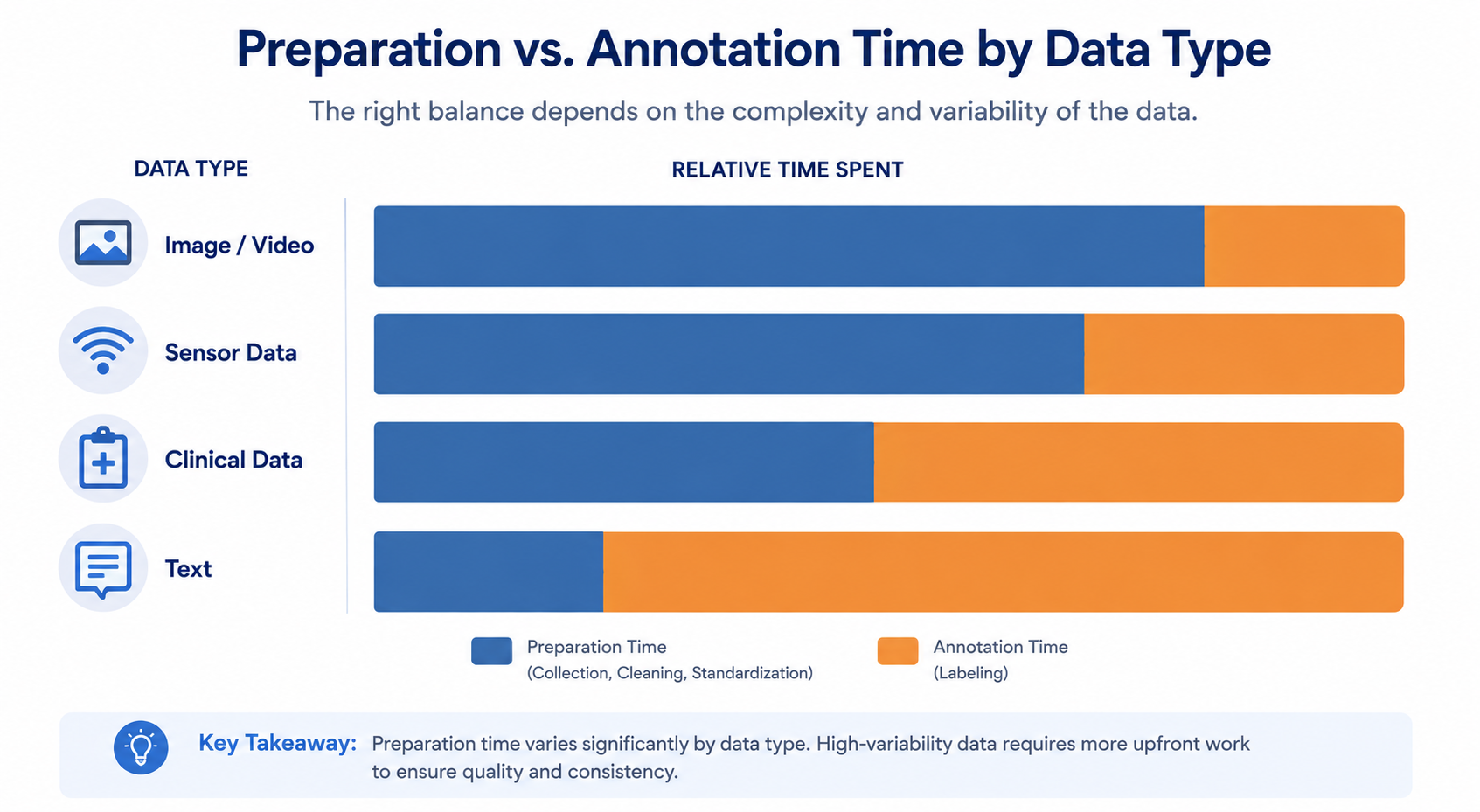
This varies significantly by data type and source quality, so it's best scoped based on your specific dataset's condition rather than assumed to be a minor step relative to labeling.

What does "production-ready" mean for a training dataset?

A dataset that meets a defined bar for format, completeness, and quality established before the workflow began — production-ready isn't just "labeled," it's validated against that original definition.

How does a machine learning data pipeline differ from a data annotation pipeline?

A machine learning data pipeline includes annotation as one stage among several — collection, cleaning, standardization, and validation are also part of it, whereas an annotation pipeline typically refers to the labeling stage specifically.

What happens if data preparation is skipped or rushed?

Labeling tends to take longer and produce less consistent results, since annotators end up handling duplicate, corrupted, or inconsistently formatted data that preparation should have caught beforehand.

Conclusion

An AI training data workflow is a full sequence, not a synonym for labeling. Collection, cleaning, standardization, annotation, and validation each shape what the next stage has to work with, and underinvesting in the stages before annotation is one of the most common, avoidable reasons a labeling project runs into friction. Treating the full workflow as a connected pipeline — not annotation in isolation — produces more consistent, genuinely production-ready datasets.

🚀 Your All‑In‑One Virtual Experience Stack
🎬
PhotoAIVideo
Turn photos into scroll‑stopping AI videos.
Get Started →
🏡
Pictastic
Instantly stage listings with AI.
Try Staging →
🌀
CloudPano
Create stunning 360° tours in minutes.
Launch Tour →
💰
VirtualTourProfit
Build a profitable virtual tour business.
Learn More →
🤝
CloudPano Reseller
Resell AI visual software without building it.
Become a Reseller →
🚗
Auto CloudPano
Sell more vehicles with 360° experiences.
Explore Auto →
🏗️
AI Floor Plan Builder
Generate detailed floor plans with AI.
Build Now →
📐
3D Measure
Capture accurate floor plans & 3D measurements.
Measure Now →
🧠
AI Training Data
Custom AI training data services.
Learn More →
Share this post
Cloudpano

Choose The Right 360° Camera

Insta360 ONE RS 1-Inch 360 Edition

  • Compact, ready to go anywhere

  • Interchangeable lens that’s upgradeable

  • Dual 1-inch sensors for improved clarity and low light performance

  • Dynamic range and 6K 360° capture

  • 360° photo resolution at 21MP

Learn More

Insta360 X4

  • 8K 360° video recording for ultra-detailed visuals.

  • 4K single-lens mode for traditional wide-angle shots.

  • Invisible selfie stick effect for drone-like perspectives.

  • 2.5-inch touchscreen with Gorilla Glass protection.

  • Waterproof up to 33ft for underwater shooting.

Learn More

Ricoh Theta Z1

  • 360° photo resolution in 23MP

  • Slim design at 24 mm thick

  • Built-in image stabilization for smooth video capture.

  • Internal 19GB storage for photo and video storage.

  • Wireless connectivity for remote control and sharing.

Learn More

Ricoh Theta X

  • 60MP 360° still images for high-resolution photography.

  • 5.7K 360° video recording at 30fps.

  • 2.25-inch touchscreen for intuitive control.

  • USB Type-C port for fast charging and data transfer.

  • MicroSD card slot for expandable storage.

Learn More
Property Marketing
Allows potential buyers to explore properties in detail from anywhere, enhancing the real estate marketing process.
Automotive Spins
Create an interactive virtual showroom and engage affluent digital buyers with live 360º video calls, all through the CloudPano mobile app for a complete automotive sales solution.
Interactive Floor Plans
Create 2D and 3D floor plans with measurements in 4 minutes or less, all from your phone. Download the Floor Plan Scanner app and get your first scan free.

360 Virtual Tours With CloudPano.com. Get Started Today.

Try it free. No credit card required. Instant set-up.
Try it free
Latest posts

See our other posts

Interviews, tips, guides, industry best practices, and news.

Selecting the Best AI Training Data Provider: A Practical Buyer's Guide

How to choose an AI training data provider works best as a defined sequence: assess your actual needs, shortlist candidates, request proposals, run demos and reference checks, pilot on real data, negotiate a specific contract, and structure onboarding deliberately. Skipping or reordering these stages is the most common cause of a rushed or mismatched decision.
Read post

How AI Training Data Becomes Production-Ready: A Step-by-Step Workflow

An AI training data workflow covers more than labeling — it includes data collection, cleaning and deduplication, format standardization, annotation, and validation before data is production-ready. Skipping the preparation stages before labeling is one of the most common reasons annotation projects run into inconsistency and rework later in the process.
Read post

Enterprise AI Training Data Providers: The Services That Actually Move the Needle

Among the services an enterprise AI training data provider offers, the ones that most consistently affect model outcomes are domain-specific taxonomy design, calibrated quality assurance for your specific task, and structured edge-case sourcing — not generic workforce size or a long feature list. Prioritizing these over table-stakes services improves project results more directly.
Read post