Pricing Models in AI Training Data: Per-Label, Per-Hour, or Per-Project?

Cloudpano
July 23, 2026
5 min read
Share this post

AI Training Data Pricing Models: Per-Label, Per-Hour, or Per-Project?

Comparing two vendor quotes gets confusing fast when one is priced per-label, another per-hour, and a third as a flat project fee. AI training data pricing models aren't standardized across the industry, which means the lowest number on a proposal isn't always the lowest actual cost.

Each model shifts risk differently between you and the provider. Understanding what's actually driving each structure — not just the headline rate — is what makes a real cost comparison possible.

Why It Matters

Choosing a pricing model that doesn't fit your project's actual characteristics doesn't just affect the invoice — it affects incentives. A per-label rate on ambiguous, high-complexity data can quietly push a provider toward speed over accuracy, since more items processed means more revenue regardless of quality. Google Research's "Data Cascades" study documented how such quality trade-offs, introduced early and often invisibly, compound into significant downstream problems (Sambasivan et al., Google Research).

NIST's AI Risk Management Framework treats data quality as foundational to trustworthy AI, which is a useful reminder that a pricing model's incentive structure has real implications beyond cost — it shapes the quality of the training data you actually receive (NIST AI RMF).

Budget predictability matters more given how quickly AI projects move from pilot to production. Stanford HAI's AI Index has tracked this acceleration (Stanford HAI, AI Index Report), and a pricing model that doesn't scale predictably with your actual volume can create budget surprises right when a project needs to move fastest.
How It Works

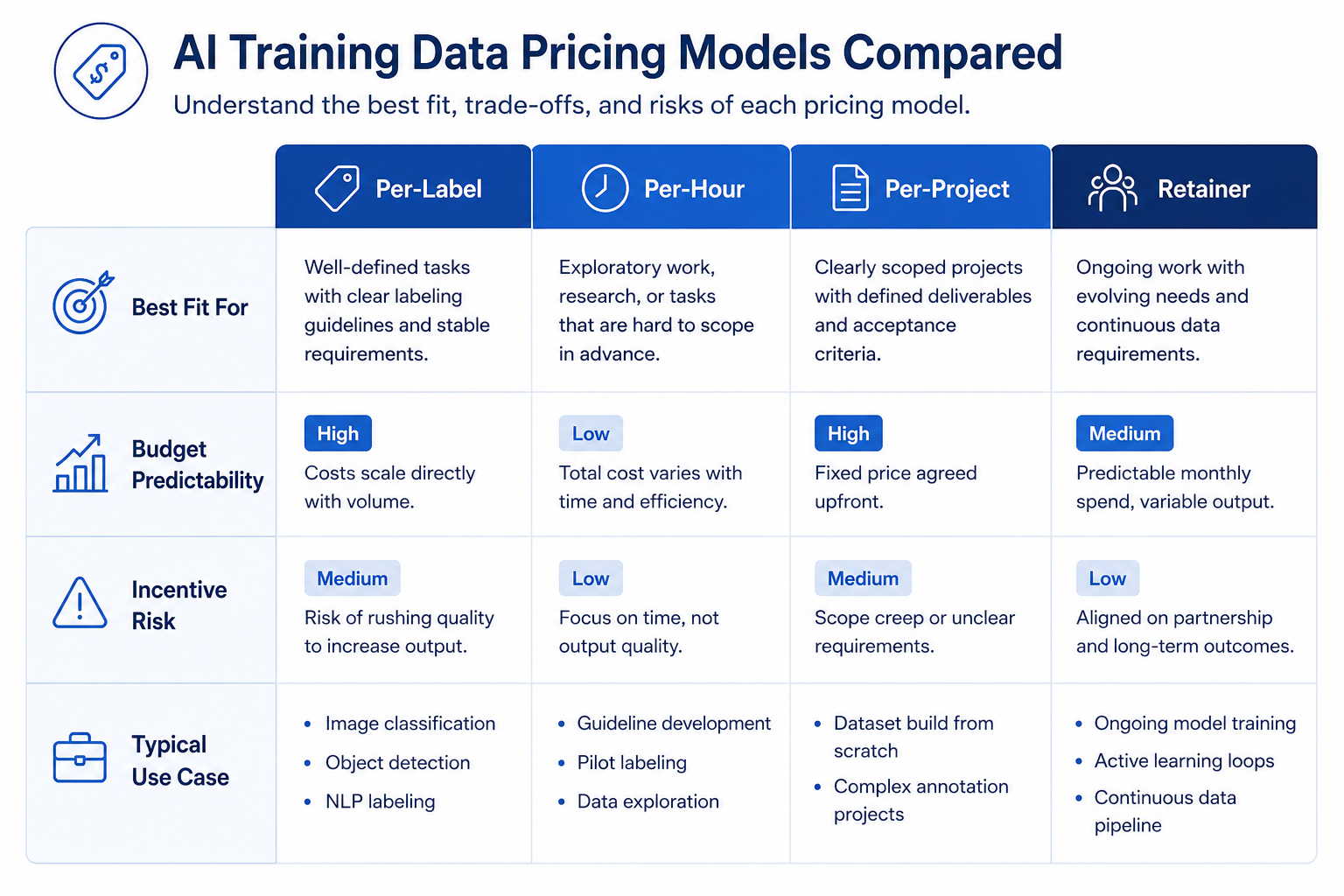
Per-label pricing charges a fixed rate per annotated item. It's straightforward to compare across vendors for simple, well-defined tasks, but the rate needs to reflect task complexity — a flat per-label rate applied to both simple classification and complex segmentation tends to either overpay for the easy work or underpay for the hard work.

Per-hour pricing charges for annotator time rather than output volume. It fits ambiguous or evolving tasks well, where output volume is hard to predict upfront, but it requires more trust that time is being used efficiently, since the incentive to move quickly is weaker than in a per-label model.

Per-project pricing sets a flat fee for a clearly defined scope — a specific dataset, labeled to specific guidelines, delivered by a specific date. It offers the most budget predictability but only works well when scope is genuinely well-defined upfront, since scope changes typically require renegotiation.

Retainer pricing reserves ongoing capacity for a monthly fee, common in managed AI data services pricing for teams with continuous, evolving annotation needs rather than a single discrete project.

Understanding how these workflows operate behind each pricing model — what's actually driving the provider's cost structure — makes it possible to evaluate whether a given rate is fair for your specific project, not just low relative to a competing quote.

Step-by-Step Workflow for Choosing a Pricing Model

  1. Assess how well-defined your project scope is. Clearly bounded, stable requirements fit per-project pricing; evolving or exploratory work fits per-hour better.
  2. Evaluate task complexity and consistency. Simple, uniform tasks fit per-label pricing well; highly variable complexity makes a flat per-label rate harder to price fairly.
  3. Consider your volume predictability. Steady, ongoing needs may fit a retainer model; one-time or irregular volume often fits per-project or per-label better.
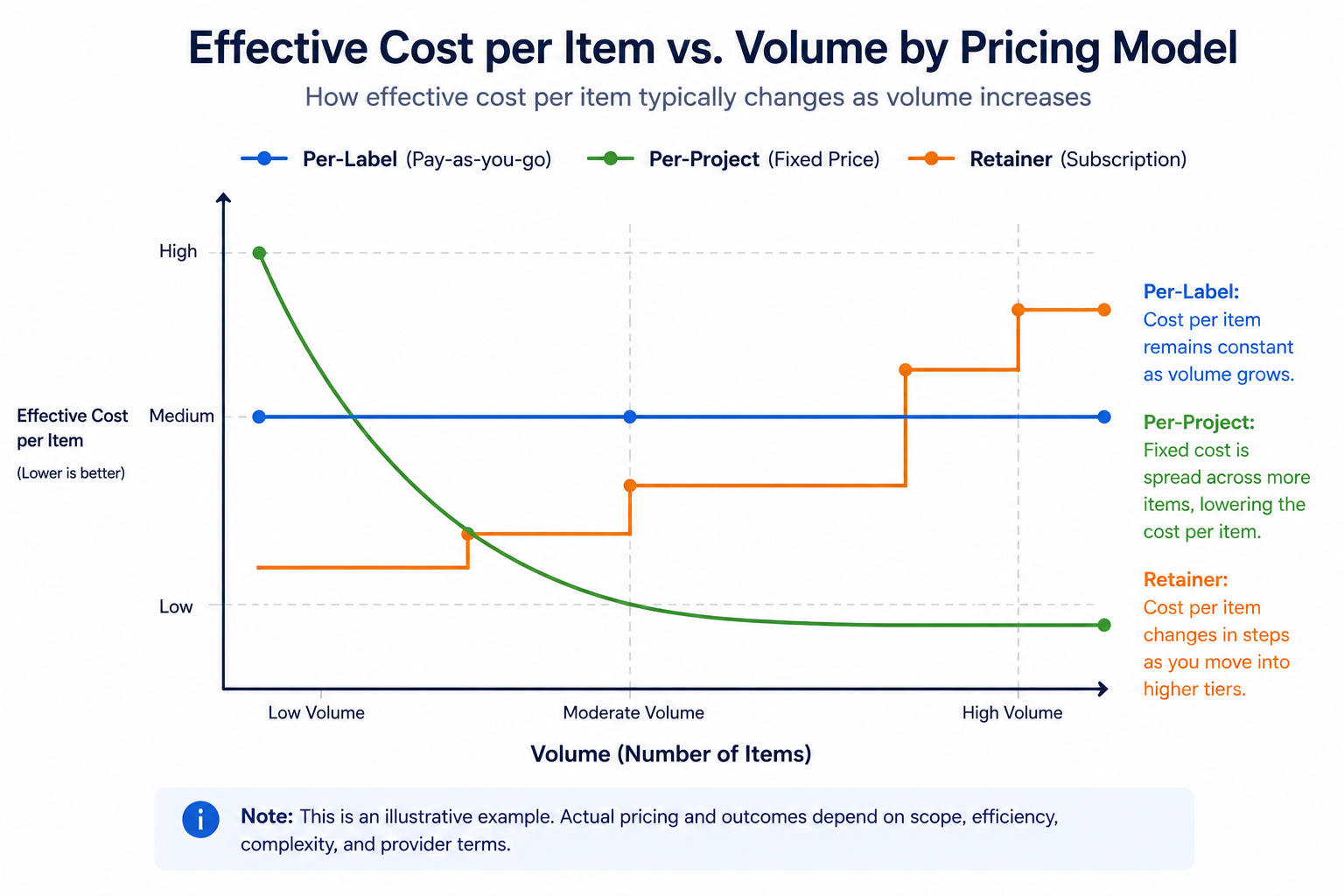
  4. Request quotes structured the same way for true comparison. Ask multiple vendors to quote the same pricing model where possible, or convert quotes to a common basis (like effective cost per item) for comparison.
  5. Identify what each pricing model incentivizes. Understand whether a given structure rewards speed, thoroughness, or efficiency, and confirm that aligns with what your project actually needs.
  6. Factor in training data cost factors beyond the headline rate. Rework costs, minimum commitments, and scope-change fees can significantly change the real total cost under any pricing model.
  7. Pilot under the proposed pricing model before committing to full scope. Confirm the pricing structure holds up in practice, not just in the proposal.

Industry Use Cases

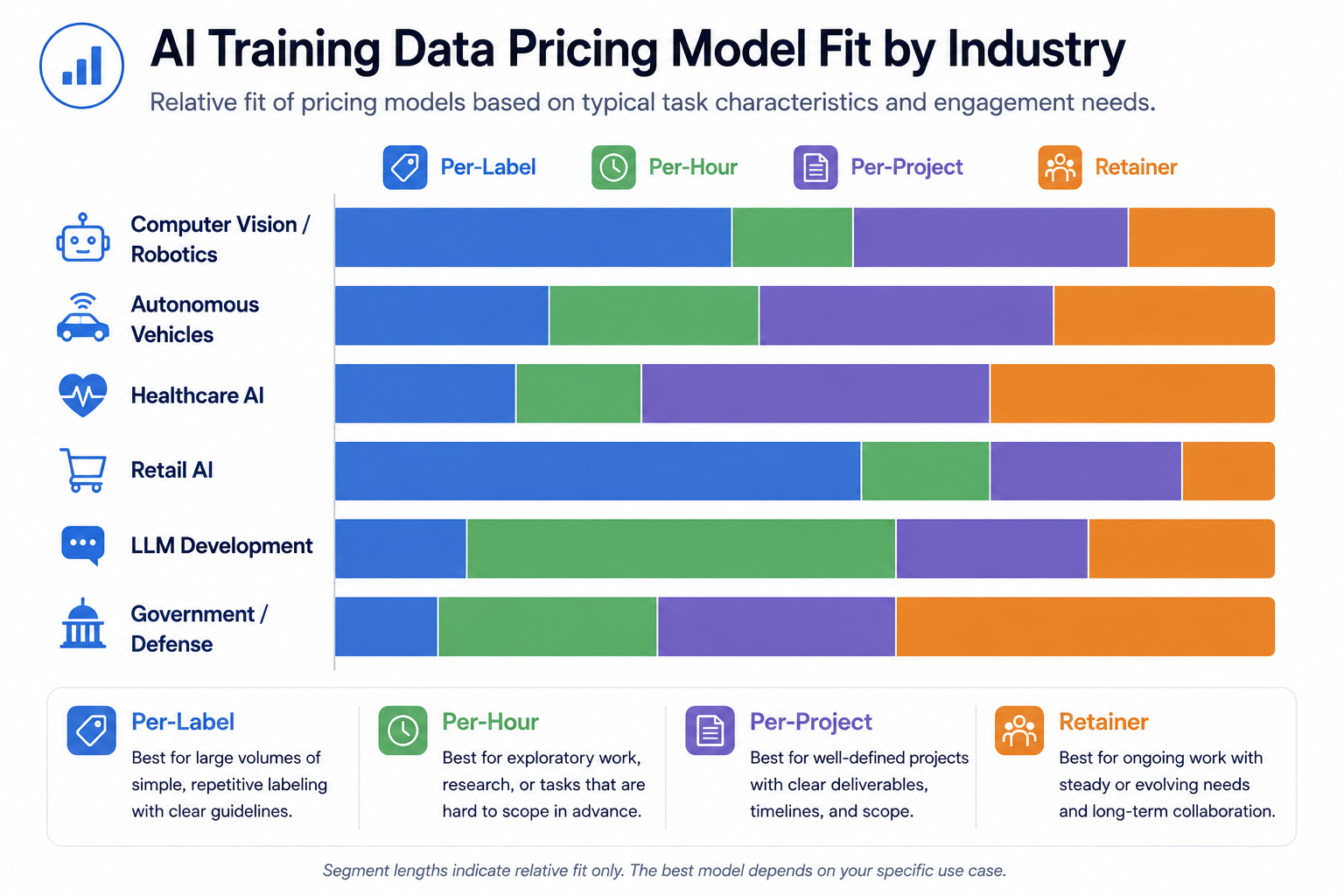
  • Computer vision / robotics: Per-label pricing often fits well for high-volume, relatively uniform tasks like bounding box annotation at scale.
  • Autonomous vehicles: Per-hour or per-project pricing often suits complex, evolving scenario labeling where output volume is harder to predict upfront.
  • Healthcare AI: Per-project pricing with clearly defined scope is common for clinical annotation work, given the importance of well-documented, bounded engagements in regulated contexts.
  • Retail AI: Per-label pricing typically fits high-volume, lower-complexity product categorization tasks well.
  • LLM developers: Per-hour or retainer pricing often suits preference and safety labeling, where guidelines evolve and output volume varies significantly.
  • Government & defense: Per-project pricing with detailed scope documentation is common, often required for procurement and audit purposes regardless of task type.

Benefits of Understanding Pricing Models

  • More accurate vendor comparisons. Understanding what drives each pricing structure lets you compare quotes on their actual economics, not just the headline number.
  • Better incentive alignment. Choosing a pricing model that matches your project's actual needs reduces the risk of a provider's incentives working against your quality goals.
  • More predictable budgeting. Matching pricing model to project characteristics — rather than defaulting to whichever is cheapest upfront — reduces the risk of budget surprises from scope changes or rework.
  • Stronger negotiating position. Knowing what typically drives cost under each model gives you a more informed basis for negotiating rates or terms.

Common Mistakes

Infographic of hidden training data cost factors to ask about beyond the base rate
  • Comparing quotes without converting to a common basis. Directly comparing a per-hour quote to a per-label quote without calculating an effective cost per item.
  • Choosing per-label pricing for highly ambiguous or complex tasks. A flat rate applied to inconsistent task difficulty tends to produce inconsistent quality, since annotators are incentivized toward speed on the hardest items.
  • Not accounting for training data cost factors beyond the base rate. Ignoring rework costs, minimum commitments, or scope-change fees that significantly affect real total cost.
  • Locking into a per-project fee with poorly defined scope. This tends to produce disputes and change-order fees once the actual work reveals scope gaps.
  • Assuming the lowest quoted rate is the lowest actual cost. Not accounting for how a pricing model's incentives affect quality, and the retraining or rework costs that quality gaps eventually produce.
  • Ignoring how managed AI data services pricing bundles cost. Assuming a retainer or managed service quote is directly comparable to a per-label rate without accounting for what's bundled into it (QA, account management, tooling).

Best Practices

  • Match the pricing model to your project's actual scope definition, task complexity, and volume predictability rather than defaulting to whichever seems cheapest.
  • Convert competing quotes to a common cost basis before comparing them directly.
  • Ask providers what each pricing model incentivizes and confirm that aligns with your quality requirements.
  • Get all training data cost factors — rework, minimums, scope-change terms — documented in writing before signing.
  • Pilot under the actual proposed pricing structure to confirm it holds up in practice.
  • Revisit your pricing model choice if your project's scope, complexity, or volume changes materially over time. McKinsey's research on generative AI adoption notes that data readiness — including how deliberately organizations structure the economics of their data work — remains one of the most consistently underestimated factors in AI project outcomes (McKinsey, "The economic potential of generative AI").

FAQ

What are the main AI training data pricing models?

Per-label (a fixed rate per annotated item), per-hour (charging for annotator time), per-project (a flat fee for defined scope), and retainer (ongoing reserved capacity for a monthly fee).

Which pricing model is cheapest for AI training data?

There's no universally cheapest model — the right choice depends on task complexity, scope definition, and volume predictability, and the lowest headline rate doesn't always produce the lowest real total cost.

What are the most important training data cost factors beyond the base rate?

Rework costs for rejected batches, minimum volume commitments, scope-change fees, and what's bundled into the rate (quality assurance, account management, tooling) all significantly affect real total cost.

When does per-label pricing make the most sense?

For simple, well-defined, relatively uniform tasks at high volume, where a flat rate per item accurately reflects the actual effort involved across the dataset.

When does per-hour pricing make more sense than per-label?

For ambiguous, evolving, or highly variable-complexity tasks where output volume is difficult to predict upfront and a flat per-item rate wouldn't fairly reflect effort.

What is included in managed AI data services pricing?

Typically workforce, tooling, quality assurance, and account management bundled into a single rate, which is why comparing it directly to a bare per-label rate from a different provider requires accounting for what's actually included.

How do I fairly compare quotes structured with different pricing models?

Convert every quote to a common basis, such as effective cost per labeled item, factoring in rework, minimums, and what's bundled into the rate, rather than comparing headline numbers directly.

Conclusion

AI training data pricing models each shift cost and risk differently between buyer and provider, and the right choice depends on your project's scope definition, task complexity, and volume predictability — not simply which quote has the lowest number attached. Understanding what drives each model's economics turns a confusing multi-vendor comparison into a genuinely informed decision.

🚀 Your All‑In‑One Virtual Experience Stack
🎬
PhotoAIVideo
Turn photos into scroll‑stopping AI videos.
Get Started →
🏡
Pictastic
Instantly stage listings with AI.
Try Staging →
🌀
CloudPano
Create stunning 360° tours in minutes.
Launch Tour →
💰
VirtualTourProfit
Build a profitable virtual tour business.
Learn More →
🤝
CloudPano Reseller
Resell AI visual software without building it.
Become a Reseller →
🚗
Auto CloudPano
Sell more vehicles with 360° experiences.
Explore Auto →
🏗️
AI Floor Plan Builder
Generate detailed floor plans with AI.
Build Now →
📐
3D Measure
Capture accurate floor plans & 3D measurements.
Measure Now →
🧠
AI Training Data
Custom AI training data services.
Learn More →
Share this post
Cloudpano

Choose The Right 360° Camera

Insta360 ONE RS 1-Inch 360 Edition

  • Compact, ready to go anywhere

  • Interchangeable lens that’s upgradeable

  • Dual 1-inch sensors for improved clarity and low light performance

  • Dynamic range and 6K 360° capture

  • 360° photo resolution at 21MP

Learn More

Insta360 X4

  • 8K 360° video recording for ultra-detailed visuals.

  • 4K single-lens mode for traditional wide-angle shots.

  • Invisible selfie stick effect for drone-like perspectives.

  • 2.5-inch touchscreen with Gorilla Glass protection.

  • Waterproof up to 33ft for underwater shooting.

Learn More

Ricoh Theta Z1

  • 360° photo resolution in 23MP

  • Slim design at 24 mm thick

  • Built-in image stabilization for smooth video capture.

  • Internal 19GB storage for photo and video storage.

  • Wireless connectivity for remote control and sharing.

Learn More

Ricoh Theta X

  • 60MP 360° still images for high-resolution photography.

  • 5.7K 360° video recording at 30fps.

  • 2.25-inch touchscreen for intuitive control.

  • USB Type-C port for fast charging and data transfer.

  • MicroSD card slot for expandable storage.

Learn More
Property Marketing
Allows potential buyers to explore properties in detail from anywhere, enhancing the real estate marketing process.
Automotive Spins
Create an interactive virtual showroom and engage affluent digital buyers with live 360º video calls, all through the CloudPano mobile app for a complete automotive sales solution.
Interactive Floor Plans
Create 2D and 3D floor plans with measurements in 4 minutes or less, all from your phone. Download the Floor Plan Scanner app and get your first scan free.

360 Virtual Tours With CloudPano.com. Get Started Today.

Try it free. No credit card required. Instant set-up.
Try it free
Latest posts

See our other posts

Interviews, tips, guides, industry best practices, and news.

Pricing Models in AI Training Data: Per-Label, Per-Hour, or Per-Project?

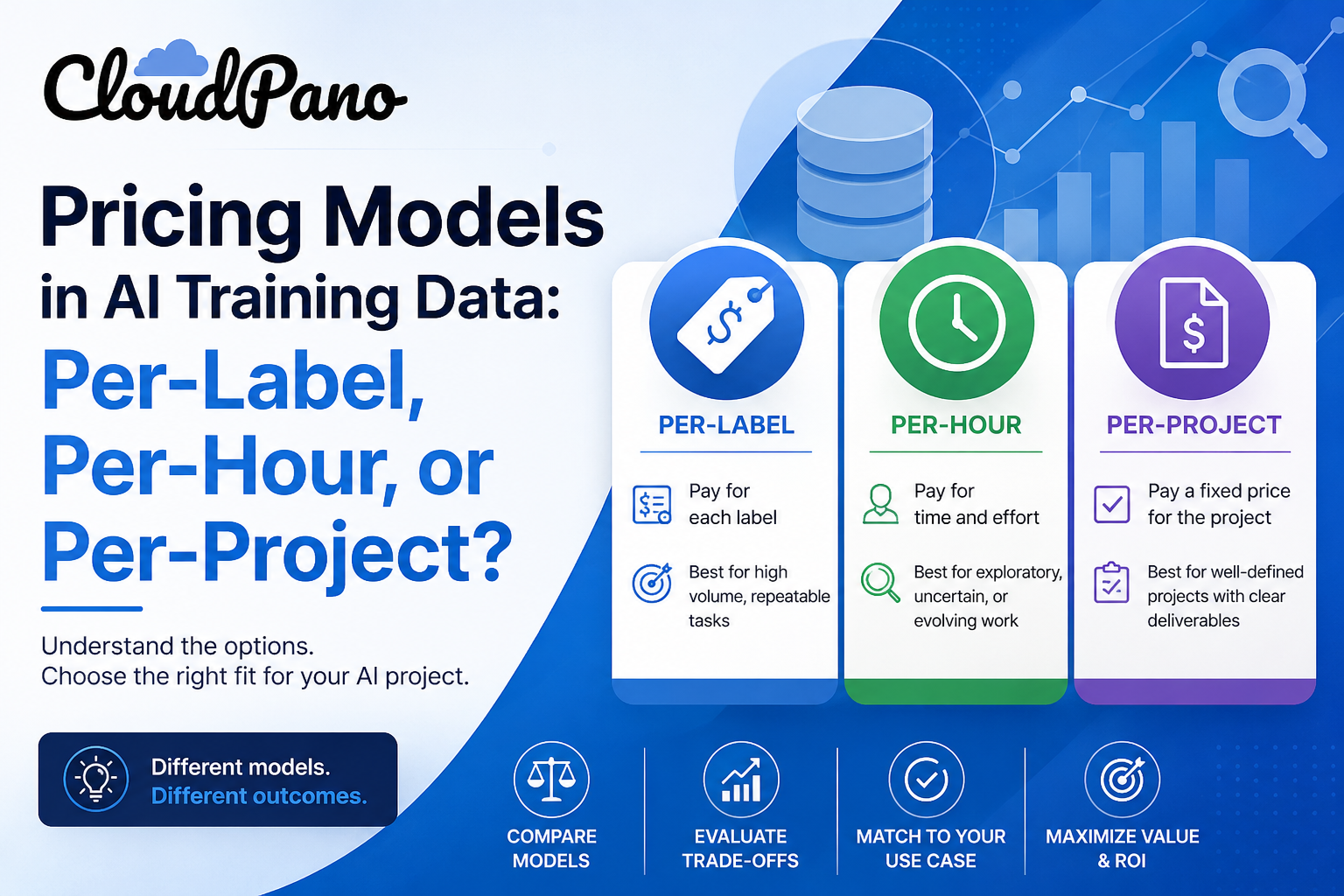
AI training data pricing models generally fall into four types: per-label (pay per annotated item), per-hour (pay for annotator time), per-project (a flat fee for defined scope), and retainer (ongoing capacity reserved monthly). The right model depends on task complexity, volume predictability, and how well-defined your project scope is upfront.
Read post

Data Provider Case Study: Building a Multimodal Dataset From Scratch

A multimodal dataset case study typically shows how image and text data get sourced, annotated with cross-modal relationships, and validated together rather than as separate pipelines. The key challenge is maintaining consistency between what an image shows and what its paired text describes, which requires coordinated guidelines and joint quality review.
Read post

Best Property Video AI Tool: Create Professional Real Estate Listing Videos for Realtors

Discover how the best property video AI tool helps Realtors turn listing photos into professional real estate videos. This guide explains how AI video software works, the most important features to compare, its advantages and limitations, and practical tips for creating branded, unbranded, vertical, and horizontal listing videos.
Read post