


.png)


A $4 million listing does not forgive a shaky pan or a stock-music intro that feels like every other property video on the market. So when agents who specialize in luxury real estate hear "AI real estate video," the skepticism is understandable.
Luxury buyers expect a certain visual language — unhurried pacing, confident camera work, and branding that looks bespoke rather than templated. Traditionally, achieving that level of polish often meant booking a videographer, a drone operator, and a full production day.
But AI real estate video tools have evolved considerably. The question is no longer simply, "Can AI make something watchable?" but rather, "Can it create something polished enough to belong in a seven-figure property's marketing package?"
In several important ways, yes — although there are still situations where traditional video production has a clear advantage.
This article breaks down where AI earns its place in a luxury listing strategy, where a human crew still justifies the investment, and how agents can use both approaches together.
Strong visual media matters across real estate, but luxury listings raise the expectations considerably.
Research and market data from Zillow Research regularly examine how photography, video, virtual tours, and other digital tools influence the online home-shopping experience. Broader video marketing research, such as Wyzowl's State of Video Marketing survey, also demonstrates the important role video plays in helping audiences understand products and services.
At the high end of the real estate market, however, there's less tolerance for mediocre production.
An awkward transition or unnatural camera movement might be a relatively minor flaw in an everyday listing video. On a multimillion-dollar property, the same mistake can create a noticeable mismatch between the quality of the home and the quality of its marketing.
Luxury agents aren't simply presenting rooms; they're creating a visual experience that reflects the property's positioning and their own professional brand. That means polished presentation, thoughtful pacing, and consistent branding matter considerably.
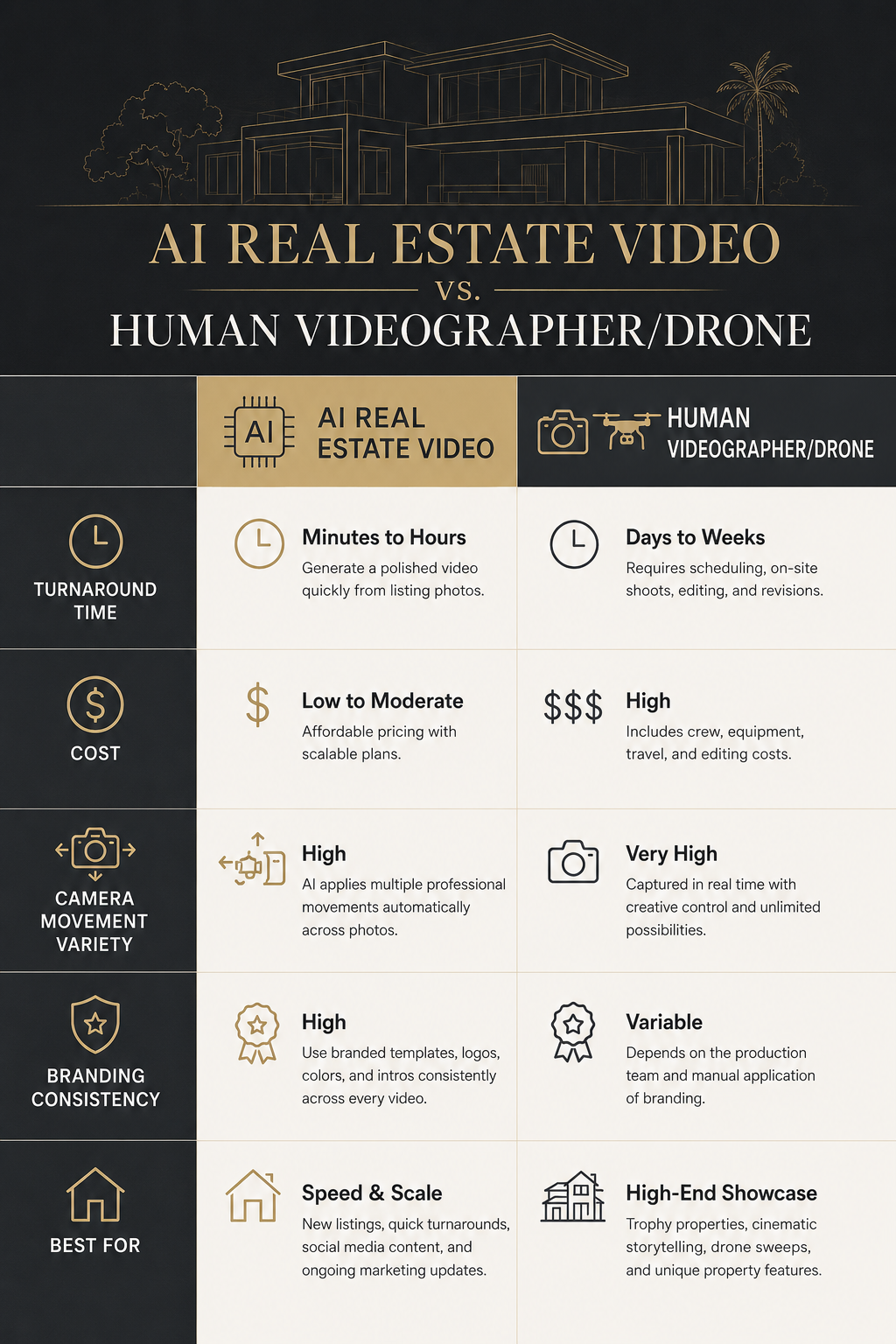
Before deciding whether AI real estate video "holds up," it helps to define what luxury property marketing actually demands. Three areas stand out.
This is the most obvious one: clean transitions, steady and purposeful camera movement, appropriate pacing, and minimal visual artifacts.
The goal is for the technology to disappear into the presentation. Viewers should be focused on the property rather than distracted by how the video was created.
A luxury listing video isn't only about the property — it also represents the agent or brokerage behind it.
Consistent logo placement, a coherent color palette, professional typography, and polished intro and outro sequences can help create a presentation that feels intentional rather than generic.
Luxury property videos often benefit from room to breathe.
Rather than racing through every space, a video might linger on the entryway, gradually move through the main living areas, and finish with a signature feature such as a dramatic view, pool, chef's kitchen, or landscaped outdoor space.
That sequencing can be just as important as any individual shot.
AI real estate video isn't necessarily a compromise across the board. There are several areas where it can fit comfortably into a luxury marketing workflow.
Modern AI real estate video tools can transform still property photos using different types of simulated camera movement, including pans, zooms, tilts, dolly-style pushes, orbits, and other effects.
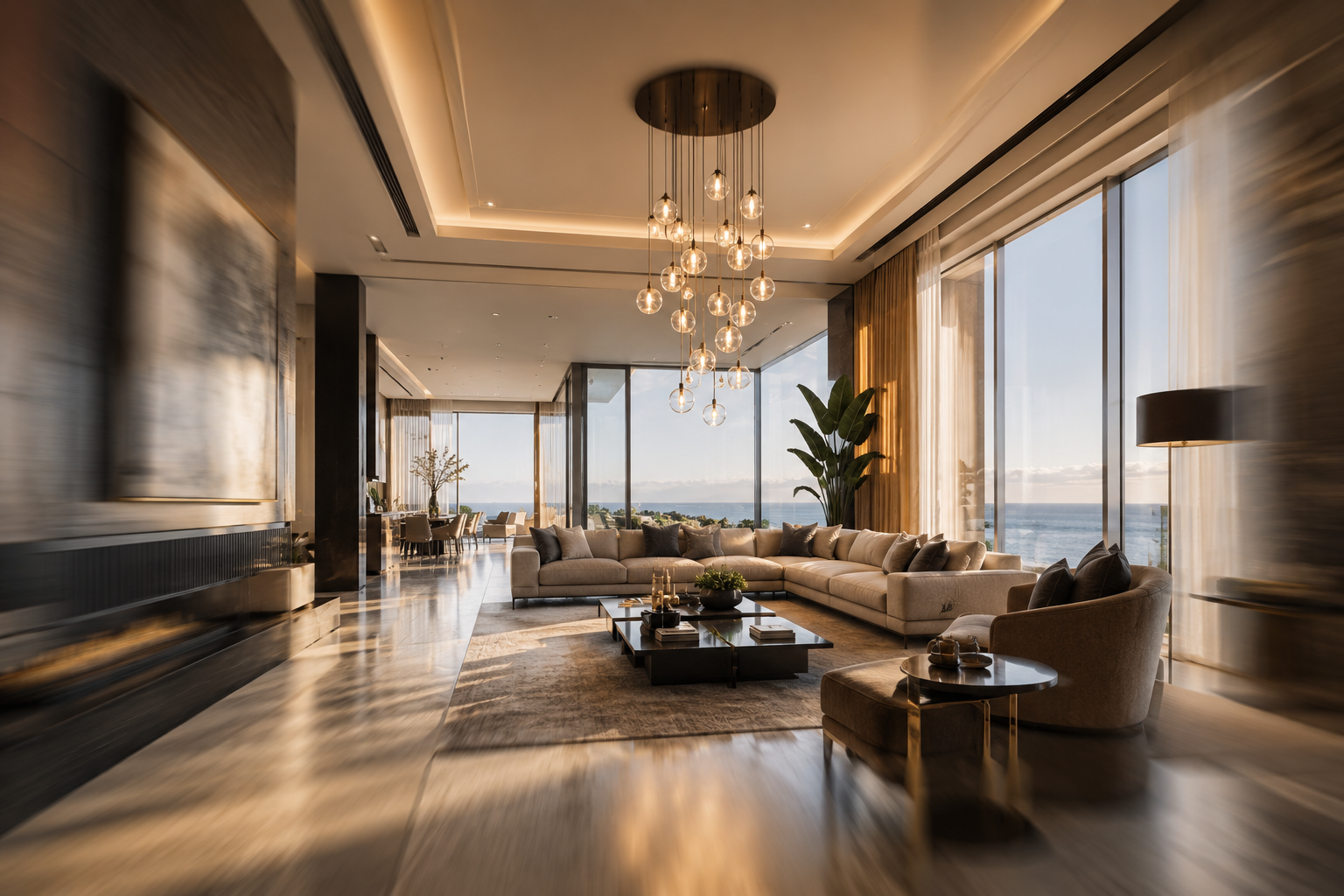
Having different movement options for different photos helps prevent the finished video from feeling like a conventional slideshow in which every image receives the same generic zoom.
You can see examples of this approach in PhotoAIVideo's before-and-after video examples, where static listing photographs are transformed into moving property sequences.
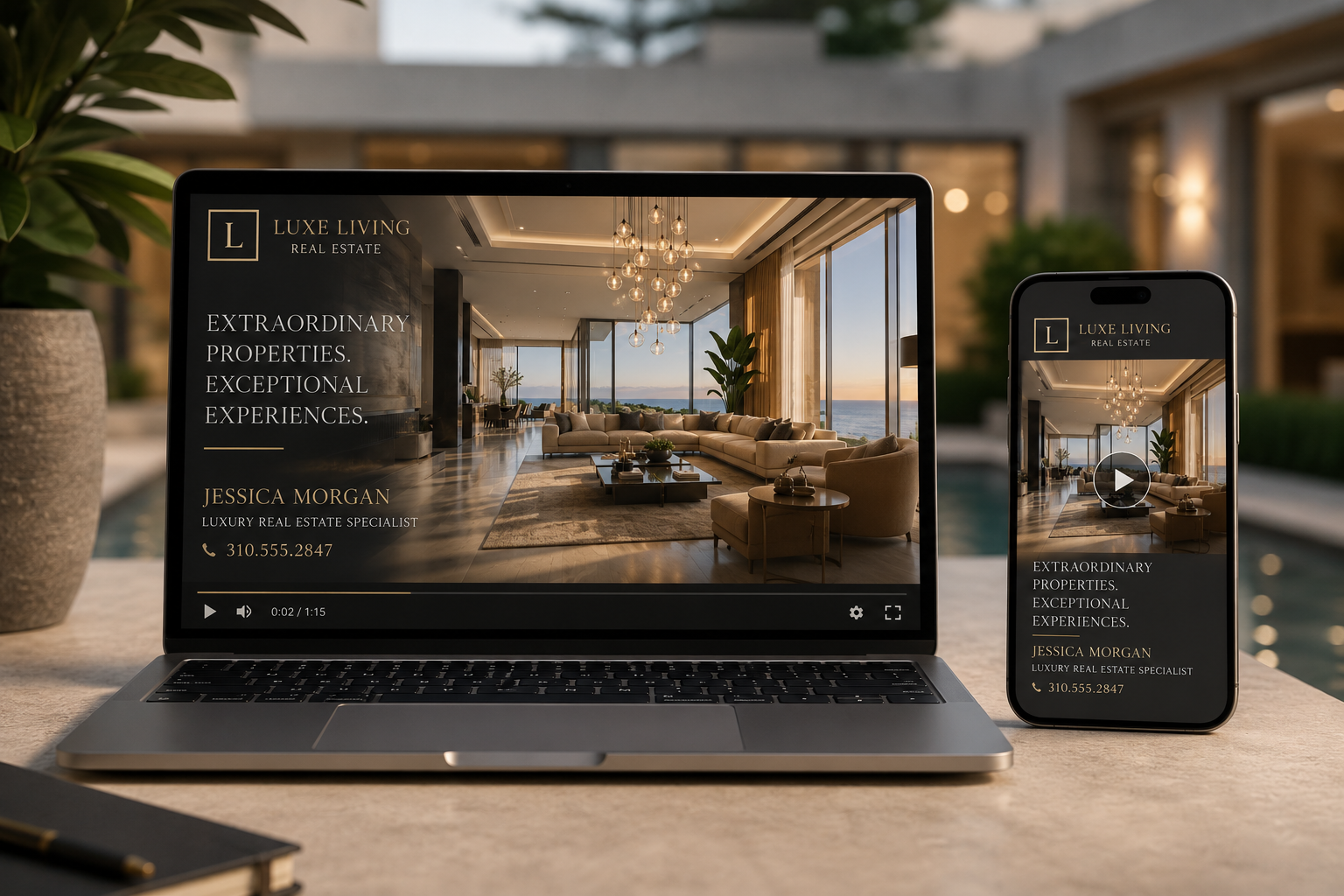
Rather than forcing every property into exactly the same presentation, platforms such as PhotoAIVideo can provide different visual styles for different types of listings.
Combined with control over room sequencing, this gives agents more flexibility to create a presentation that complements the property rather than relying on a one-size-fits-all approach.
A contemporary luxury home, for example, may benefit from a different visual treatment than a warm, traditional estate.
Reusable branding is particularly valuable for agents managing multiple listings.
Instead of rebuilding branding elements for every video, agents can use consistent elements such as logos, colors, contact information, and intro or outro content across their property marketing.
For an agent specializing in luxury real estate, that consistency can help establish a recognizable visual identity across multiple listings.
AI-generated voiceover can add narration to a property video without requiring the agent to record every script manually.
Some platforms also offer AI avatar or digital-clone features that can provide an on-camera-style introduction without requiring a new filming session for every property.
For agents who want a more personal, hosted-video feel but don't want to repeatedly set up cameras, lighting, and recording equipment, these tools can provide another option for producing branded property content.
Speed is another significant advantage.
Because AI real estate video can work from listing photos that have already been captured, agents don't necessarily need to coordinate another on-site shoot before creating video content.
For a luxury listing launch where photography, social content, email marketing, and listing pages all need to go live within a coordinated timeframe, reducing the additional production work required for video can be valuable.
Taken together, camera movement, style customization, branding, narration, and faster production can make AI-generated video a practical component of luxury real estate marketing.
There are also important limitations.
AI real estate video typically works from visual material that has already been captured. It cannot reveal something that isn't present in the original photographs.
If an estate has a feature best experienced through genuine motion — a wraparound view revealed during a walking shot, sunlight changing across a pool at golden hour, or an architectural sequence that only becomes apparent while physically moving through the property — AI-generated movement from a still image can't completely reproduce that experience.
A human videographer can deliberately capture a particular angle, movement, lighting condition, or moment. A drone operator can also reveal acreage, waterfront, landscaping, surrounding scenery, and the relationship between different parts of a property in ways that individual interior photographs cannot.
There's also a bespoke storytelling advantage.
A skilled videographer and editor can design an entire production around the distinctive characteristics of one property rather than adapting existing photos into a predetermined workflow.
For a true trophy property with a marketing budget that supports custom production, that level of human craftsmanship can still be worth commissioning.
The most useful question isn't necessarily "AI or human?" It's which approach makes sense for this particular listing and marketing goal?
For many luxury and near-luxury listings, AI real estate video can provide a practical primary or supplementary solution. It can turn existing photography into branded video content without requiring an additional full-scale production.
For exceptional trophy estates — where the marketing budget is substantial and the property's unique features genuinely benefit from purpose-built cinematography — commissioning a professional videographer and, where appropriate, a drone operator can still make sense.
That's where custom on-site production has its greatest advantage: capturing things that existing still photographs simply don't contain.
But the two approaches don't have to compete.
Even a property with a professionally produced hero video may need additional content throughout the marketing campaign: a vertical social clip, a short teaser before an open house, updated promotional material after a price change, or content designed for a different platform.
Creating another professional shoot for every one of those needs isn't always practical.
This is where AI-generated property video can complement traditional production particularly well: the commissioned video can serve as the flagship piece, while AI tools help agents create additional content from existing listing assets.
Is AI real estate video good enough for a luxury listing, or does it look obviously artificial?
It depends on the source material, platform, and type of video you're trying to create. AI can produce polished motion, branding, and presentation from high-quality listing photographs, but it can't capture visual information that wasn't present in those photographs in the first place. The quality of the source material therefore remains extremely important.
Can I use AI real estate video alongside a traditional videographer instead of choosing one or the other?
Yes. In fact, the two approaches can complement each other particularly well for high-end listings. A commissioned shoot can provide the property's flagship cinematic video, while AI-generated video can support additional social, promotional, and fast-turnaround content.
How long does it take to produce a listing video this way?
Production time depends on the platform, number of photos, selected features, and current processing conditions. Because the workflow starts with existing listing photography, however, it can eliminate much of the scheduling and on-site production involved in a traditional video shoot.
What export formats are available for social and marketing use?
Export options depend on the platform and plan. Common formats for real estate marketing include widescreen 16:9 for websites and YouTube, vertical 9:16 for short-form social platforms, and square 1:1 for certain feed placements. Check your platform's current export options before choosing a format.
AI real estate video isn't a wholesale replacement for a human production crew on every luxury property. But dismissing it entirely also overlooks where the technology can be genuinely useful: creating fast, polished, consistently branded video from listing photography and supporting the steady demand for additional marketing content.
For many agents working with luxury and near-luxury inventory, the most practical strategy isn't choosing one side. It's using AI where its speed and scalability make sense, while reserving custom video production for properties and moments where genuine on-site cinematography provides something AI-generated movement cannot.


Compact, ready to go anywhere
Interchangeable lens that’s upgradeable
Dual 1-inch sensors for improved clarity and low light performance
Dynamic range and 6K 360° capture
360° photo resolution at 21MP

8K 360° video recording for ultra-detailed visuals.
4K single-lens mode for traditional wide-angle shots.
Invisible selfie stick effect for drone-like perspectives.
2.5-inch touchscreen with Gorilla Glass protection.
Waterproof up to 33ft for underwater shooting.

360° photo resolution in 23MP
Slim design at 24 mm thick
Built-in image stabilization for smooth video capture.
Internal 19GB storage for photo and video storage.
Wireless connectivity for remote control and sharing.

60MP 360° still images for high-resolution photography.
5.7K 360° video recording at 30fps.
2.25-inch touchscreen for intuitive control.
USB Type-C port for fast charging and data transfer.
MicroSD card slot for expandable storage.
.png)

.png)

Try it free. No credit card required. Instant set-up.





.svg)


.svg)