


.png)


AI data labeling gets treated in a lot of organizations as a back-office task — something that happens before the "real" work of model development begins. That framing consistently undersells how much this step actually determines whether an enterprise AI investment pays off.
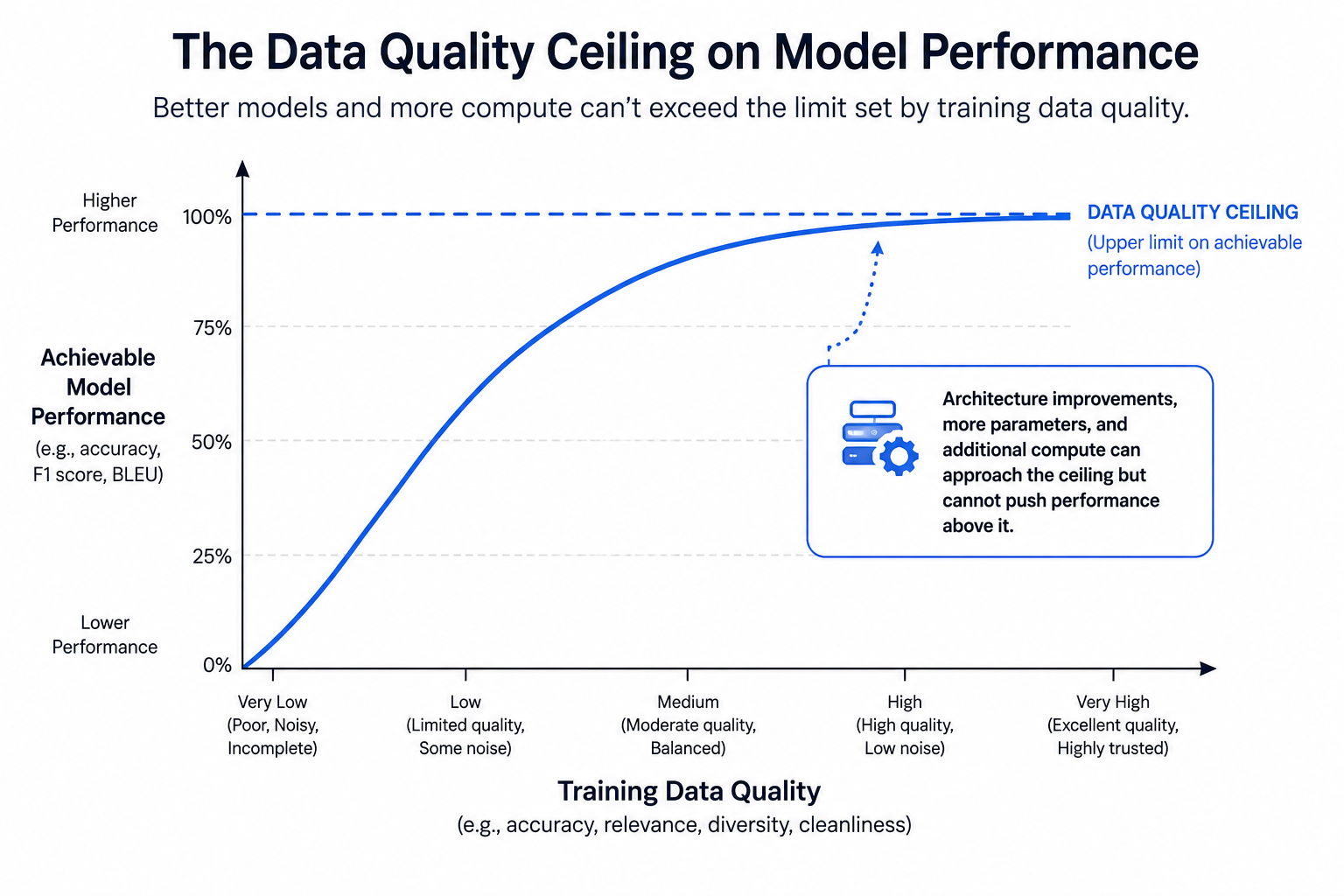
A model's ceiling is set by the data it learns from, not just its architecture or the compute behind training it. Enterprise teams that treat labeling as a strategic input, rather than a checkbox before training starts, tend to get meaningfully better and more reliable outcomes from the same model investment.
The gap between "we have labeled data" and "we have data labeled well enough for our use case" is where a lot of enterprise AI investment quietly underdelivers. Google Research's "Data Cascades" study documented how small, unaddressed problems in data preparation compound over time into expensive, hard-to-trace production failures — a pattern that shows up repeatedly in enterprise AI programs that treat labeling as a commodity step (Sambasivan et al., Google Research).
NIST's AI Risk Management Framework treats data quality and provenance as foundational to trustworthy AI, positioning it as a governance concern on par with model evaluation, not a preliminary step to move past quickly (NIST AI RMF).
The urgency here is compounding. Stanford HAI's AI Index has tracked how rapidly organizations are deploying models from research into production (Stanford HAI, AI Index Report), which means enterprise AI programs increasingly don't have the runway to discover a training data quality problem after a model is already live.
At a strategic level, AI data labeling isn't just annotators applying tags — it's a system with several layers, each of which affects the final quality of a model's training data.
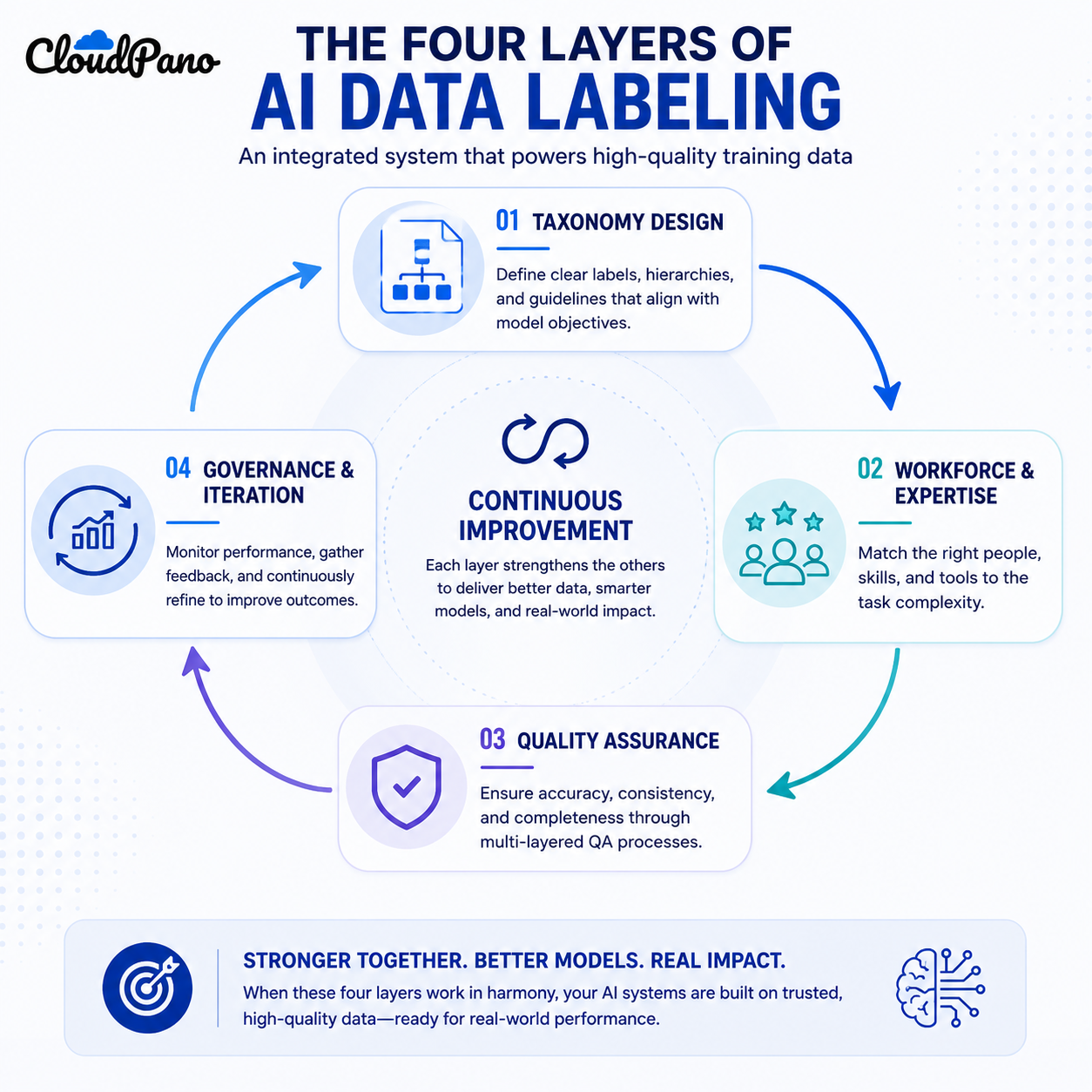
Taxonomy design. Deciding what labels or categories actually matter for the model's objective, which shapes everything downstream.
Workforce and expertise. Matching annotator skill and domain knowledge to the complexity of the data, from generalist tagging to clinical or technical specialization.
Quality assurance. The processes — gold-standard testing, consensus labeling, agreement tracking, audits — that catch and correct errors before they reach a model.
Governance and iteration. Treating labeling guidelines as living documents that evolve as edge cases surface, rather than a one-time specification.
Understanding how these workflows operate as an integrated system — not four separate checkboxes — is what separates enterprise AI programs that scale reliably from ones that hit an unexplained quality ceiling.


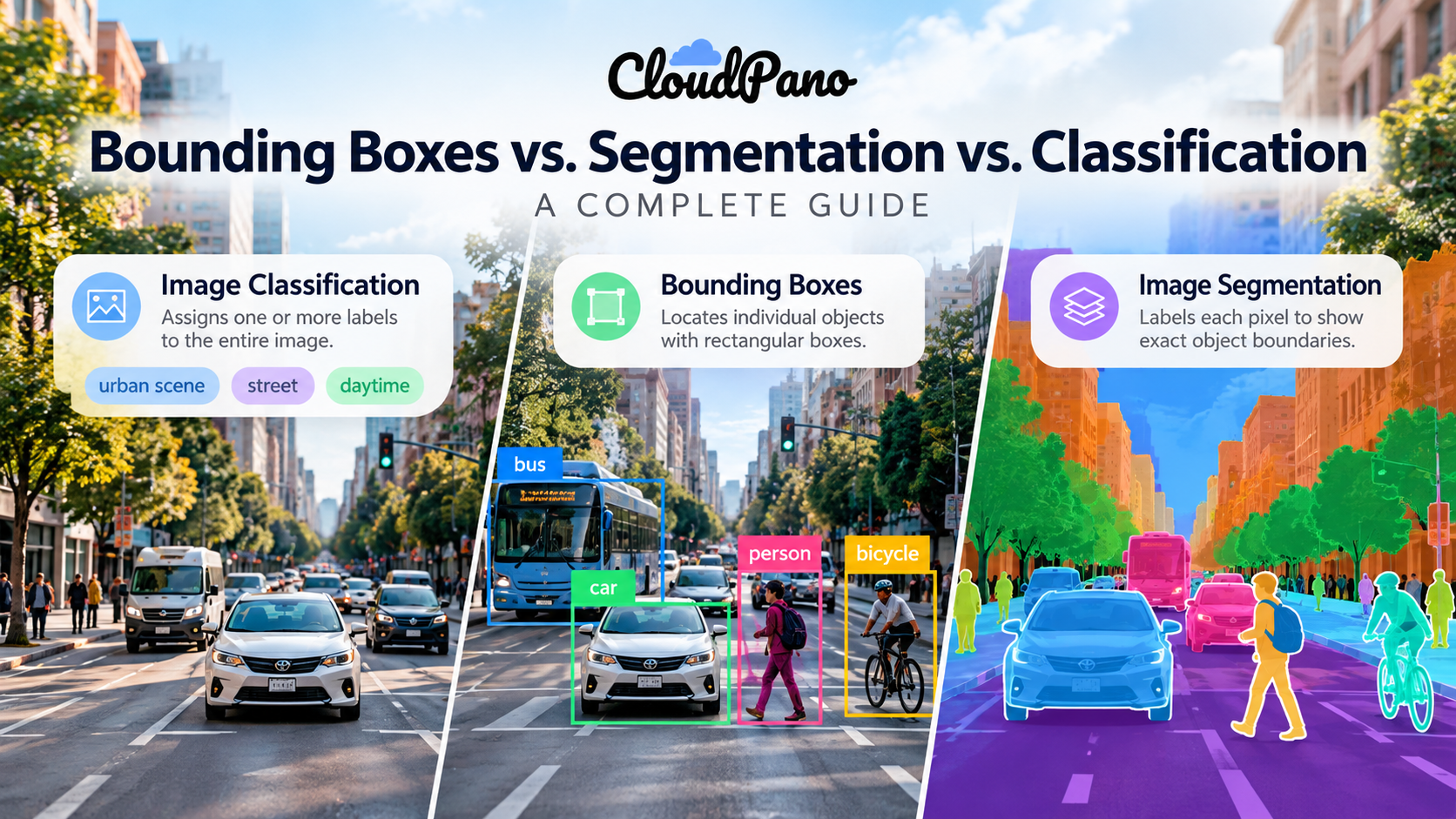
It's the process of adding structured information — tags, categories, bounding boxes, or other annotations — to raw data so a machine learning model can learn patterns from it.
Enterprise AI systems operate at a scale and stakes level where labeling errors compound quickly and are expensive to trace and fix, making training data quality a strategic concern rather than a minor operational detail.
A model can't learn a distinction its training data never captured correctly, so inconsistent or incorrect labels directly cap what a model can reliably do, regardless of how sophisticated its architecture is.
Ongoing. Most enterprise AI systems require continuous labeling as models are retrained, expanded to new use cases, or as edge cases are discovered, rather than a single upfront data build.
This varies by use case and industry, so it's best assessed against your specific model requirements and risk tolerance rather than a fixed ratio.
Accountability typically sits with the AI/ML team executing the project, but governance and quality outcomes are increasingly relevant to leadership, compliance, and risk functions given the downstream implications for model reliability.
Models that appear to perform well in testing but fail unpredictably in production on edge cases, since underlying training data quality issues are often invisible until a model is already deployed.
AI data labeling isn't a preliminary step to move past on the way to model development — it's a determining factor in whether an enterprise AI investment actually delivers reliable results. Teams that resource and govern it as a strategic function, not an afterthought, consistently get more value out of the same underlying model investment.


Compact, ready to go anywhere
Interchangeable lens that’s upgradeable
Dual 1-inch sensors for improved clarity and low light performance
Dynamic range and 6K 360° capture
360° photo resolution at 21MP

8K 360° video recording for ultra-detailed visuals.
4K single-lens mode for traditional wide-angle shots.
Invisible selfie stick effect for drone-like perspectives.
2.5-inch touchscreen with Gorilla Glass protection.
Waterproof up to 33ft for underwater shooting.

360° photo resolution in 23MP
Slim design at 24 mm thick
Built-in image stabilization for smooth video capture.
Internal 19GB storage for photo and video storage.
Wireless connectivity for remote control and sharing.

60MP 360° still images for high-resolution photography.
5.7K 360° video recording at 30fps.
2.25-inch touchscreen for intuitive control.
USB Type-C port for fast charging and data transfer.
MicroSD card slot for expandable storage.
.png)

.png)

Try it free. No credit card required. Instant set-up.





.svg)


.svg)