


.png)


The residential real estate marketplace has shifted into a high-velocity, attention-driven arena. For years, the industry relied on a standard operating playbook: secure a residential listing, capture high-resolution static photography, and publish those static assets to local Multiple Listing Services (MLS) databases.
However, macro consumer data tracked by platforms like Statista illustrates an unmistakable trend—user engagement with traditional, non-moving web listings has experienced a steep downward trajectory over recent quarters. Modern buyers no longer look for homes through simple photo galleries; they consume properties within dynamic, vertical social feeds.
This change has created an operational crisis for individual real estate agents and brokerage teams: massive content fatigue. The average top-producing agent is already overloaded with client management, open houses, transaction legalities, and local market analysis. Expecting these same agents to act as expert mobile cinematographers and desktop video editors is unrealistic.
The barriers blocking traditional real estate video production software deployment are clear:
As a result, forward-thinking real estate teams are pivoting. Instead of scheduling complex, expensive physical video shoots, they are adopting deep-learning engines to turn their existing static photography portfolios into rich, algorithmically optimized vertical video assets on autopilot.
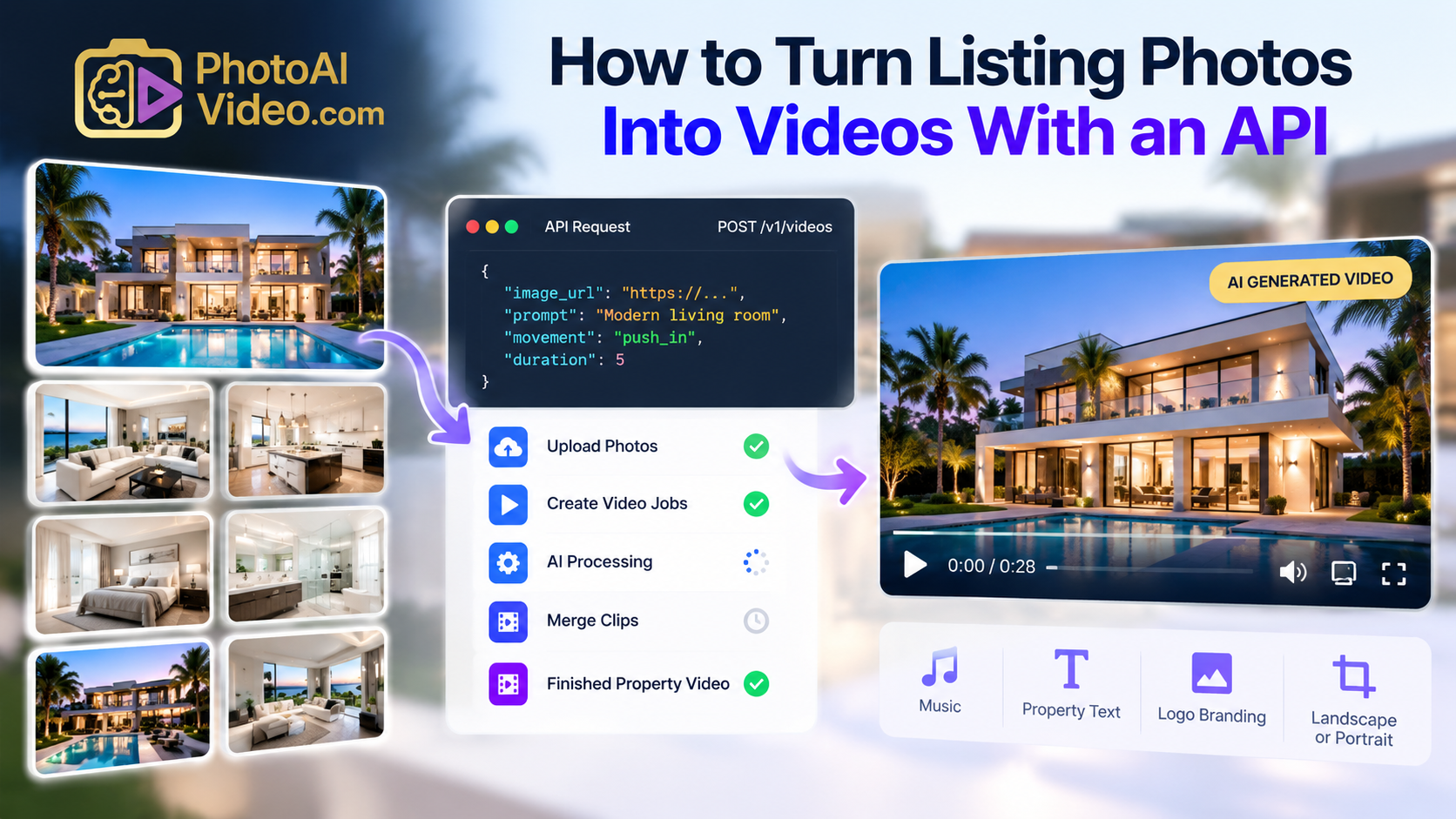
The operational bottleneck is addressed by optimizing asset utilization: leveraging the digital media properties you already own. This is where PhotoAIVideo.com redefines real estate marketing workflows. Engineered as a high-performance, automated photo-to-video short-form engine, the platform eliminates the technical and financial hurdles that traditionally stall video marketing campaigns.
Rather than requiring agents to purchase expensive camera rigs or navigate complex, manual real estate video production software, the system takes standard MLS static images and converts them. By processing structural visuals through an advanced AI property reels software model, it applies cinematic camera pans, perspective shifts, and smooth tracking transitions tailored directly to mobile displays.
The software functions as an integrated real estate Instagram video maker and short-form real estate video AI engine. It builds high-impact vertical assets structured to fit the precise framing, pacing, and emotional hooks required by modern social video delivery frameworks. This allows elite teams to maximize their asset output, converting single property portfolios into multi-channel marketing campaigns without increasing production overhead.
To appreciate why a premium real estate reels generator AI produces superior consumer engagement metrics, it is necessary to examine the core imaging mechanics under the hood. The system does not simply overlay elementary sliding animations across a two-dimensional image plane. Instead, it processes assets through an advanced computer vision rendering pipeline.
When a standard interior or exterior photograph enters the system, the model analyzes the pixels to estimate depth. By evaluating shadows, light diffusion, and architectural geometries, the algorithm constructs a detailed structural mesh of the room. This process allows the engine to separate distinct spatial layers:
Once these geometric zones are isolated, the engine applies customized camera tracking paths. This approach creates a true parallax effect, mimicking the natural movement of a high-end physical camera rig within a fully virtual space.
Additionally, the system eliminates the erratic transitions common in amateur mobile editing apps. It maps out smooth motion curves based on professional real estate film principles:
This controlled approach delivers polished, consistent messaging across short-form real estate video AI applications, preserving your brand's luxury positioning while maximizing content velocity.
For high-performing real estate agents, operational scaling is achieved by minimizing manual tasks. Complex tools fail to gain widespread adoption because they demand too much time. According to efficiency documentation published by Webflow University, digital tool design must focus on lowering friction points to ensure users can reliably replicate workflows at scale.
The data ingest pipeline on PhotoAIVideo.com uses a streamlined, four-stage loop that turns raw listing portfolios into live marketing campaigns within moments.
The agent uploads their existing property media files directly to the secure processing dashboard. The system accepts standard image outputs exported directly from local MLS property databases.
The user selects a presentation style optimized for their target channel, whether they are deploying an AI social media videos for Realtors program or launching a paid real estate video ad maker AI campaign. The platform's processing nodes handle the heavy lifting automatically.
The rendering engine compiles the assets into a clean, mobile-native 9:16 vertical layout. It balances the visual composition, inserts smooth transitions, and renders high-definition, color-corrected video files.
The completed vertical videos are exported instantly, ready for direct distribution across modern short-form channels—including TikTok feeds, Instagram Reels playlists, and YouTube Shorts carousels.
Launching content successfully requires an understanding of digital user interaction habits. Modern vertical video spaces depend entirely on real-time feedback loops. Research data published by the Nielsen Norman Group shows that users browsing digital interfaces make engagement choices within micro-windows, requiring visual media to deliver value immediately to hold user interest.
To maintain positive distribution loops within short-form networks, your content must satisfy several key retention markers. The engines running behind PhotoAIVideo.com are designed precisely around these behavioral patterns.
Social discovery algorithms monitor user retention within the opening three seconds of playback. If viewers skip content immediately, the platform slows down its broader reach.
While typical real estate walk-throughs open with a slow exterior shot of a driveway, an AI listing reels for Realtors application changes the presentation order. It starts with the property's most compelling room—like a premium master bath or a sun-drenched sunroom—using smooth, active tracking to stop the scroll and capture user attention.
Modern vertical content performs best when kept short, ideally between 8 and 14 seconds. The real estate TikTok creator tool builds around this dynamic by adjusting its transition timing.
By delivering clear spatial motion alongside clean text labels, the system encourages viewers to watch the asset completely. High completion percentages signal to distribution networks that the video provides value, which pushes the asset out to broader local audiences.
Choosing to buy AI property video maker licenses is an investment that directly improves customer acquisition costs (CAC) and expands local brand reach. Operational data insights shared by HubSpot highlight that deploying automated media variations allows businesses to optimize ad spend while increasing overall user conversion volume.
By replacing manual content creation loops with automated video engines, real estate teams can build reliable, cost-effective lead generation funnels. When these video assets are deployed strategically, your social profiles function as active lead capture points.
Instead of scrolling past static property photos, prospective buyers click through to tour registration forms, listing pages, or direct messaging channels. This strategy works efficiently across paid and organic networks:
Beyond individual home sales, consistent content velocity builds valuable market authority. When local homeowners look for a listing agent, they prefer tech-forward realtors with strong digital reach.
Regularly publishing high-quality vertical videos demonstrates a modern, proactive approach to property marketing, helping real estate teams win listing presentations and stand out from local competitors.
While real estate reels generator AI tools make production simple, agents must avoid common execution mistakes to ensure their short-form videos remain effective:
An AI real estate reels app requires clean input data to render polished results. Uploading blurry, pixelated, or low-light listing photos limits the engine's quality. Always use high-resolution, clear images to ensure sharp video tracking and professional-looking transitions.
Many agents clutter their videos with flashing stickers, multiple competing fonts, and oversized pricing badges.
Keep your presentation clean. Let the property's architectural details stand out, using minimal text labels to highlight key details like location, price, and your call to action.
Repurposing widescreen landscape images without adjusting for a vertical layout produces ugly black bars at the top and bottom of mobile displays. This signals to users that the content is low-effort, prompting them to swipe away. Use dedicated short-form real estate video AI settings to format your assets natively for 9:16 mobile screens from the start.
The real estate industry is moving away from manual asset production toward automated, system-driven workflows. Relying on slow, expensive editing teams makes it difficult to maintain the content volume needed to compete.
As digital real estate insight reports from Adobe Experience Cloud point out, modern marketing success depends on deploying smart systems that automate asset variations quickly across channels.
Integrating automated software like PhotoAIVideo.com into your business lets you step away from time-consuming video editing and focus your energy on client relationships and closing sales. The automation tools are ready to deploy—use them to scale your business today.


Compact, ready to go anywhere
Interchangeable lens that’s upgradeable
Dual 1-inch sensors for improved clarity and low light performance
Dynamic range and 6K 360° capture
360° photo resolution at 21MP

8K 360° video recording for ultra-detailed visuals.
4K single-lens mode for traditional wide-angle shots.
Invisible selfie stick effect for drone-like perspectives.
2.5-inch touchscreen with Gorilla Glass protection.
Waterproof up to 33ft for underwater shooting.

360° photo resolution in 23MP
Slim design at 24 mm thick
Built-in image stabilization for smooth video capture.
Internal 19GB storage for photo and video storage.
Wireless connectivity for remote control and sharing.

60MP 360° still images for high-resolution photography.
5.7K 360° video recording at 30fps.
2.25-inch touchscreen for intuitive control.
USB Type-C port for fast charging and data transfer.
MicroSD card slot for expandable storage.
.png)

.png)

Try it free. No credit card required. Instant set-up.






.svg)


.svg)