


.png)


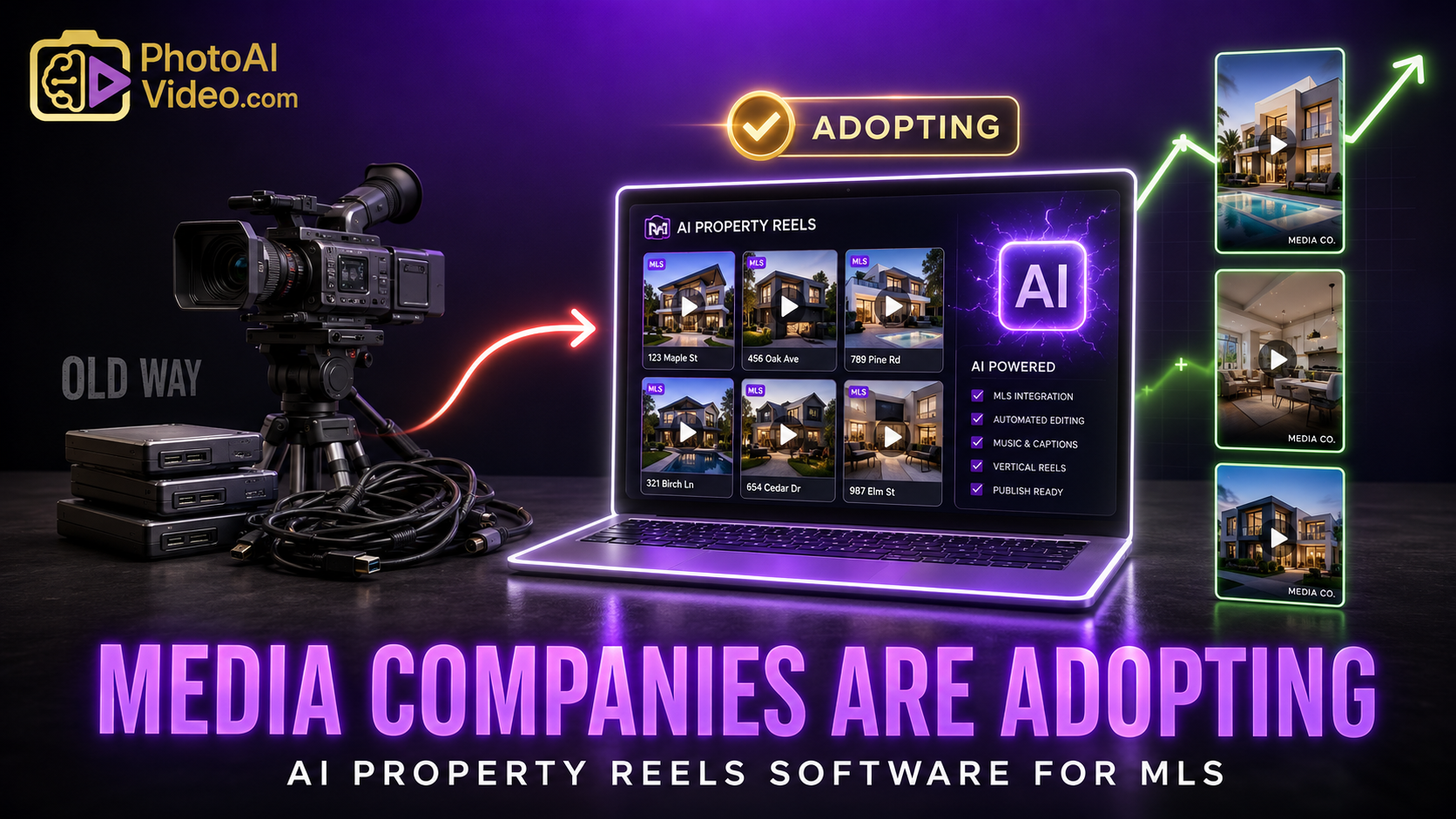
Spend a morning sitting in on an executive planning session at any regional real estate imaging agency. You will find that the chief operational anxiety has very little to do with raw camera sensors, lighting gears, or drone hardware configurations. The modern crisis is centered entirely on a margin-crushing bottleneck: the sheer math of video production timelines vs. what local brokerages are actually willing to pay.
Independent realtors and corporate teams alike demand a constant stream of native vertical loops to populate their digital channels. Yet, traditional filming pipelines are fundamentally too slow and too expensive to deploy across every standard suburban listing, commercial space, or mid-tier multi-family property.
The online distribution space has become incredibly unforgiving for flat visual media. When an agent posts standard stationary image grids across major consumer discovery networks, the network algorithms restrict the content's visibility rank. Data tracking metrics updated by Meta for Business prove that modern streaming systems place a massive priority on active motion states. Unmoving graphic uploads are penalized with low reach because smartphone users naturally scan right past them.
This behavioral trend leaves commercial media houses facing a structural wall. Dispatching an on-site video crew to track down every entry on a client's MLS roster destroys profitability. You end up juggling scheduling conflicts, high editor hours, and weather delays. Trying to fix this by cutting corners on production value simply yields cheap slideshow loops that agents reject. Media teams require an automated system that extracts cinematic motion straight from raw photography.
To maintain client retention and stabilize delivery margins, modern media agencies are treating vertical video assembly as an automated software utility rather than a manual, handcrafted art form. Look closely at your current client asset folders. Your field crews are already capturing high-resolution, perfectly lit architectural photography portfolios for standard property database indexes. Leaving those high-end photo files static means your business is ignoring an incredible source of leverage.
This is where PhotoAIVideo.com modifies your daily operational speed. Operating as a fast, browser-based web application, it serves your media production desk as a high-powered short-form real estate video AI pipeline built to completely eliminate design bottlenecks.
Your editing assistant does not need to build multi-track timelines or wrestle with specialized desktop software. You drop a single high-resolution architectural image straight into the platform.
The application processes the base file instantly, turning a flat layout into an immersive 3D vertical motion file that matches native mobile specifications. By moving asset processing over to an automated engine, your agency can scale vertical media delivery across an entire real estate network on autopilot, adding an instant premium upsell to your photography packages without adding field labor.

Static 2D source file. Suppressed by vertical algorithms due to zero interactive visual signals.
Calculated multi-plane computer vision creates deep cinematic camera sweep patterns to hold user engagement.
The programmatic capability to build genuine moving visual content from a single photographic exposure relies completely on monocular depth estimation math. It skips the artificial, uniform pixel scaling that makes legacy slideshow software look incredibly cheap. Understanding how the program splits image maps helps production teams select top-tier photographic inputs from their active library.
When you drop an architectural interior or exterior master shot into the rendering line, the application reads color patterns, wall geometry, and illumination lines across the pixel matrix. The cloud engine calculates a spatial coordinates grid, identifying precisely what structure sits in the immediate foreground—such as a modern marble kitchen counter, a floating glass stair tread, or staging furniture pieces—and slices those objects cleanly away from back-tier environments like far-off window scenery or deep tree lines.
Once the application completes this precise plane isolation, it runs a programmatic parallax motion matrix. By shifting the foreground layer on a slightly faster vector relative to the deep background backdrop, it flawlessly matches the visual depth tracking signals of human sight.
The resulting layout acts as a verified real estate reels generator AI output that looks like it was captured by a heavy tracking camera sliding past an architectural frame. Because spatial proportions and dimensions remain entirely accurate, property buyers receive a real sense of home layout, establishing professional credibility before they ever choose to book a live walkthrough tour.
Sustaining absolute creative scale across a media agency's entire database requires an ultra-lean operational architecture. Implementing a dedicated AI property reels software model into your post-production pipeline allows your team to convert static delivery folders into ready-to-publish social campaigns before your morning review wrap-up:
Consumer browsing behavior inside mobile streaming networks is incredibly ruthless. Interface navigation research monitored by the Nielsen Norman Group establishes that smartphone home buyers parse their digital channels using ultra-rapid pattern-matching loops, tossing aside traditional branded content slides inside milliseconds to preserve mental focus. Within a highly competitive mobile feed, your creative asset has exactly three seconds to execute a physical thumb-stop and earn focused attention.
If your ad campaigns open with slow-fading brand names, stationary graphic blocks, or static introduction photos, you are burning your media capital. System auction landscapes score this rapid user exit with zero tolerance. When targets skip past your creative inside the initial two seconds, data networks flag your content quality weight as poor, which automatically drops your delivery priority and spikes your baseline cost-per-click levels.
Deploying optimized AI social media videos for Realtors entirely neutralizes this algorithmic drop-off block. Because the 3D parallax transformation applies deep drifting movement from the literal first frame, you trigger a primal tracking reflex in the human eye.
The viewer slows their swipe because their brain requires an extra moment to process the changing dimensional perspectives. This visual hold window preserves attention long enough for prospects to digest your property parameters and click your lead generation links, optimizing your ad performance while lowering target lead costs.
Scaling up commercial media contracts requires strict control over asset exhaustion metrics. Analytical field studies tracked by HubSpot establish that localized real estate target segments suffer visual saturation and creative exhaustion faster than nearly any other consumer demographic. If your agency framework relies on slow manual videography schedules or expensive corporate video retainer teams, your ad testing agility remains locked. You end up serving identical listing previews to your geographic target audiences for weeks, driving up your lead acquisition costs as consumer response flatlines.
Transitioning your asset production tasks to automated cloud rendering systems completely decouples your creative variant volume from your marketing payroll. Your growth coordinator can instantly produce 15 distinct, high-motion parallax variations from a single residential image set in an afternoon, verifying separate interior perspectives and camera tracking tracks to identify exactly what triggers high local click-through depth.
This systematic visual velocity feeds a reliable client acquisition funnel built to scale:
Scaling up media production volume gives your agency a massive tactical advantage, but you must still monitor fundamental visual boundaries to keep your deliverables looking premium for client brokerages:
The production groups locking down the highest volume of qualified transactions across modern local landscapes aren't winning purely on brute financial spend. They rule their territories because they choose high creative velocity—the capacity to turn raw photographic inventories into dozens of moving, conversion-optimized video ads while competitor offices are still waiting for an outside videography firm to clear an edit queue slot.
Instead of burning valuable capital on heavy agency margins or wasting agent production time on complex timeline tracking software, move your design pipeline straight to automated cloud rendering tools. Introduce true dimensional scale to your listings, capture high-retention consumer blocks, and expand your business by injecting cinematic 3D motion into your standard property folders.


Compact, ready to go anywhere
Interchangeable lens that’s upgradeable
Dual 1-inch sensors for improved clarity and low light performance
Dynamic range and 6K 360° capture
360° photo resolution at 21MP

8K 360° video recording for ultra-detailed visuals.
4K single-lens mode for traditional wide-angle shots.
Invisible selfie stick effect for drone-like perspectives.
2.5-inch touchscreen with Gorilla Glass protection.
Waterproof up to 33ft for underwater shooting.

360° photo resolution in 23MP
Slim design at 24 mm thick
Built-in image stabilization for smooth video capture.
Internal 19GB storage for photo and video storage.
Wireless connectivity for remote control and sharing.

60MP 360° still images for high-resolution photography.
5.7K 360° video recording at 30fps.
2.25-inch touchscreen for intuitive control.
USB Type-C port for fast charging and data transfer.
MicroSD card slot for expandable storage.
.png)

.png)

Try it free. No credit card required. Instant set-up.






.svg)


.svg)