AI Training Data Provider vs. Data Labeling Company: What's the Difference?

Cloudpano
July 24, 2026
5 min read
Share this post

When Do You Need an AI Training Data Provider Instead of a Data Labeling Company?

The AI training data provider vs data labeling company question usually surfaces at a specific, recognizable moment: a team requests a proposal from a labeling vendor, and the vendor asks for the raw data — data the team doesn't actually have yet. That's the signal, not a general curiosity about terminology.

This article isn't another definitional breakdown of the two terms. It's a set of specific signals that tell you, for your actual project, which one you need — because getting this wrong doesn't usually surface until you're already partway into an engagement that can't solve your real problem.

Why It Matters

Engaging the wrong type of vendor for your actual gap doesn't just waste time — it delays discovery of the real problem until you're further into a project timeline. Google Research's "Data Cascades" study documented how issues that trace back to a fundamental mismatch early in a data pipeline tend to surface later as expensive, hard-to-diagnose problems (Sambasivan et al., Google Research).

NIST's AI Risk Management Framework treats data provenance — where data actually comes from — as a distinct governance concern from data quality alone, which is a useful reminder that "how was this data obtained" is a different question from "how well was this data labeled" (NIST AI RMF).

Getting this right the first time matters more given how quickly AI projects move. Stanford HAI's AI Index has tracked the accelerating pace of enterprise AI deployment (Stanford HAI, AI Index Report), and discovering a vendor-type mismatch partway through a timeline is a costly place to lose momentum.

How It Works

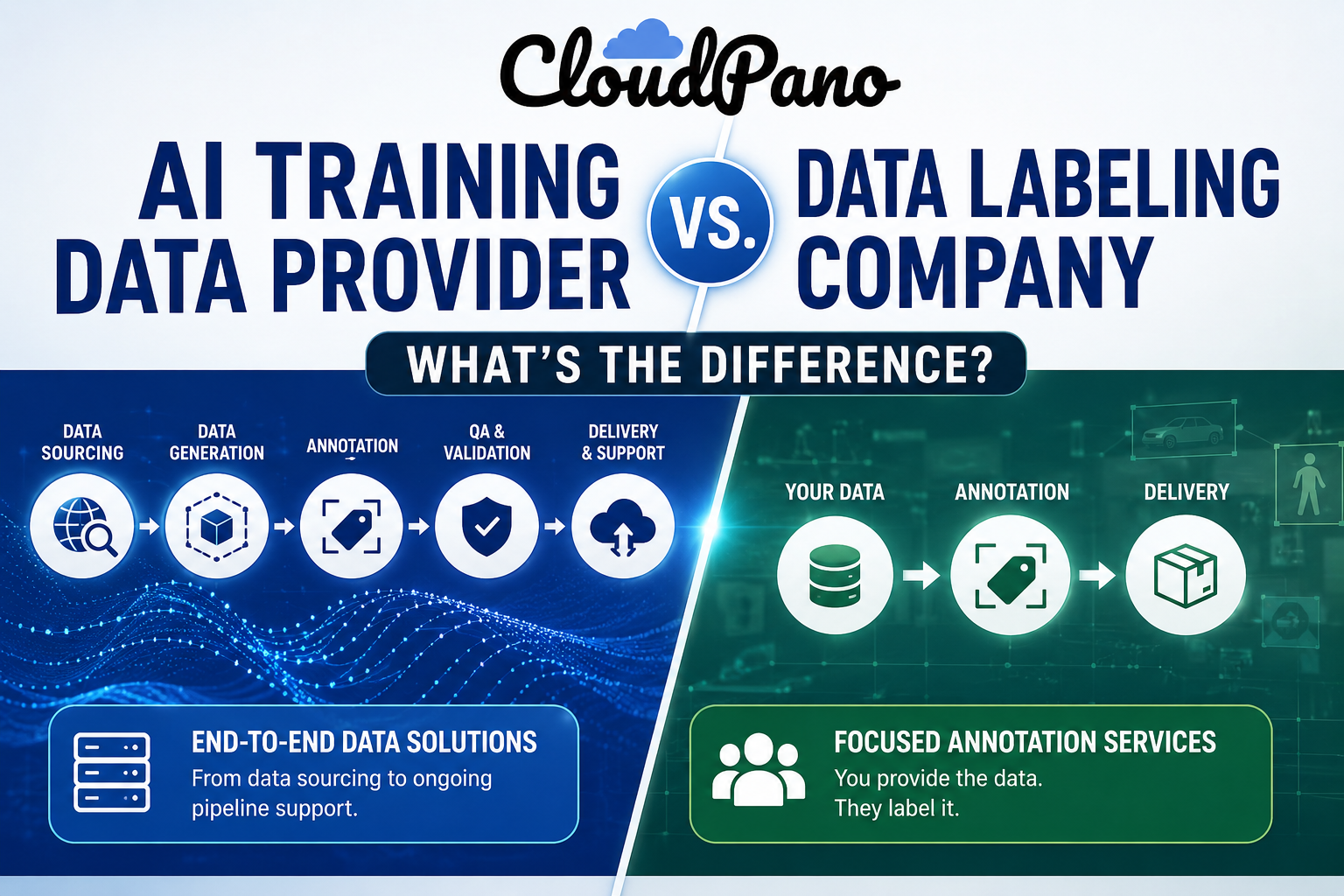
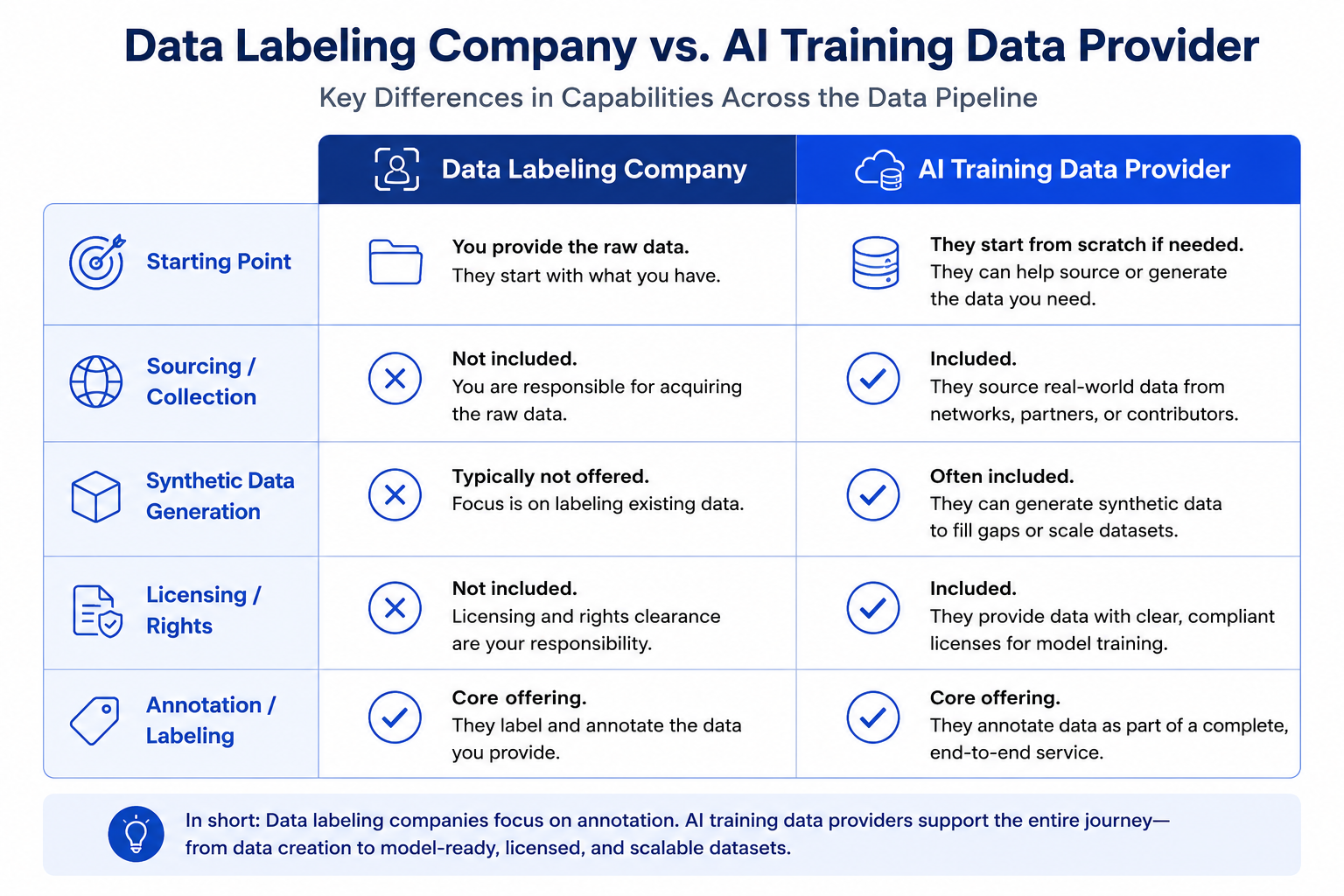
A data labeling company solves one specific problem: applying structure — tags, categories, bounding boxes, entity annotations — to data you already have in hand. A training data provider solves a broader problem: getting usable training data in the first place, which can include sourcing, collecting, licensing, or generating data, in addition to labeling it.
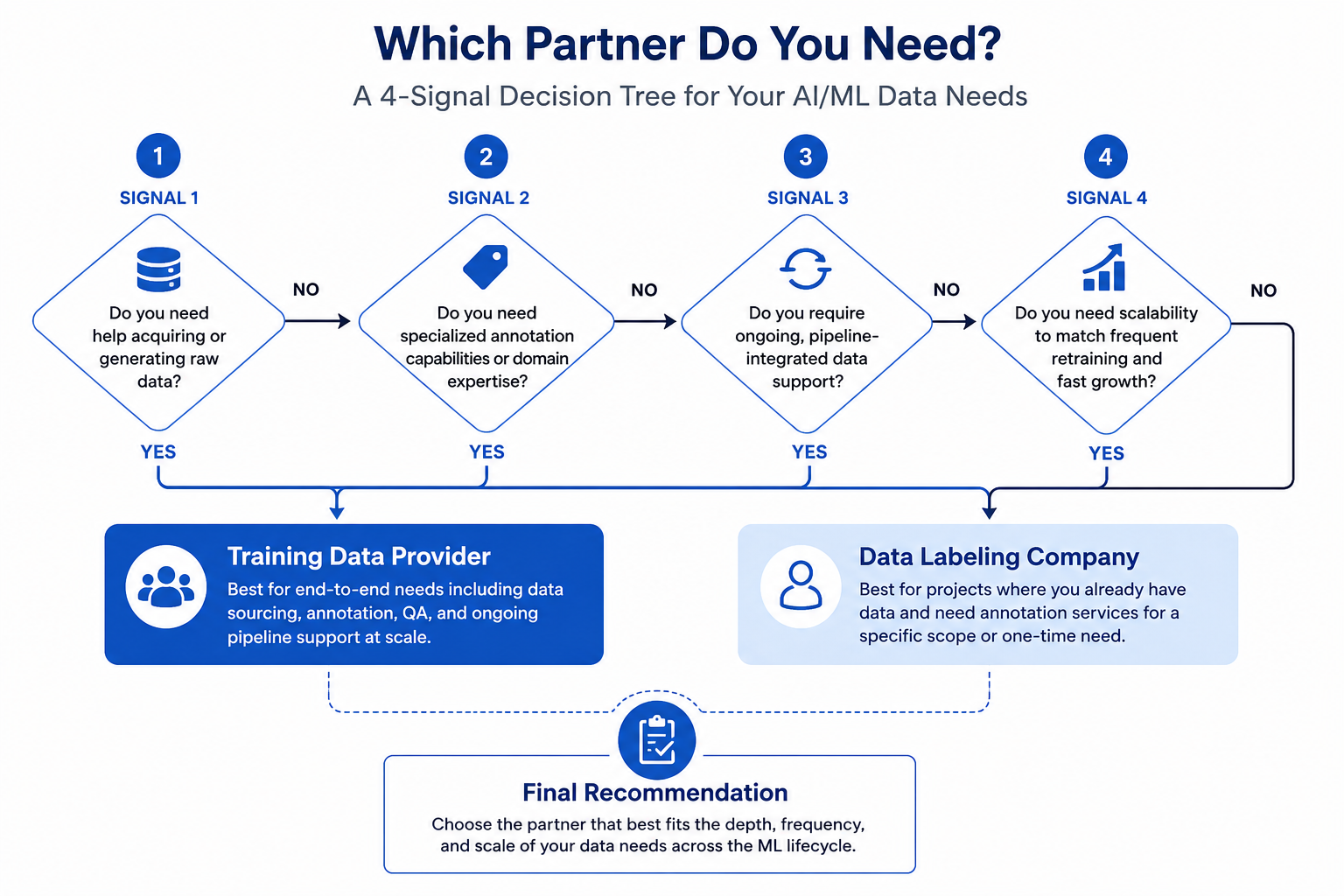
Flowchart of signals for choosing an AI training data provider vs data labeling company

The signal for which one you need isn't about company size, reputation, or how they market themselves — it's about where your actual gap sits in the pipeline. Understanding how these workflows operate at this level of specificity is what separates a fast, accurate vendor decision from a slow, trial-and-error one.
Signal 1 — Do you already have the raw data? If yes, and the gap is purely in adding structure to it, a data labeling company is likely sufficient.

Signal 2 — Does the raw data not exist yet, or exist in insufficient volume? This points toward a training data provider capable of sourcing, collecting, or generating data, not just labeling what's already there.

Signal 3 — Is the gap in rare or edge-case scenarios specifically? This often points toward a provider with synthetic data generation capability, which most pure labeling companies don't offer.

Signal 4 — Does the data require licensing, rights clearance, or sourcing from specific environments? This points toward a provider with sourcing and provenance capability beyond annotation alone.
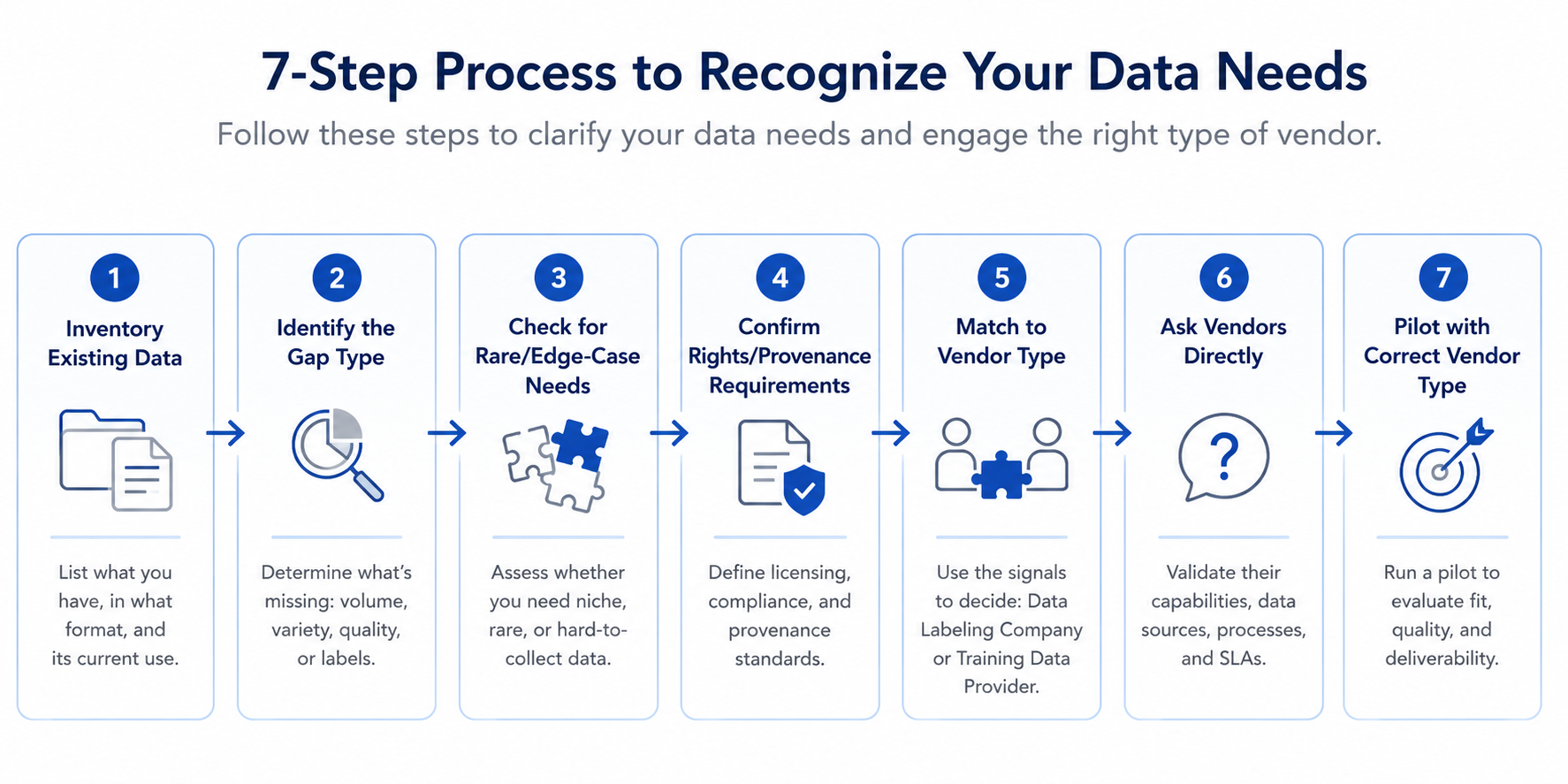
Step-by-Step Workflow for Recognizing Your Actual Need

  1. Inventory what raw data you currently have. Be specific about volume, coverage, and whether it represents the full range of scenarios your model needs to learn.
  2. Identify the gap between what you have and what your model needs. Is it a labeling gap (data exists, needs structure) or a data gap (the data itself doesn't exist yet)?
  3. Check whether the gap includes rare, dangerous, or hard-to-collect scenarios. This is a strong signal for provider capability beyond pure labeling, potentially including synthetic data generation.
  4. Confirm data rights and provenance requirements for any data you'd need sourced. If licensing or collection rights are involved, this points toward a provider, not a labeling-only vendor.
  5. Match your finding to the right vendor type. A pure labeling gap fits a data labeling company; a data-existence gap fits a broader training data provider.
  6. Ask candidate vendors directly which category they fall into. Don't assume from marketing language — confirm whether sourcing, collection, or synthetic generation are actually part of their offering.
  7. Pilot with the vendor type matched to your actual gap. Testing a labeling company on a sourcing problem, or vice versa, won't produce a meaningful pilot result either way.

Industry Use Cases

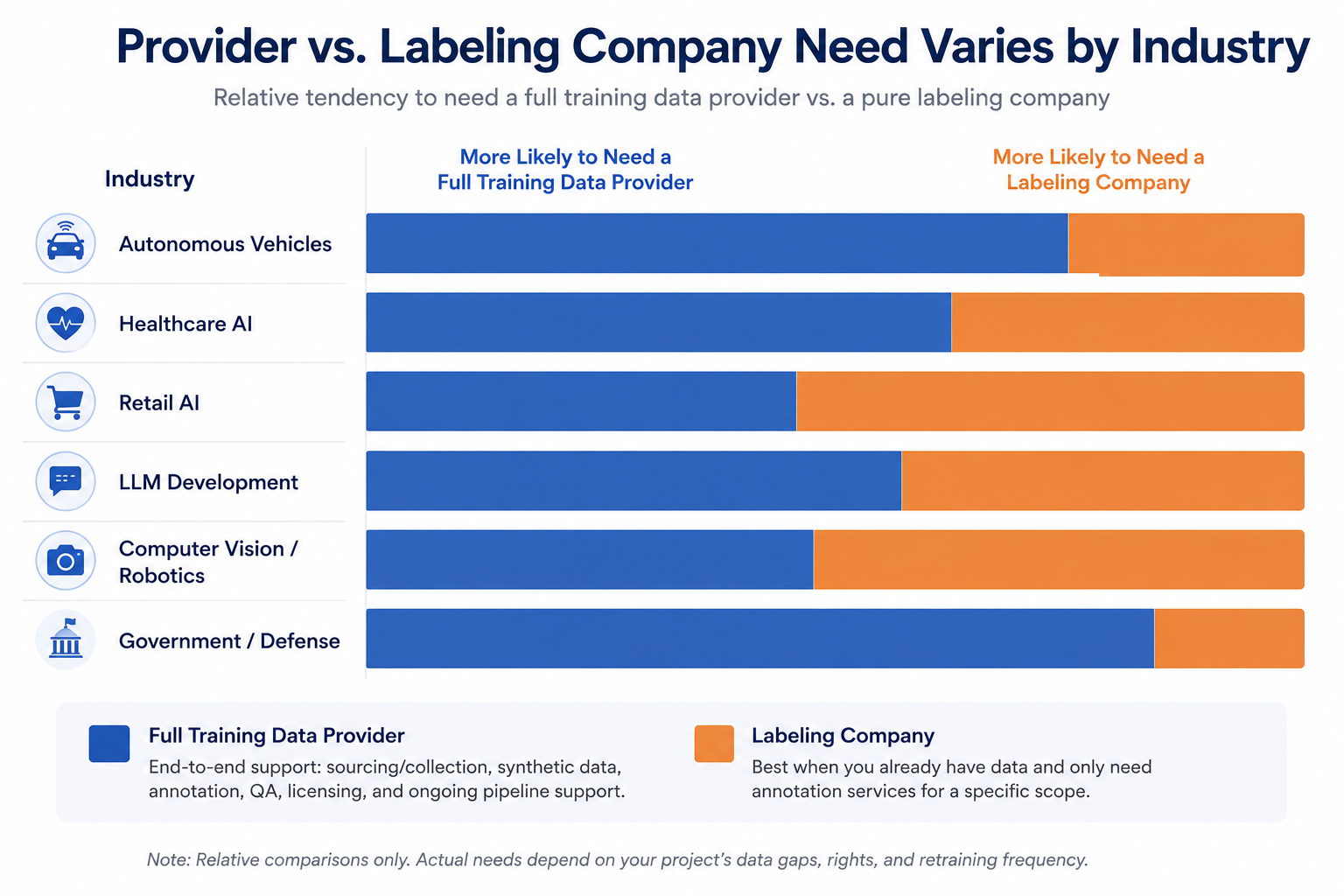
  • Computer vision / robotics: Teams with existing image datasets that just need structure typically need a data labeling company; teams needing images of specific, uncommon environments need a broader provider.
  • Autonomous vehicles: Rare driving scenarios frequently require a provider with synthetic data generation capability, not just a labeling company applying annotation to existing footage.
  • Healthcare AI: Licensing and sourcing clinical data under proper regulatory constraints points toward a full provider; annotating already-licensed clinical data points toward a specialized labeling company.
  • Retail AI: Existing product catalogs that just need categorization typically fit a data labeling company well; a need for new customer interaction data points toward a broader provider.
  • LLM developers: General text classification on existing corpora fits a labeling company; generating custom domain-specific conversational data points toward a training data provider.
  • Government & defense: Data provenance and chain-of-custody requirements often push toward a full provider capable of documenting sourcing, not just a labeling vendor.

Benefits of Getting This Distinction Right Early

  • Faster, more accurate vendor shortlisting. Knowing which category you need narrows the field immediately instead of evaluating vendors that can't solve your actual problem.
  • Avoiding a mid-project pivot. Recognizing the gap correctly upfront prevents discovering, partway through an engagement, that the vendor type was wrong from the start.
  • More accurate proposals and timelines. Vendors scoping against your actual need — not a mismatched assumption — produce more realistic cost and timeline estimates.
  • Clearer internal communication. Being specific about which type of gap you have makes it easier to explain the project's actual requirements to stakeholders and procurement.

Common Mistakes

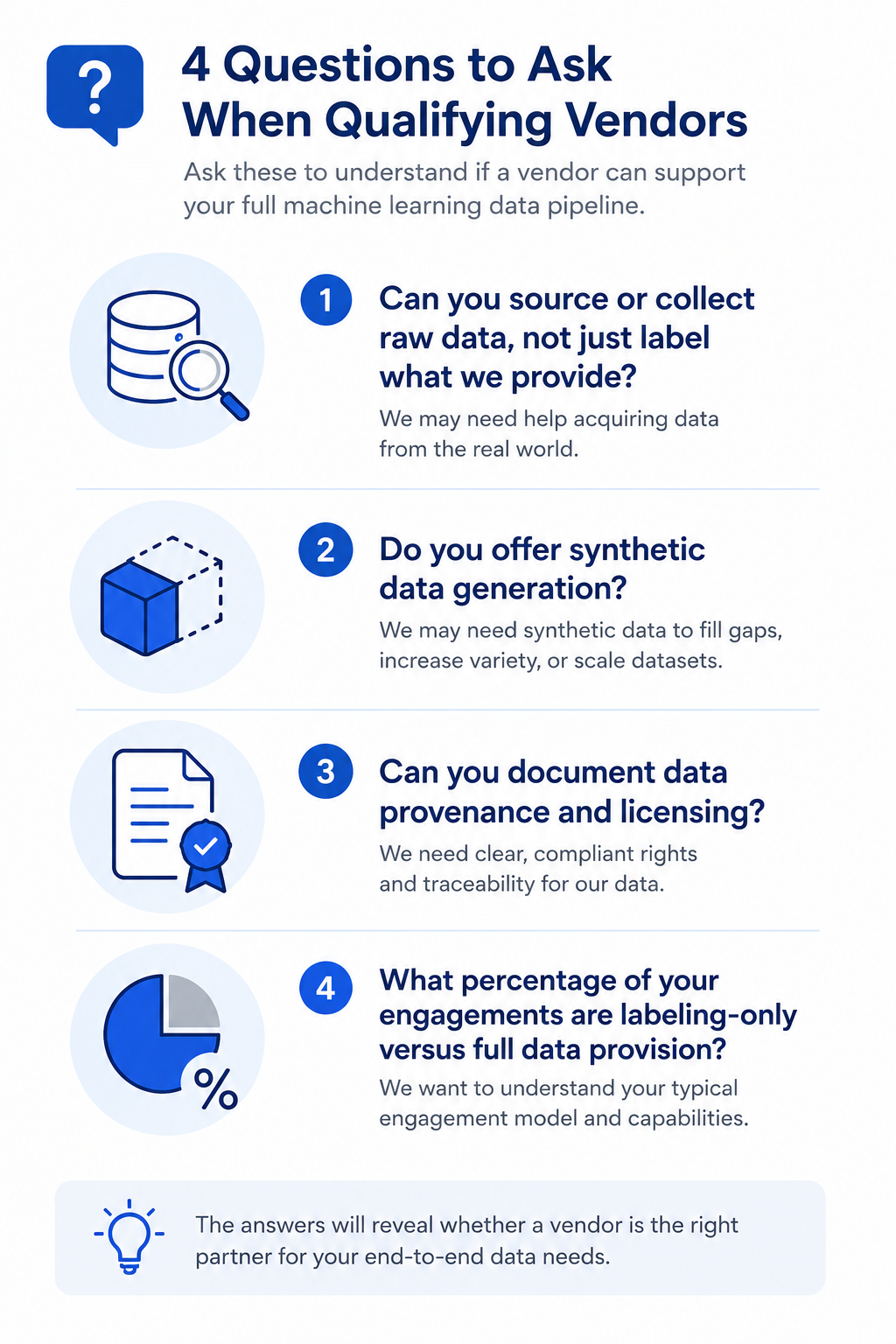
Infographic of questions to ask a vendor to confirm their AI training data category
  • Assuming any AI-focused vendor covers the full pipeline. Treating "training data provider" and "data labeling company" as interchangeable terms rather than checking which capabilities a specific vendor actually offers.
  • Requesting labeling proposals before confirming you have the raw data. Discovering mid-conversation that a labeling company can't help because the data itself doesn't exist yet.
  • Underestimating how much of the gap is a data-existence problem. Assuming more labeling volume will solve a problem that's actually about missing scenario coverage, not insufficient structure on existing data.
  • Not asking directly about sourcing or synthetic data capability. Assuming a vendor's marketing language accurately reflects whether they can source or generate data, rather than confirming directly.
  • Evaluating labeling quality when the real problem is data provenance. Focusing evaluation criteria on annotation accuracy when the actual gap requires sourcing or licensing expertise instead.

Best Practices

  • Inventory your existing raw data honestly before evaluating any vendor, including gaps in scenario coverage, not just volume.
  • Separate "do we have the data" from "is the data labeled" as two distinct questions before scoping a vendor search.
  • Ask every candidate vendor directly whether sourcing, collection, or synthetic generation are part of their actual capability, not just labeling.
  • Match your vendor search to the specific signal your project shows — a data-existence gap needs a provider, a pure structuring gap needs a labeling company.
  • Pilot with a vendor matched to the correct category, since testing the wrong type against your actual gap won't produce a useful signal either way.

FAQ

What's the core difference between an AI training data provider and a data labeling company?

A data labeling company applies structure to data you already have; a training data provider can also source, collect, license, or generate data you don't yet have, in addition to labeling it.

How do I know if I need a data labeling company or a full training data provider?

Check whether your actual gap is in structuring existing data (labeling company) or in obtaining data that doesn't exist yet in sufficient volume or coverage (training data provider).

Can a data labeling company help if I need rare or edge-case data?

Usually not directly — most pure labeling companies work with data you provide, so rare or edge-case coverage gaps typically require a provider with sourcing or synthetic data generation capability.

Do I need a training data provider if my project involves data licensing?

Yes, generally. Licensing, rights clearance, and sourcing from specific environments fall outside what most pure data labeling companies offer, pointing toward a broader training data solutions partner.

Is it possible to need both a labeling company and a training data provider on the same project?

Yes. Some projects have a labeling-only gap for one portion of their data and a data-existence gap for another, which can mean working with different vendor types for different parts of the same project.

How should I phrase my requirements when contacting a potential vendor?

Be specific about whether you need structure added to existing data or need help obtaining data that doesn't yet exist, rather than using "training data" or "labeling" generically, since both terms get used loosely across vendor marketing.

What happens if I hire a labeling company for a project that actually needs data sourcing?

The engagement typically stalls once the vendor requests raw data you don't have, requiring a restart with a different type of vendor and losing the time already spent on the mismatched engagement.

Conclusion

The AI training data provider vs data labeling company question resolves quickly once you identify where your actual gap sits: in structuring data you already have, or in obtaining data that doesn't exist yet. Getting specific about that distinction before contacting any vendor is what prevents a mismatched engagement and the timeline cost of discovering it partway through a project.

Share this post
Cloudpano

Choose The Right 360° Camera

Insta360 ONE RS 1-Inch 360 Edition

  • Compact, ready to go anywhere

  • Interchangeable lens that’s upgradeable

  • Dual 1-inch sensors for improved clarity and low light performance

  • Dynamic range and 6K 360° capture

  • 360° photo resolution at 21MP

Learn More

Insta360 X4

  • 8K 360° video recording for ultra-detailed visuals.

  • 4K single-lens mode for traditional wide-angle shots.

  • Invisible selfie stick effect for drone-like perspectives.

  • 2.5-inch touchscreen with Gorilla Glass protection.

  • Waterproof up to 33ft for underwater shooting.

Learn More

Ricoh Theta Z1

  • 360° photo resolution in 23MP

  • Slim design at 24 mm thick

  • Built-in image stabilization for smooth video capture.

  • Internal 19GB storage for photo and video storage.

  • Wireless connectivity for remote control and sharing.

Learn More

Ricoh Theta X

  • 60MP 360° still images for high-resolution photography.

  • 5.7K 360° video recording at 30fps.

  • 2.25-inch touchscreen for intuitive control.

  • USB Type-C port for fast charging and data transfer.

  • MicroSD card slot for expandable storage.

Learn More
Property Marketing
Allows potential buyers to explore properties in detail from anywhere, enhancing the real estate marketing process.
Automotive Spins
Create an interactive virtual showroom and engage affluent digital buyers with live 360º video calls, all through the CloudPano mobile app for a complete automotive sales solution.
Interactive Floor Plans
Create 2D and 3D floor plans with measurements in 4 minutes or less, all from your phone. Download the Floor Plan Scanner app and get your first scan free.

360 Virtual Tours With CloudPano.com. Get Started Today.

Try it free. No credit card required. Instant set-up.
Try it free
Latest posts

See our other posts

Interviews, tips, guides, industry best practices, and news.

AI Training Data Provider vs. Data Labeling Company: What's the Difference?

You need an AI training data provider instead of a data labeling company when your project's real gap is in the data itself — rare scenarios, domain-specific content, or data that doesn't exist yet — rather than in structuring data you already have. A pure labeling company only solves the second problem.
Read post

How AI Training Data Providers Support the Entire Machine Learning Pipeline

AI training data provider services extend beyond an initial dataset delivery when integrated properly into the machine learning pipeline — covering ongoing data collection, ingestion into the training pipeline, ongoing annotation as models are retrained, and feedback loops from production monitoring back into future data collection and labeling needs.
Read post

Pricing Models in AI Training Data: Per-Label, Per-Hour, or Per-Project?

AI training data pricing models generally fall into four types: per-label (pay per annotated item), per-hour (pay for annotator time), per-project (a flat fee for defined scope), and retainer (ongoing capacity reserved monthly). The right model depends on task complexity, volume predictability, and how well-defined your project scope is upfront.
Read post