


.png)


An agent found out her listing video was non-compliant the way most people do: someone else told her first. A competing agent, not her broker, flagged the missing equal housing language in a comment on the listing platform, visible to anyone who scrolled down. By the time her office pulled the video to fix it, it had been live for eleven days and the screenshot had already been forwarded twice.
Most content about MLS compliant real estate software comparison focuses on prevention — which is the right instinct, but it skips the part agents actually want to know once something's already gone wrong: what actually happens next. This walks through the real sequence, not the theoretical one, so you know what you're dealing with if a compliance gap surfaces, and what the fastest, least damaging path out looks like.
Non-compliance in a listing video usually means one of a handful of specific gaps: missing or incorrect equal housing language, absent or outdated brokerage licensing information, incorrect agent name or license number, or disclosure text that's present but not legible (cropped, too small, wrong color contrast against the background). It's rarely a dramatic, obvious violation — it's almost always a small omission that looks fine at a glance and only matters once someone checks closely.
That's part of what makes it dangerous. A video with genuinely offensive or clearly wrong content gets caught fast because it's visible. A video missing a specific disclosure line can sit live for weeks precisely because nothing about it looks alarming on a casual watch.
The real cost of a compliance gap isn't usually the fine, though those exist and vary by board and jurisdiction. It's the sequence of events around discovery: the video has to be pulled or corrected, the source of the error has to be traced, similar videos from the same agent or template have to be audited in case the same mistake repeats elsewhere, and — this is the part that stings — the broker or compliance officer now has to explain to leadership, and sometimes to the board itself, how it happened and what's being done to prevent it again.
The National Association of Realtors has consistently flagged fair housing compliance as an area of active enforcement attention, and boards vary in how aggressively they pursue violations — but the reputational cost of a public compliance miss, screenshotted and shared, often outpaces whatever formal penalty follows.
Here's the actual sequence, stripped of the theoretical version. A video goes live with a compliance gap. It sits, unnoticed, because nothing about it visually signals a problem. Eventually someone notices — a competing agent, a buyer who knows the rules, a board audit, or occasionally the agent's own broker doing a routine check. That person flags it, usually publicly or semi-publicly, because most flagging happens through visible channels like listing platform comments or a direct message that gets forwarded around before it reaches the person who can actually fix it.
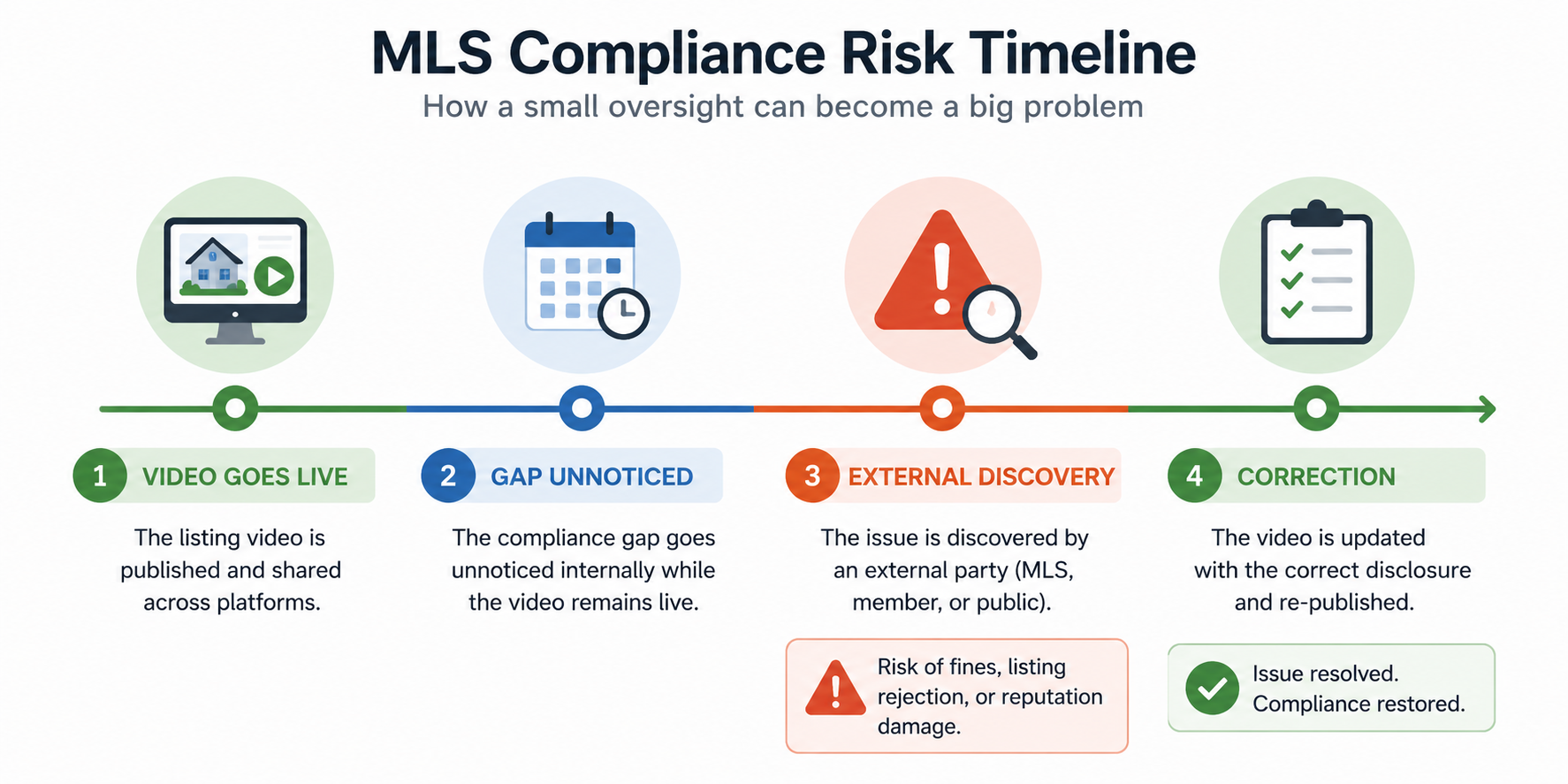
This actually happens constantly in exactly that order: discovery is rarely internal and rarely private. By the time the video is corrected, the awkward version has usually already been seen by more people than the fixed one ever will be, because corrections don't get the same visibility as the original mistake did.
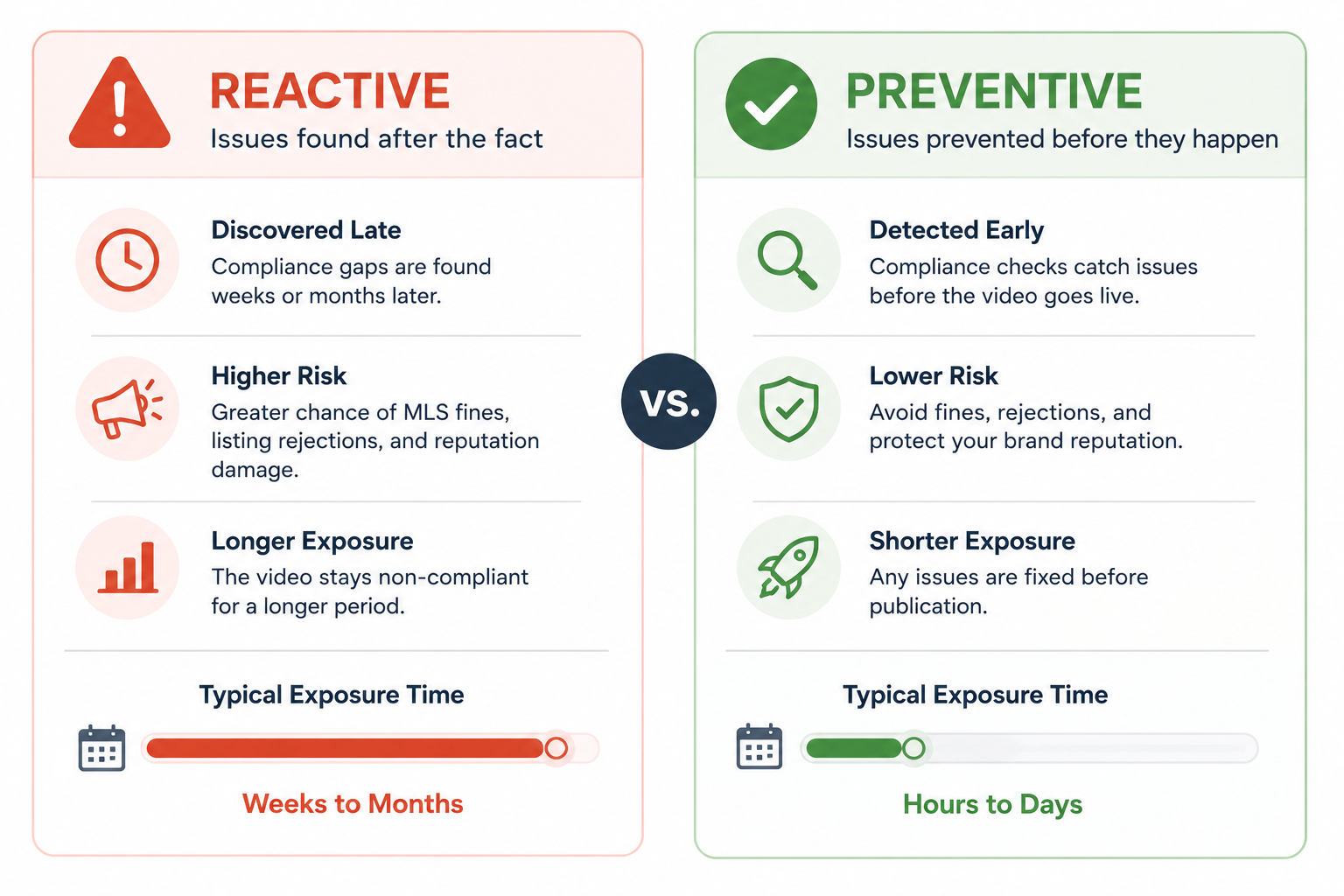
The most useful thing software can do here isn't damage control after the fact — it's shortening the gap between "a mistake exists" and "someone internal catches it before someone external does." With PhotoAIVideo, that means compliance elements that are locked into templates by default, reducing the chance a gap gets created in the first place, and a video library that's easy to audit in bulk if a pattern needs checking across multiple listings rather than reviewing each one individually from scratch.
Step 1: Pull or correct the video immediately, don't wait for a full explanation first. Speed matters more than a perfect understanding of how it happened — fix the visible problem before investigating the root cause.
Step 2: Check whether the same template or settings produced other videos with the same gap. A single mistake is often not isolated — audit your recent video library for the same error before assuming it was a one-off.
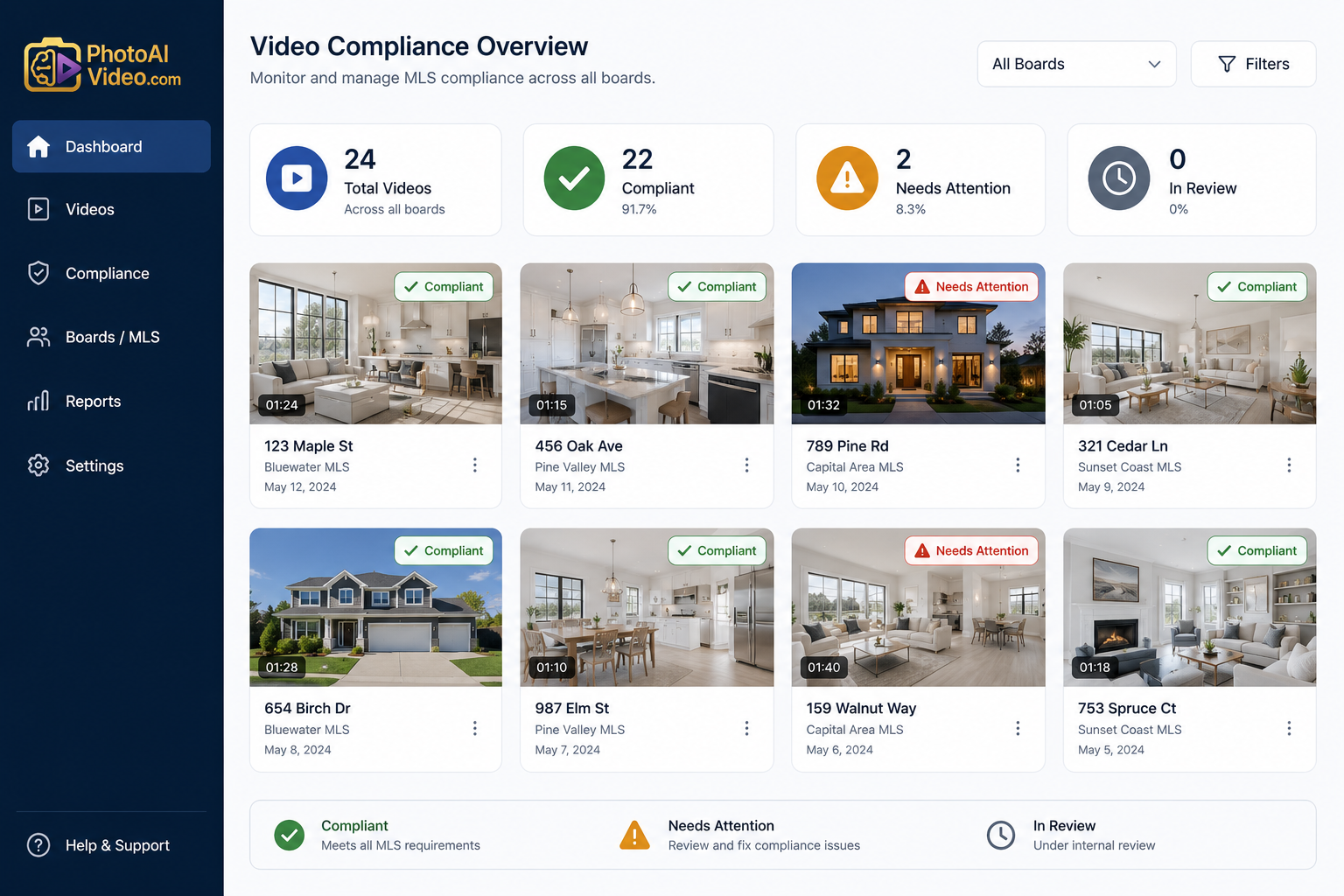
Step 3: Document what was found and corrected. If a board or brokerage compliance review follows, having a clear record of when the issue was found and how quickly it was addressed matters for how the situation is received.
Step 4: Identify the root cause in the workflow, not just the individual video. Was it a template setting, a manual edit that removed a locked element, or an outdated compliance profile? Confirm which template or profile setting caused the gap so the fix addresses the actual source.
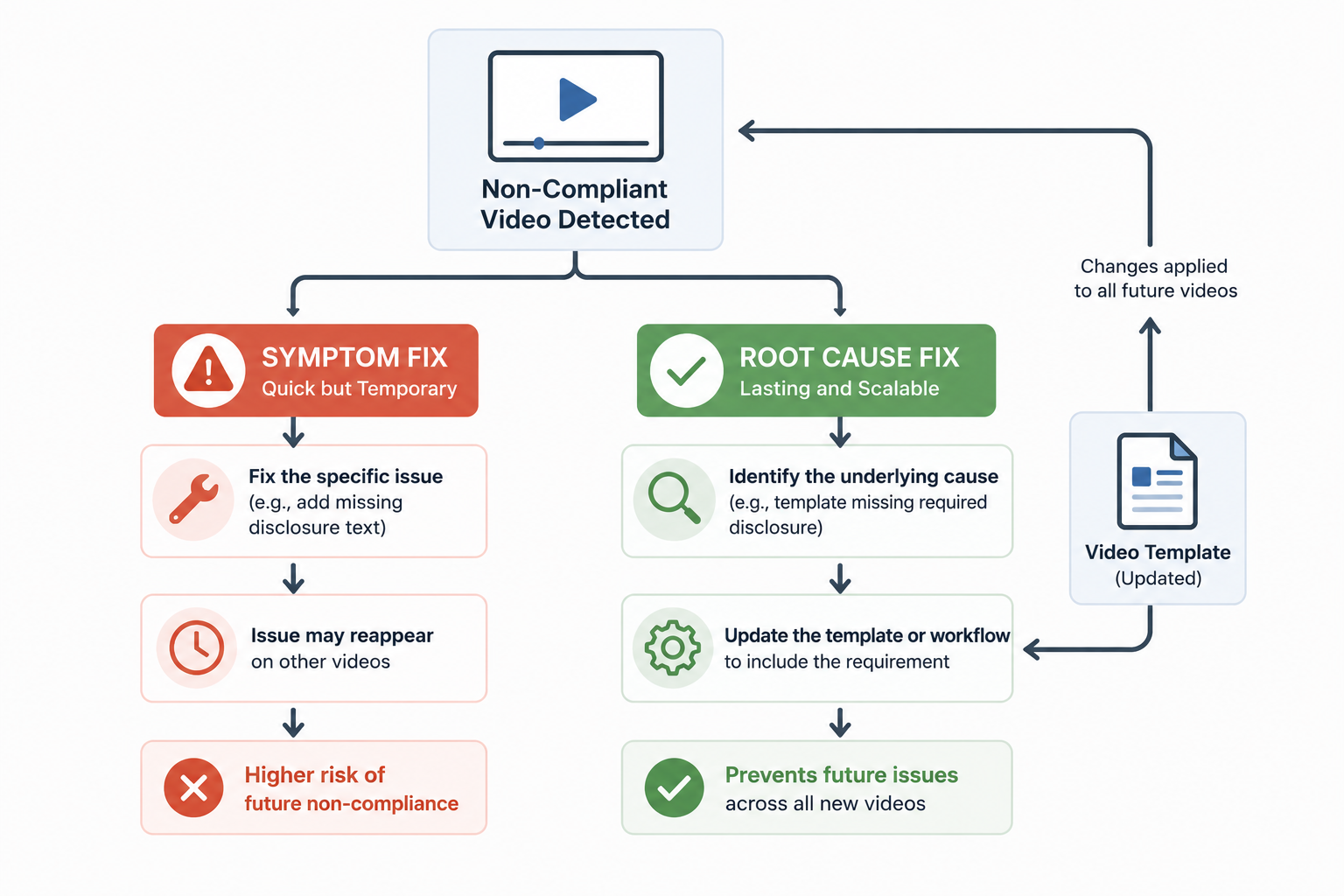
Step 5: Communicate proactively rather than waiting to be asked. If a broker or compliance officer becomes aware of a gap, an agent or team that reports it and shows the correction already in progress is in a fundamentally different position than one that's caught having ignored it.

What usually happens first when a real estate video isn't MLS compliant?
Discovery is rarely internal — it's most often flagged by a competing agent, a buyer familiar with the rules, or a routine board audit, frequently through a visible channel like a listing platform comment rather than a private message.
How quickly should a non-compliant video be corrected once discovered?
As fast as possible. Correcting the visible problem should happen before fully understanding the root cause — speed reduces public exposure, and root-cause investigation can happen in parallel.
Is a single flagged video usually an isolated mistake?
Not always. The same template setting or workflow habit that produced one non-compliant video often affected other listings produced the same way, which is why a quick audit of similar videos matters after any single gap is found.
What are the real consequences of a non-compliant real estate video?
Consequences vary by board and severity, but often include required corrections, potential fines depending on the jurisdiction, internal scrutiny from brokerage leadership, and reputational exposure if the issue was publicly flagged before being fixed.
Should an agent report a compliance gap themselves or wait to be asked?
Proactive disclosure is almost always the better path — an agent who reports and corrects an issue before being confronted about it is generally viewed very differently than one caught having ignored it.
How can software reduce the risk of this happening in the first place?
Software that locks required compliance elements into templates by default reduces the chance a gap is created during editing, and tools with searchable video libraries make it easier to audit for the same mistake across multiple listings.
How often should a brokerage audit its videos for compliance, even without a complaint?
A periodic internal review — quarterly is common for many brokerages — helps catch gaps created by template changes or MLS rule updates before an external party finds them first.


Compact, ready to go anywhere
Interchangeable lens that’s upgradeable
Dual 1-inch sensors for improved clarity and low light performance
Dynamic range and 6K 360° capture
360° photo resolution at 21MP

8K 360° video recording for ultra-detailed visuals.
4K single-lens mode for traditional wide-angle shots.
Invisible selfie stick effect for drone-like perspectives.
2.5-inch touchscreen with Gorilla Glass protection.
Waterproof up to 33ft for underwater shooting.

360° photo resolution in 23MP
Slim design at 24 mm thick
Built-in image stabilization for smooth video capture.
Internal 19GB storage for photo and video storage.
Wireless connectivity for remote control and sharing.

60MP 360° still images for high-resolution photography.
5.7K 360° video recording at 30fps.
2.25-inch touchscreen for intuitive control.
USB Type-C port for fast charging and data transfer.
MicroSD card slot for expandable storage.
.png)

.png)

Try it free. No credit card required. Instant set-up.







.svg)


.svg)