


.png)



For decades, the campus visit has been a cornerstone of college recruitment. Prospective students and their families would drive for hours, walk the quad, sit in on a lecture, and eat in the dining hall to get a feel for whether a school was "the one."
That experience still matters. But admissions offices today are working with a very different applicant pool — one that includes international students who may never set foot on campus before enrolling, first-generation students balancing work and family responsibilities, and families who simply want to narrow down a long list of schools before committing to expensive travel.
That's where virtual tour software enters the conversation — not as a replacement for the campus visit, but as a complementary tool that extends its reach.
Understanding the practical differences between an in-person visit and a well-built 360-degree virtual tour platform for higher education helps enrollment marketing teams decide where to invest their limited time and budget. This article breaks down what each format offers, where they overlap, and where each has a clear advantage.
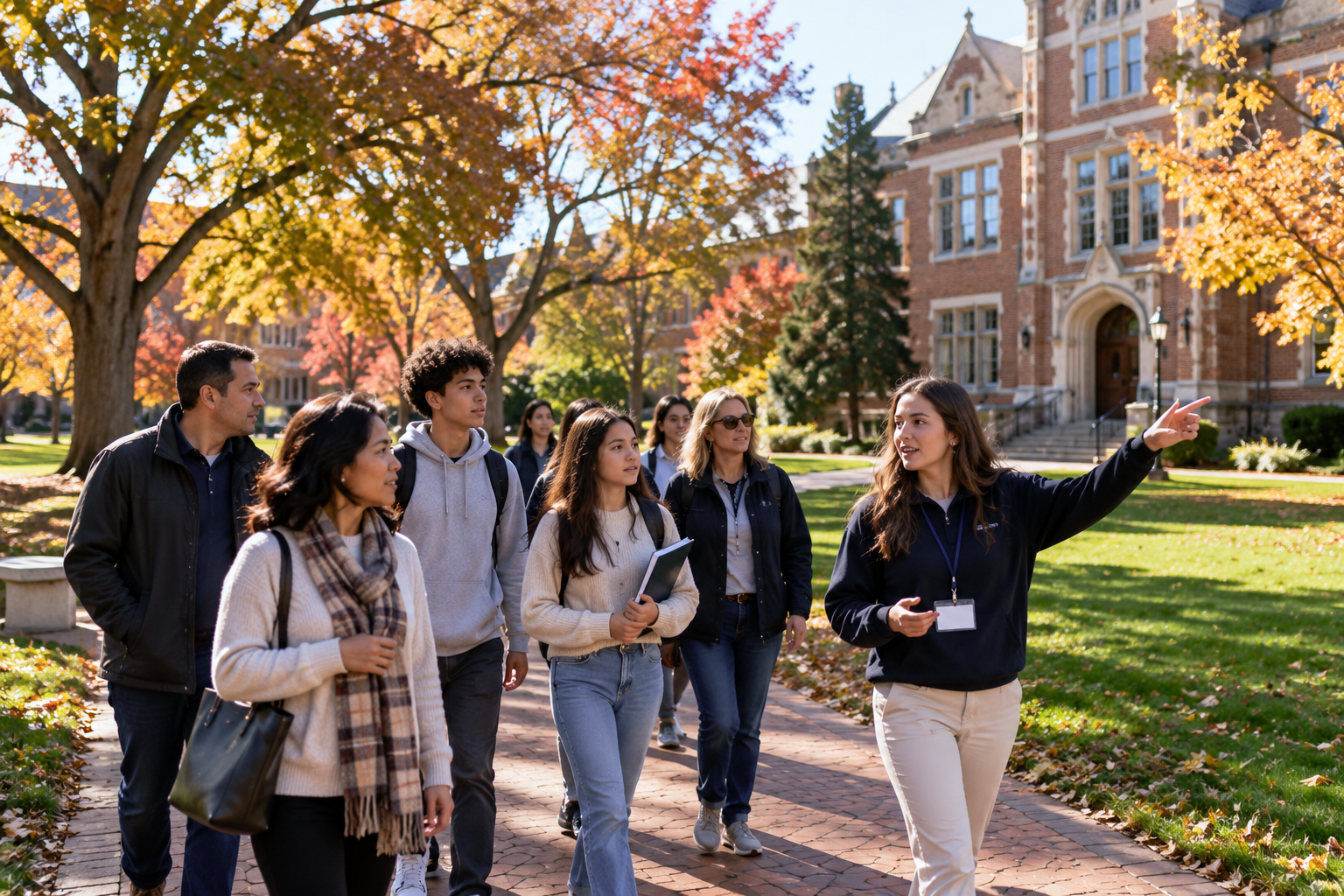
There's a reason campus visits remain an important part of the enrollment process for many institutions: they engage all five senses.
A prospective student can smell the dining hall, hear the ambient noise of a busy student union, and get a physical sense of how far the residence halls really are from the science building. Admissions counselors can read body language, answer unscripted questions in real time, and build personal rapport that's difficult to replicate through a screen.
Campus visits also allow for serendipity — a chance conversation with a current student in the library, an impromptu stop at a club fair, or a professor who happens to be available for a quick chat. These unplanned moments can become meaningful factors for admitted students weighing multiple offers.
For families who can make the trip, an in-person visit remains one of the strongest ways to evaluate campus "fit," and virtual tour software shouldn't try to pretend otherwise.
The tradeoff is accessibility.
Campus visits require travel budgets, time away from school or work, and a level of logistical coordination that not every family can manage. A scheduled visit day reaches only the families who are physically able to attend.
Coverage of enrollment trends from publications such as Inside Higher Ed has frequently highlighted the challenges institutions face in reaching students across different income levels, geographic areas, and international markets.
When an institution relies too heavily on physical visits, it can unintentionally limit access for students who simply don't have the same ability to travel.
No-code 360° virtual tour platforms allow admissions offices to create interactive, hotspot-driven walkthroughs of campus spaces — residence halls, classrooms, athletic facilities, student centers, laboratories, libraries, and more — that prospective students can explore from virtually any device.
Instead of clicking through a flat photo gallery, visitors can move between connected scenes in a way that more closely resembles walking through the property itself. A student might move from the admissions building to a residence hall, into a dorm room, through the student union, and eventually out to an athletic facility without leaving their browser.
Modern virtual tour platforms can also extend beyond the basic walkthrough experience. Depending on the platform and plan, features may include:
That last point is especially useful.
A physical campus visit generates valuable conversations and impressions, but much of that engagement can be difficult to quantify beyond registrations, attendance records, surveys, and counselor notes.
A virtual tour can provide additional digital engagement data, depending on the platform and analytics configuration. Admissions and enrollment marketing teams may be able to use that information to better understand which spaces attract attention and how visitors interact with the tour.
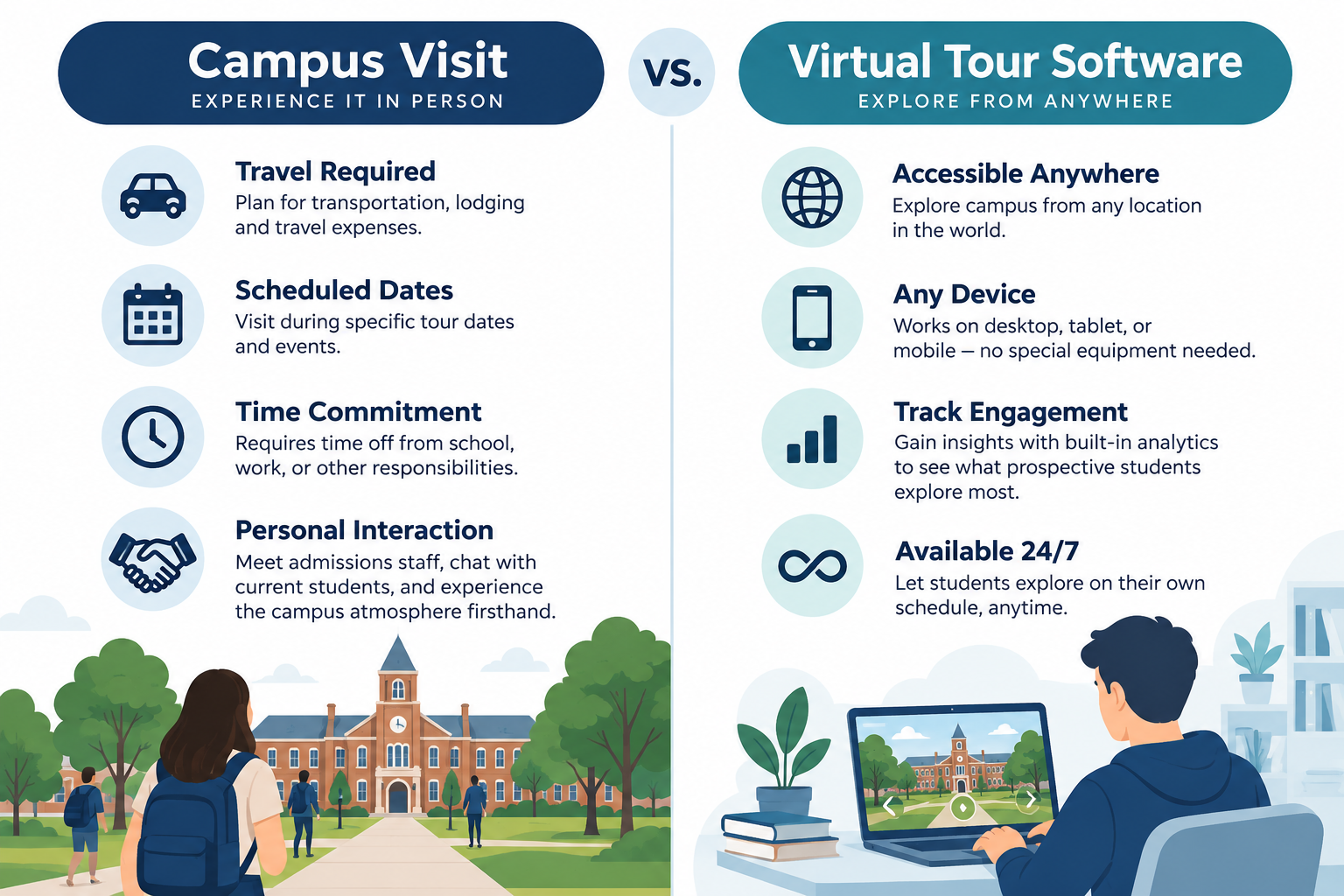
The core tradeoff is straightforward: campus visits have the advantage when it comes to atmosphere, spontaneity, and personal connection, while virtual tours offer advantages in scalability, accessibility, scheduling flexibility, and digital measurement.
Neither format is inherently "better." They solve different problems at different stages of the enrollment journey.
The most useful way to think about virtual tour software isn't as a competitor to the campus visit. It's better understood as an early- and mid-funnel tool that can help students explore an institution before deciding whether an in-person visit makes sense.
A prospective student's journey might look something like this:
This audience-expanding role aligns with the broader digital recruitment strategies discussed by organizations such as EAB, particularly as enrollment teams look for ways to engage students without depending entirely on in-person touchpoints.
A virtual tour built for university admissions doesn't need to persuade every prospective student to skip a physical visit. Its role is to help more students explore the institution meaningfully before they decide whether to travel.
Live 360° video chat can also serve as a bridge between self-guided virtual exploration and a traditional campus visit. An admissions counselor can guide a prospective family through a residence hall or other space remotely while answering questions in real time.
It isn't identical to physically walking through campus, but it can add a valuable human element to a remote experience.
Enrollment decisions rarely happen because of a single interaction. For many prospective students, choosing a university involves a series of touchpoints over several months.
Organizations such as Ruffalo Noel Levitz have long emphasized the importance of meeting prospective students at different stages of the enrollment journey with appropriate communication and engagement.
Virtual tours and physical visits don't necessarily compete for the same touchpoint. In many cases, they work best when they support each other.
A practical approach might look like this:
This layered approach can also help admissions teams manage limited staff capacity. A self-guided virtual tour can handle a portion of exploratory interest without requiring an admissions counselor to personally guide every prospective student through campus.
Does a virtual tour replace the need for prospective students to visit campus in person?
No. Virtual tours are best understood as a complement to, not a replacement for, in-person visits. They're particularly useful for early-stage research, remote and international students, and admitted students who want to revisit campus virtually. For many students, a physical campus visit remains an important part of choosing where to enroll.
How do universities measure whether a virtual tour is working?
Measurement depends on the platform and analytics configuration. Virtual tour platforms may support tools such as Google Analytics, scene engagement tracking, and embedded lead-generation forms. Admissions teams can combine that information with broader website, CRM, application, and enrollment data to evaluate how the tour contributes to the recruitment journey.
Can a virtual tour be used during live recruitment events or fairs?
Yes. VR headset compatibility can make virtual tours useful at college fairs, high school visits, international recruitment events, and open houses. A university can provide an immersive campus preview even when the physical campus is far away.
Platforms that support live 360° video chat can also allow remote prospective students to interact with an admissions counselor while exploring campus virtually.
Is virtual tour software difficult to set up for a university with many buildings?
No-code platforms are designed to make tour creation and management more accessible to admissions and marketing teams without requiring a developer for every change.
Multiple buildings and scenes can be connected using hotspots, and updated photography or newly renovated spaces can be added as the campus changes.
Traditional campus visits and virtual tour software aren't rivals competing for the same job. They're two tools suited to different moments in a prospective student's decision-making journey.
Physical visits provide an authentic, sensory, relationship-building experience that a virtual tour cannot fully replicate.
Virtual tours provide reach, accessibility, repeatability, and digital engagement opportunities that a scheduled physical visit cannot always provide.
Admissions offices that treat the two as complementary can use interactive campus tour software to help prospective students explore earlier in the funnel, while reserving in-person visits for moments when the personal experience of being on campus can have the greatest value.


Compact, ready to go anywhere
Interchangeable lens that’s upgradeable
Dual 1-inch sensors for improved clarity and low light performance
Dynamic range and 6K 360° capture
360° photo resolution at 21MP

8K 360° video recording for ultra-detailed visuals.
4K single-lens mode for traditional wide-angle shots.
Invisible selfie stick effect for drone-like perspectives.
2.5-inch touchscreen with Gorilla Glass protection.
Waterproof up to 33ft for underwater shooting.

360° photo resolution in 23MP
Slim design at 24 mm thick
Built-in image stabilization for smooth video capture.
Internal 19GB storage for photo and video storage.
Wireless connectivity for remote control and sharing.

60MP 360° still images for high-resolution photography.
5.7K 360° video recording at 30fps.
2.25-inch touchscreen for intuitive control.
USB Type-C port for fast charging and data transfer.
MicroSD card slot for expandable storage.
.png)

.png)

Try it free. No credit card required. Instant set-up.





.svg)


.svg)