


.png)


Virtual tour platforms designed specifically for college and university admissions help prospective students explore campus remotely, revisit important spaces, and engage with admissions content on their own schedule. When combined with lead capture, analytics, accessible mobile experiences, and admissions outreach, virtual tours can support recruitment throughout the enrollment journey.
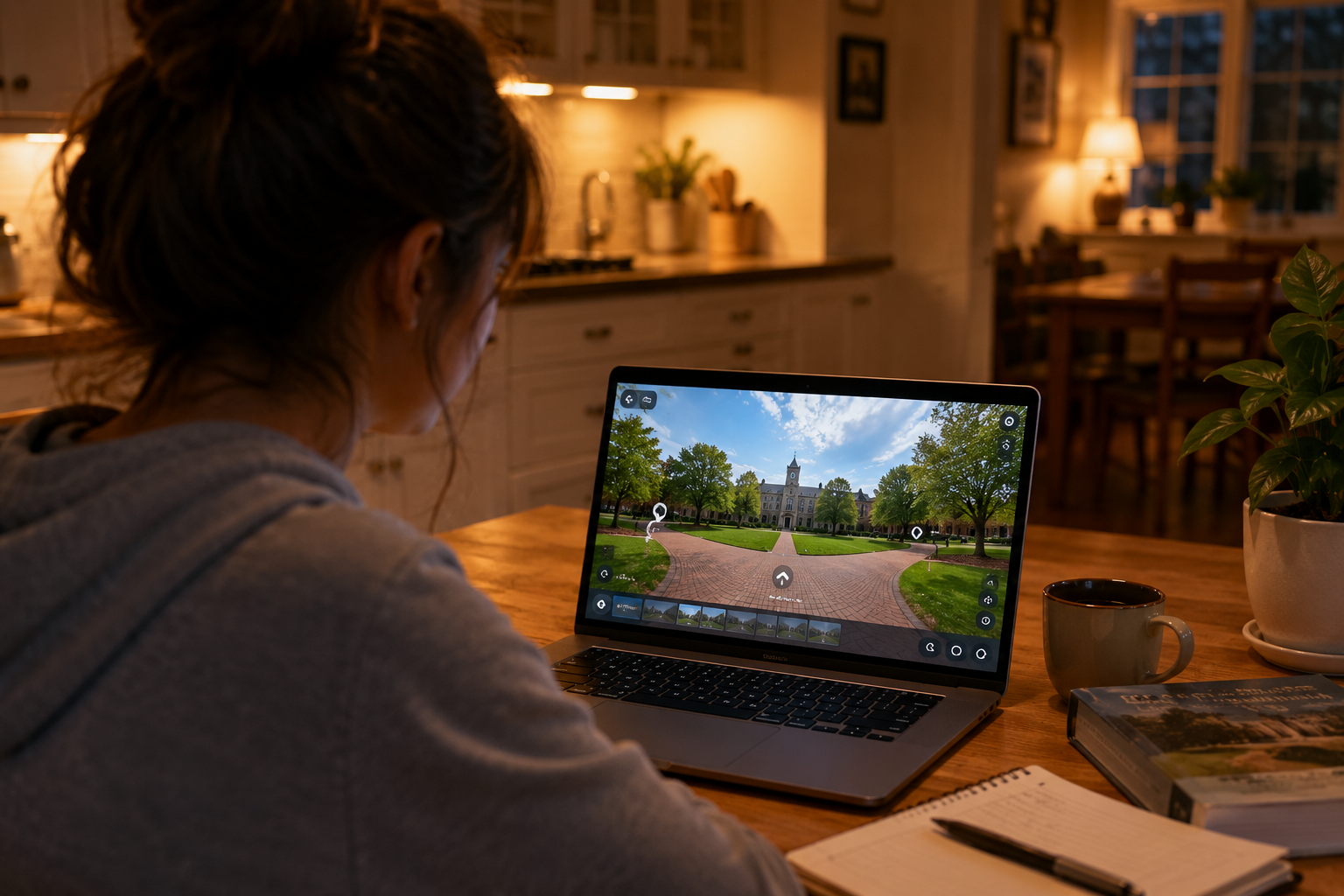
For most prospective students, the college search no longer begins with a campus visit — it begins with a screen. Long before a family books a flight or plans a weekend drive, students are scrolling through admissions websites, comparing programs, and trying to picture what daily life on campus might feel like.
That shift in behavior is one reason admissions offices are increasingly turning to virtual tour software as part of their enrollment marketing strategy. When a campus visit isn't possible — because of distance, cost, timing, or health concerns — a well-built 360° virtual tour can still let a student walk the quad, peek into a residence hall, and imagine themselves as part of the community.
For institutions evaluating their options, it's worth taking the time to understand what separates purpose-built virtual tour software for universities from a simple photo gallery or static video.
Admissions offices have long treated the in-person campus visit as the gold standard of the enrollment funnel — and for good reason. Walking through a lecture hall, sitting in on a class, or grabbing lunch in the dining commons gives prospective students an emotional connection that a brochure simply can't replicate.
But relying solely on physical visits creates a structural problem: not every student who's a good fit for your institution can actually get to campus.
A student in another state may not have the travel budget for a weekend trip. An international applicant may be managing visa timelines, flight costs, and time zone differences that make an in-person visit impractical until after they've already committed. A first-generation or low-income student may not have a family member who can take time off work to drive them several hours for an open house.
In these cases, an institution may lose engagement from otherwise interested students not because the fit is wrong, but because the traditional visit model creates practical barriers to participation.
This is one reason enrollment organizations such as EAB have emphasized the growing importance of digital engagement throughout the student search and consideration stages, particularly as institutions look for ways to reach students who may not be able to visit campus in person.
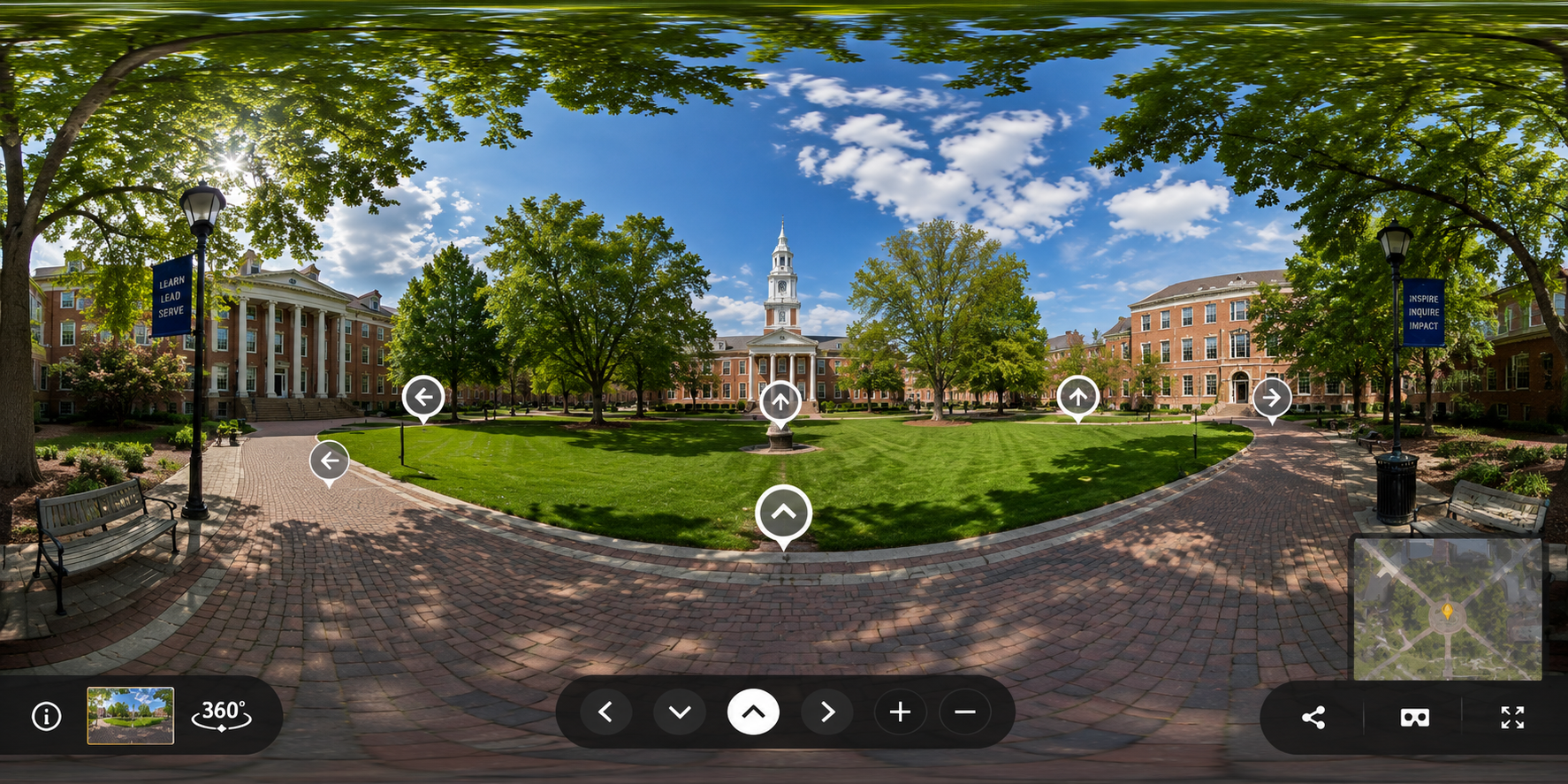
Virtual tour software helps close this gap by making the campus experience portable. Instead of a single open house weekend, a 360° tour lives on the admissions website every day of the year, available to anyone with an internet connection.
A student in another country can explore the science building at midnight their time. A working parent can walk through a residence hall with their child after dinner instead of taking a day off work. A student with mobility challenges can experience spaces that might otherwise be physically difficult to tour in person.
With hotspot navigation between scenes, a virtual tour can guide a visitor logically from the admissions building to a lecture hall, into a dorm room, through the student union, and out to an athletic facility — all without a live guide. Because the tours are no-code and easy to update, admissions marketing teams don't need to loop in IT or a developer every time a new building opens or a space is renovated.
For students weighing multiple schools at once, this kind of self-directed exploration matters. It lets them compare campuses side by side on their own schedule rather than trying to remember details from a single scheduled visit weeks or months apart.
Offering this kind of flexibility can also signal to prospective families that an institution is investing in accessibility and modern communication — qualities that may matter to today's applicants and their parents.
Open house events are resource-intensive. They require staff time, event coordination, catering, parking logistics, and a significant push to get families to show up on one specific date.
Virtual tours don't replace the value of an in-person open house, but they do let admissions offices extend that same experience throughout the year rather than concentrating it into a handful of weekends.
A prospective student who misses the fall open house because of a scheduling conflict doesn't have to wait for the spring event — they can explore the tour the same night they hear about the school. Admissions counselors can also use the tour proactively, sending a direct link to a specific building or program space in a follow-up email after a phone call or college fair visit. This turns a passive marketing asset into an active part of the outreach sequence.
CloudPano's white-label domain options also let institutions keep the tour experience fully on-brand, embedding the tour directly on the admissions or program page rather than sending traffic to a third-party site. Combined with the ability to publish select scenes to Google Street View, a university can extend its visibility even further, appearing in map searches when a student is exploring the surrounding area or neighborhood.
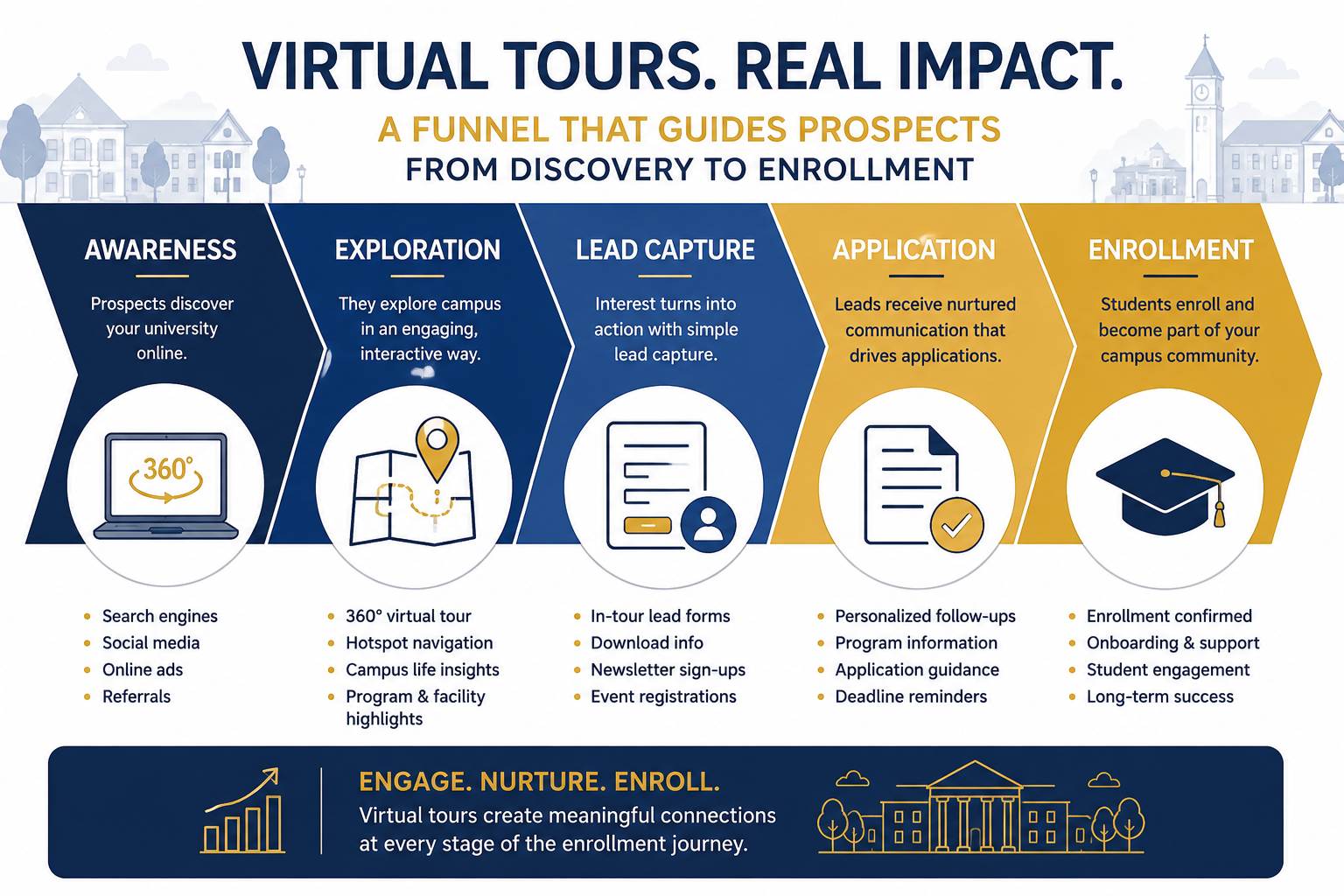
Admissions and enrollment marketing teams don't just need students to look at a campus — they need that interest to convert into applications, deposits, and eventually enrolled students.
This is where virtual tours can do more than sit passively on a webpage — they can become an active part of the enrollment funnel.
Because CloudPano tours support lead-generation forms built directly into the tour experience, a university can prompt a visitor at a meaningful moment — say, after they've explored the residence halls — to request more information, schedule a call with an admissions counselor, or sign up for a newsletter.
Rather than hoping a visitor remembers to click over to a separate "Request Info" page, the prompt appears within the experience itself, at a point when interest is naturally high.
That data doesn't have to disappear into a spreadsheet, either. With Google Analytics integration, admissions marketing teams can gain additional insight into how visitors interact with the tour. That behavioral data can help teams understand engagement and inform decisions about which campus spaces, programs, or amenities to feature more prominently in other marketing campaigns.
Enrollment professionals who study yield — the percentage of admitted students who ultimately enroll — often point to the cumulative effect of many small touchpoints rather than any single tactic.
Organizations like Ruffalo Noel Levitz have long researched how consistent, personalized engagement throughout the admissions cycle can influence a student's final enrollment decision. A virtual tour that a student can revisit multiple times, share with parents, and interact with on their own terms fits naturally into that kind of sustained engagement strategy.
Today's applicants are increasingly used to interacting with schools through digital-first platforms during the application process itself. Tools like Common App have become a standard part of how students research and apply to multiple institutions, often comparing several colleges' digital presences side by side in the same sitting.
An admissions page that includes an interactive, explorable tour gives prospective students another way to engage with the institution beyond static photography — and another reason to spend time exploring the school's digital presence.
For institutions recruiting internationally, VR headset compatibility adds another layer of accessibility. A student attending a college fair overseas can put on a headset at an agent's office or an on-site event and get a more immersive sense of campus without ever needing to board a plane.
This can be particularly valuable for programs actively recruiting international students, for whom traveling to campus before making a decision may not always be feasible.
Not every virtual tour tool is built with admissions offices in mind. Enrollment marketing teams typically need features that go beyond a simple photo carousel: multi-scene navigation with hotspots, embeddable tours that match institutional branding, lead capture built into the experience, and analytics that connect back to broader recruitment goals.
Because admissions marketing budgets and staffing vary widely by institution size, it also helps to have flexible pricing — from a smaller department managing a handful of published tours to a large enrollment division overseeing tours across multiple schools or colleges within a university system.
This is why enrollment marketing teams may benefit from comparing virtual tour platforms designed specifically for college and university admissions rather than adapting a generic tool.
The right platform should feel like a natural extension of the admissions website and recruitment funnel, not a bolted-on add-on.
Can a virtual tour really replace an in-person campus visit?
Not entirely — but it doesn't need to. For students who genuinely cannot travel due to distance, cost, or timing, a detailed 360° tour can serve as their primary way of experiencing campus before applying or enrolling. For students who can visit in person, the virtual tour can serve as a helpful preview or a way to revisit spaces afterward.
How does a virtual tour help with student recruitment beyond just "looking nice" on a website?
When lead-generation forms and analytics are built into the tour itself, admissions marketing teams can gain greater insight into prospective student engagement and create opportunities for follow-up outreach. This helps turn the tour into an active part of the recruitment funnel rather than a passive brochure.
Is virtual tour software difficult for an admissions marketing team to manage without technical staff?
No-code platforms like CloudPano are designed so admissions and marketing staff can build, update, and publish tours themselves without needing a developer every time a new building or renovated space needs to be added.
Does virtual tour software help with international student recruitment specifically?
Yes. Because international applicants may not be able to travel to campus before making enrollment decisions, an accessible, shareable, and VR-headset-compatible tour gives them another meaningful way to explore campus remotely and can support broader international recruitment efforts.
Ultimately, the goal of any admissions marketing strategy is to remove friction between a student's curiosity and their decision to apply or enroll. Virtual tours don't replace the relationships admissions counselors build with prospective students, but they can make campus feel reachable to far more of them — including those who might never otherwise set foot there before decision day.
As enrollment offices continue refining their digital recruitment strategies, software built specifically for university virtual tours can provide another way to broaden access, strengthen digital engagement, and help prospective students explore campus on their own terms.
Virtual tours can support enrollment by making campus exploration available to prospective students who cannot visit in person and by creating additional opportunities for digital engagement. However, universities should avoid treating a virtual tour as a guaranteed enrollment driver. Its impact should be measured alongside other admissions and recruitment activities.
Not completely. An in-person visit provides experiences that a digital tour cannot fully reproduce. However, a 360° tour can serve as an alternative for students unable to travel and as a useful preview before a campus visit or a way to revisit important locations afterward.
Universities should consider interactive 360° navigation, hotspots, mobile usability, accessibility, branding, website embedding, lead capture, analytics, easy content updates, and support for multiple campus locations. The best platform should fit naturally into the institution's existing admissions website and recruitment workflow.
Universities can track meaningful interactions such as tour visits, scene engagement, link clicks, information requests, and other configured actions. Google Analytics uses events to measure specific interactions and allows particularly important actions to be designated as key events.
Yes. Virtual tours can give international prospects an opportunity to explore campus before traveling to the institution. They can be especially useful when distance, travel costs, timing, or other practical barriers make an in-person visit difficult before application or enrollment decisions.


Compact, ready to go anywhere
Interchangeable lens that’s upgradeable
Dual 1-inch sensors for improved clarity and low light performance
Dynamic range and 6K 360° capture
360° photo resolution at 21MP

8K 360° video recording for ultra-detailed visuals.
4K single-lens mode for traditional wide-angle shots.
Invisible selfie stick effect for drone-like perspectives.
2.5-inch touchscreen with Gorilla Glass protection.
Waterproof up to 33ft for underwater shooting.

360° photo resolution in 23MP
Slim design at 24 mm thick
Built-in image stabilization for smooth video capture.
Internal 19GB storage for photo and video storage.
Wireless connectivity for remote control and sharing.

60MP 360° still images for high-resolution photography.
5.7K 360° video recording at 30fps.
2.25-inch touchscreen for intuitive control.
USB Type-C port for fast charging and data transfer.
MicroSD card slot for expandable storage.
.png)

.png)

Try it free. No credit card required. Instant set-up.





.svg)


.svg)