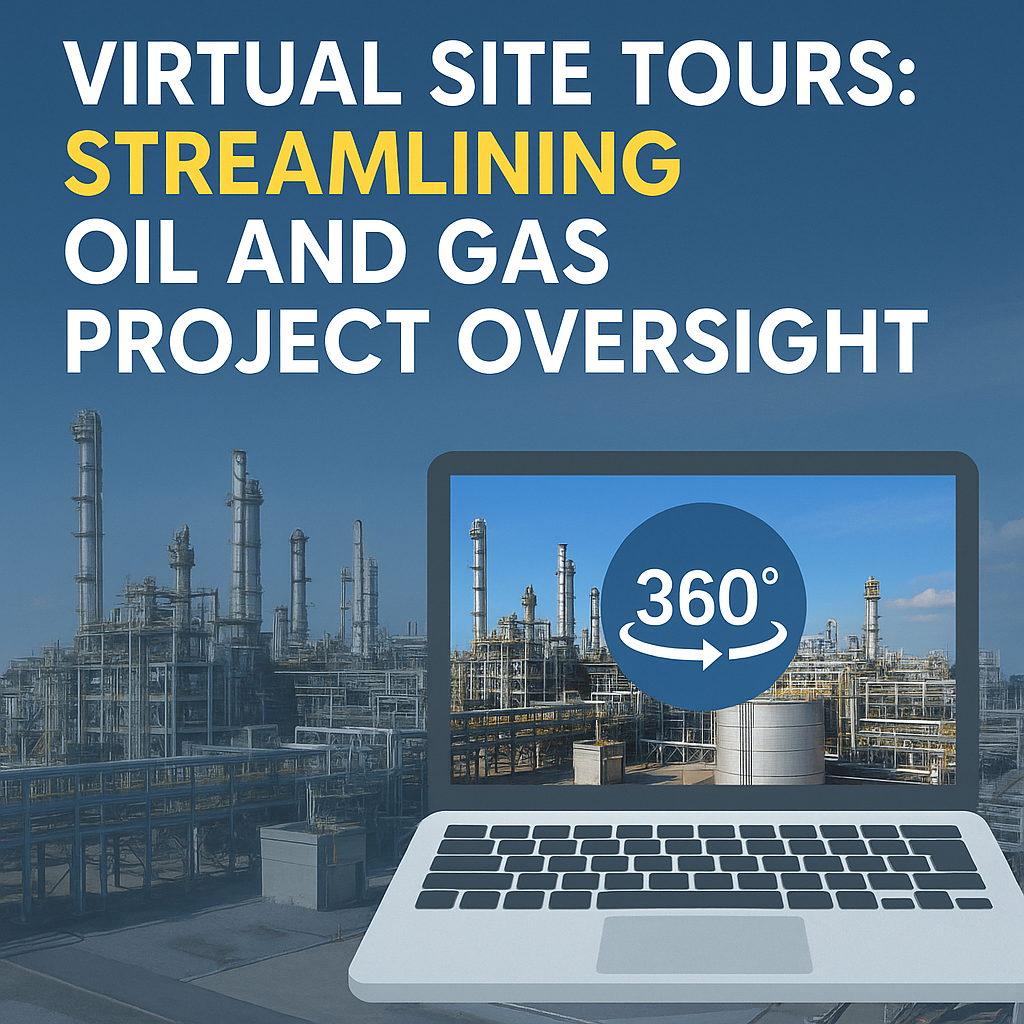
Virtual Site Tours: Streamlining Oil and Gas Project Oversight

Cloudpano
July 24, 2025
5 min read
Share this post

🚀 Virtual Site Tours: Streamlining Oil and Gas Project Oversight

In the high-stakes world of oil and gas, project oversight is everything. From safety and compliance to operational efficiency, staying ahead requires visibility—without the risks or delays of traditional on-site inspections. That’s where virtual site tours come in. 🔍✨

These immersive 360° walkthroughs and remote inspection tools are revolutionizing how oil and gas teams manage projects, providing real-time visibility, streamlining communication, and reducing costs. In this post, we’ll explore why virtual tours are no longer a luxury—but a must-have for modern energy operations.

🌐 What Are Virtual Site Tours?

Virtual site tours use 360° imagery, drones, and virtual reality (VR) to create a digital representation of a physical oilfield, refinery, or drilling platform. Team members and stakeholders can access these walkthroughs remotely from anywhere, anytime.

No travel required
Real-time collaboration
Improved documentation and transparency

Whether you’re monitoring pipeline installations, conducting hazard recognition training, or ensuring vendor accountability, virtual tours bring the site to your screen—literally.

🛢️ The Top Benefits for Oil and Gas Oversight

1. 🦺 Better Safety Compliance

Remote walk-throughs minimize the need for personnel to enter hazardous zones. This significantly reduces exposure to risks, making compliance and safety checks more efficient.

→ Learn how VR Hazard Recognition Training for Oil and Gas enhances workforce preparedness through immersive simulations.

2. 💡 Faster Decision-Making

When your team can visually inspect a site in real-time—without waiting for flights or field reports—decisions get made faster. Virtual tours improve the pace of operations and eliminate bottlenecks.

→ See how Remote Site Inspection Tools Every Oil and Gas Company Should Use can optimize your inspection workflow.

3. 💰 Reduced Travel and Downtime Costs

Virtual inspections eliminate the cost of site visits, saving thousands in travel, lodging, and productivity loss. They also minimize site disruptions during inspections.

→ Discover how Cut Downtime and Improve Accuracy with Remote Oil & Gas Site Monitoring boosts your bottom line.

4. 📊 Improved Project Documentation

Virtual tours can be recorded, timestamped, and shared across teams. This allows for clear project milestones, better contractor accountability, and complete project records.

→ Explore Digitize Oil and Gas Emergency Protocols with 360 Virtual Tour Software to document processes with precision.

🛠️ Key Use Cases in Oil and Gas

📍 Construction Progress Monitoring

Track your project as it evolves—from rig construction to pipeline installations. Teams can virtually walk through new builds and check contractor milestones without stepping foot on site.

→ Related post: Revolutionizing Oil and Gas: How Remote Site Inspections Save Time and Costs

📍 Emergency Response Readiness

Need to simulate an oil spill response or a refinery evacuation plan? Virtual tours offer immersive training tools that prepare teams for crisis scenarios in a realistic but safe environment.

→ Read Oil and Gas Emergency Response Scenarios Enhanced by Virtual Tours

📍 Vendor and Contractor Oversight

Virtual tours help verify third-party work, from infrastructure builds to routine maintenance. Your team can verify progress and quality remotely.

→ Also check out: Virtual Walk-Throughs Are Transforming Oil and Gas Operations

👷 Real Teams, Real Impact

Let’s say your engineering manager is in Houston, your drilling team is in West Texas, and your compliance officer is in Calgary. Traditionally, aligning these roles on inspection or progress reports would be chaotic.

With virtual tours, each stakeholder logs into a shared interface and explores the same real-time scene with full context—annotations, measurements, documents—like being there, but safer and faster. 🖥️📍

→ Get inspired by Boost Safety in Oil and Gas with VR-Based Hazard Recognition Virtual Tours

🛑 Overcoming Common Objections

❓ “Is it accurate enough?”
360° tours and drone photogrammetry are accurate to within inches and integrate easily with other engineering tools.

❓ “Do we need special gear?”
Many platforms run in-browser and don’t require VR headsets (though they enhance immersion).

❓ “Will it replace field engineers?”
Nope. It augments their work—letting them focus on decision-making, not travel.

🔧 How to Get Started

  1. Choose a Platform – Look for tools like CloudPano that support 360° virtual tours, annotations, and real-time sharing.
  2. Capture the Site – Use drones, 360 cameras, or upload architectural imagery.
  3. Add Context – Embed maps, floor plans, safety checklists, and documentation directly inside the tour.
  4. Share & Train – Share tours with internal teams, stakeholders, or regulatory agencies.

🏁 Final Thoughts: It’s Time to Step Inside—Remotely 🛰️

Virtual site tours are redefining project oversight in oil and gas—combining visual fidelity, safety, and collaboration in one immersive interface. 🌍✨

Instead of waiting weeks for updates or risking on-site exposure, you can now streamline every aspect of oil and gas operations from your laptop.

🔗 Explore more:

💡 Ready to explore how virtual tours can streamline your project oversight?

Share this post
Cloudpano

Choose The Right 360° Camera

Insta360 ONE RS 1-Inch 360 Edition

  • Compact, ready to go anywhere

  • Interchangeable lens that’s upgradeable

  • Dual 1-inch sensors for improved clarity and low light performance

  • Dynamic range and 6K 360° capture

  • 360° photo resolution at 21MP

Learn More

Insta360 X4

  • 8K 360° video recording for ultra-detailed visuals.

  • 4K single-lens mode for traditional wide-angle shots.

  • Invisible selfie stick effect for drone-like perspectives.

  • 2.5-inch touchscreen with Gorilla Glass protection.

  • Waterproof up to 33ft for underwater shooting.

Learn More

Ricoh Theta Z1

  • 360° photo resolution in 23MP

  • Slim design at 24 mm thick

  • Built-in image stabilization for smooth video capture.

  • Internal 19GB storage for photo and video storage.

  • Wireless connectivity for remote control and sharing.

Learn More

Ricoh Theta X

  • 60MP 360° still images for high-resolution photography.

  • 5.7K 360° video recording at 30fps.

  • 2.25-inch touchscreen for intuitive control.

  • USB Type-C port for fast charging and data transfer.

  • MicroSD card slot for expandable storage.

Learn More
Property Marketing
Allows potential buyers to explore properties in detail from anywhere, enhancing the real estate marketing process.
Automotive Spins
Create an interactive virtual showroom and engage affluent digital buyers with live 360º video calls, all through the CloudPano mobile app for a complete automotive sales solution.
Interactive Floor Plans
Create 2D and 3D floor plans with measurements in 4 minutes or less, all from your phone. Download the Floor Plan Scanner app and get your first scan free.

360 Virtual Tours With CloudPano.com. Get Started Today.

Try it free. No credit card required. Instant set-up.

Try it free
Latest posts

See our other posts

Interviews, tips, guides, industry best practices, and news.

Mastering Compliance: The Future of Automated Property Video

This article provides a definitive guide for real estate professionals on navigating strict MLS branding regulations through AI-driven automation. It addresses the risks of compliance violations, details the limitations of manual editing workflows, and introduces a scalable, "compliance-first" system for generating high-quality, MLS-approved property videos. The post serves as a strategic blueprint for agents aiming to maintain listing visibility, avoid regulatory penalties, and streamline their marketing operations.
Read post

Future-Proofing Your Business with MLS Safe AI Video for Listings

This high-authority guide focuses on long-term operational stability and the strategic advantages of leveraging artificial intelligence to bypass the industry-wide friction between high-impact marketing and regulatory compliance. Key Takeaways & Content Structure: The Reputation-Risk Factor: Explains the high cost of compliance errors, focusing on how a single technical oversight—such as a misplaced logo or branded watermark—can trigger a systemic board audit, leading to immediate listing suspension and lasting reputational damage with sellers. The Production Disconnect: Breaks down the "two-version" operational tax, where marketing teams suffer from repetitive rendering, file-management bloat, and the persistent danger of human error when manually managing branded vs. unbranded media assets. AI as a Compliance Engine: Defines how advanced AI media platforms move beyond mere aesthetics to function as regulatory safeguards. It illustrates the technical architecture where the AI engine isolates branding data from structural property data at the rendering level, effectively "forking" the output into two distinct, safe-to-use tracks. Operational Blueprint: Maps out a transparent, 6-step automation funnel that takes a listing from flat photograph ingestion to syndicate-ready, neutral-hosted media in minutes. Strategic Scalability: Demonstrates why centralizing production into a single SaaS platform is the only way for growing brokerages to maintain consistency, remove contractor-level liability, and recover significant administrative time. The PhotoAIVideo.com Edge: Concludes by positioning the platform as a purpose-built solution that combines high-definition parallax AI motion with an automated "compliance-first" export workflow, ensuring Realtors can generate professional, engaging video content that passes even the most stringent board audits on the first attempt.
Read post

Streamlining Your Workflow with a Specialized MLS Compliant Real Estate Media App

This article functions as a tactical operations guide for real estate marketers and brokerage leaders focused on reducing technical friction and human error in their media publishing pipeline. Key Takeaways & Content Structure: The "Stop-Work" Order: Addresses the high-stakes reality of MLS compliance flags, where automated rules block properties from IDX feeds due to accidental branding, causing immediate listing velocity loss. The Fragmented Workflow Problem: Identifies the "manual bottleneck"—the inefficiency of having field photographers deliver single assets that then require internal staff to manually strip, re-render, and verify separate branded and unbranded versions. Architecture of Dual-Path Rendering: Illustrates the technological shift toward programmatic asset management. It explains how a modern app processes a single source file into two isolated rendering tracks: a lead-gen-heavy marketing track and a strictly compliant, unbranded track for MLS syndication. Operational Workflow Mapping: Provides a clear, 6-step blueprint for moving from raw photography ingestion to compliant deployment, including automated motion application, metadata scrubbing, and neutral link hosting. Risk Mitigation for Brokerages: Highlights how centralized management dashboards eliminate the "wild west" of agent-led media creation, providing brokers with a single-pane-of-glass view to ensure compliance across all active listings. The PhotoAIVideo.com Advantage: Positions the platform as the ideal MLS compliant real estate media app that leverages AI to inject cinematic motion into flat listing photos, effectively automating the entire compliance-forking process and increasing overall production capacity by up to 94%.
Read post