


.png)


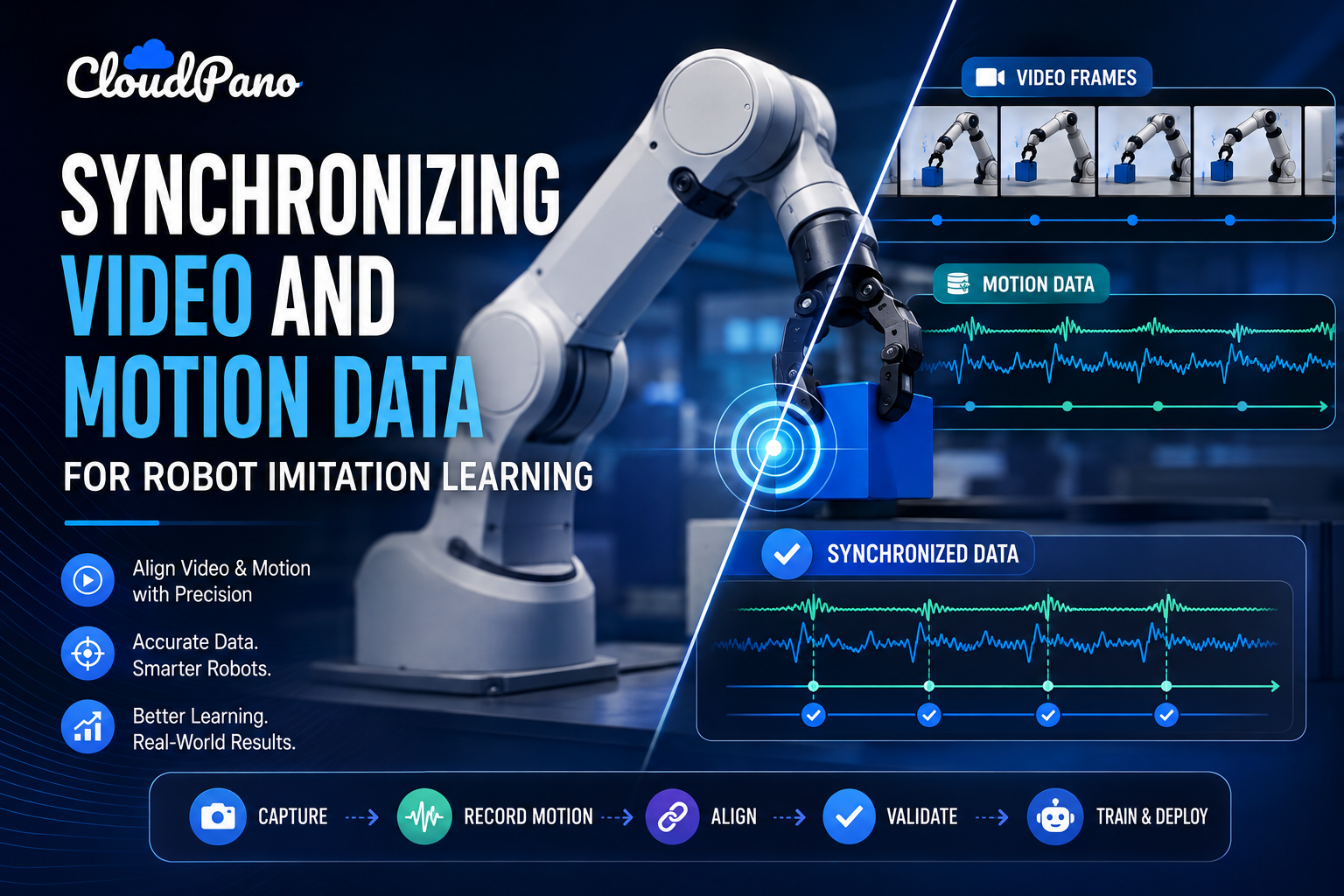
Most robotics annotation work focuses on what's visible in a video frame — objects, grasp points, human hands. Video annotation robotics motion data for imitation learning raises a different, less visible problem: aligning that video precisely with the robot's own joint angles, end-effector position, or trajectory data, since that's the actual signal an imitation learning model needs to map visual input to motor output.
Robotics Video Annotation for this purpose isn't primarily about labeling what's in the frame. It's about timing — confirming that a given video frame corresponds accurately to the exact robot state recorded at that same instant, since even small misalignment teaches a model a distorted relationship between perception and action.
A model trained on video and motion data that aren't precisely synchronized learns a systematically wrong mapping between what it perceives and how it should respond, and this kind of error is often invisible until the robot performs the learned behavior and the timing is subtly, consistently off. Google Research's "Data Cascades" study documented how such data quality issues compound as they move through a pipeline, becoming much harder to trace back to their source once a model has already learned from misaligned data (Sambasivan et al., Google Research).
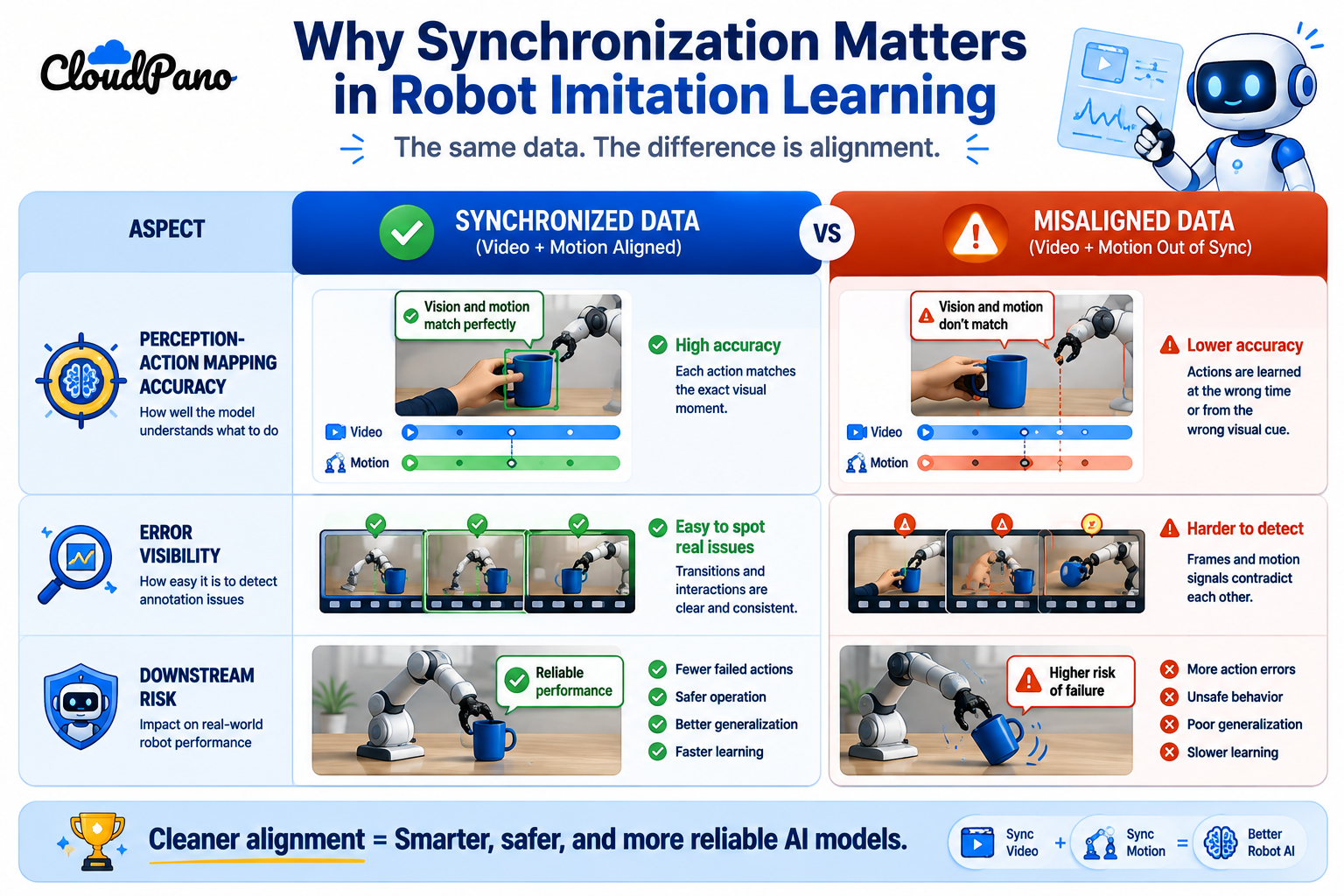
NIST's AI Risk Management Framework treats data fitness for the intended task as foundational to trustworthy AI, directly relevant to Motion Tracking Annotation needing to address synchronization accuracy specifically, not just whether the right objects and actions were labeled (NIST AI RMF).
The stakes rise as imitation learning becomes a more common approach to robot training. Stanford HAI's AI Index has tracked growing research and industry interest in learning-from-demonstration approaches for robotics (Stanford HAI, AI Index Report), and synchronization errors at scale can quietly degrade a model's real-world performance in ways that are difficult to diagnose after the fact.
Robot Training Data Annotation for imitation learning generally addresses a few specific synchronization and labeling challenges.
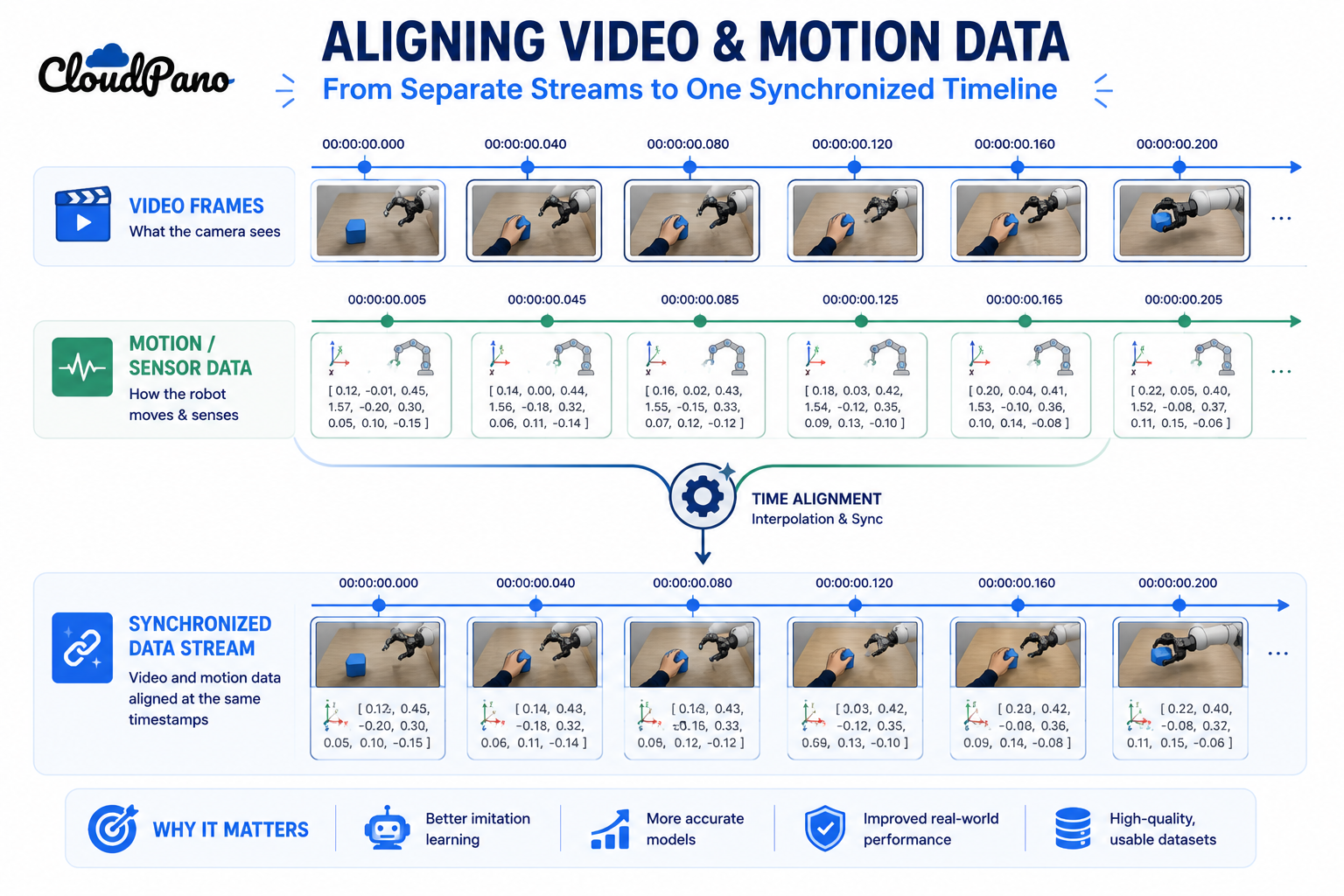
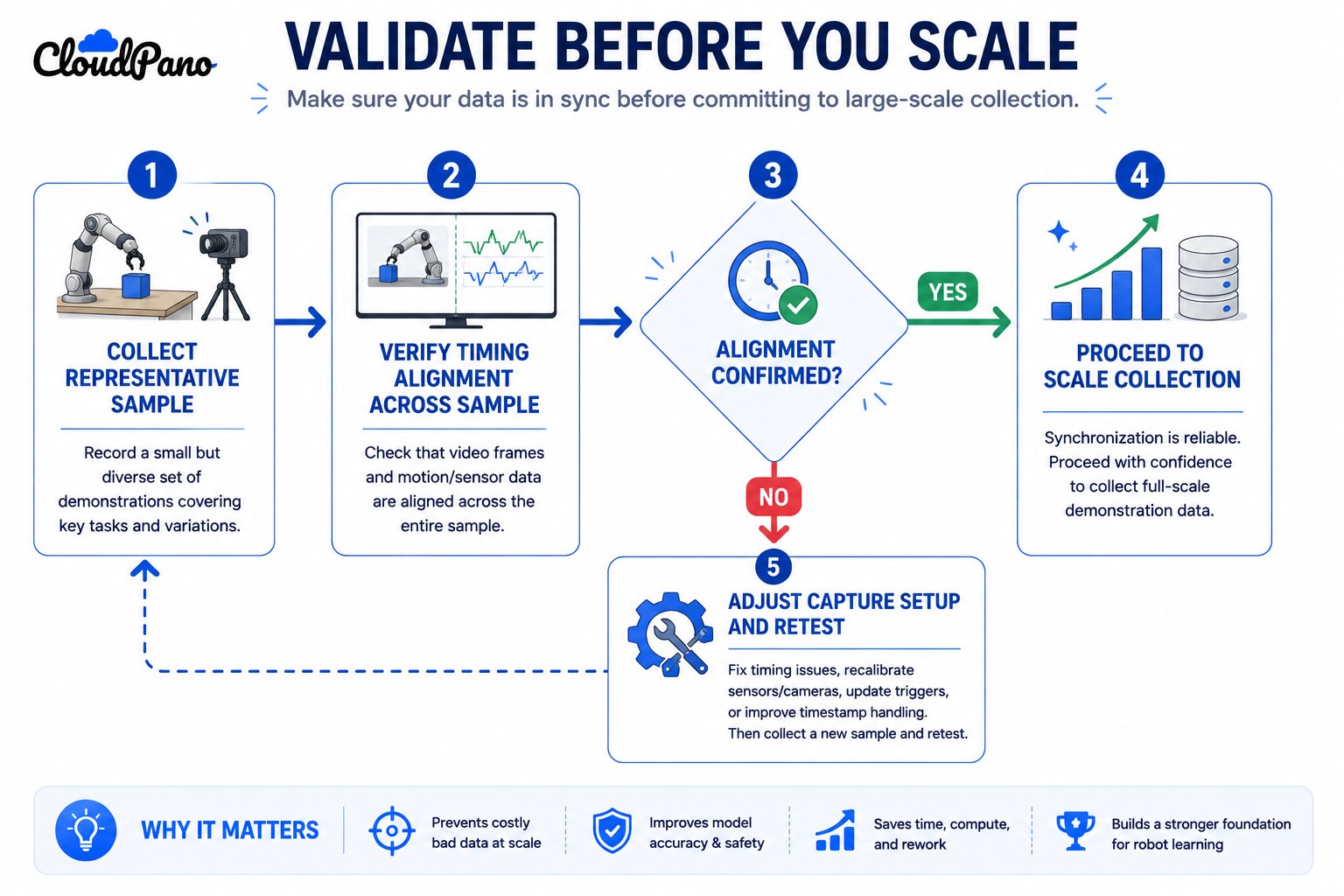
Timestamp alignment. Video frames and motion or sensor data typically come from separate capture systems running on their own clocks, requiring careful alignment to confirm a given frame actually corresponds to the motion state recorded at that instant.
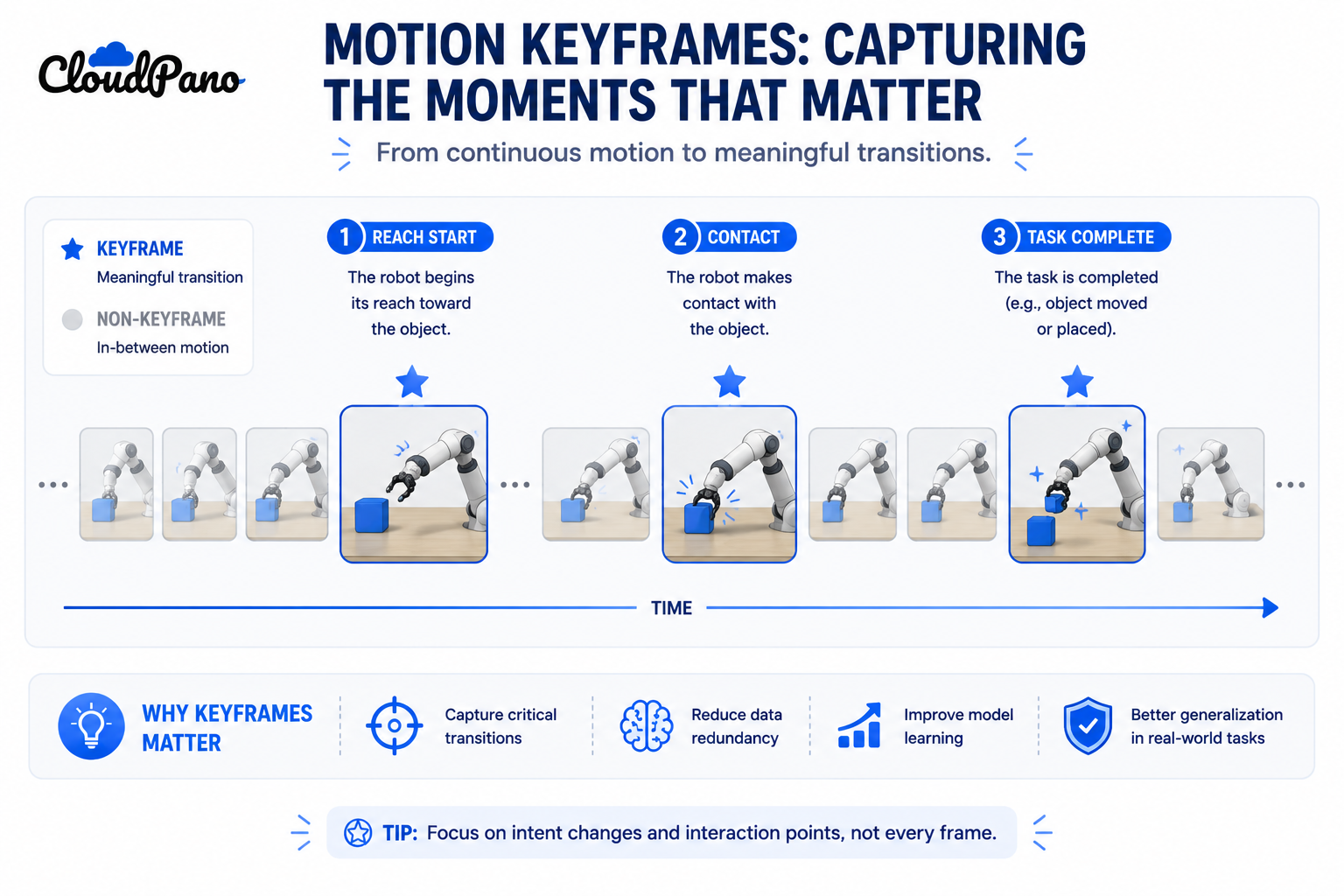
Keyframe identification. Rather than treating every frame as equally important, identifying specific keyframes that mark meaningful transitions in a motion sequence — the start of a reach, the moment of contact, the completion of a task — gives a model clearer structure to learn from.
Trajectory segmentation. Long demonstration sequences often need to be broken into discrete segments representing distinct sub-tasks or motion phases, rather than treated as one continuous, undifferentiated sequence.
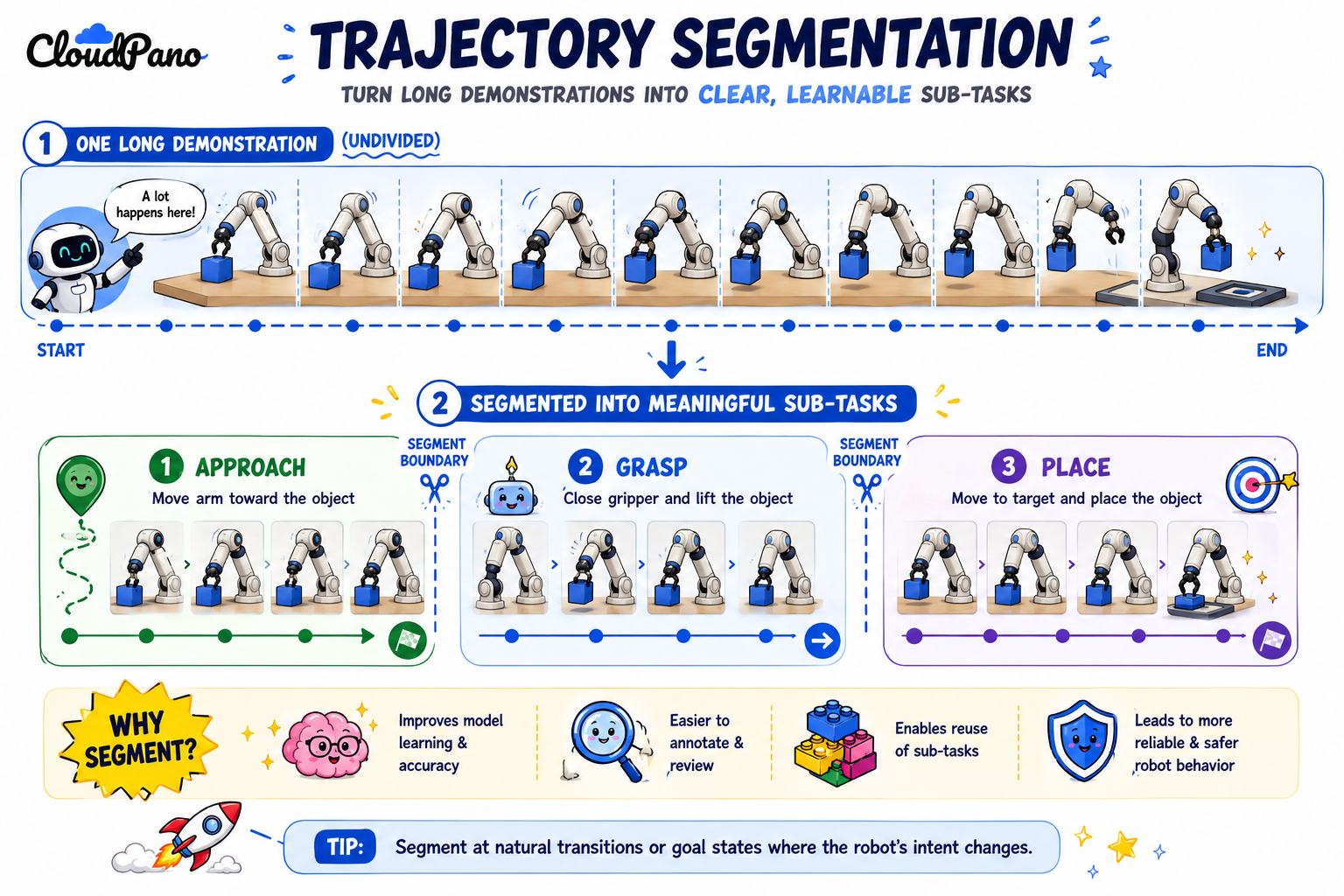
Quality validation of paired data. Confirming that the video and motion data genuinely correspond — not just that both exist for the same demonstration — requires specific checks beyond standard video annotation quality assurance.
Understanding how these workflows operate as fundamentally a synchronization and structuring problem — not primarily an object-labeling task — is what separates imitation learning data that actually teaches accurate perception-to-action mapping from data that looks complete but carries subtle timing errors.
Synchronizing video frames precisely with a robot's own motion or trajectory data, identifying meaningful keyframes, segmenting demonstrations into sub-tasks, and validating that the paired data genuinely corresponds in time.
Because an imitation learning model needs to learn the relationship between what it perceives and how it should move; misaligned timing teaches a distorted version of that relationship even if visible objects are labeled correctly.
A specific moment in a demonstration marking a meaningful transition — the start of a reach, the point of contact, the completion of a task — that gives a model clearer structure than treating every frame equally.
Through specific checks confirming that a given video frame corresponds to the correct robot state at that same instant, distinct from general visual annotation quality review.
Because treating an entire extended sequence as one undifferentiated block gives a model less useful structure than breaking it into discrete phases representing specific sub-tasks or motion stages.
Often yes, since it requires handling synchronized multi-stream data (video plus motion or sensor data) rather than video alone, which standard video annotation tools aren't necessarily built for.
The resulting model can learn a systematically inaccurate mapping between perception and action, an error that's often invisible until the robot performs the learned behavior and the timing proves subtly wrong.
Video annotation robotics motion data for imitation learning is fundamentally a synchronization and structuring challenge, not primarily an object-labeling task. Precise timestamp alignment, meaningful keyframe identification, and deliberate trajectory segmentation are what actually determine whether a model learns an accurate relationship between what it sees and how it should move. Getting this right before scaling demonstration data collection is what prevents a hard-to-diagnose error from being baked into a trained model's behavior.


Compact, ready to go anywhere
Interchangeable lens that’s upgradeable
Dual 1-inch sensors for improved clarity and low light performance
Dynamic range and 6K 360° capture
360° photo resolution at 21MP

8K 360° video recording for ultra-detailed visuals.
4K single-lens mode for traditional wide-angle shots.
Invisible selfie stick effect for drone-like perspectives.
2.5-inch touchscreen with Gorilla Glass protection.
Waterproof up to 33ft for underwater shooting.

360° photo resolution in 23MP
Slim design at 24 mm thick
Built-in image stabilization for smooth video capture.
Internal 19GB storage for photo and video storage.
Wireless connectivity for remote control and sharing.

60MP 360° still images for high-resolution photography.
5.7K 360° video recording at 30fps.
2.25-inch touchscreen for intuitive control.
USB Type-C port for fast charging and data transfer.
MicroSD card slot for expandable storage.
.png)

.png)

Try it free. No credit card required. Instant set-up.






.svg)


.svg)