


.png)


Buyers scrolling through listings at midnight don't linger on photos the way they once did. They swipe, pause on the ones that move, and keep scrolling past the ones that don't. That shift in behavior is exactly why a real estate video maker has quietly become one of the most useful tools in a modern agent's kit — not a luxury reserved for million-dollar listings, but a practical way to keep properties competitive in a market where static photos can struggle to hold attention in increasingly video-driven feeds.
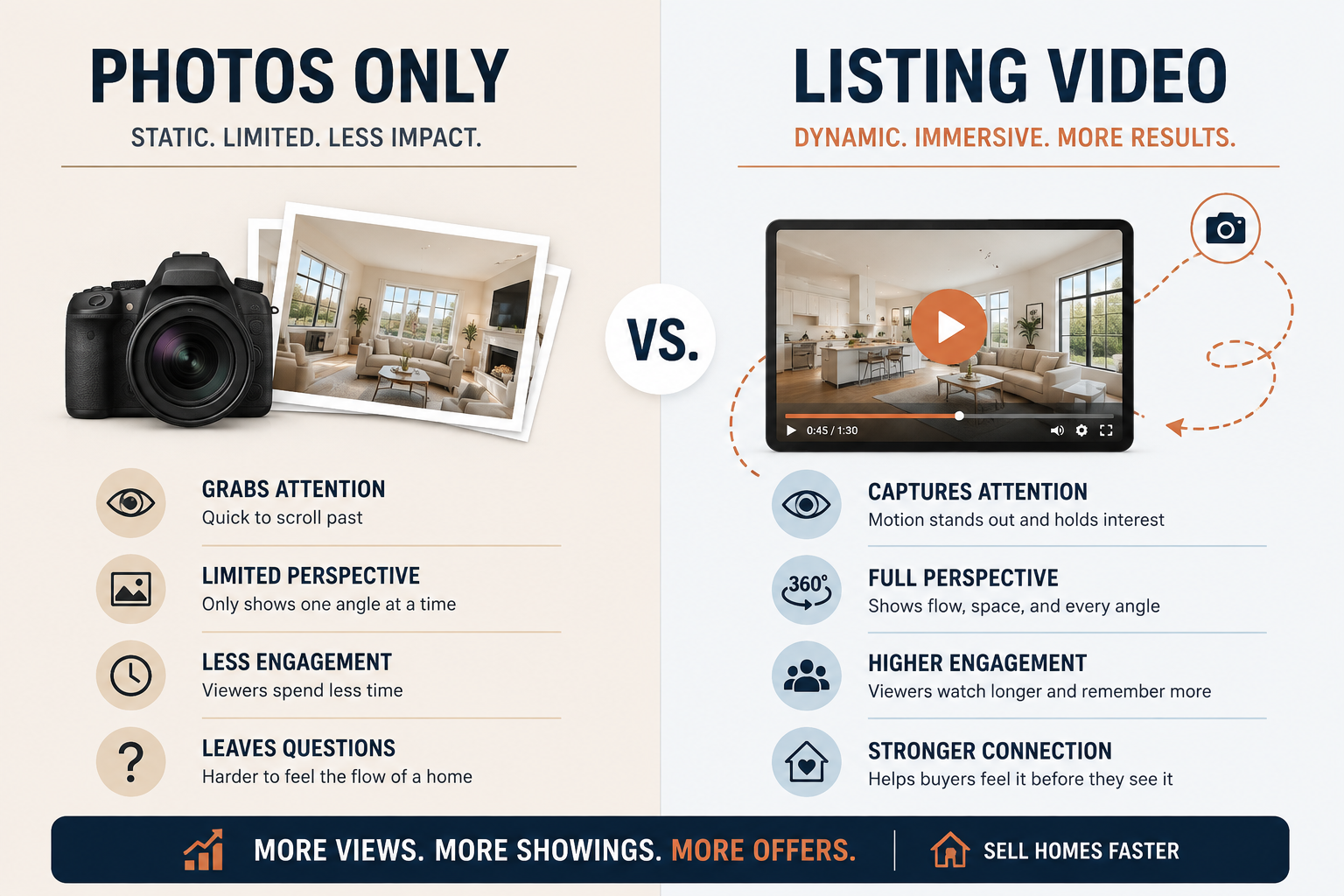
For years, listing photos were the standard, and for good reason: they were fast, affordable, and easy to produce. But buyer expectations have evolved. People are now accustomed to immersive, motion-rich content across the platforms they use every day. A gallery of still images can show that a kitchen exists. It can't fully show what it feels like to walk into it.
This article looks at why video can give listings an advantage over photos alone, what that means for the way buyers shop for homes, and how agents can realistically add video to more listings — not just flagship properties — without hiring a production crew or learning to edit.
Home shopping is no longer a weekend activity confined to open houses and printed flyers. It happens in short bursts throughout the day, often on a phone and before a buyer has even contacted an agent. By the time someone reaches out, they may have already narrowed down their options based largely on what they saw online.
That means the listing itself is doing much of the early marketing long before an agent ever picks up the phone. According to the National Association of Realtors' research and statistics, online resources play a significant role in today's home search. When buyers are comparing multiple properties online, listings that incorporate engaging visual media have another opportunity to capture attention.
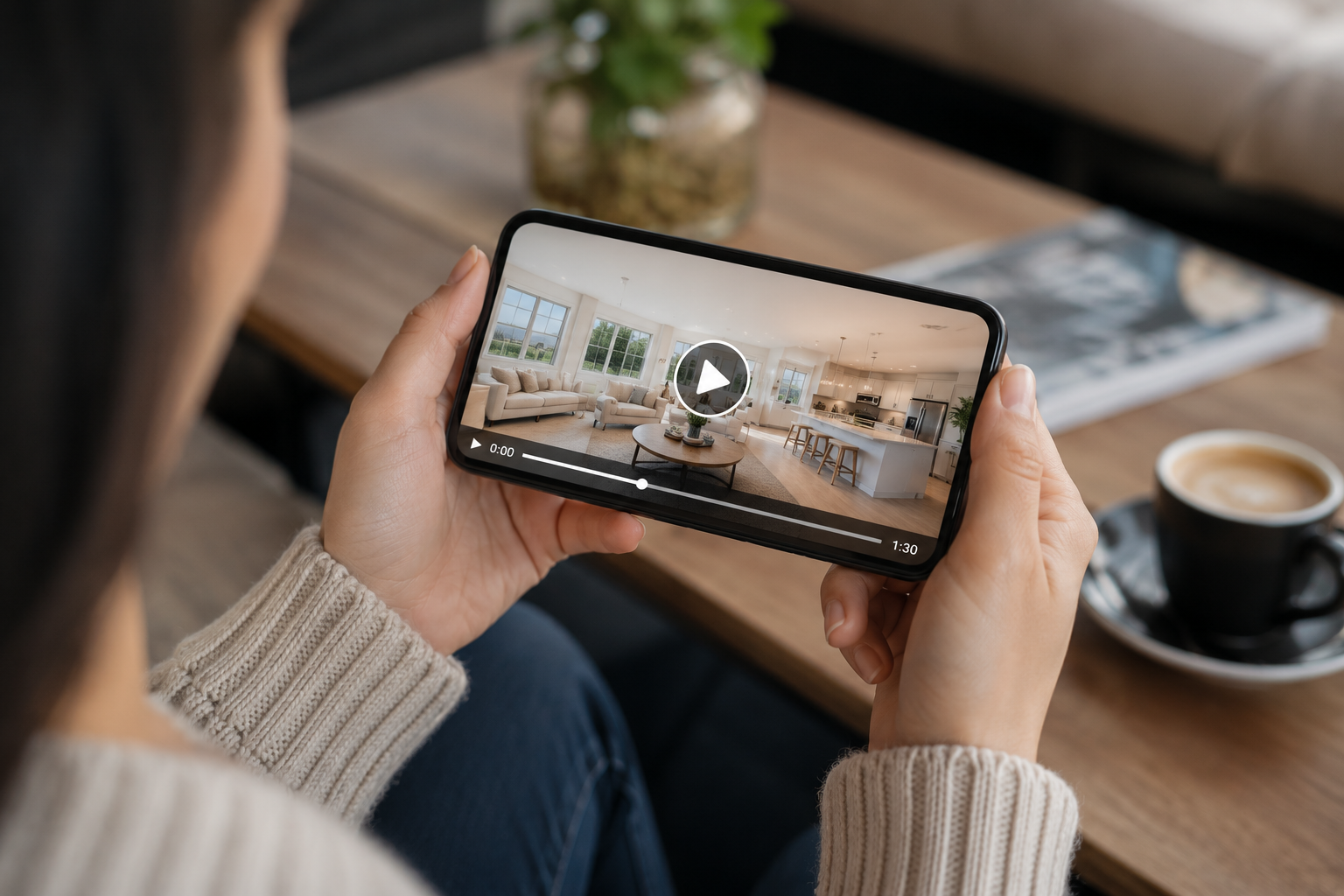
This is one reason a real estate video maker has moved from a "nice to have" toward becoming a practical addition to an agent's marketing toolkit. It's not simply about chasing a trend — it's about adapting property marketing to the way people increasingly consume content online.
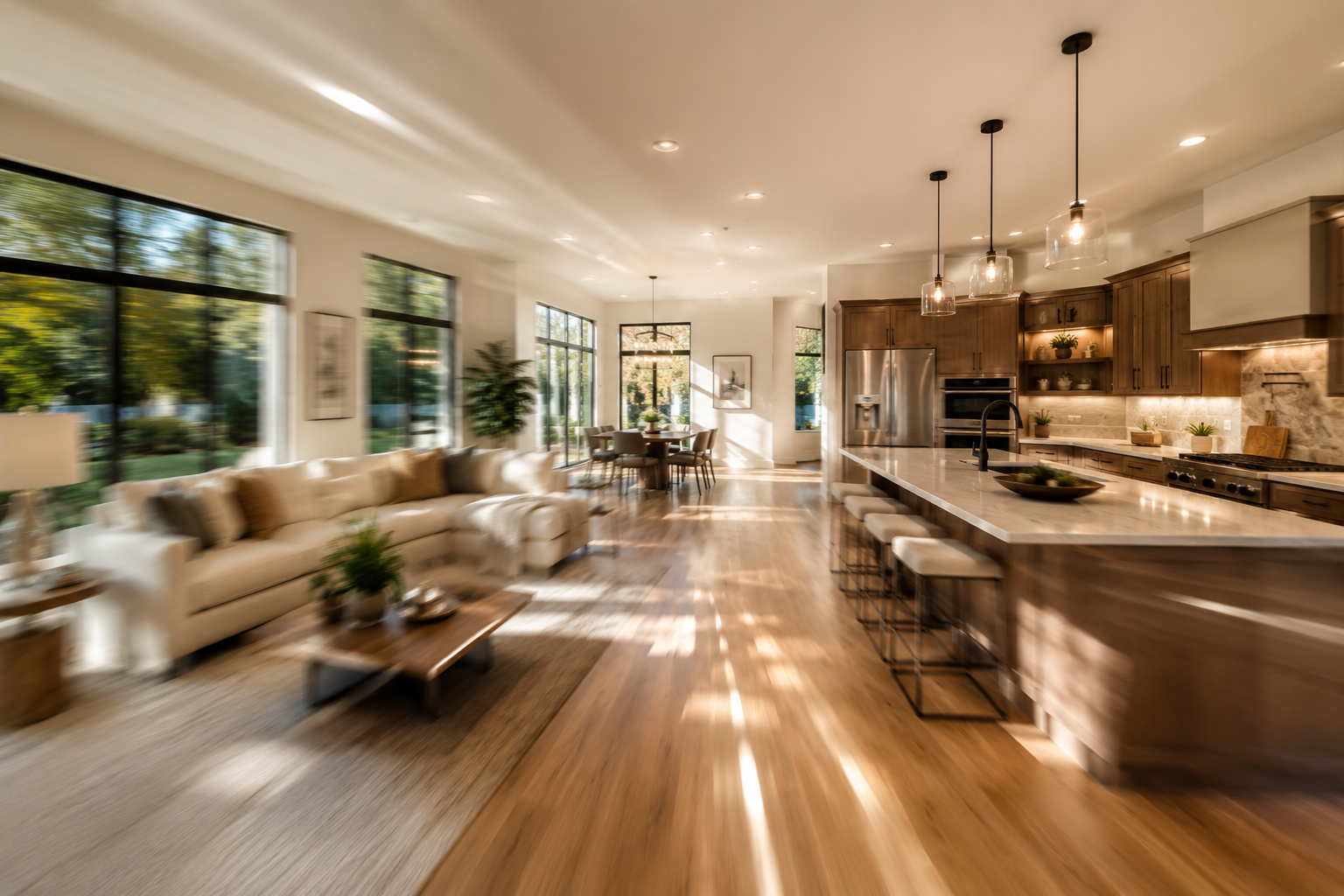
Photos are snapshots. Video creates an experience. That distinction matters because buying a home often involves an emotional decision alongside a significant financial one. Buyers aren't just evaluating square footage and finishes — they're imagining themselves living there, and video can make that easier by showing how a space actually flows.
A pan across a living room, a slow dolly down a hallway, or an orbit around a kitchen island can communicate scale, natural light, and layout in ways that are difficult to capture with individual still photos. Video lets viewers mentally walk through the front door, turn the corner into the kitchen, and understand how one room connects to the next.
That sense of flow is often what's missing from a traditional photo gallery, where each room is presented as an individual frame.
This is also where video marketing for realtors can provide value beyond aesthetics. Video can communicate tone, context, and emotion quickly, helping viewers develop a stronger sense of the property before they ever visit it in person. For a listing, that emotional connection may help turn casual interest into a showing request.
Attention is one of the scarcest resources in online home shopping, and video can be particularly effective at holding it because movement and narrative encourage viewers to keep watching.
A photo gallery invites viewers to move through individual images at their own pace. A well-produced property video creates a more guided experience, using motion and sequencing to lead viewers from one feature to the next.
That additional engagement can matter. The longer buyers spend exploring a listing, the more opportunities they have to understand its layout, finishes, and overall character — and the more information they have when comparing it with other properties later.
This is one of the practical advantages of adding a listing video to a property page or social post: it doesn't simply provide another visual asset. It gives buyers another way to experience and remember the home.
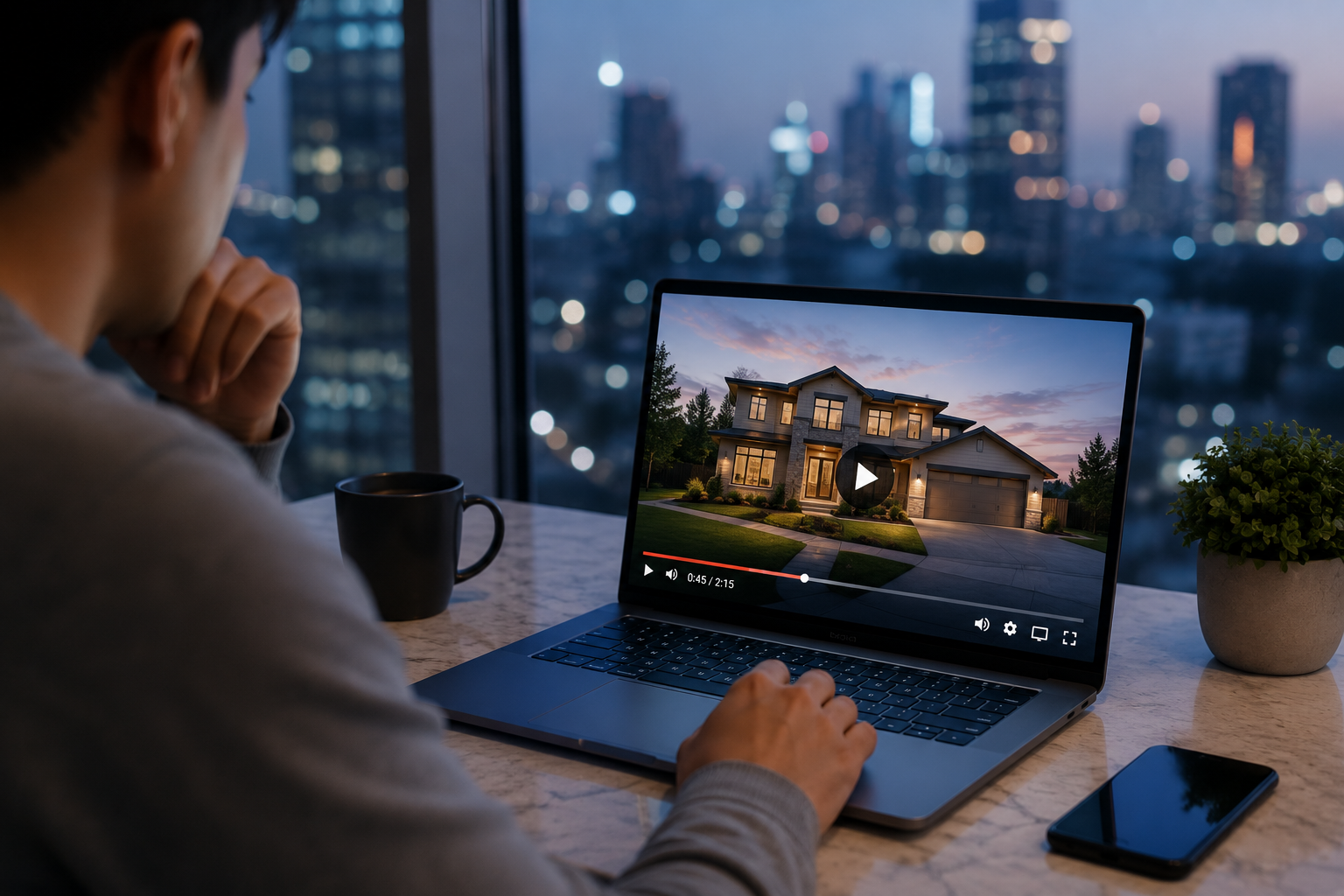
Not every buyer can walk through a home in person before deciding whether it's worth pursuing. For relocating and out-of-town buyers in particular, a real estate video can provide valuable context before they commit to traveling for an in-person showing.
Photos can leave important questions unanswered. Is the layout awkward? Does the primary bedroom actually get natural light? How far is the kitchen from the garage entry?
Video can help answer these questions because it shows spatial relationships and transitions between rooms instead of asking buyers to piece them together mentally from disconnected images.
For agents who work with military relocations, corporate transfers, or out-of-state buyers, a video walkthrough can therefore be much more than a marketing extra. It's a practical way to help remote buyers understand a property before visiting it.
A tool purpose-built for real estate agents can make it easier to offer that experience across more listings rather than waiting until a relocating buyer specifically requests a video.
In many markets, buyers are looking at dozens of similar homes within the same price range and neighborhood. When listings offer similar sets of photos taken from similar angles, differentiation becomes difficult.
Video provides agents with another way to present the property and demonstrate the effort being put into its marketing. A polished listing video can also contribute to a more professional and cohesive presentation alongside traditional photography.
This is where a real estate video maker changes the math for agents.
Producing property videos traditionally meant hiring a videographer, coordinating a shoot schedule, and waiting for the footage to be edited. That workflow often made the most sense for higher-value properties or listings with larger marketing budgets.
An AI video generator can remove much of that friction. Instead of scheduling a separate shoot, an agent can turn photos already taken for the listing into a polished video with camera movement, transitions, and branding.
That faster workflow can be especially useful in active markets, where agents often want their marketing assets ready shortly after a listing goes live.
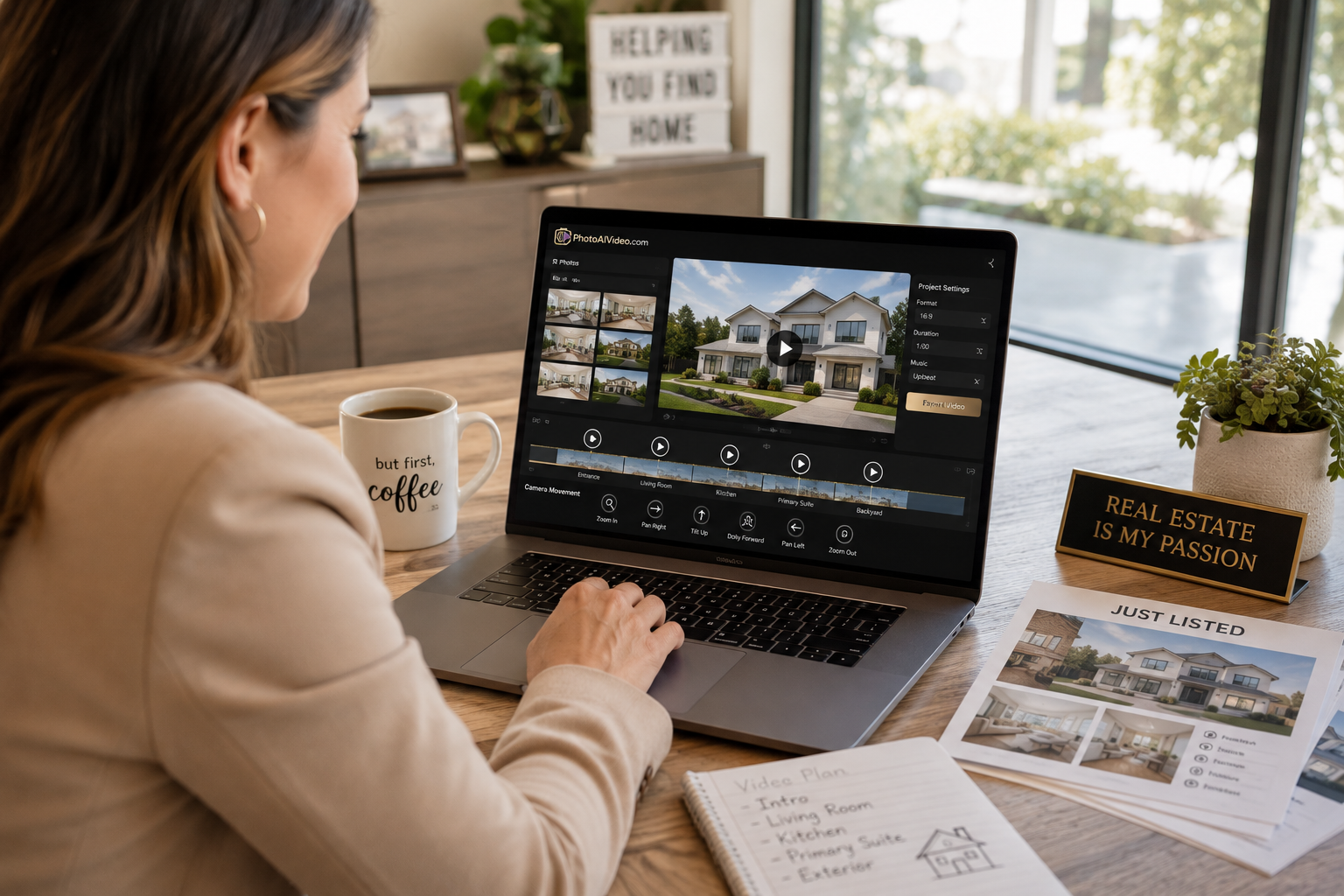
The idea of adding video to every listing sounds ambitious until much of the traditional production burden is removed from the equation.
For many agents, the barriers to video have historically been time, cost, and the skills required for filming and editing. A real estate video maker built around AI can reduce those barriers, making "video on every listing" a much more realistic goal.
The workflow is straightforward: upload the listing photos already taken for the MLS and marketing materials, choose from a range of professional camera movements — including pans, zooms, tilts, dolly moves, and orbits — and let the platform assemble the images into a cinematic listing video.
Branding, voiceover, and even an AI avatar for a personal introduction can be layered on top, giving agents additional ways to customize the finished video without having to film everything from scratch.
This is also where the earlier points about relocating buyers and standing out in a crowded market come together.
When video no longer requires a separate filming day or lengthy editing workflow, it becomes much easier to offer it beyond flagship listings. Properties ranging from starter condos to luxury estates can receive video marketing without requiring the same resources as a traditional production.
That can be particularly useful for individual agents and smaller teams that don't have access to in-house video production.
Agents, agencies, and photographers can all use this type of tool differently. An individual agent might use it to add video to new listings without arranging a separate video shoot. An agency might standardize videos across its agents' listings to create a more consistent brand presence. A photographer might offer video as an additional service alongside existing photography packages.
Whatever the use case, PhotoAIVideo approaches the problem as an AI-powered real estate video maker designed to reduce the traditional barriers between having listing photos and having a finished property video.
Does every listing really need a video, or just high-end homes?
Video can benefit listings across a wide range of price points, not just luxury properties. A starter home competing for attention online can benefit from the same ability to demonstrate movement, layout, and room-to-room flow as a luxury estate. Modern AI tools also make it easier to create video across a larger portfolio rather than reserving it exclusively for flagship listings.
How long should a real estate listing video be?
A useful range for many listing videos is between 30 seconds and two minutes — long enough to communicate the property's flow and key features without unnecessarily stretching the content. The ideal length will also depend on the platform and audience. Short-form social videos may need to be considerably shorter, while a more complete property walkthrough can run longer.
The goal is to create an engaging overview that complements the full photo gallery rather than replacing it.
Do I need filming experience or expensive equipment to create property videos?
Not necessarily. Traditional real estate videography may require cameras, stabilization equipment, filming experience, and editing skills. An AI-based real estate video maker can instead create a video from listing photos an agent already has, reducing the need for a separate filming and editing workflow.
Can video work alongside my existing listing photos instead of replacing them?
Yes — and the two formats can complement each other well. Photos allow buyers to study individual rooms and details at their own pace, while video can communicate movement, scale, layout, and the connections between spaces.
Rather than treating them as competing formats, agents can use photos and video together to give buyers a more complete visual understanding of the property.
Photos were once the primary visual format for marketing homes online. Today, buyers encounter properties across websites, listing portals, social feeds, and mobile devices, giving agents more reasons to consider video alongside traditional photography.
Video can help communicate room-to-room flow, create a stronger sense of the property's atmosphere, provide useful context for out-of-town buyers, and give listings another way to capture attention online.
And creating that content no longer has to mean organizing an entirely separate video production.
Trying a real estate video maker on an upcoming listing is a practical, relatively low-friction way to test the format alongside your existing photo-first marketing. Compare how buyers engage with both approaches, track what performs best for your audience, and use those insights to decide how video fits into your future listing strategy.


Compact, ready to go anywhere
Interchangeable lens that’s upgradeable
Dual 1-inch sensors for improved clarity and low light performance
Dynamic range and 6K 360° capture
360° photo resolution at 21MP

8K 360° video recording for ultra-detailed visuals.
4K single-lens mode for traditional wide-angle shots.
Invisible selfie stick effect for drone-like perspectives.
2.5-inch touchscreen with Gorilla Glass protection.
Waterproof up to 33ft for underwater shooting.

360° photo resolution in 23MP
Slim design at 24 mm thick
Built-in image stabilization for smooth video capture.
Internal 19GB storage for photo and video storage.
Wireless connectivity for remote control and sharing.

60MP 360° still images for high-resolution photography.
5.7K 360° video recording at 30fps.
2.25-inch touchscreen for intuitive control.
USB Type-C port for fast charging and data transfer.
MicroSD card slot for expandable storage.
.png)

.png)

Try it free. No credit card required. Instant set-up.





.svg)


.svg)