Scaling a Video Annotation Pipeline: Workforce, Throughput, and Tooling

Cloudpano
August 2, 2026
5 min read
Share this post

Scaling a Video Annotation Pipeline: Workforce, Throughput, and Tooling

A pilot video annotation project with five annotators and a manageable weekly volume runs on informal coordination just fine. Video annotation at scale is a different operational problem entirely — workforce sizing, task distribution, and tooling all need deliberate design once volume grows past what a small team can coordinate through direct communication.

Large-Scale Video Annotation projects fail less often because of annotation quality and more often because of operational bottlenecks nobody planned for — a workforce that can't be onboarded fast enough, tooling that doesn't parallelize well, or a pipeline architecture with a single point where everything backs up.

Why It Matters

A video annotation pipeline that isn't designed for scale doesn't fail gradually — it hits a specific bottleneck point where throughput stops matching demand, and the fix at that stage is far more disruptive than designing for scale from the start. Google Research's "Data Cascades" study documented how operational gaps that seem manageable early compound into larger problems as a project scales, a pattern directly relevant to annotation pipelines that weren't architected with volume growth in mind (Sambasivan et al., Google Research).
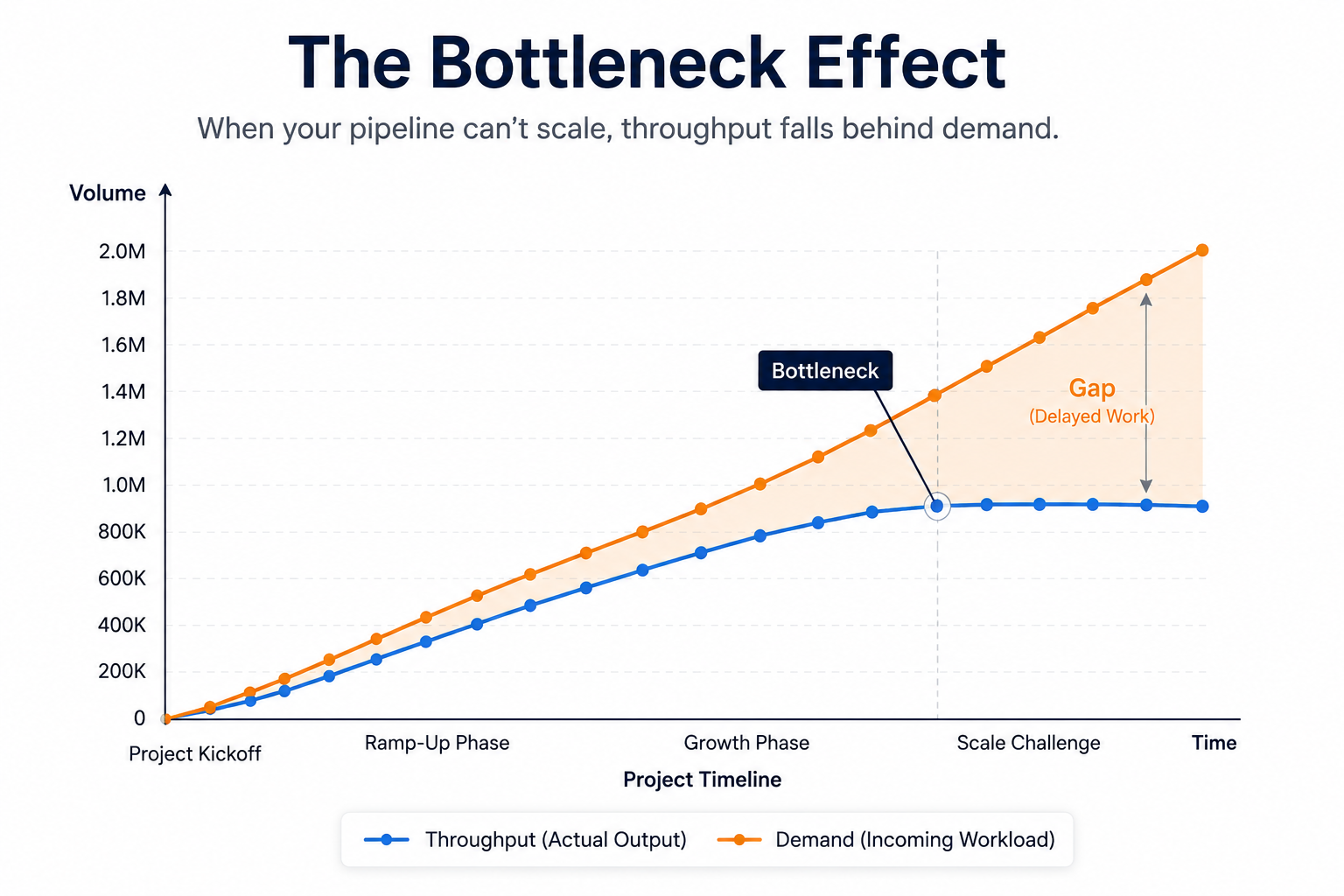
Line graph showing throughput falling behind demand at a video annotation bottleneck point

NIST's AI Risk Management Framework treats process reliability and scalability as relevant considerations for trustworthy AI development, directly applicable to Video Annotation Workflow design needing to hold up operationally, not just produce accurate labels at small scale (NIST AI RMF).

The stakes rise given how much video data modern computer vision projects require. Stanford HAI's AI Index has tracked the growing data volumes underlying computer vision and multimodal AI development (Stanford HAI, AI Index Report), and a pipeline that can't scale operationally becomes the actual constraint on a project's timeline, regardless of how good the underlying annotation methodology is.
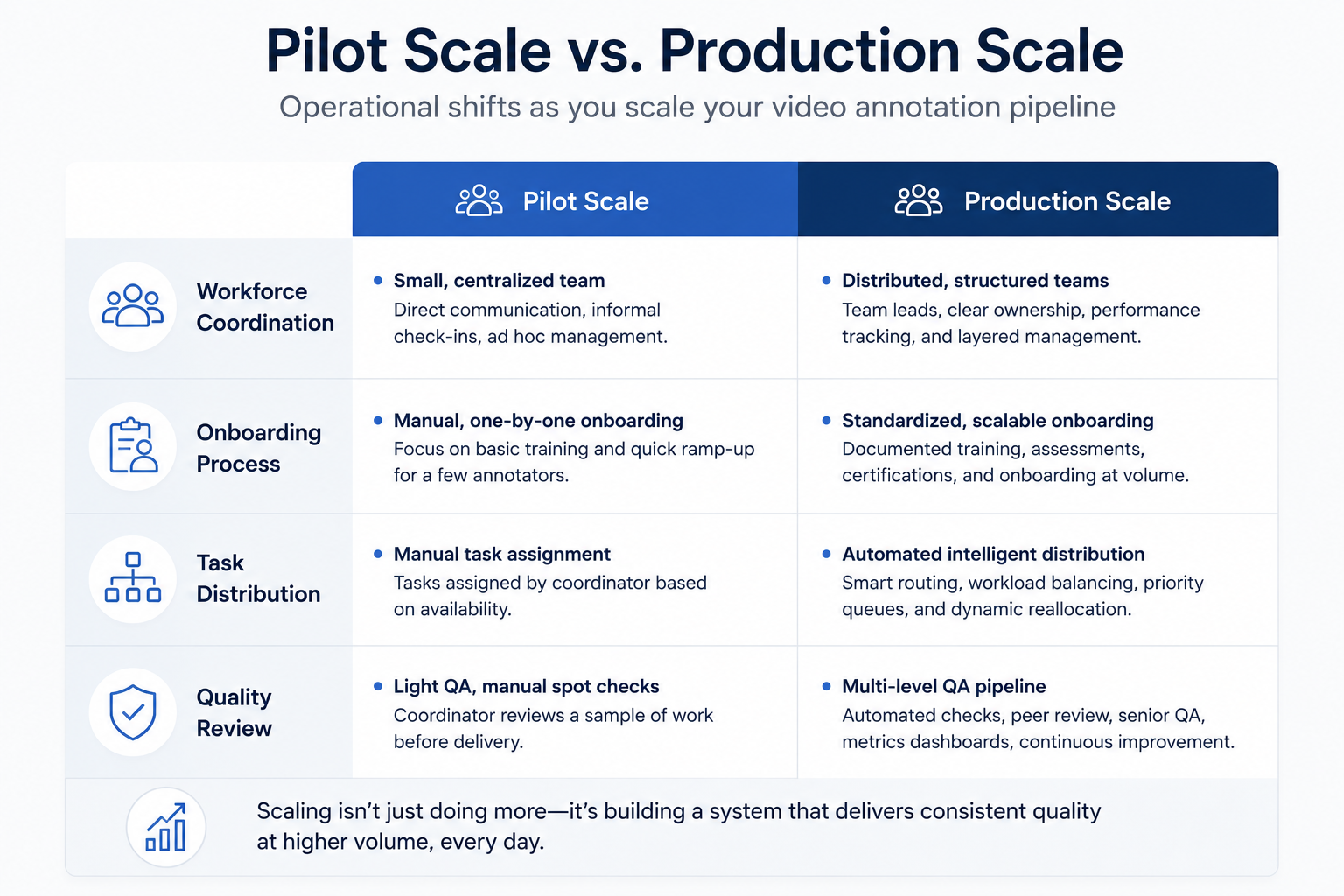
Comparison table of pilot-scale vs production-scale video annotation operations

How It Works

AI Training Data Annotation at video scale requires deliberate decisions across three operational dimensions.
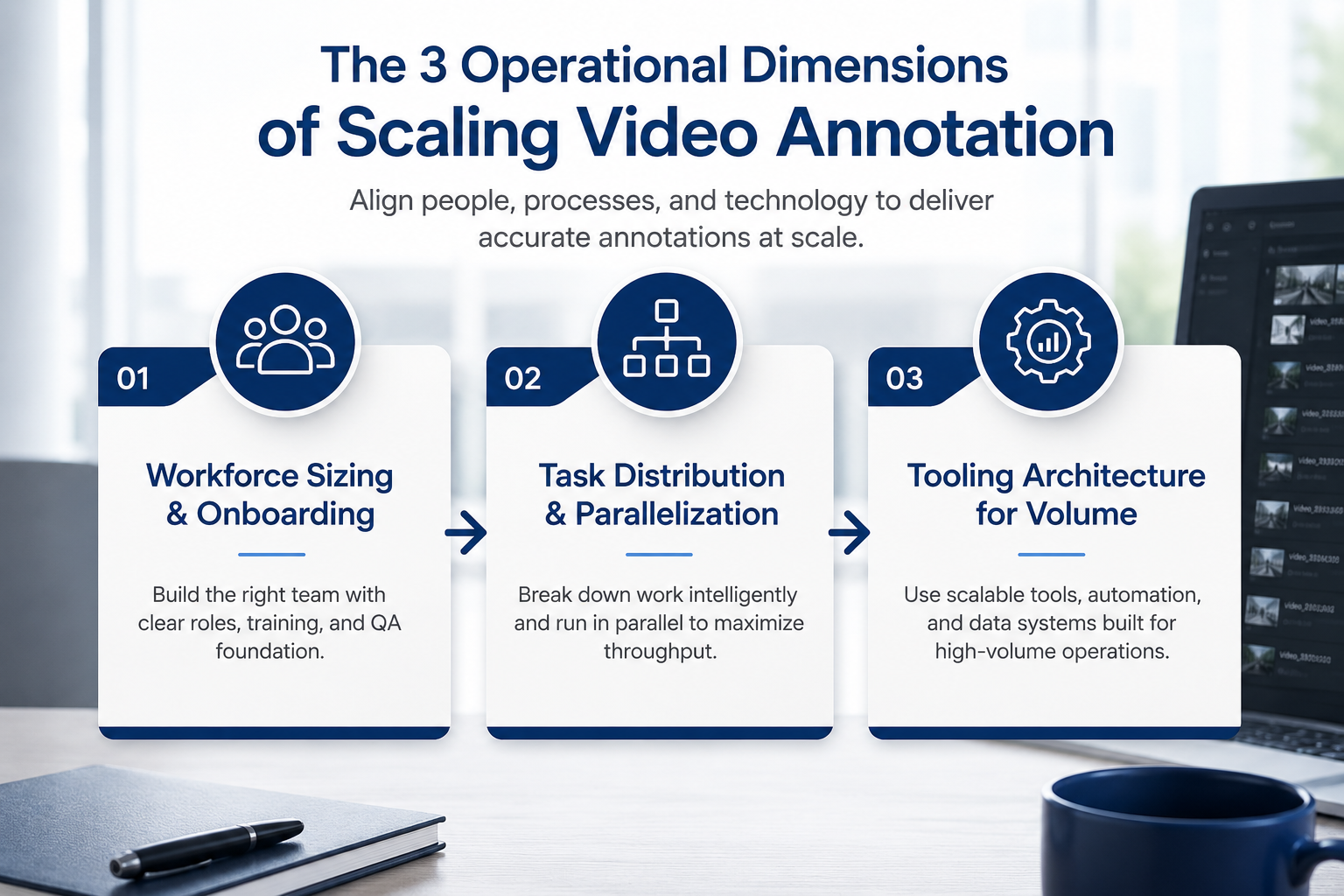
Diagram of the three operational dimensions of scaling video annotation at scale

Workforce sizing and onboarding. Matching annotator headcount to actual throughput requirements, with an onboarding process that can bring new annotators up to production quality fast enough to keep pace with volume growth.

Task distribution and parallelization. Structuring work so many annotators can operate on a large video library simultaneously without creating coordination bottlenecks or duplicate effort.

Tooling architecture for volume. Selecting or building systems that support task queuing, progress tracking, and quality routing at a scale manual coordination and spreadsheets simply can't sustain.

A pipeline that works well for a hundred hours of video often needs meaningfully different architecture at ten thousand hours, not just more of the same setup scaled up proportionally. Understanding how these workflows operate as requiring deliberate operational design — not just "the same process with more people" — is what actually prevents the bottleneck point most scaling projects hit.

Step-by-Step Workflow

  • Forecast actual throughput requirements before scaling the workforce. Calculate the annotation volume and timeline your project genuinely needs, not just an estimate based on pilot-stage pace.
  • Design an onboarding process that can keep pace with workforce growth. Build training and qualification that scales, since ad hoc onboarding that worked for five people won't work for fifty.
  • Architect task distribution to avoid coordination bottlenecks. Structure work assignment so throughput doesn't depend on a small number of people manually routing tasks.
Flowchart comparing centralized versus distributed video annotation task routing
  • Select tooling built for queuing and parallel task management at volume. Confirm your annotation platform can actually support the scale you're planning for, not just the pilot's smaller volume.
  • Build quality routing that scales with volume. Design review and escalation processes that don't require every item to pass through a single reviewer as throughput increases.
  • Monitor for bottleneck points as volume grows. Watch specifically for where throughput starts lagging demand, rather than assuming the pipeline will scale linearly and uniformly.
  • Revisit workforce, tooling, and architecture decisions as the project matures. What worked at initial scale-up may need further adjustment as volume continues to grow.

Industry Use Cases

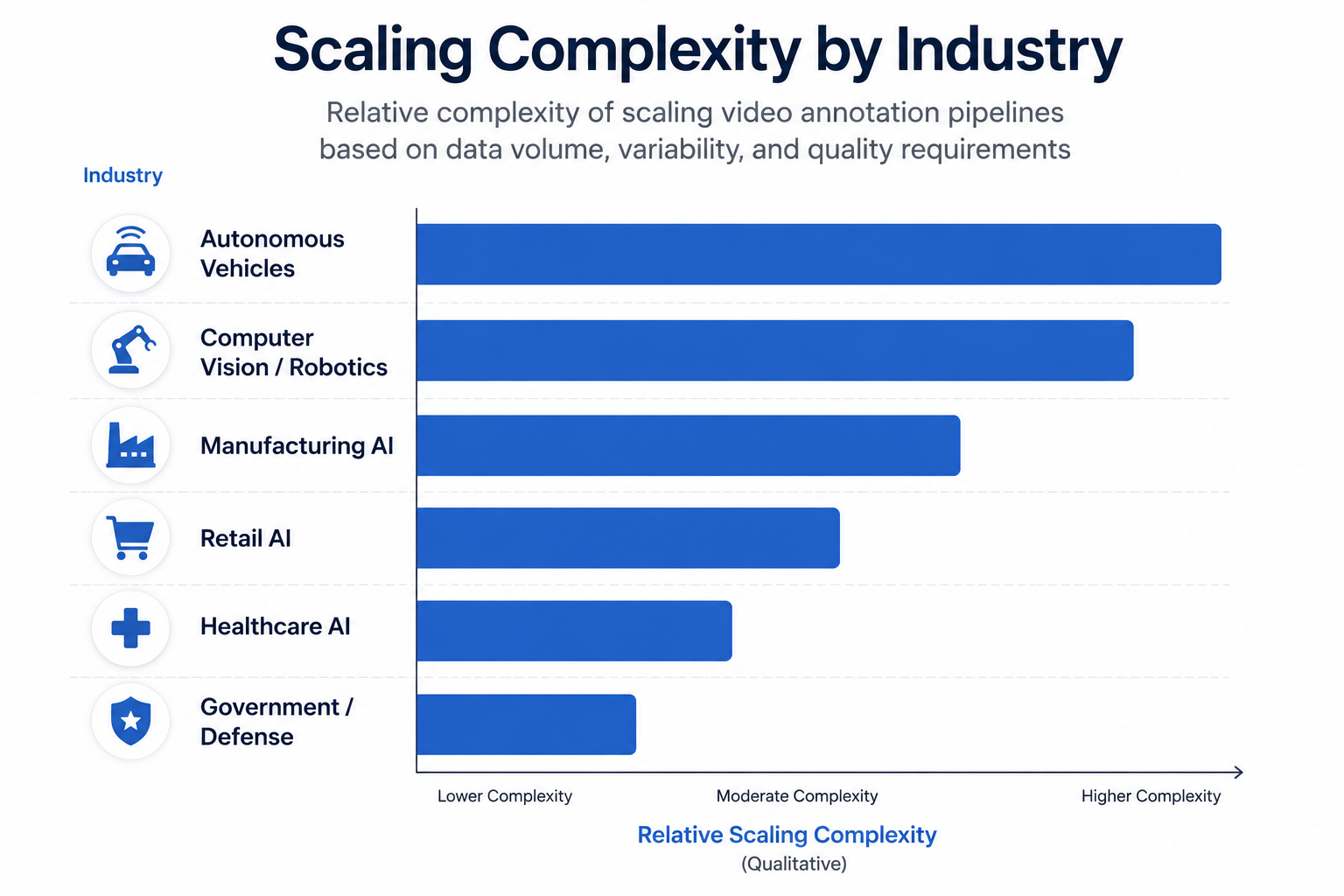
  • Computer vision / robotics: Large-scale annotation projects here often require the full range of operational scaling — workforce, tooling, and architecture — given the video volumes typical detection and tracking models require.
  • Autonomous vehicles: Massive driving datasets demand particularly deliberate pipeline architecture, since the volume involved is often an order of magnitude beyond typical computer vision projects.
  • Healthcare AI: Scaling video annotation in this domain often requires balancing throughput needs against the smaller, more specialized workforce pool qualified for clinical content.
  • Manufacturing AI: Process monitoring and defect detection video annotation projects benefit from deliberate task distribution given the often continuous, high-volume nature of production line footage.
  • Retail AI: In-store video annotation at scale requires workforce and tooling planning matched to the sheer volume of footage large retail operations typically generate.
  • Government & defense: Scaling considerations here often layer security and access-control requirements on top of standard workforce and tooling scaling decisions.

Benefits

  • Predictable throughput as volume grows. Deliberate workforce and architecture planning avoids the bottleneck point where demand outpaces actual annotation capacity.
  • Faster time to production-scale volume. A scalable onboarding process and task distribution architecture get a growing workforce productive faster than ad hoc scaling.
  • More efficient use of tooling investment. Selecting systems built for volume from the start avoids the cost of migrating tooling mid-project once pilot-stage systems hit their limits.
  • Reduced quality degradation risk at scale. Quality routing designed to scale prevents review bottlenecks that would otherwise force a choice between throughput and quality.
  • Clearer visibility into actual project timelines. Understanding genuine throughput capacity supports more accurate project planning than assuming pilot-stage pace scales linearly.

Common Mistakes

  • Assuming pilot-stage processes scale linearly with more people. Missing that coordination and quality processes that worked informally at small scale often break down entirely at volume.
  • Underinvesting in onboarding scalability. Treating annotator training as a one-off process rather than building a system that can bring new people up to speed quickly and consistently.
  • Not planning task distribution architecture before scaling. Discovering coordination bottlenecks only once volume has already outpaced the informal systems that worked at pilot scale.
  • Choosing tooling based on pilot-stage needs alone. Selecting a platform without confirming it can actually support the throughput and parallelization the full-scale project will require.
  • Centralizing quality review through a single bottleneck. Designing a review process that depends on one person or small team, which becomes an obvious constraint as volume grows.
  • Not monitoring for the actual bottleneck point as scaling progresses. Assuming the pipeline is scaling smoothly without tracking where throughput starts lagging demand.

Best Practices

  • Forecast actual throughput requirements before committing to a workforce or tooling scaling plan.
  • Build an onboarding process designed to scale, not an informal system that only worked because of a small initial team.
  • Architect task distribution to avoid dependence on a small number of people manually coordinating work.
  • Select tooling with genuine confirmation that it supports the volume and parallelization your full-scale project actually needs.
  • Design quality routing that scales with throughput, avoiding a single reviewer bottleneck.
  • Monitor actively for the specific point where throughput starts lagging demand, rather than assuming smooth, linear scaling.

FAQ

What does scaling video annotation actually require beyond adding more annotators?

Deliberate workforce onboarding design, task distribution architecture that avoids coordination bottlenecks, and tooling genuinely built to support parallel work and quality routing at volume.

Why do video annotation projects hit bottlenecks when scaling from pilot to production volume?

Because informal coordination, ad hoc onboarding, and centralized quality review that work fine with a small team don't scale linearly and often break down at a specific, identifiable volume point.

How should onboarding change for a large-scale video annotation workforce?

It needs to become a repeatable, scalable process capable of bringing new annotators to production quality quickly and consistently, rather than relying on informal, one-on-one training that worked at small scale.

What tooling considerations matter most for large-scale video annotation?

Confirming the platform genuinely supports task queuing, parallel work distribution, and quality routing at the actual volume the full-scale project requires, not just the smaller pilot-stage volume.

How can quality review avoid becoming a bottleneck at scale?

By designing a review and escalation process that distributes quality checking rather than routing every item through a single reviewer or small team, which becomes an obvious constraint as throughput increases.

Is it possible to predict where a video annotation pipeline will bottleneck before it happens?

Forecasting actual throughput requirements and monitoring closely as volume grows helps identify likely bottleneck points before they become acute, though ongoing monitoring remains necessary since specific constraints vary by project.

Should tooling decisions be made based on pilot-stage or full-scale needs?

Full-scale needs. Choosing tooling based only on pilot volume risks hitting its limits mid-project, requiring a disruptive migration once the project has already scaled.

Conclusion

Video annotation at scale is fundamentally an operational design problem, not just a matter of adding more annotators to a process that worked at pilot volume. Workforce onboarding built to scale, task distribution architecture that avoids coordination bottlenecks, and tooling genuinely suited to production volume are what actually determine whether a growing project hits a disruptive bottleneck or scales smoothly toward the throughput it actually needs.

🚀 Your All‑In‑One Virtual Experience Stack
🎬
PhotoAIVideo
Turn photos into scroll‑stopping AI videos.
Get Started →
🏡
Pictastic
Instantly stage listings with AI.
Try Staging →
🌀
CloudPano
Create stunning 360° tours in minutes.
Launch Tour →
💰
VirtualTourProfit
Build a profitable virtual tour business.
Learn More →
🤝
CloudPano Reseller
Resell AI visual software without building it.
Become a Reseller →
🚗
Auto CloudPano
Sell more vehicles with 360° experiences.
Explore Auto →
🏗️
AI Floor Plan Builder
Generate detailed floor plans with AI.
Build Now →
📐
3D Measure
Capture accurate floor plans & 3D measurements.
Measure Now →
🧠
AI Training Data
Custom AI training data services.
Learn More →
Share this post
Cloudpano

Choose The Right 360° Camera

Insta360 ONE RS 1-Inch 360 Edition

  • Compact, ready to go anywhere

  • Interchangeable lens that’s upgradeable

  • Dual 1-inch sensors for improved clarity and low light performance

  • Dynamic range and 6K 360° capture

  • 360° photo resolution at 21MP

Learn More

Insta360 X4

  • 8K 360° video recording for ultra-detailed visuals.

  • 4K single-lens mode for traditional wide-angle shots.

  • Invisible selfie stick effect for drone-like perspectives.

  • 2.5-inch touchscreen with Gorilla Glass protection.

  • Waterproof up to 33ft for underwater shooting.

Learn More

Ricoh Theta Z1

  • 360° photo resolution in 23MP

  • Slim design at 24 mm thick

  • Built-in image stabilization for smooth video capture.

  • Internal 19GB storage for photo and video storage.

  • Wireless connectivity for remote control and sharing.

Learn More

Ricoh Theta X

  • 60MP 360° still images for high-resolution photography.

  • 5.7K 360° video recording at 30fps.

  • 2.25-inch touchscreen for intuitive control.

  • USB Type-C port for fast charging and data transfer.

  • MicroSD card slot for expandable storage.

Learn More
Property Marketing
Allows potential buyers to explore properties in detail from anywhere, enhancing the real estate marketing process.
Automotive Spins
Create an interactive virtual showroom and engage affluent digital buyers with live 360º video calls, all through the CloudPano mobile app for a complete automotive sales solution.
Interactive Floor Plans
Create 2D and 3D floor plans with measurements in 4 minutes or less, all from your phone. Download the Floor Plan Scanner app and get your first scan free.

360 Virtual Tours With CloudPano.com. Get Started Today.

Try it free. No credit card required. Instant set-up.

Try it free
Latest posts

See our other posts

Interviews, tips, guides, industry best practices, and news.

Scaling a Video Annotation Pipeline: Workforce, Throughput, and Tooling

Video annotation at scale requires workforce sizing matched to actual throughput needs, tooling that supports parallel task distribution, and pipeline architecture that doesn't create single-point bottlenecks. Practices that work at pilot volume — manual task assignment, informal quality checks — typically break down well before reaching production-scale annotation volume.
Read post

How Structured Metadata Improves Video Dataset Value

Structured metadata video datasets rely on includes consistent fields describing content, provenance, annotation status, and quality — searchable in a way raw video files alone aren't. Without this structure, large video datasets become difficult to find, reuse, or govern, even when the underlying annotation work is high quality.
Read post

Synchronizing Video and Motion Data for Robot Imitation Learning

Video annotation robotics motion data for imitation learning requires precise synchronization between video frames and the robot's own joint angles or end-effector trajectory, not just labeling visible objects. Timing misalignment between video and motion data teaches a model an inaccurate mapping between what it sees and how it should move.
Read post