Transform University Admissions with CloudPano Virtual Campus Tours

Cloudpano
January 17, 2026
5 min read
Share this post

🎓 Transform University Admissions with CloudPano Virtual Campus Tours

How Immersive Digital Experiences Are Redefining Student Recruitment

University admissions has entered a new era. Prospective students no longer rely solely on brochures, static photos, or short campus visit windows to make life-changing decisions. They expect immersive, accessible, and interactive experiences—available anytime, anywhere.

This shift has made Virtual Campus Tours one of the most powerful tools in modern higher education recruitment. When implemented correctly, virtual tours don’t just supplement in-person visits—they expand reach, increase engagement, and accelerate enrollment decisions.

In this guide, we’ll explore how CloudPano University Tours are transforming the University Admissions Virtual Experience, why Higher Education Virtual Tours are now essential, and how Interactive Campus Tour Software is redefining how students connect with institutions.

🌍 Why Campus Tours Matter More Than Ever

Choosing a university is one of the most emotional and high-stakes decisions a student will make. Campus environment, culture, facilities, and atmosphere all play a critical role in that decision.

Traditionally, students had two options:

  • Visit campus in person
  • Rely on limited online photos and videos

Today, that’s no longer enough.

Students want to experience campus before they ever step foot on it—and virtual tours make that possible at scale.
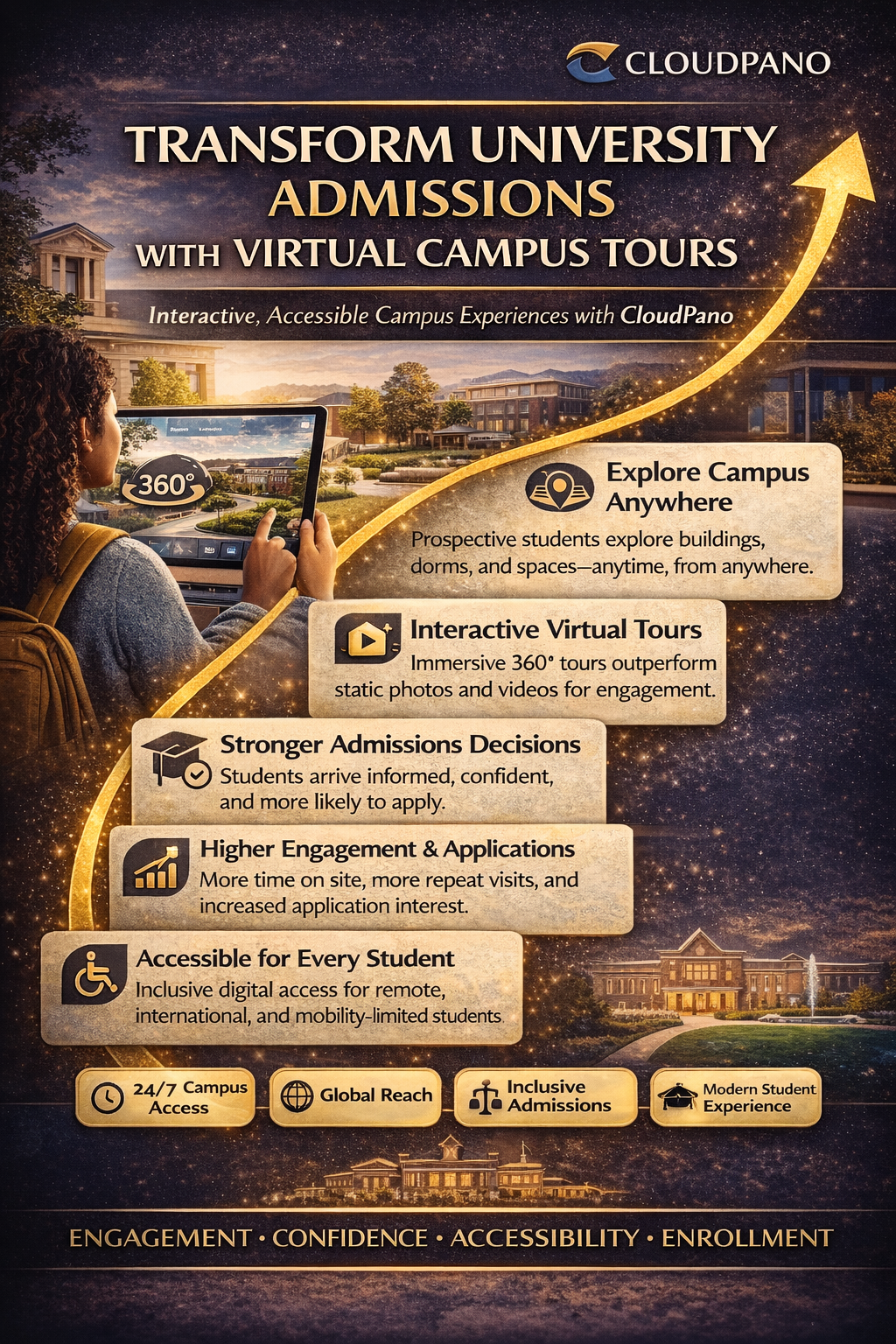
🎥 What Are Virtual Campus Tours?

Virtual Campus Tours are immersive, digital walkthroughs of a university’s campus, allowing prospective students and families to explore buildings, dorms, classrooms, and common spaces interactively.

Unlike simple videos, modern virtual tours offer:

  • 360° navigation
  • Interactive hotspots
  • Informational overlays
  • Self-guided exploration
  • Mobile and desktop accessibility

They allow students to explore at their own pace—on their own schedule.

🎓 The Rise of Higher Education Virtual Tours

Over the past few years, Higher Education Virtual Tours have evolved from novelty to necessity.

Key drivers include:

  • Increased competition for enrollment
  • Global and remote student recruitment
  • Travel limitations and scheduling conflicts
  • Growing expectations for digital engagement
  • Accessibility and inclusion requirements

Universities that invest in high-quality virtual tours gain a measurable advantage in visibility, engagement, and conversion.

🧠 The Modern University Admissions Virtual Experience

Admissions is no longer a linear process. Students:

  • Research across multiple platforms
  • Compare schools globally
  • Involve parents and advisors
  • Revisit campuses digitally multiple times

A strong University Admissions Virtual Experience meets students wherever they are—on phones, tablets, or laptops—and provides consistent, engaging access to campus life.

Virtual tours act as a 24/7 digital campus ambassador.

🏫 Why CloudPano University Tours Stand Out

Not all virtual tours are created equal.

CloudPano University Tours are designed to support admissions teams with flexibility, scalability, and ease of use—without sacrificing quality.

Universities benefit from:

  • Easy tour creation and updates
  • Custom branding for institutional identity
  • Interactive hotspots for programs and facilities
  • Embedding across websites and portals
  • Simple sharing for admissions outreach

This makes CloudPano a powerful foundation for long-term digital recruitment strategy.

🚀 How Virtual Campus Tours Improve Recruitment Outcomes

When implemented strategically, virtual tours directly impact admissions performance.

They help:

  • Increase application interest
  • Improve inquiry-to-application conversion
  • Support international and out-of-state recruitment
  • Extend campus access beyond physical limits
  • Reduce pressure on in-person tour schedules

Students who engage with virtual tours arrive more informed—and more confident in their decisions.

🌐 Expanding Reach Beyond Geography

One of the biggest advantages of Interactive Campus Tour Software is reach.

Virtual tours allow universities to:

  • Recruit internationally without travel
  • Engage students who cannot visit in person
  • Support rural and underserved communities
  • Reach families across time zones

For global recruitment strategies, virtual tours are no longer optional—they are essential.

♿ Accessibility and Inclusion Through Virtual Tours

Accessibility is a critical consideration in higher education.

Virtual campus tours support inclusive admissions by:

  • Providing access for students with mobility limitations
  • Allowing captioned and guided content
  • Supporting screen readers and ADA-friendly design
  • Reducing physical and logistical barriers

A strong University Admissions Virtual Experience should work for all prospective students—not just those who can travel easily.

🧩 Interactive Storytelling That Builds Connection

What truly differentiates modern virtual tours is interactivity.

With Interactive Campus Tour Software, universities can:

  • Highlight academic departments
  • Showcase student housing options
  • Feature athletics and recreation
  • Explain student services and resources
  • Share student stories and testimonials

This transforms a passive tour into an engaging narrative that helps students imagine themselves on campus.

📈 Data-Driven Admissions Support

Virtual tours also provide valuable insight.

Admissions teams can learn:

  • Which locations students view most
  • How long visitors stay engaged
  • Which programs attract the most attention
  • Where prospective students drop off

These insights help refine messaging, improve tour design, and optimize recruitment strategies over time.

🔄 Virtual Tours as a Long-Term Admissions Asset

Unlike one-time events or seasonal campaigns, virtual tours compound in value.

Once created, they:

  • Serve multiple admissions cycles
  • Support marketing, admissions, and alumni outreach
  • Integrate into emails, landing pages, and portals
  • Remain accessible year-round

CloudPano University Tours become part of the university’s long-term digital infrastructure—not a temporary solution.

🎯 Supporting the Entire Admissions Funnel

Virtual campus tours support every stage of the student journey:

  • Awareness and discovery
  • Research and comparison
  • Decision-making
  • Confirmation and enrollment

They help answer questions before they’re asked and reduce uncertainty throughout the admissions process.

Don’t Miss These Articles:

🔮 The Future of Higher Education Admissions

As digital expectations continue to rise, universities that fail to modernize risk falling behind.

The future of admissions is:

  • Immersive
  • Interactive
  • Accessible
  • Data-informed
  • Student-centric

Higher Education Virtual Tours are no longer a competitive advantage—they are becoming a baseline expectation.

🏁 Final Thoughts: Virtual Tours Are the New Front Door

A university’s website is no longer the first impression.
The virtual campus tour is.

By investing in CloudPano University Tours, institutions can:

  • Transform the University Admissions Virtual Experience
  • Expand global reach
  • Improve engagement and conversion
  • Deliver inclusive, modern recruitment
  • Future-proof their admissions strategy

Virtual tours don’t replace campus visits—they elevate them.

And for universities looking to stand out in an increasingly competitive landscape, that elevation makes all the difference. 🚀

The Complete Virtual Experience Stack Starts Here:

Share this post
Cloudpano

Choose The Right 360° Camera

Insta360 ONE RS 1-Inch 360 Edition

  • Compact, ready to go anywhere

  • Interchangeable lens that’s upgradeable

  • Dual 1-inch sensors for improved clarity and low light performance

  • Dynamic range and 6K 360° capture

  • 360° photo resolution at 21MP

Learn More

Insta360 X4

  • 8K 360° video recording for ultra-detailed visuals.

  • 4K single-lens mode for traditional wide-angle shots.

  • Invisible selfie stick effect for drone-like perspectives.

  • 2.5-inch touchscreen with Gorilla Glass protection.

  • Waterproof up to 33ft for underwater shooting.

Learn More

Ricoh Theta Z1

  • 360° photo resolution in 23MP

  • Slim design at 24 mm thick

  • Built-in image stabilization for smooth video capture.

  • Internal 19GB storage for photo and video storage.

  • Wireless connectivity for remote control and sharing.

Learn More

Ricoh Theta X

  • 60MP 360° still images for high-resolution photography.

  • 5.7K 360° video recording at 30fps.

  • 2.25-inch touchscreen for intuitive control.

  • USB Type-C port for fast charging and data transfer.

  • MicroSD card slot for expandable storage.

Learn More
Property Marketing
Allows potential buyers to explore properties in detail from anywhere, enhancing the real estate marketing process.
Automotive Spins
Create an interactive virtual showroom and engage affluent digital buyers with live 360º video calls, all through the CloudPano mobile app for a complete automotive sales solution.
Interactive Floor Plans
Create 2D and 3D floor plans with measurements in 4 minutes or less, all from your phone. Download the Floor Plan Scanner app and get your first scan free.

360 Virtual Tours With CloudPano.com. Get Started Today.

Try it free. No credit card required. Instant set-up.
Try it free
Latest posts

See our other posts

Interviews, tips, guides, industry best practices, and news.

How to Choose a Data Annotation Partner (Buyer's Checklist)

To choose a data annotation company, evaluate domain expertise, quality assurance methodology, data security certifications, tooling flexibility, and scalability under your expected volume. The best data annotation company for one project may not fit another — the right partner matches your specific annotation type, industry compliance needs, and growth timeline, not just price per label.
Read post

Human Annotation vs. Automated Annotation: Accuracy Trade-Offs

Human vs automated data annotation is the choice between manual labeling by trained annotators and model-driven labeling with minimal human input. Human annotation is more accurate on ambiguous or high-stakes data but slower and costlier per label. Automated data labeling tools are faster and cheaper at scale but need human-in-the-loop review to catch edge-case errors.
Read post

Data Annotation 101: Types, Tools, and Best Practices

Data annotation types and tools are the labeling methods and software platforms teams use to prepare raw data for machine learning. Common types include bounding boxes, semantic segmentation, and named entity recognition; tools range from open-source labelers to managed platforms with built-in quality control, workflow routing, and pricing tied to annotation complexity.
Read post