


.png)



Let’s look at a weird quirk of human neurology. When a prospective buyer scrolls through an online feed, their brain processes visual data about sixty thousand times faster than accompanying text description blocks. Yet, standard industry practice is to take an expensive, gorgeous house asset, slap a dense paragraph of text specs onto a flat presentation block, and expect people to stop tracking their personal social updates to read it.
It doesn’t work. The human brain is inherently lazy online. It filters out predictable, repetitive shapes to conserve mental energy.
When your real estate business drops static MLS imagery directly into highly competitive social spaces, you aren't just battling other agencies. You are actively fighting the natural biological defenses of the consumer’s brain. Paid ad deployment portals recognize this lack of connection immediately.
If target markets continuously zip past your unmoving graphic sets without stopping, the core delivery mechanics of platforms like Meta and ByteDance interpret that behavior as a bad user signal. According to deep advertising performance guidelines outlined by HubSpot, lower visual engagement scores automatically drive up your customer acquisition costs while dropping your total impressions.
This establishes a brutal production dilemma for local teams. Hiring high-end media houses to film immersive video narratives for every single neighborhood townhome or mid-tier single-family property drains upfront cash reserves. Between organizing interior design details, managing physical video crews, and waiting days for high-end editing desks to return draft clips, you lose your early marketing window.
Trying to solve the issue by spending late nights inside professional desktop video software eats up the hours you should be using to close active transaction deals. You need a system that addresses human spatial psychology instantly without creating a massive production chore.
To fix your ad account efficiency, you have to approach visual design from an entirely fresh angle. Stop assuming that premium motion require you to deploy physical camera rigs onto location spaces. Look through your existing project files. Your team is already investing hundreds of dollars per listing to capture beautiful, crisp architectural photography for standard local property portals.
Leaving those files completely unmoving means you are leaving major conversion leverage on the table.
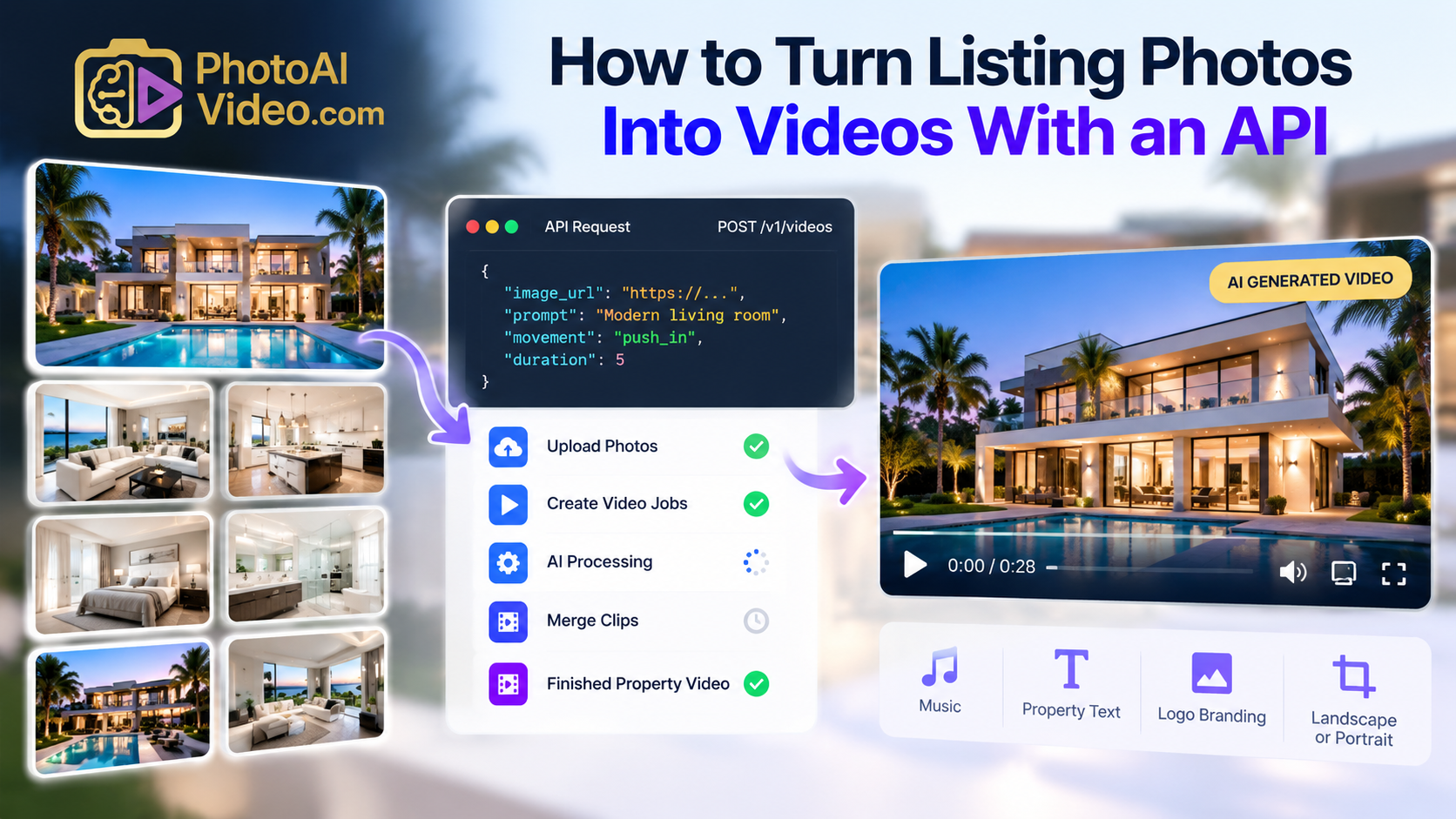
This is where PhotoAIVideo.com modifies your daily operational pipeline. It acts as an agile, web-based tool built to completely change your creative output speed. The platform acts as a specialized short-form real estate video AI engine that takes standard flat images and activates them into dynamic vertical assets.
Static MLS Photo: Flat, unmoving 2D frame. Rapidly skipped by social algorithms and scrolling buyers.
3D Parallax Video: Immersive depth mapping creates a sweeping cinematic camera movement instantly.
By dropping flat master shots into an automated processing app, you bypass manual formatting challenges completely. The system outputs 9:16 aspect ratio vertical video ads optimized to sit cleanly inside native portrait delivery networks. You get cinematic camera sweeps without scheduling or production delays, scaling your total media output across your real estate portfolio without hurting your bottom line.
The core reason why this motion style triggers a strong psychological response is rooted in advanced monocular depth mapping. When you supply a traditional, flat architectural capture to the rendering pipeline, the system doesn't merely pan across the borders or apply a basic zoom layer. It reads the pixels to extract 3D geometric information.
The cloud software splits your asset into multi-tiered fields of view. It calculates what structures belong in the immediate front view—such as an exposed hardwood breakfast bar or contemporary interior columns—and handles background isolation for deep components, like custom exterior infinity pools or mountain ranges visible past panoramic glass.
Once these geometric planes are isolated, the system executes a sophisticated parallax motion sequence. By translating the foreground elements along a slightly different mathematical grid than the background objects, the application tricks human visual centers into perceiving actual volumetric depth.
The resulting clip works as a pristine short-form real estate video AI file that simulates a mechanical drone or slide rig tracking beautifully past the room. Because structural proportions remain completely accurate, home seekers receive an immersive feeling of scale that anchors their attention before they can slide to the next post.
Consistency is what keeps paid client channels running efficiently. Utilizing an automated content workflow gives you the capability to transform underused local property galleries into active, conversion-driven campaigns in less time than it takes to pull up a listing report:
Consumer focus curves inside mobile environments have settled at razor-thin lows. Comprehensive digital behavior analysis published by the Nielsen Norman Group establishes that modern phone users skim visual media landscapes with extremely fast pattern matching, using subconscious processing cues to skip dry or repetitive promotional framing elements. Inside an active paid social application feed, your creative material has precisely three seconds to halt a user's thumb and establish an attention hook.
If your ad project leads with a static splash graphic, slow broker introductions, or heavy corporate branding boards, your audience will scroll right past. Meta's automated internal auction software monitors these immediate abandonment trends with strict mathematical rules. If viewers bounce inside the initial two seconds, the platform reduces your baseline asset relevance ranking, which instantly drives up your required cost-per-click thresholds.
Deploying a calculated AI Facebook video ads for real estate infrastructure directly resolves this cognitive hurdle. Because the 3D parallax rendering presents smooth drifting spatial movement right from the very first frame, you activate a human tracking reflex.
The eyes hold focus on the screen because the brain naturally takes a moment to process the unfolding dimensional changes. This visual retention window holds target markets long enough to process your core listing details, boosting your primary click-through values while optimizing auction costs.
Paid audience acquisition requires an eye on asset lifespan. If your real estate team depends entirely on manual video production cycles, your creative testing capabilities will bottleneck. You run into creative fatigue by serving the same file across your market area, causing click-through values to flatline over time.
Integrating an automated AI property reels software option decouples your creative production volume from your marketing budget. You gain the operational leverage to build multiple asset variations from a single home shoot in minutes, testing alternative angles and pacing paths to maintain account freshness.
This creative output speed allows you to build a reliable local conversion funnel that feeds your CRM around the clock:
While ramping up asset processing speeds provides a powerful market advantage, you must stay aligned with clean layout parameters to ensure your brand maintains a premium look:
The real estate marketing machines capturing the largest concentration of high-intent local buyers aren't winning through brute force spend. They dominate because they operate with high creative velocity—the capacity to turn raw photography assets into polished, moving video ads before competitor networks can even clear an appointment slot with an outside media agency.
Instead of burning out over manual script tracking or draining your acquisition capital on heavy video retainers, shift your creation tasks straight to automated cloud rendering tools. Introduce true dimensional scale to your listings, capture high-retention consumer blocks, and expand your business by injecting cinematic 3D motion into your standard property folders.


Compact, ready to go anywhere
Interchangeable lens that’s upgradeable
Dual 1-inch sensors for improved clarity and low light performance
Dynamic range and 6K 360° capture
360° photo resolution at 21MP

8K 360° video recording for ultra-detailed visuals.
4K single-lens mode for traditional wide-angle shots.
Invisible selfie stick effect for drone-like perspectives.
2.5-inch touchscreen with Gorilla Glass protection.
Waterproof up to 33ft for underwater shooting.

360° photo resolution in 23MP
Slim design at 24 mm thick
Built-in image stabilization for smooth video capture.
Internal 19GB storage for photo and video storage.
Wireless connectivity for remote control and sharing.

60MP 360° still images for high-resolution photography.
5.7K 360° video recording at 30fps.
2.25-inch touchscreen for intuitive control.
USB Type-C port for fast charging and data transfer.
MicroSD card slot for expandable storage.
.png)

.png)

Try it free. No credit card required. Instant set-up.






.svg)


.svg)