


.png)


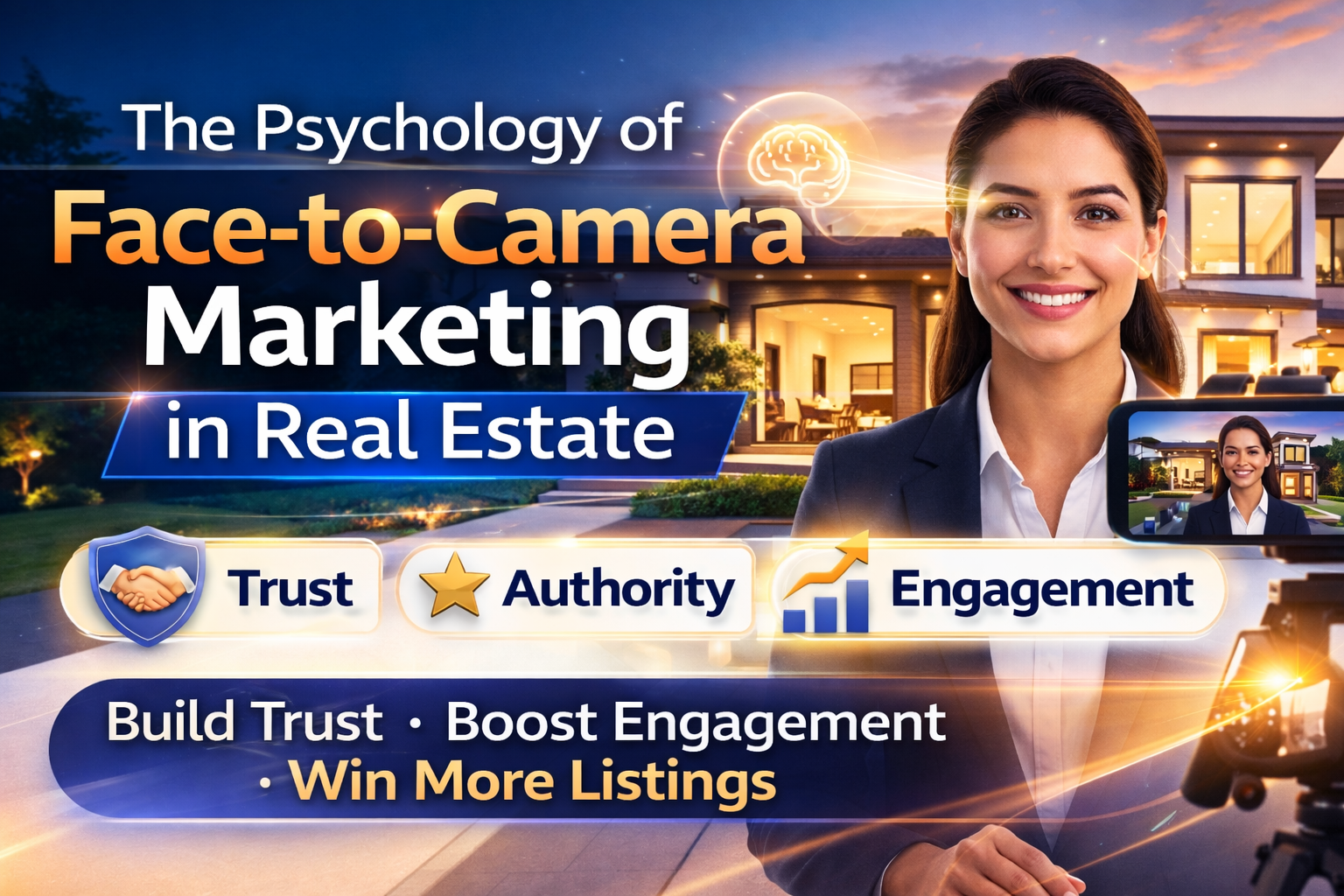
Quick question for you…
If you watched a property video and saw a confident agent speaking directly to the camera — would you feel more connected to the listing?
Now another question:
If that presenter looked real, sounded natural, and delivered the message clearly… would it matter whether they were filmed traditionally or generated through AI?
That tension captures the evolving psychology behind face to camera marketing real estate professionals are using today.
At its core, face-to-camera marketing isn’t about technology.
It’s about trust.
And understanding the psychology behind it gives agents, brokers, and marketing teams a powerful competitive edge.
Humans are wired to respond to faces.
From infancy, we are trained to:
This biological tendency makes face to camera marketing real estate strategies incredibly powerful.
When an agent speaks directly to the viewer:
A face transforms content into conversation.
And conversation builds confidence.
Direct eye contact triggers psychological responses associated with:
In real estate, trust is currency.
Buyers and sellers aren’t just evaluating properties.
They’re evaluating the agent.
Face-to-camera videos simulate in-person interaction. Even through a screen, viewers subconsciously feel:
That emotional layer is why face to camera marketing real estate content consistently outperforms static images alone.
Traditional listing marketing relied on:
While informative, static content lacks personality.
Video introduced motion and music.
But face-to-camera delivery introduces presence.
Now, with AI-generated presenters and digital avatars, agents can maintain this presence without constant filming.
That evolution is changing how face-based marketing scales.
Let’s break down the key emotional triggers activated by face-to-camera content.
Repeated exposure to the same face increases comfort and trust.
When agents appear consistently in their listings — whether filmed or AI-assisted — they become recognizable.
Recognition reduces resistance.
Reduced resistance increases inquiry rates.
A confident presenter speaking directly to camera signals expertise.
In real estate, perceived authority influences:
Face-to-camera delivery reinforces that authority visually.
Buyers often feel overwhelmed.
A direct-to-camera presenter:
Guidance reduces cognitive load.
Reduced cognitive load increases engagement.
Understanding psychology is one thing.
Applying it strategically is another.
Here’s how face to camera marketing real estate can be implemented effectively.
Instead of silent tours, agents can:
Even a short face-to-camera introduction dramatically increases perceived professionalism.
Weekly or monthly updates delivered directly to camera build:
Viewers begin to anticipate the familiar face.
Face-to-camera marketing isn’t only for buyers.
Agents can create:
These strengthen trust before the contract is even signed.
Here’s where psychology meets scalability.
Modern AI platforms allow agents to:
This allows agents to maintain the psychological benefits of face-to-camera marketing without constant filming.
It preserves:
While removing production friction.
Agents who master face-to-camera strategies gain measurable advantages.
Listings with visible presenters typically hold attention longer than silent slideshows.
Repeated exposure builds mental availability.
When sellers think “real estate,” they think of the face they’ve seen consistently.
Sellers want modern marketing strategies.
Showing face-based video presentations during listing consultations demonstrates professionalism.
Most listings rely solely on photos.
Adding a face-to-camera introduction immediately stands out.
Even with clear psychological advantages, some agents hesitate.
Let’s address the most common concerns.
This is the most frequent objection.
But comfort improves with repetition.
Alternatively, AI-generated presenters allow agents to maintain presence without filming repeatedly.
You focus on the message.
Technology handles the delivery.
Authenticity is about clarity and intent — not production method.
If the content is helpful and transparent, viewers respond positively.
AI tools simply amplify communication.
They do not replace relationship-building.
Not necessarily.
Luxury cinematic videos may emphasize visuals over talking head segments.
However, incorporating even short introductions strengthens emotional connection.
Strategic integration matters more than constant usage.
The future of face to camera marketing real estate is not either/or.
It’s hybrid.
Agents can blend:
This allows:
Understanding psychology ensures the face element remains central — even when production methods evolve.
The real shift isn’t technological.
It’s strategic.
Instead of asking:
“How do I film more?”
Agents can ask:
“How do I maintain visible authority across every listing?”
Face-to-camera marketing answers that question.
Whether through traditional video or AI automation, the key element remains:
Human presence.
Brokerages and marketing teams can integrate face-to-camera strategies into:
Systemized face-based marketing ensures consistency — and consistency strengthens brand equity.
Photographers and marketing agencies can offer:
Instead of selling one-off productions, professionals can build recurring service models around scalable face-based marketing.
Real estate is built on relationships.
Relationships begin with trust.
Trust begins with connection.
Face-to-camera marketing leverages fundamental human psychology:
Whether filmed traditionally or generated through intelligent automation, the face remains one of the most powerful marketing assets an agent can deploy.
The agents who understand this psychology — and build scalable systems around it — will:
Because in real estate marketing, properties matter.
But people close deals.
And the face on camera is often where that trust begins. 🤝🏡


Compact, ready to go anywhere
Interchangeable lens that’s upgradeable
Dual 1-inch sensors for improved clarity and low light performance
Dynamic range and 6K 360° capture
360° photo resolution at 21MP

8K 360° video recording for ultra-detailed visuals.
4K single-lens mode for traditional wide-angle shots.
Invisible selfie stick effect for drone-like perspectives.
2.5-inch touchscreen with Gorilla Glass protection.
Waterproof up to 33ft for underwater shooting.

360° photo resolution in 23MP
Slim design at 24 mm thick
Built-in image stabilization for smooth video capture.
Internal 19GB storage for photo and video storage.
Wireless connectivity for remote control and sharing.

60MP 360° still images for high-resolution photography.
5.7K 360° video recording at 30fps.
2.25-inch touchscreen for intuitive control.
USB Type-C port for fast charging and data transfer.
MicroSD card slot for expandable storage.
.png)

.png)

Try it free. No credit card required. Instant set-up.






.svg)


.svg)