


.png)


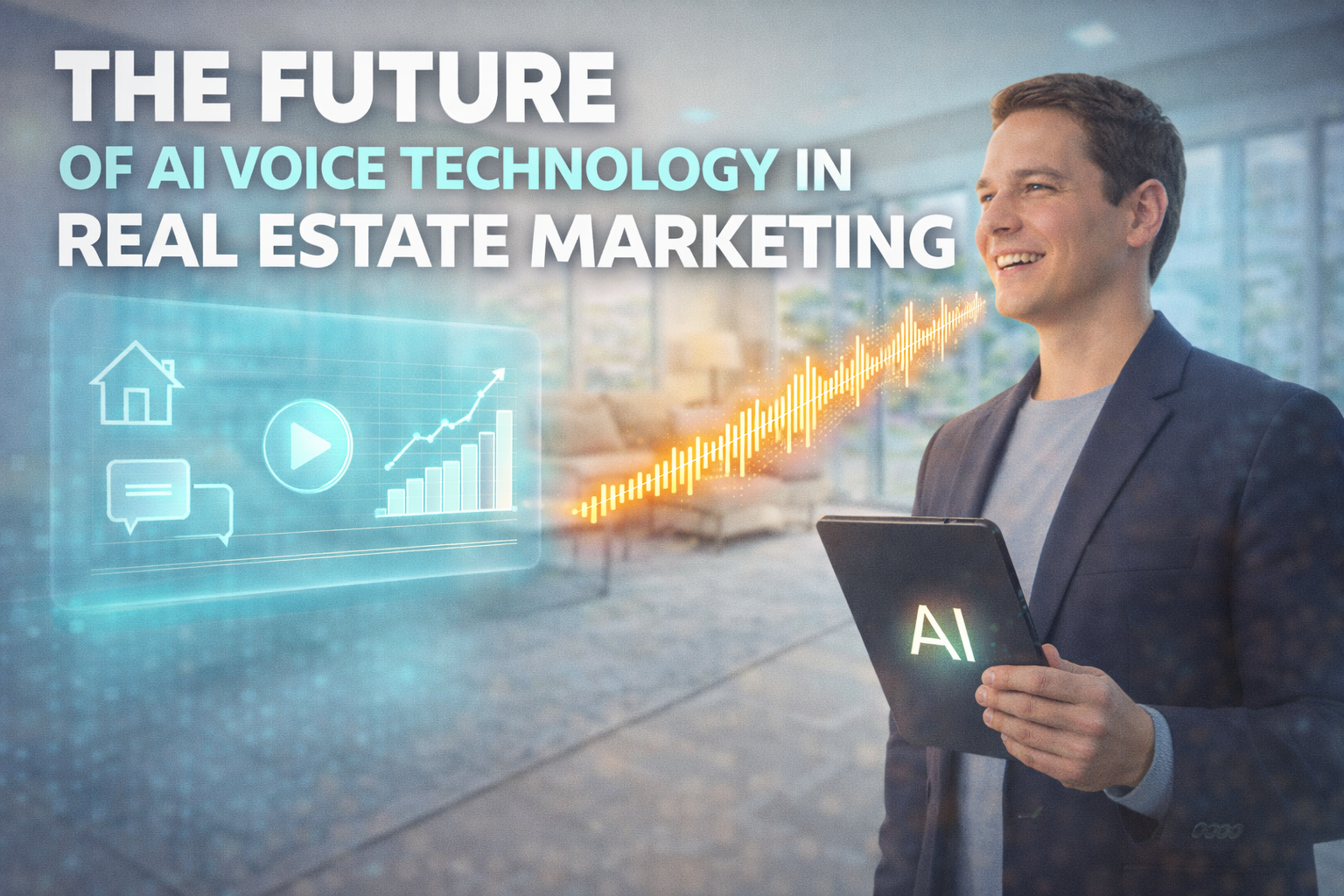
Real estate marketing has always evolved alongside technology. From newspaper listings to online marketplaces, drone photography, and immersive virtual tours, each innovation has changed how properties are presented to buyers. Today, another breakthrough is transforming the industry: AI voice technology.
Instead of spending hours recording videos, real estate professionals can now create dynamic property presentations using AI voice avatars, voice cloning, and automated narration. This shift represents one of the most exciting AI real estate technology trends shaping the future of property marketing.
So what does the future of AI voice marketing actually look like? And how will AI voice real estate technology reshape the way agents present listings, communicate with buyers, and scale their marketing?
Let’s explore how this powerful technology works and why it’s quickly becoming a must-have tool for modern real estate professionals.
In the past, creating real estate videos required significant time and resources. Agents needed cameras, microphones, editing software, and sometimes even a production crew.
Today, AI has simplified that process dramatically.
Modern platforms allow agents to:
• upload listing photos
• convert them into cinematic video scenes
• add an AI avatar presenter
• narrate the video using voice cloning or recorded audio
The result is a professional video walkthrough that can be created in minutes instead of hours.
This is why AI voice real estate technology is rapidly gaining popularity among agents, brokers, and marketing teams.
According to industry research on artificial intelligence adoption, AI-generated content tools are becoming a core part of digital marketing strategies:
https://www.ibm.com/topics/artificial-intelligence
For real estate professionals, this technology opens the door to faster and more scalable marketing.
AI voice technology uses machine learning models to replicate human speech patterns. After analyzing a short voice recording, the system can generate natural-sounding narration that closely matches the speaker.
In real estate marketing, this allows agents to:
• clone their voice
• narrate listing videos automatically
• create consistent branded video content
For example, an agent might record a short voice memo describing a property:
“Welcome to this beautiful four-bedroom home with hardwood floors, vaulted ceilings, and a stunning backyard pool.”
AI software can then synchronize that narration with an avatar presenter inside a property video.
This means agents no longer need to record themselves on camera for every listing.
Instead, they can simply upload a voice recording and let the AI handle the presentation.
A helpful overview of text-to-speech and voice generation technology can be found here:
https://cloud.google.com/text-to-speech
One of the most exciting developments in future AI voice marketing is the emergence of digital avatars.
These avatars act as presenters within property videos.
Rather than appearing on camera, agents can create a digital version of themselves that speaks using their cloned voice.
This opens up new possibilities:
• AI-generated property walkthroughs
• social media real estate videos
• automated listing presentations
• branded marketing content
Agents can even create avatars for their team members or clients, allowing multiple digital presenters to appear across marketing campaigns.
The combination of avatars and voice cloning creates a scalable system for producing video content at a much faster pace.
One of the biggest breakthroughs in AI real estate technology trends is the ability to convert static listing photos into animated videos.
Using AI-powered motion effects, real estate photos can be transformed into cinematic scenes.
Common movement styles include:
• pull-out camera movement
• dolly zoom effects
• left-to-right panning
• slow push-in transitions
These effects create the illusion of a moving camera even though the original image was static.
Once these scenes are generated, an AI avatar can be added to the video to narrate the property.
The avatar may appear in the corner of the screen, guiding viewers through the home and explaining its features.
This transforms a simple listing gallery into a full video presentation.
The real estate market is becoming increasingly competitive. Buyers expect engaging content, and video has become one of the most effective ways to showcase properties.
According to the National Association of Realtors, many buyers now consider video tours an essential part of property searches:
https://www.nar.realtor/research-and-statistics
However, producing traditional video content for every listing can be time-consuming.
This is where AI voice real estate technology provides a huge advantage.
AI-powered video tools allow agents to:
• create listing videos quickly
• maintain consistent branding
• scale marketing across multiple properties
• generate social media content efficiently
Instead of filming dozens of videos each month, agents can automate much of the process.
One of the biggest benefits of future AI voice marketing is scalability.
Imagine a real estate team managing 50 listings at once. Recording a custom video for each property would require a massive time investment.
AI voice tools simplify that workflow.
Agents can:
1️⃣ Upload property photos
2️⃣ Apply cinematic video movements
3️⃣ Add an AI presenter
4️⃣ Upload a short voice memo
5️⃣ Generate the finished video
Within minutes, a professional listing video is ready to share.
This efficiency allows agents to produce far more marketing content without increasing workload.
Some agents worry that AI might remove the personal element from real estate marketing.
In reality, voice cloning helps preserve it.
Instead of using generic narration, agents can record their own voice and allow the AI to replicate it.
This means every listing video still sounds like the agent—even when they aren’t on camera.
Voice cloning helps maintain consistency across:
• listing walkthroughs
• social media content
• educational videos
• neighborhood tours
The agent’s voice becomes a recognizable brand element across all content.
Short-form video platforms like Instagram Reels, TikTok, and YouTube Shorts are now essential marketing channels.
However, producing frequent content for these platforms can be challenging.
AI voice technology simplifies the process by allowing agents to quickly generate narrated clips.
For example, agents can create:
• property highlights
• neighborhood introductions
• home feature spotlights
• quick market updates
Because AI tools automate production, agents can maintain a consistent presence on social media.
Looking ahead, AI real estate technology trends will continue evolving rapidly.
Some potential innovations include:
• interactive AI property tours
• personalized video walkthroughs for buyers
• multilingual AI voice narration
• automated real estate marketing campaigns
• AI-powered customer engagement videos
Imagine sending a buyer a personalized video tour narrated specifically for them, highlighting features that match their preferences.
These types of experiences may soon become standard in property marketing.
As with any new technology, AI voice tools raise important questions.
Real estate professionals should use AI responsibly by ensuring transparency with audiences.
For example, if a digital avatar is used as a presenter, it should represent the agent authentically and avoid misleading viewers.
Responsible implementation will help maintain trust while still benefiting from technological innovation.
The future of property marketing will be driven by speed, engagement, and personalization.
AI voice technology allows real estate professionals to create narrated property videos quickly while maintaining a personal brand voice.
By combining voice cloning, avatars, and automated video creation, agents can scale their marketing efforts and produce engaging content for every listing.
As future AI voice marketing continues to evolve, early adopters will have a powerful advantage.
Real estate professionals who embrace AI voice real estate technology today will be better positioned to capture buyer attention, generate leads, and stay ahead of emerging AI real estate technology trends.
The future of real estate marketing isn’t just visual—it’s powered by voice. 🎙️🏡


Compact, ready to go anywhere
Interchangeable lens that’s upgradeable
Dual 1-inch sensors for improved clarity and low light performance
Dynamic range and 6K 360° capture
360° photo resolution at 21MP

8K 360° video recording for ultra-detailed visuals.
4K single-lens mode for traditional wide-angle shots.
Invisible selfie stick effect for drone-like perspectives.
2.5-inch touchscreen with Gorilla Glass protection.
Waterproof up to 33ft for underwater shooting.

360° photo resolution in 23MP
Slim design at 24 mm thick
Built-in image stabilization for smooth video capture.
Internal 19GB storage for photo and video storage.
Wireless connectivity for remote control and sharing.

60MP 360° still images for high-resolution photography.
5.7K 360° video recording at 30fps.
2.25-inch touchscreen for intuitive control.
USB Type-C port for fast charging and data transfer.
MicroSD card slot for expandable storage.
.png)

.png)

Try it free. No credit card required. Instant set-up.






.svg)


.svg)