How Structured Metadata Improves Video Dataset Value

Cloudpano
August 2, 2026
5 min read
Share this post

How Structured Metadata Improves Video Dataset Value

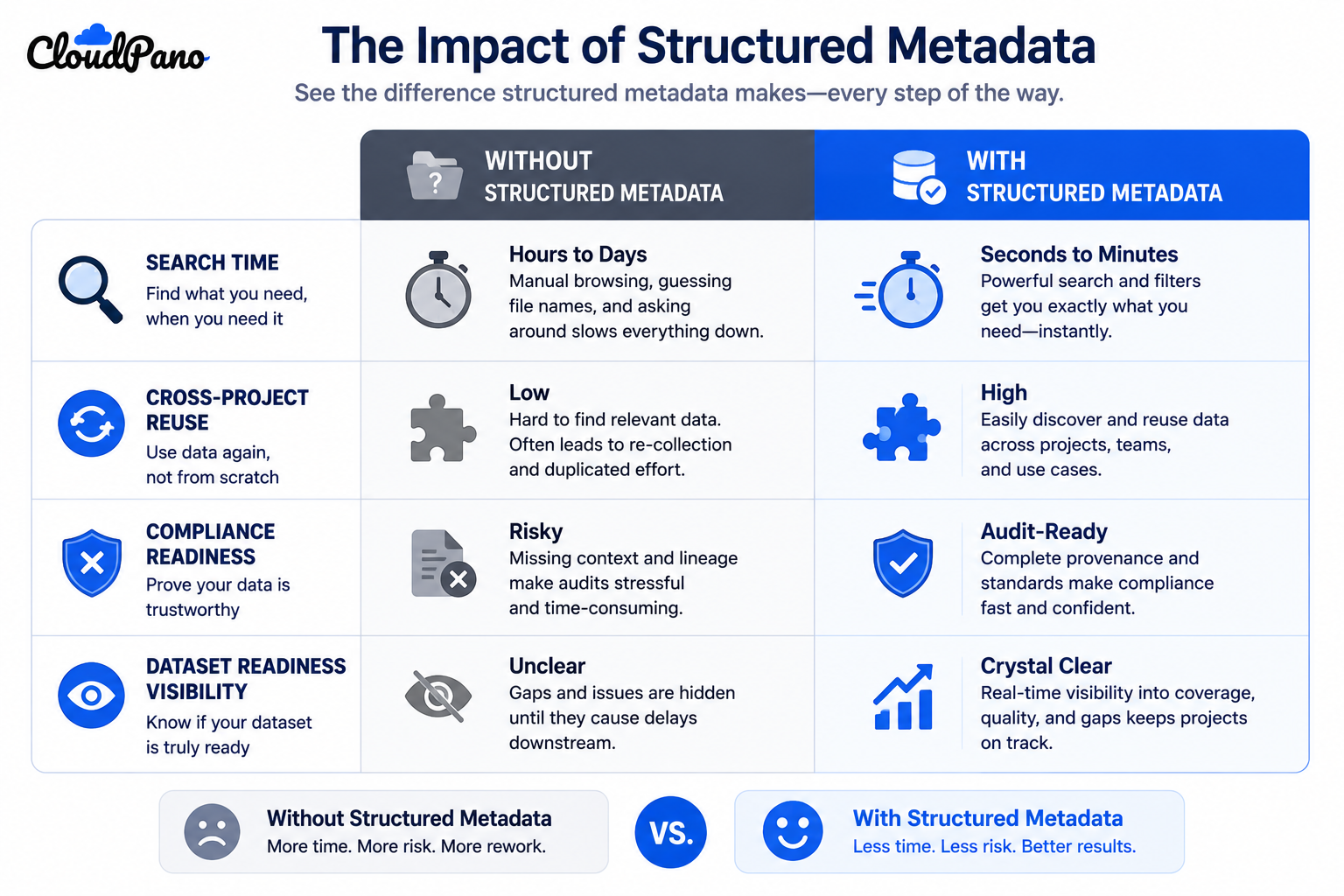
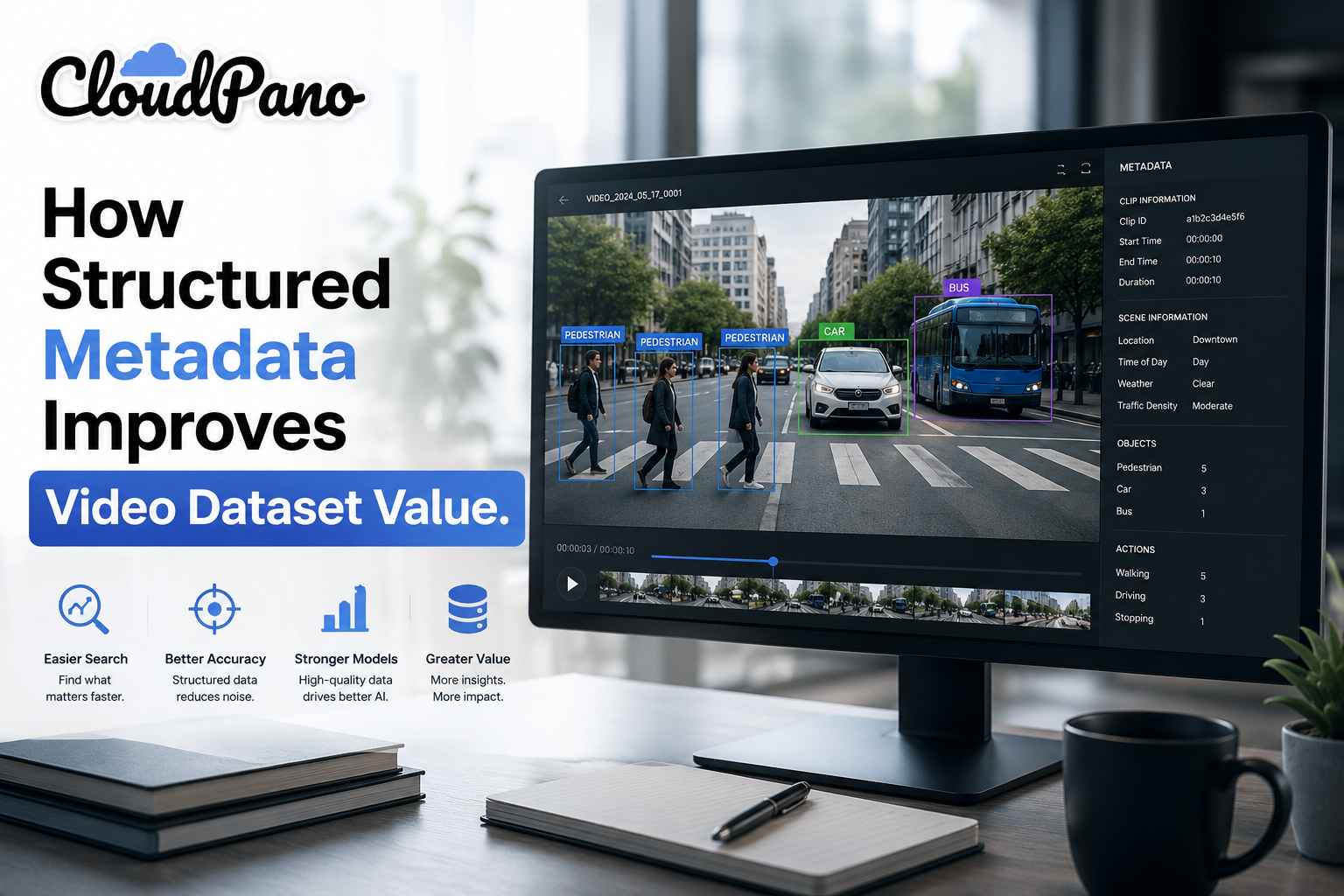
A well-annotated video dataset that nobody can efficiently find or filter is worth less than its annotation quality suggests. Structured metadata video datasets rely on is what actually makes a large video collection usable at scale — searchable by content, traceable by source, and filterable by quality or annotation status, rather than a folder of files nobody can navigate without opening each one.

Video Dataset Metadata gets treated as an afterthought far more often than annotation quality itself, even though a dataset's practical value depends heavily on whether teams can actually locate, understand, and reuse the specific subsets they need for a given project.

Why It Matters

A video dataset without structured metadata becomes progressively harder to use as it grows, since the effort required to manually search through files scales with volume in a way that structured search doesn't. Google Research's "Data Cascades" study documented how unaddressed data management gaps compound into larger problems over time, a pattern directly relevant to metadata debt that accumulates as a video dataset scales without a structured system in place (Sambasivan et al., Google Research).
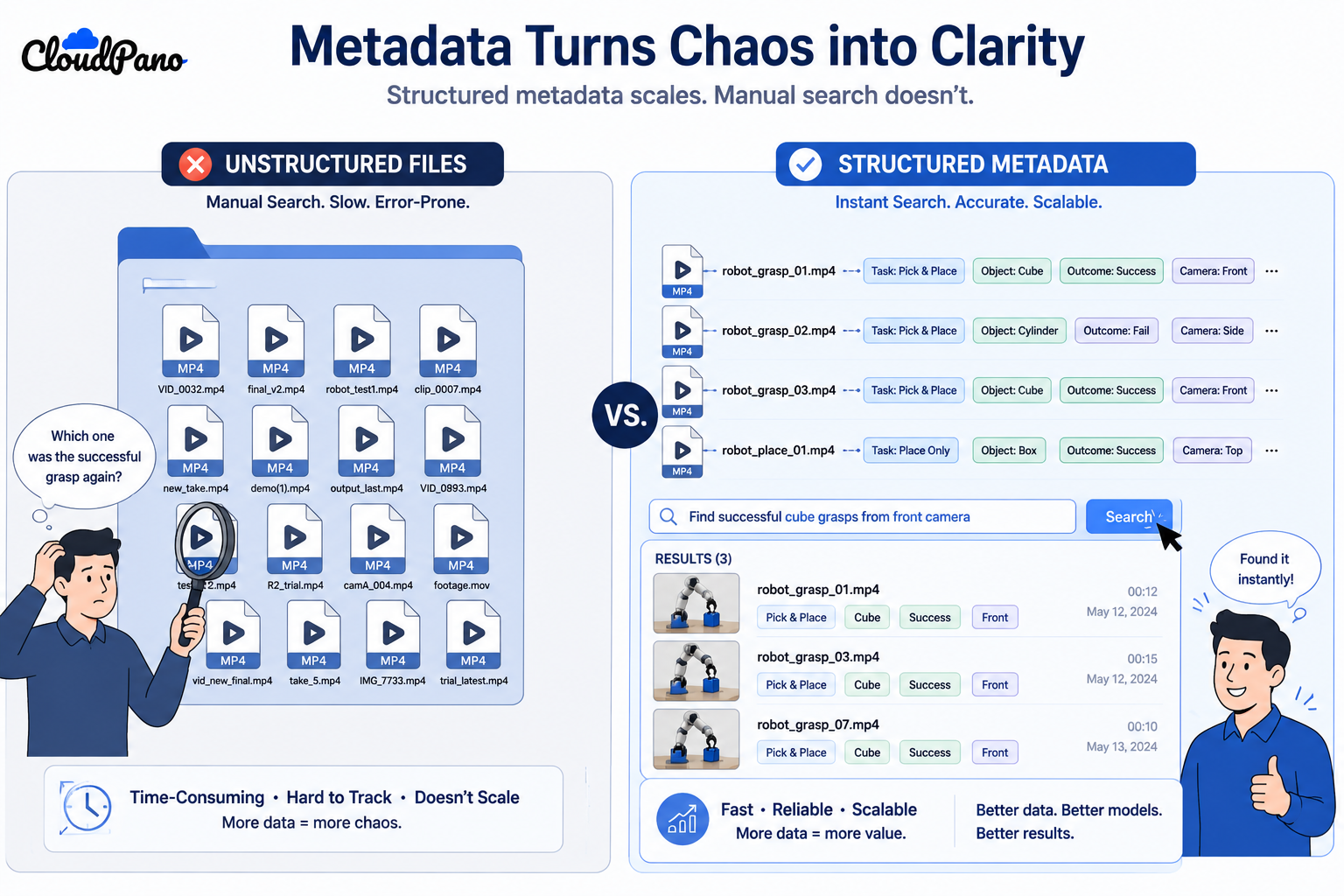
Illustration comparing searchable video metadata to unstructured file storage

NIST's AI Risk Management Framework treats data governance and provenance tracking as foundational to trustworthy AI, directly relevant to Video Annotation Metadata needing to capture not just content descriptions but the history and quality status of how a video was labeled (NIST AI RMF).

The stakes rise as organizations accumulate video data across more projects and teams. Stanford HAI's AI Index has tracked the growing scale of data underlying computer vision and AI development generally (Stanford HAI, AI Index Report), and unmanaged metadata at that scale becomes a genuine operational bottleneck, not just an inconvenience.

How It Works

AI Training Data Management for video specifically requires structured metadata addressing a few core categories.
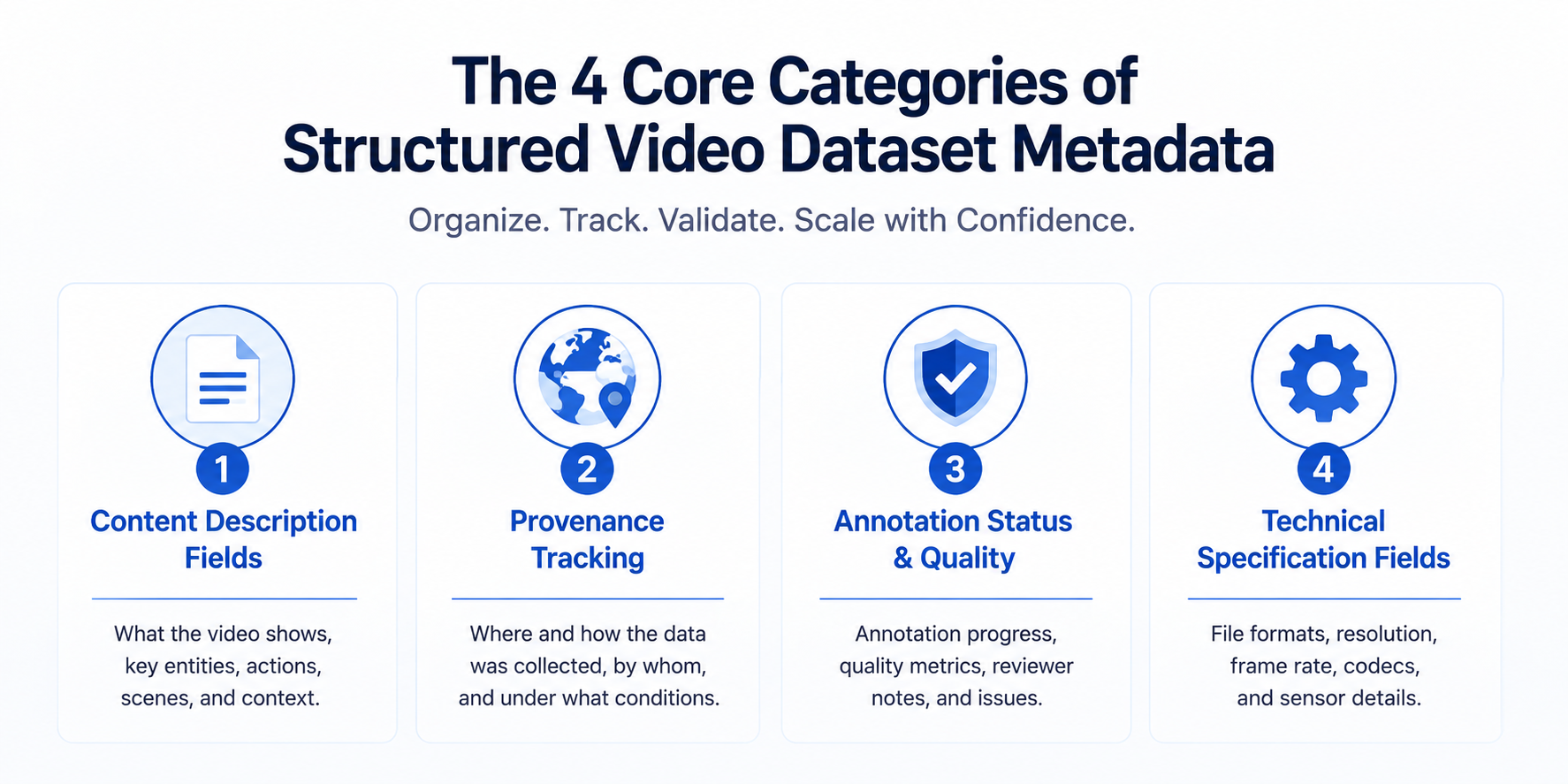
Infographic of four core categories of structured video dataset metadata

Content description fields. Structured, consistent fields describing what a video actually contains — scene type, object categories present, environmental conditions — searchable in a way raw file names or folder structures aren't.

Provenance tracking. Metadata capturing where a video came from, when it was collected, and under what conditions or rights, supporting both practical reuse decisions and compliance documentation.

Annotation status and quality metadata. Recording what annotation has been applied, by what method, at what quality level, and whether it's been validated, so teams can filter for datasets meeting specific readiness criteria.

Technical specification fields. Consistent metadata on resolution, frame rate, duration, and format, which matters for confirming a given video subset actually fits a specific model's technical requirements.

Understanding how these workflows operate as a structured system built alongside data collection and annotation — not a catalog assembled retroactively — is what keeps a growing video dataset navigable rather than becoming an unsearchable archive.

Step-by-Step Workflow

  • Define a consistent metadata schema before large-scale collection begins. Establish the specific fields — content description, provenance, annotation status, technical specs — your organization actually needs.
  • Populate metadata at the point of collection, not retroactively. Capture provenance and technical details when a video enters the pipeline, since this information is much harder to reconstruct later.
  • Update annotation status metadata as labeling progresses. Reflect current annotation completeness and quality validation status, not just a static "annotated" flag.
  • Build search and filtering capability around the defined schema. Ensure metadata fields are actually queryable, not just recorded in a static document nobody searches.
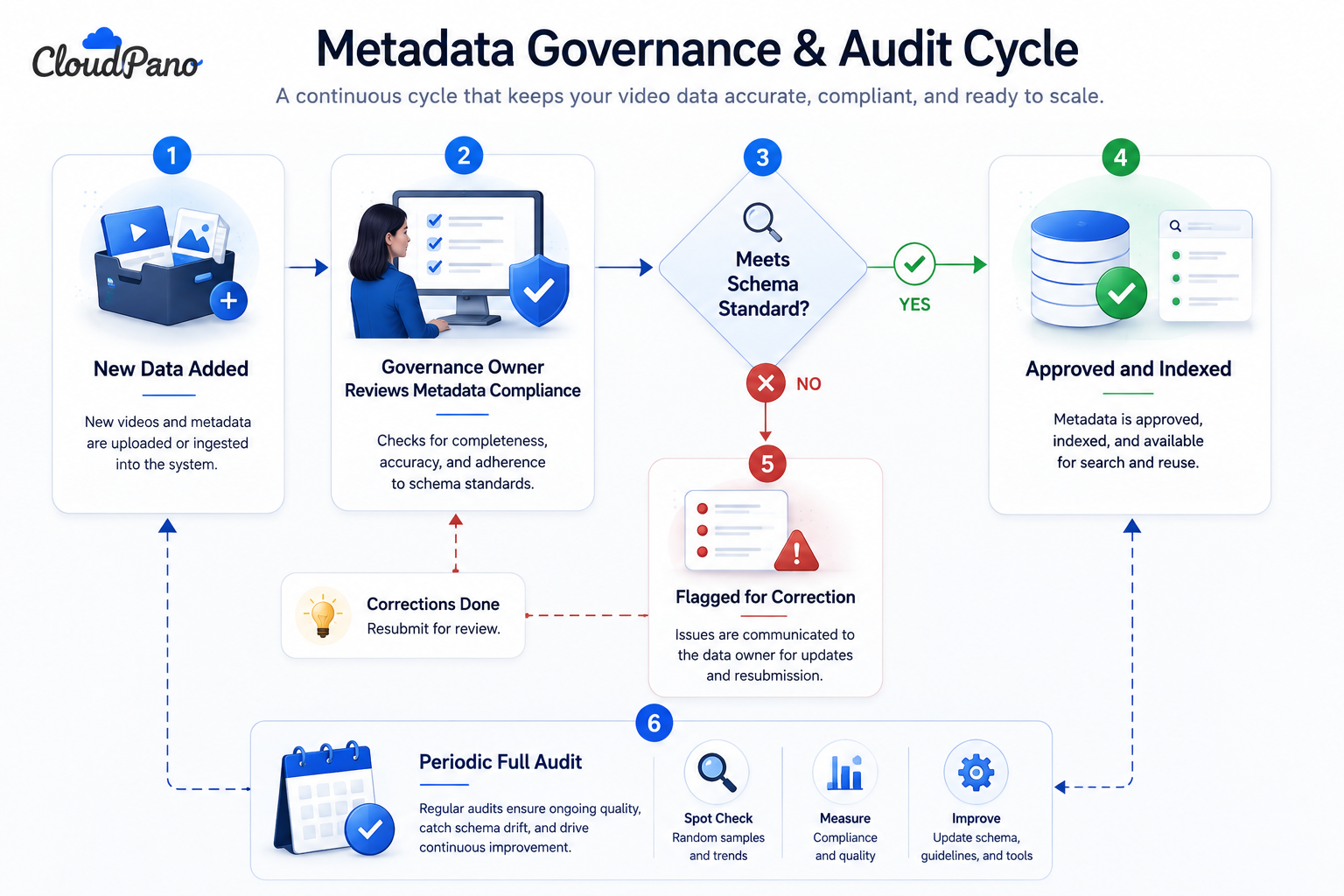
  • Establish metadata governance responsibility. Assign ownership for maintaining schema consistency as new data types or projects are added.
  • Audit metadata completeness and accuracy periodically. Confirm records stay accurate and complete as a dataset grows, rather than assuming initial population remains sufficient.
Flowchart of metadata governance ownership and audit cycle for video datasets
  • Revise the schema as organizational needs evolve. Add new fields or adjust existing ones as data types, projects, or governance requirements change over time.

Industry Use Cases

  • Computer vision / robotics: Structured metadata supports efficient reuse of video subsets across multiple projects, particularly valuable given how much data these teams typically accumulate.
  • Autonomous vehicles: Metadata describing environmental conditions, scenario type, and sensor configuration is essential for locating specific scenario types within massive driving datasets.
  • Healthcare AI: Provenance and consent-related metadata carry particular importance here, given regulatory requirements around clinical video data.
  • Retail AI: Metadata supporting search by store location, product category, or interaction type helps teams efficiently locate relevant subsets from large in-store video collections.
  • Government & defense: Metadata governance often carries formal classification and access-control requirements layered on top of standard content and provenance fields.
  • Manufacturing AI: Metadata describing production line, defect type, or process stage supports efficient reuse of video data across different quality inspection model projects.

Benefits

  • Faster access to relevant data subsets. Structured search and filtering dramatically reduces the time needed to locate specific video content compared to manual file review.
  • More efficient data reuse across projects. Teams can identify and reuse existing annotated video rather than unnecessarily re-collecting or re-annotating similar content.
  • Stronger governance and compliance support. Provenance and rights metadata provide the documentation needed to support privacy, licensing, and audit requirements.
  • Clearer visibility into dataset readiness. Annotation status metadata lets teams quickly assess whether a given subset is actually ready for a specific training use.
  • Reduced technical mismatch errors. Consistent technical specification metadata helps confirm a dataset subset actually meets a model's format and quality requirements before use.
  • Better cross-team collaboration. A shared, consistent metadata vocabulary lets different teams understand what a dataset contains without needing to consult whoever originally collected or annotated it.
  • More accurate project planning. Visibility into what data already exists, and its actual readiness state, helps teams scope new projects more realistically instead of assuming from incomplete information.

Common Mistakes

  • Treating metadata as an afterthought added after collection. Missing the opportunity to capture provenance and technical details when they're easiest to record accurately.
  • Using inconsistent or ad hoc metadata fields across projects. Making cross-project search and reuse difficult when different teams describe similar data differently.
  • Not updating annotation status metadata as work progresses. Leaving stale status information that misrepresents a dataset's actual current readiness.
  • Building metadata records that aren't actually searchable. Recording information in unstructured documents rather than a genuinely queryable system.
  • Not assigning clear ownership for metadata governance. Allowing schema consistency to degrade as different teams add data without coordinated standards.
  • Assuming an initial metadata schema will remain sufficient indefinitely. Not revisiting the schema as new data types or organizational needs emerge.

Best Practices

  • Define a consistent metadata schema before large-scale video collection begins, covering content, provenance, annotation status, and technical specifications.
  • Populate metadata at the point of collection rather than attempting to reconstruct it retroactively.
  • Keep annotation status metadata current as labeling and validation work actually progresses.
  • Build genuine search and filtering capability around your metadata schema, not just a static reference document.
  • Assign clear ownership for metadata governance and schema consistency across projects and teams.
  • Audit metadata completeness periodically and revise the schema as organizational needs evolve.

FAQ

What does structured metadata for video datasets actually include?

Content description fields, provenance tracking, annotation status and quality information, and technical specification fields, all recorded consistently and made genuinely searchable.

Why does video dataset metadata matter more as a dataset grows?

Because the effort required to manually search through unstructured video files scales with volume in a way that structured metadata search doesn't, making metadata increasingly valuable as a collection grows larger.

What is provenance tracking in video annotation metadata?

Recording where a video came from, when it was collected, and under what conditions or legal basis, supporting both practical reuse decisions and compliance documentation.

Should metadata be added after annotation is complete, or during collection?

During collection and annotation, whenever possible. Provenance and technical details are much easier to capture accurately at the point of collection than to reconstruct retroactively.

How does AI training data management benefit from structured video metadata?

It allows teams to efficiently locate, filter, and reuse specific data subsets across projects, rather than manually reviewing files or unnecessarily re-collecting similar content that may already exist.

What happens if metadata fields are inconsistent across different teams or projects?

Cross-project search and data reuse become significantly harder, since similar data described differently under inconsistent fields can't be reliably located or compared.

Who should be responsible for metadata governance in a growing video dataset?

A clearly assigned owner or team responsible for schema consistency, ensuring new data types and projects follow established metadata standards rather than introducing ad hoc, incompatible fields.

Conclusion

Structured metadata video datasets depend on is what actually determines whether a large video collection remains genuinely usable as it grows, not just how well the underlying content was annotated. Content description, provenance tracking, annotation status, and technical specifications, captured consistently and made searchable, are what turn an accumulating pile of video files into a dataset teams can actually find, trust, and reuse efficiently.

🚀 Your All‑In‑One Virtual Experience Stack
🎬
PhotoAIVideo
Turn photos into scroll‑stopping AI videos.
Get Started →
🏡
Pictastic
Instantly stage listings with AI.
Try Staging →
🌀
CloudPano
Create stunning 360° tours in minutes.
Launch Tour →
💰
VirtualTourProfit
Build a profitable virtual tour business.
Learn More →
🤝
CloudPano Reseller
Resell AI visual software without building it.
Become a Reseller →
🚗
Auto CloudPano
Sell more vehicles with 360° experiences.
Explore Auto →
🏗️
AI Floor Plan Builder
Generate detailed floor plans with AI.
Build Now →
📐
3D Measure
Capture accurate floor plans & 3D measurements.
Measure Now →
🧠
AI Training Data
Custom AI training data services.
Learn More →
Share this post
Cloudpano

Choose The Right 360° Camera

Insta360 ONE RS 1-Inch 360 Edition

  • Compact, ready to go anywhere

  • Interchangeable lens that’s upgradeable

  • Dual 1-inch sensors for improved clarity and low light performance

  • Dynamic range and 6K 360° capture

  • 360° photo resolution at 21MP

Learn More

Insta360 X4

  • 8K 360° video recording for ultra-detailed visuals.

  • 4K single-lens mode for traditional wide-angle shots.

  • Invisible selfie stick effect for drone-like perspectives.

  • 2.5-inch touchscreen with Gorilla Glass protection.

  • Waterproof up to 33ft for underwater shooting.

Learn More

Ricoh Theta Z1

  • 360° photo resolution in 23MP

  • Slim design at 24 mm thick

  • Built-in image stabilization for smooth video capture.

  • Internal 19GB storage for photo and video storage.

  • Wireless connectivity for remote control and sharing.

Learn More

Ricoh Theta X

  • 60MP 360° still images for high-resolution photography.

  • 5.7K 360° video recording at 30fps.

  • 2.25-inch touchscreen for intuitive control.

  • USB Type-C port for fast charging and data transfer.

  • MicroSD card slot for expandable storage.

Learn More
Property Marketing
Allows potential buyers to explore properties in detail from anywhere, enhancing the real estate marketing process.
Automotive Spins
Create an interactive virtual showroom and engage affluent digital buyers with live 360º video calls, all through the CloudPano mobile app for a complete automotive sales solution.
Interactive Floor Plans
Create 2D and 3D floor plans with measurements in 4 minutes or less, all from your phone. Download the Floor Plan Scanner app and get your first scan free.

360 Virtual Tours With CloudPano.com. Get Started Today.

Try it free. No credit card required. Instant set-up.

Try it free
Latest posts

See our other posts

Interviews, tips, guides, industry best practices, and news.

Scaling a Video Annotation Pipeline: Workforce, Throughput, and Tooling

Video annotation at scale requires workforce sizing matched to actual throughput needs, tooling that supports parallel task distribution, and pipeline architecture that doesn't create single-point bottlenecks. Practices that work at pilot volume — manual task assignment, informal quality checks — typically break down well before reaching production-scale annotation volume.
Read post

How Structured Metadata Improves Video Dataset Value

Structured metadata video datasets rely on includes consistent fields describing content, provenance, annotation status, and quality — searchable in a way raw video files alone aren't. Without this structure, large video datasets become difficult to find, reuse, or govern, even when the underlying annotation work is high quality.
Read post

Synchronizing Video and Motion Data for Robot Imitation Learning

Video annotation robotics motion data for imitation learning requires precise synchronization between video frames and the robot's own joint angles or end-effector trajectory, not just labeling visible objects. Timing misalignment between video and motion data teaches a model an inaccurate mapping between what it sees and how it should move.
Read post