


.png)


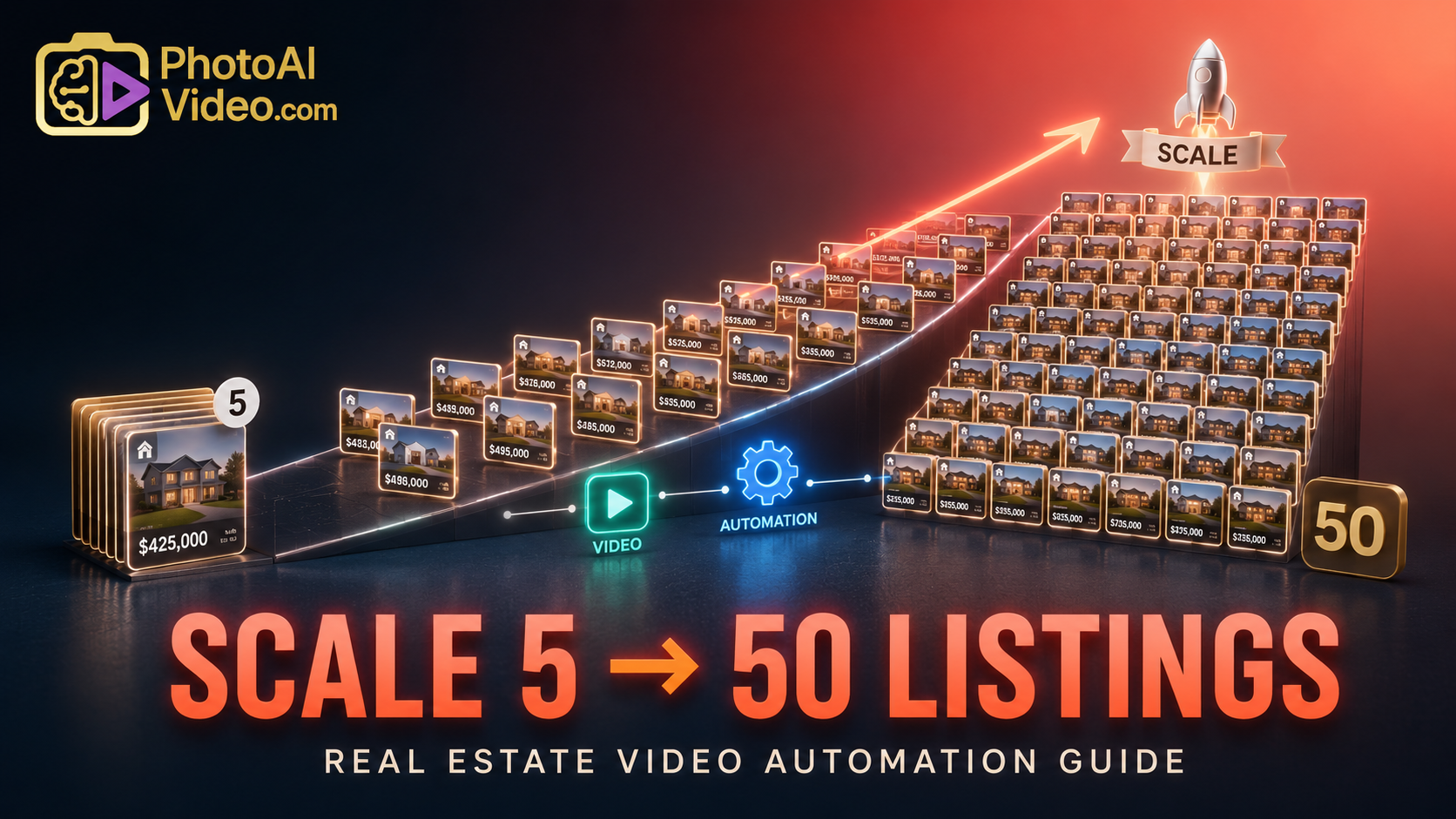
When a boutique real estate agency hits a sudden growth spurt, the internal structural cracks show up first in the marketing department. Managing five active listings is a bespoke, hands-on process. You can easily schedule localized drone flights, show up to properties early to record custom walk-through tracks, and manually cut social promotional pieces over the weekend.
But when your inventory scales to 50 active MLS records spanning luxury estates, multi-family flips, and suburban single-family homes, that artisanal approach breaks down.
Your primary obstacle isn’t a lack of property data or listing volume; it’s the physical limitations of your creative production line. If you stick to the old manual methods at scale, your marketing coordinator becomes a severe business bottleneck.
Worse yet, if you try to sidestep the production crunch by posting standard flat photo galleries to your social accounts, major ad channels will suppress your network reach. Growth studies verified by HubSpot prove that smartphone users scan through text and image arrays using ultra-rapid mental patterns, discarding unmoving corporate posts in milliseconds.
To maintain market authority across multiple ZIP codes, scaling teams require a predictable, programmatic engine that delivers short-form vertical assets continuously from inventory layers they already control.
The real reason most mid-sized brokerages fail to scale their online footprint is that traditional video production is completely unscalable for high listings volume. Think about the direct logistical friction. Coordinating physical camera operators to travel to 50 scattered residential or commercial addresses requires immense calendar management. You end up constantly wrestling with client rescheduling, unexpected rain clouds, and long turn-around delays from video editing houses.
The economic math simply doesn't work out. Paying professional filming invoices for 50 distinct properties drains your aggregate customer acquisition spend. If you try to offload that burden onto your field agents by forcing them to capture property clips on their personal smartphones, you compromise your brand's public quality.
Even worse, you pull your top closers away from their high-value tasks—like dialing outbound lead lists and securing new property representations. Leaving properties as flat image cards on your portal means your brand gets buried by mobile feed sorting tools. You are caught in a painful operational gap: manual video creation limits your volume, but skipping video entirely removes your brand from local screens.
To break out of this operational deadlock, scaling growth teams must completely replace the "filming-first" mindset. You need to transition your production system over to a fully automated asset utility. You don't need to shoot entirely new video files on-site to capture mobile feed traffic.
Instead, look at the high-resolution architectural photography your agency already uploads to the local database every morning. Activating those hidden visual assets turns your flat inventory files into dynamic social media magnets.
This structural optimization is exactly what PhotoAIVideo.com delivers to expanding brokerages. Operating as an enterprise-grade cloud system, it serves your office as a highly efficient AI property reels software engine built to clear your production lines.
Your administrative team doesn't need technical timeline experience or expensive processing computers. You simply drop an existing flat MLS listing photo directly into the browser dashboard interface.
The web application instantly reads the underlying pixel layout, converting the stationary 2D file into a native 9:16 vertical motion track that's ready for immediate feed distribution. By changing your workflow from physical recording to automated image animation, you gain the leverage to generate polished, screen-filling video tracks for all 50 properties simultaneously. This approach lets your team scale up content output while protecting your marketing budget.

Fixed 2D photography layer. Suppressed by social media discovery systems due to a lack of visual pattern interrupts.
Calculated multi-plane computer vision creates deep cinematic camera drift lines to anchor browser focus pools.
To maximize your results with automated media platforms, it helps to look underneath the hood. The 3D movement generated from your standard residential photographs doesn't rely on simple frame stretching or artificial zoom layers. Primitive online template applications simply slide a crop frame across an image uniformly, creating a flat zoom effect that mobile users instantly dismiss as automated junk. This system uses advanced computer vision systems to parse your images mathematically.
When you drop a file into the processing dashboard, the background program triggers an advanced monocular depth estimation routine. The neural network measures pixel lighting scales, geometric wall vectors, and structural element edges to automatically compute a real spatial distance map across the layout. The application separates your image into distinct planes, isolating foreground structures—like a modern kitchen breakfast counter, custom tile layout, or living space furniture lines—and separates them cleanly from background surfaces like far-off terrace glass or landscape trees.
Once the application splits these individual layers, it applies a programmatic parallax motion formula. By moving the foreground objects along a slightly faster track relative to the deep background layer, the software perfectly matches how human eyes perceive volume and movement.
The exported file functions as a high-fidelity short-form real estate video AI loop asset that looks like it was captured by a cinematic tracking camera gliding past an architectural column. Because room dimensions and structural layouts remain entirely honest, local prospects get a genuine sense of the layout space, boosting buyer interaction indices before they ever set foot in a live open house event.
Sustaining absolute consistency across 50 active property listings requires an ultra-lean operational assembly line. Incorporating an automated AI listing reels for Realtors content workflow into your weekly schedule allows your brokerage team to translate drive folders into live campaigns in less time than it takes to pull up a morning market map:
The visual environments managing modern mobile software streams are intensely protective of user attention loops. Technical interaction metrics tracked by the Nielsen Norman Group prove that consumers navigate portrait layouts using sharp pattern-recognition scans, pushing past recognizable brand templates within fractions of a second. Inside an active visual feed, your property asset has exactly three seconds to create a definitive thumb-stop and claim cognitive concentration.
If your content opening sequence starts with generic brokerage text slides, slow-dissolving agency marks, or flat, unmoving property cards, your target demographic leaves immediately. Modern social data auctions evaluate this early user drop-off with absolute calculation. When browsers leave your video clip within the initial two seconds, network delivery matrices score your visual quality metrics as poor, which automatically suppresses your organic reach and drives up your required cost-per-click thresholds.
Deploying an agile real estate reels generator AI production flow completely reverses this retention curve. Because the 3D parallax script applies deep camera tracking motion from the very first frame, you activate a primal tracking response in the prospect's eye.
The user pauses their scroll because their brain requires an extra split second to decode the unfolding depth transitions. This visual hold preserves their attention long enough to digest your listing caption details and click your bio links, maximizing your account return metrics across all active ad networks.
Ramping up real estate operations across modern local territories requires a sharp awareness of creative wear-out speeds. Consumer tracking updates published directly by Meta for Business show that hyper-local property target groups hit intense visual exhaustion trends faster than almost any other regional commerce vertical. If your team continues to lean entirely on manual property shooting routines or high internal editing timelines, you cannot support consistent variant testing across 50 active listings. You get stuck running the exact same property clip for weeks, driving your client acquisition spend up as target conversion response flatlines.
Transitioning your marketing production over to a streamlined cloud processing engine completely decouples your creative campaign volume from your operational ledger. Your growth coordinator can instantly produce 15 separate, high-depth parallax variants from a single residential image set in an afternoon. This gives you the flexibility to verify alternative interior room perspectives and camera drift tracks to target exactly what hits high local click-through velocity.
This consistent creative volume supports a highly efficient client acquisition funnel designed to scale:
Ramping up asset construction speed across 50 active records gives your brokerage a massive local edge, but you must still police basic layout parameters to ensure your brand looks sharp and high-end across every neighborhood feed:
The real estate operators establishing the highest volume of qualified transactions across modern local landscapes aren't winning purely on brute financial spend. They rule their territories because they choose high creative velocity—the capacity to turn raw photographic inventories into dozens of moving, conversion-optimized video ads while competitor offices are still waiting for an outside videography firm to clear an edit queue slot.
Instead of burning valuable capital on heavy agency margins or wasting agent production time on complex timeline tracking software, move your design pipeline straight to automated cloud rendering tools. Introduce true dimensional scale to your listings, capture high-retention consumer blocks, and expand your business by injecting cinematic 3D motion into your standard property folders.


Compact, ready to go anywhere
Interchangeable lens that’s upgradeable
Dual 1-inch sensors for improved clarity and low light performance
Dynamic range and 6K 360° capture
360° photo resolution at 21MP

8K 360° video recording for ultra-detailed visuals.
4K single-lens mode for traditional wide-angle shots.
Invisible selfie stick effect for drone-like perspectives.
2.5-inch touchscreen with Gorilla Glass protection.
Waterproof up to 33ft for underwater shooting.

360° photo resolution in 23MP
Slim design at 24 mm thick
Built-in image stabilization for smooth video capture.
Internal 19GB storage for photo and video storage.
Wireless connectivity for remote control and sharing.

60MP 360° still images for high-resolution photography.
5.7K 360° video recording at 30fps.
2.25-inch touchscreen for intuitive control.
USB Type-C port for fast charging and data transfer.
MicroSD card slot for expandable storage.
.png)

.png)

Try it free. No credit card required. Instant set-up.






.svg)


.svg)