


.png)


If you've ever priced out a listing video, you already know the two questions that matter most: What will it cost, and how long will it take? Those two factors, more than anything about camera resolution or editing style, often determine whether video marketing for realtors becomes a regular part of your listing process or a one-off splurge reserved for your highest-priced properties.
This is exactly where the comparison between a real estate video creator and traditional videography gets interesting, because the gap isn't just about money — it's also about time you'll never get back.
Traditional videography has been the default for years, and for a single high-end listing, it can still deliver a beautiful result. But most agents aren't selling one home a year — they're juggling a rotating slate of listings, tight go-live windows, and sellers who want their properties online before the weekend open house.
A real estate video creator approaches that same challenge from a completely different angle. Instead of scheduling a shoot, an AI video generator turns photos you already have into a finished, cinematic-style property video in minutes.
This article breaks down the real cost and time considerations on both sides, using general, typical ranges rather than overly precise estimates, so you can decide which approach actually fits your budget and schedule.
A traditional real estate video shoot is a service business, and it's priced like one. You're typically paying for a videographer's time on-site, equipment — such as cameras, gimbals or stabilizers, and sometimes drone gear — along with hours of post-production editing afterward.
Depending on your market, property size, and whether you add drone footage or a full cinematic package with licensed music and multiple social media cuts, a single listing video can range from a couple hundred dollars on the low end to well over a thousand dollars.
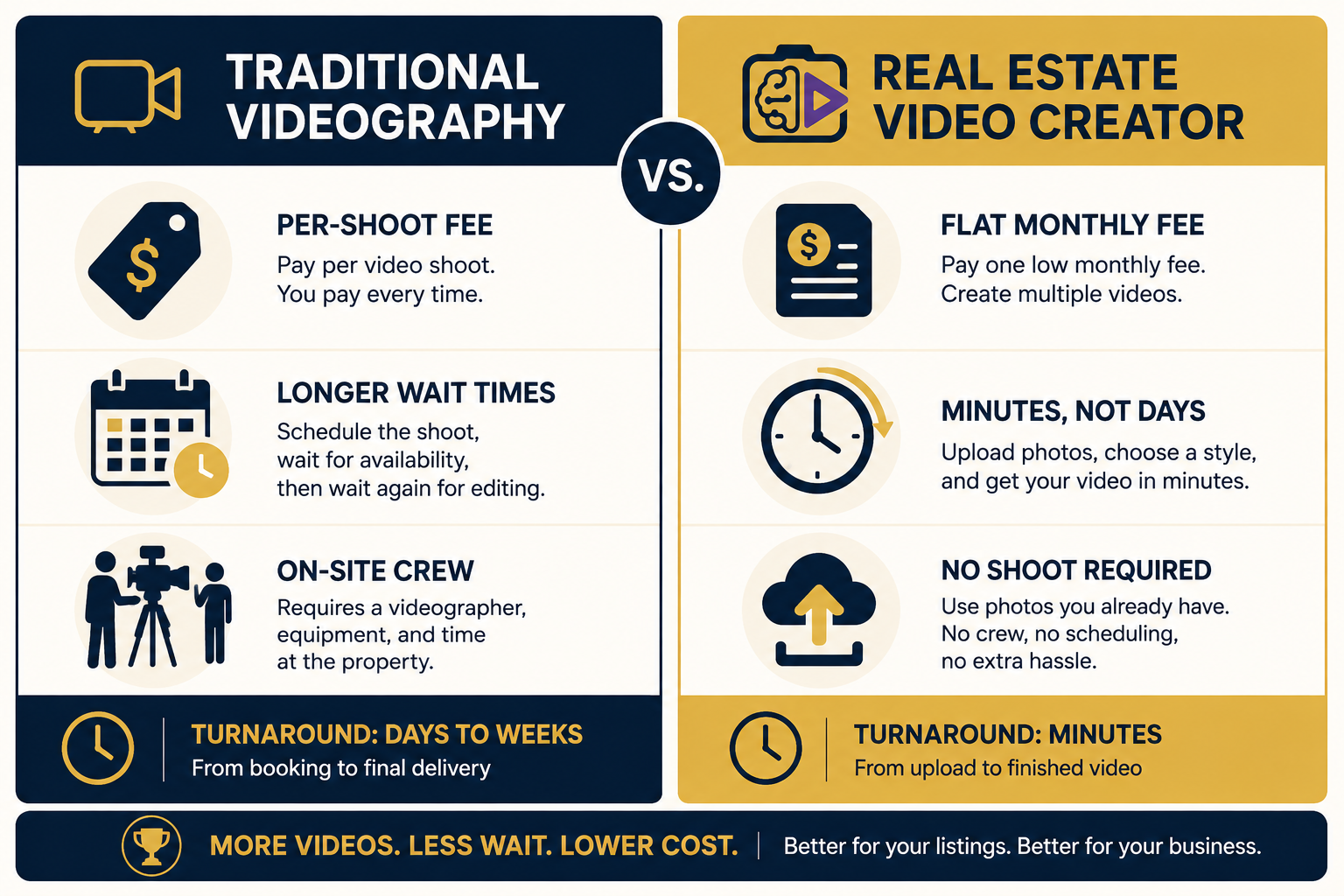
That price is generally per shoot. Book a videographer for ten listings this year, and you'll pay that rate ten separate times, potentially with an additional rush fee if you need a faster-than-standard turnaround.
A subscription-based real estate video creator flips the pricing model. Instead of paying per shoot, you typically pay a flat monthly fee that covers a set number of videos — or potentially unlimited videos, depending on the plan — for as long as you're subscribed.
Free tiers may also be available to let you test the workflow, while paid plans can cost a fraction of even one traditional videographer booking while covering multiple listings.
This is where the two models really begin to diverge.
Traditional videography costs are essentially linear: every new property video means another shoot, another invoice, and another wait. Ten listings a year at a few hundred dollars each can add up quickly, and twenty listings can become a meaningful line item in your marketing budget.
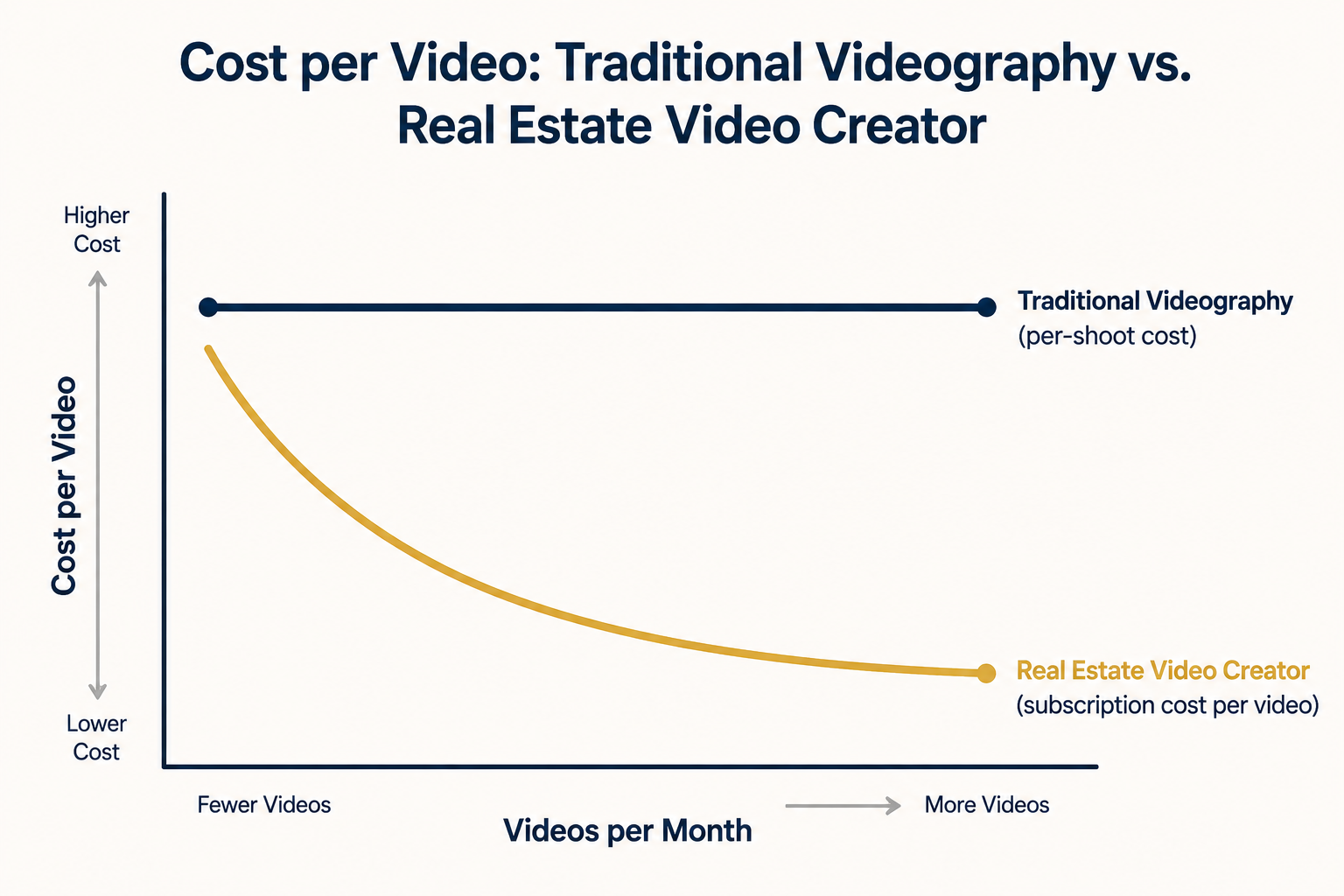
A real estate video creator, by contrast, is designed around volume. With a subscription model, your effective cost per video can decrease as you produce more videos within the limits of your plan.
For an agent listing two or three properties a month, this can make the cost per listing significantly lower as the pipeline grows. This scaling effect is particularly valuable for agents and small teams that list consistently, since it fits the workflow real estate already runs on — higher volume, tight timelines, and listing videos that need to go out quickly.
Cost is only half the equation — turnaround time can be an even bigger constraint.
A typical traditional videography timeline looks something like this: you contact a videographer, wait for an available calendar slot, coordinate a shoot time, film the property, and then wait again while the footage is edited and set to music.
Depending on the videographer's workload, the editing process alone can take several days or longer, and revisions can add more time.
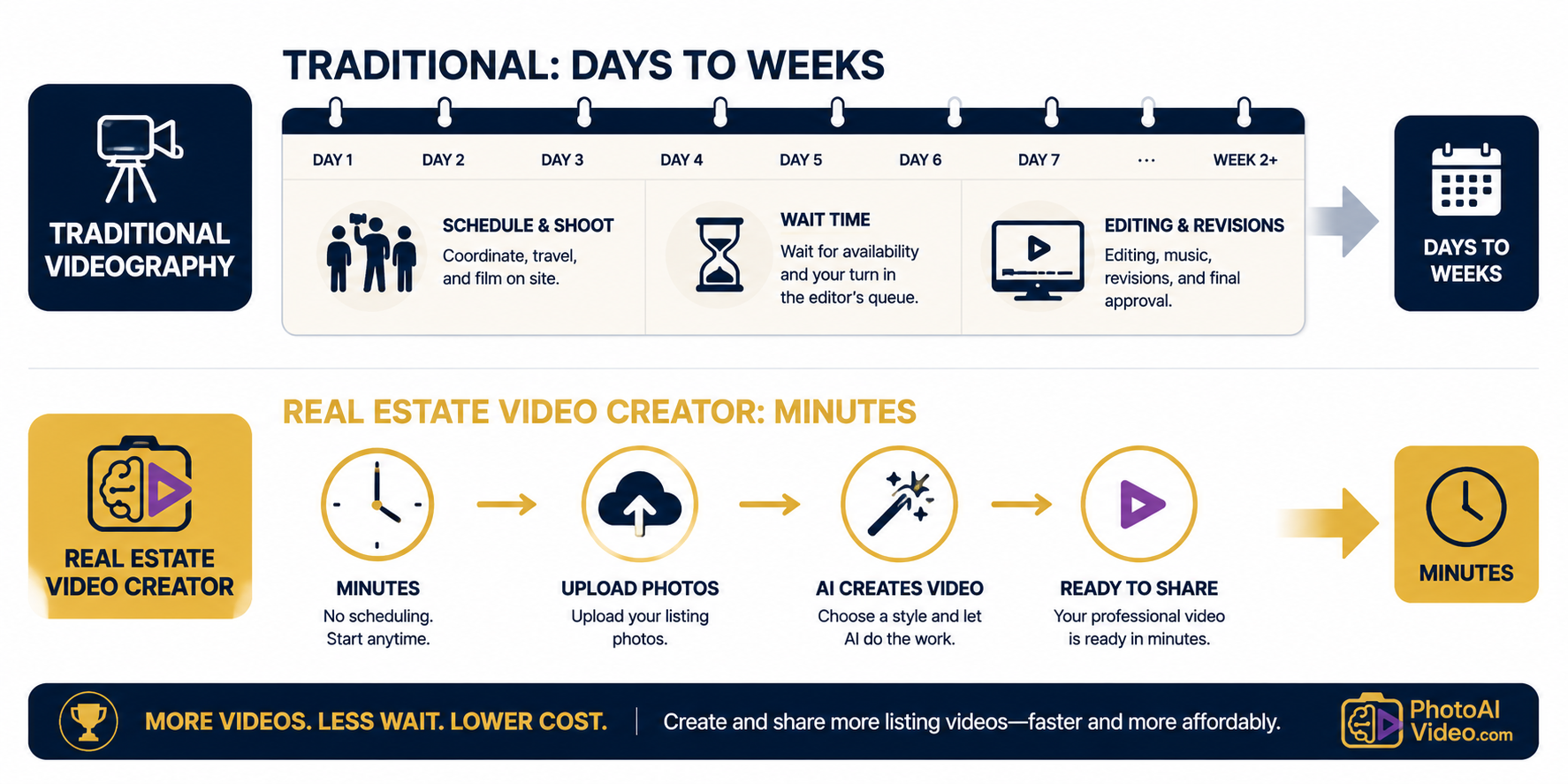
Altogether, a traditional video — from initial booking to final delivery — may take anywhere from several days to a few weeks. For a listing you want live this week, that timeline may simply be too slow.
A real estate video creator compresses much of that process. You upload the listing photos you already have — often the same photos you're using for the MLS or marketing materials — choose a style and camera movements such as pan, zoom, tilt, dolly, or orbit, and let the platform generate the finished property video.
There's no videographer's calendar to coordinate, no editor's queue to wait on, and no separate video shoot to schedule. You can browse real before-and-after video examples to see how photos can be transformed into finished, cinematic-style clips.
The videographer's invoice tells only part of the story. There's also a less visible cost: your time and the seller's.
Booking a shoot can mean back-and-forth communication to find a time that works for everyone. Someone — often the agent — may need to be on-site to unlock the property and make sure the home is ready before the crew arrives. If a shoot gets rescheduled because of weather or availability issues, that's another round of coordination.
Even after the shoot wraps, you're not necessarily done. You're waiting for the draft, potentially requesting revisions, and waiting for the moment when you can actually publish the finished video.
In a market where the first days of a listing can be especially important for generating buyer attention, that delay represents a potential opportunity cost that doesn't appear on the videographer's invoice.
A real estate video creator removes much of that hidden time. Because it works from existing photos rather than requiring another on-site shoot, there's no separate scheduling call, no waiting around for a crew, and no second visit specifically for video.
Some agents use the DIY app to generate a real estate video themselves between other tasks, while others prefer a Done-For-You option where the heavy lifting is handled for them.
The PhotoAIVideo walkthrough shows how the upload-to-finished-video process works from beginning to end.
To compare the two options fairly, it helps to calculate your true cost per listing video rather than looking only at the sticker price.
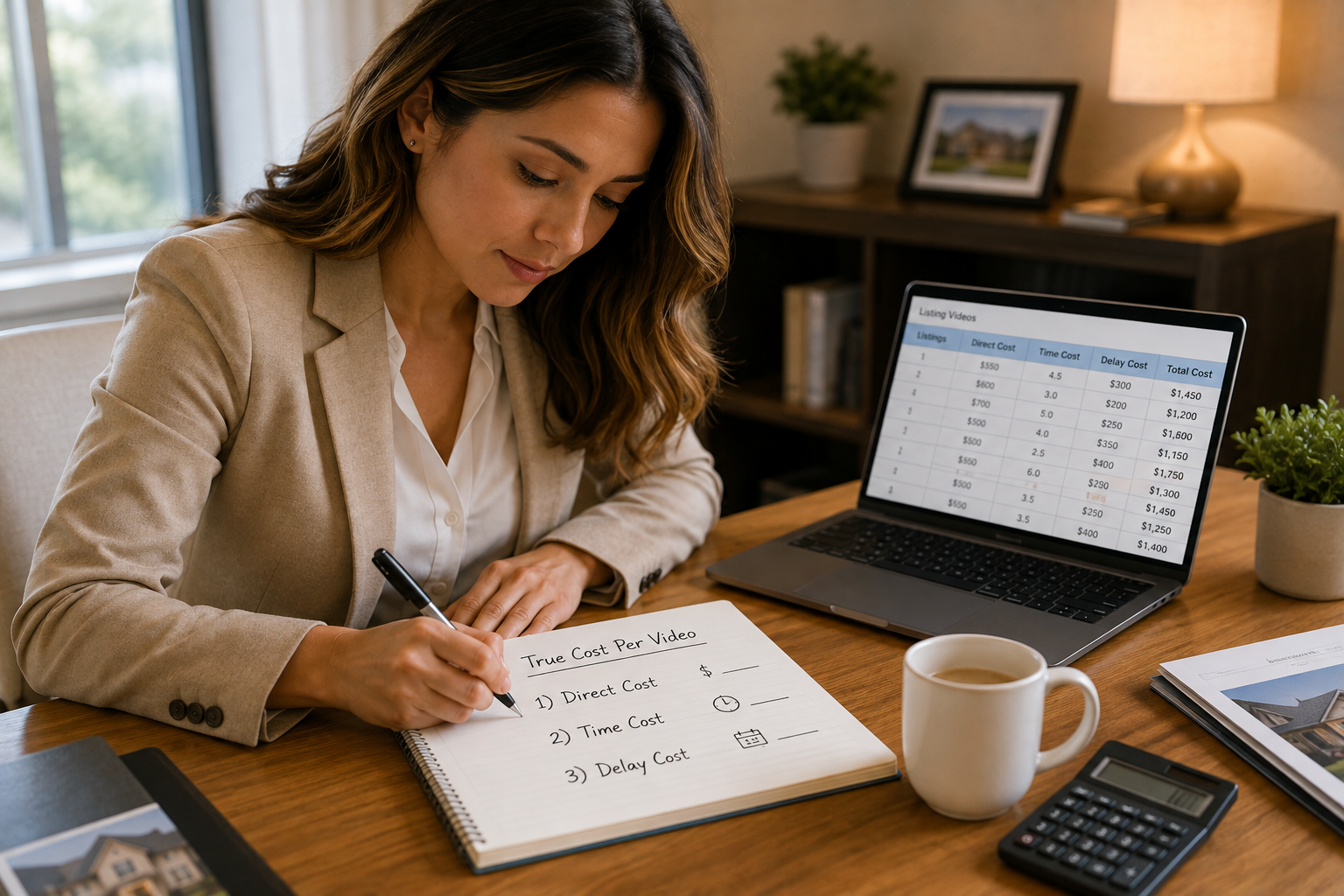
Looking at all three factors gives you a more complete picture than comparing the videographer's invoice with a software subscription alone.
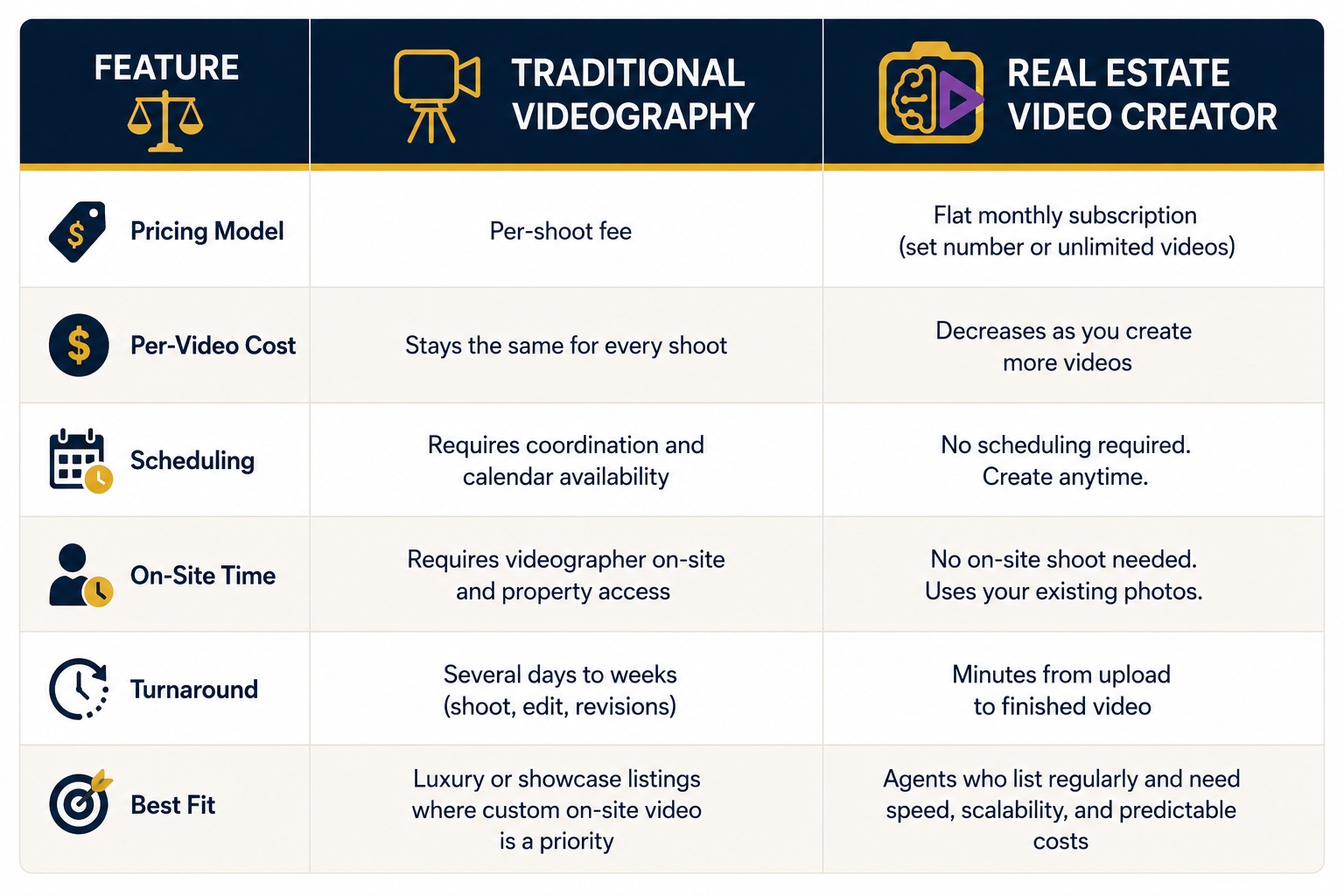
Cost and time aren't the whole story, so it's worth considering quality and creative control as well.
A skilled videographer with a drone, professional camera equipment, and time on-site can capture shots that a photo-based tool can't replicate exactly. Traditional videography also gives you greater control over how the property itself is filmed.
However, modern real estate video creators can apply camera-style movements such as pans, tilts, dolly effects, zooms, and orbits to existing photos, helping the finished video feel more dynamic than a traditional static slideshow. Features such as AI voiceovers or AI avatar introductions can add another layer of personalization.
For many everyday listings, the decision ultimately comes down to whether the additional creative flexibility of an on-location shoot outweighs the speed, convenience, and lower production requirements of an automated workflow.
Video also continues to play an important role in digital marketing. Broader video marketing research from Wyzowl's State of Video Marketing report and Think with Google's video marketing resources can provide additional context, while agents can follow buyer and market trends through the National Association of Realtors' research and statistics.
Is a real estate video creator actually cheaper than hiring a videographer?
For agents who list regularly, it can be. A monthly subscription that covers multiple videos can result in a lower per-video cost than paying a separate videography fee for every property, especially when you also consider the time spent scheduling and coordinating each shoot.
How fast can I really get a finished property video?
With a real estate video creator, the generation step can take just a few minutes once you've uploaded your photos and selected your preferred style and settings. Traditional videography generally requires additional time for scheduling, filming, editing, delivery, and potentially revisions.
Do I need professional photos to use a real estate video creator?
Professional photos aren't necessarily required, but good source images will generally produce better results. Many agents already have listing photos from a professional photographer or their own camera, and those same images can typically be used to create the video without scheduling a separate video shoot.
Can I still hire a videographer for special listings and use a video creator for the rest?
Absolutely. The two approaches don't have to be mutually exclusive. You can use a real estate video creator for regular listing volume while reserving traditional videography for flagship or luxury properties where custom, on-location cinematography adds clear value.
When you compare the true costs and timelines side by side, the right choice often comes down to how many listings you handle, how quickly you need your marketing ready, and how much creative control you need.
Traditional videography can still deliver a premium, highly customized result for standout properties. But for the ongoing rhythm of listing and marketing homes, a real estate video creator offers compelling advantages in speed, scalability, and predictable costs.
The two approaches can also work together: automate video creation for everyday listings and bring in a professional videographer when a property genuinely calls for a custom production.
If you want to see how the automated approach could fit into your workflow, the PhotoAIVideo real estate agents page walks through a tool built specifically for agents. Try PhotoAIVideo on your next listing and compare the real cost and time for yourself.


Compact, ready to go anywhere
Interchangeable lens that’s upgradeable
Dual 1-inch sensors for improved clarity and low light performance
Dynamic range and 6K 360° capture
360° photo resolution at 21MP

8K 360° video recording for ultra-detailed visuals.
4K single-lens mode for traditional wide-angle shots.
Invisible selfie stick effect for drone-like perspectives.
2.5-inch touchscreen with Gorilla Glass protection.
Waterproof up to 33ft for underwater shooting.

360° photo resolution in 23MP
Slim design at 24 mm thick
Built-in image stabilization for smooth video capture.
Internal 19GB storage for photo and video storage.
Wireless connectivity for remote control and sharing.

60MP 360° still images for high-resolution photography.
5.7K 360° video recording at 30fps.
2.25-inch touchscreen for intuitive control.
USB Type-C port for fast charging and data transfer.
MicroSD card slot for expandable storage.
.png)

.png)

Try it free. No credit card required. Instant set-up.






.svg)


.svg)