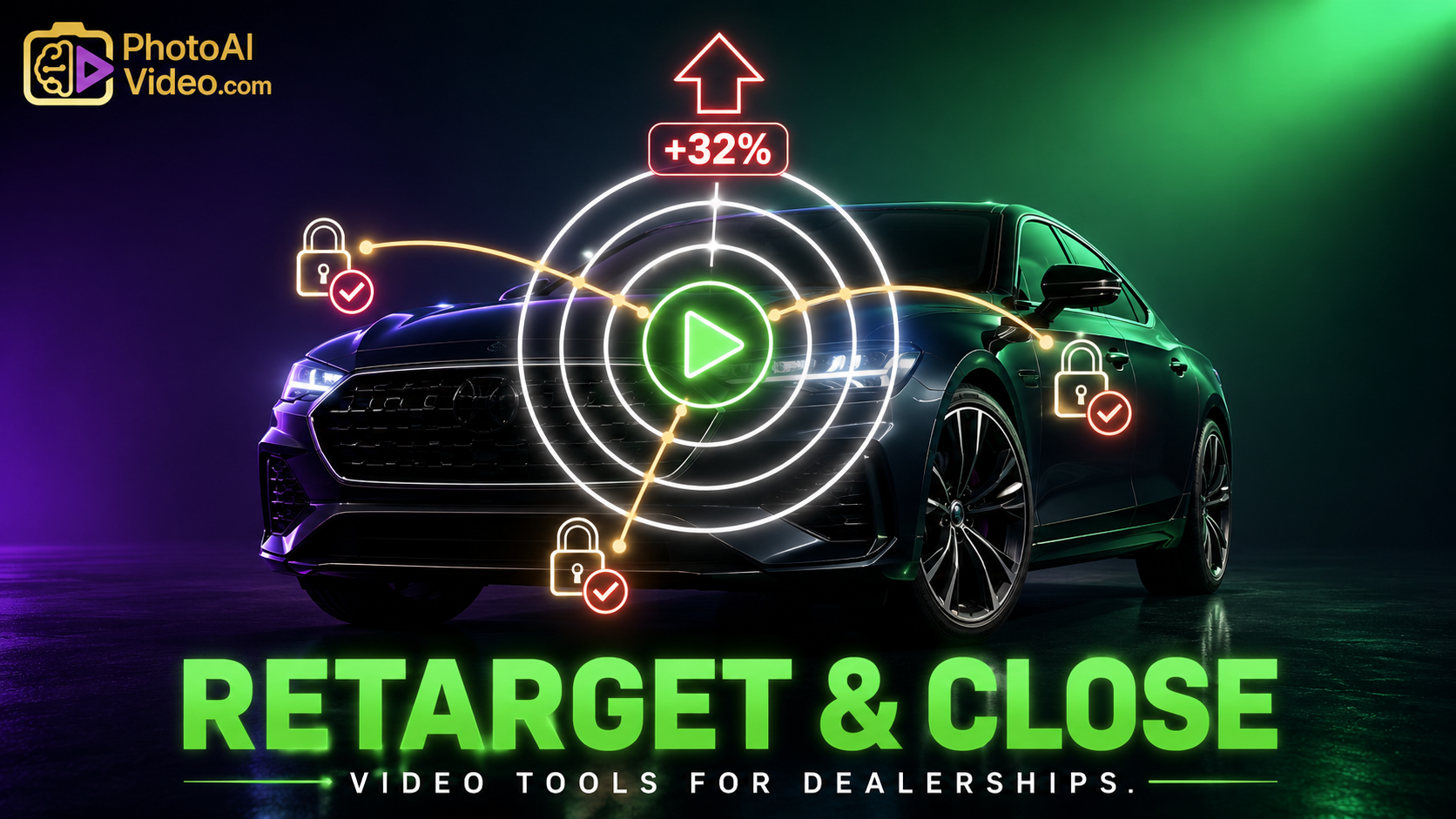
Next-Gen Retargeting: Using Video Marketing Tools for Dealerships to Close More Deals

Cloudpano
May 10, 2026
5 min read
Share this post

Next-Gen Retargeting: Using Video Marketing Tools for Dealerships to Close More Deals

The automotive industry has reached a "retargeting plateau." For years, the standard playbook has been simple: a user visits a Vehicle Detail Page (VDP), leaves, and is subsequently followed around the internet by a static banner ad of the same car. While this maintains "top-of-mind" awareness, it fails to move the needle on emotional conviction.

To break the stalemate, top-tier groups are pivoting toward Next-Gen Retargeting. This strategy swaps static, ignored banners for dynamic, high-engagement assets powered by video marketing tools for dealerships. By integrating video into the retargeting loop, you aren't just reminding the customer the car exists—you are selling the experience of owning it.

1. The Strategy: The Psychological Shift from "Reminder" to "Reassurance"

Standard retargeting is a digital nudge. Next-gen retargeting is a digital handshake. The goal is to move the customer from the "Comparison" phase to the "Intent" phase of the buyer's journey.

The Mere Exposure Effect vs. Narrative Persuasion

Psychology tells us that the "Mere Exposure Effect" (seeing something repeatedly makes us like it more) has diminishing returns. Eventually, banner blindness sets in. Narrative persuasion—delivered through video—bypasses this. A video showing the interior tech, the purr of the engine, or a 360-degree walkaround provides Information Gain.

Why Legacy Tools are Failing

Most automotive CRM marketing tools are built on logic. They trigger emails and SMS, but they struggle to serve personalized video content at the exact moment a lead cools off. Forward-thinking dealers are seeking alternatives to automotive marketing software that prioritize API-driven video delivery over static database management.

According to a study by McKinsey & Company, personalization at scale can reduce acquisition costs by as much as 50% while lifting revenue by 5–15%. In the car business, that lift represents the difference between a record month and a stagnant one.

2.8x
Retargeting ROI
↑ vs. Static Banners
42%
Lower CPC
↓ with Video Assets
19%
Lead Quality Lift
↑ Intent Signals

2. The How-To: Engineering the "Video-First" Retargeting Loop

Executing this requires a technical marriage between your inventory feed, your tracking pixels, and your video rendering engine.

Step 1: The Behavioral Trigger

When a user spends more than 60 seconds on a VDP but does not submit a lead, they are categorized as "High Interest / Low Commitment." This behavioral data must be passed from your website to your retargeting platform via a GTM (Google Tag Manager) event.

Step 2: Automated Asset Assembly

Using video marketing tools for dealerships, the system pulls the specific VIN photos and specs. Within seconds, an AI-driven engine renders a personalized "Still Available" video ad. This ad isn't just a generic brand video; it is specific to the exact truck or SUV the user was viewing.

Step 3: Multi-Platform Deployment

The video ad is then served across the Meta Audience Network, YouTube Pre-roll, and OTT (Over-the-Top) streaming platforms. The consumer sees a video of the car they want while watching their favorite news clip or streaming a show. This is the pinnacle of "omnichannel" retail strategy as defined by Harvard Business Review.

Abandonment
User leaves VDP without a lead.
Rendering
AI creates custom VIN video ad.
Serving
Video ad follows user on Social/OTT.
Conversion
User clicks back to specialized VDP.

3. Real-World Use Cases: Breaking the Monopoly of Boredom

Scenario A: The "Price Drop" Re-engagement

A shopper looks at a Ford F-150 priced at $52,000. They don't buy. Three days later, the dealership drops the price to $49,995 in the DMS. Instead of hoping the shopper returns to the site, an automated video tool triggers a retargeting ad that shouts: "The truck you wanted just dropped $2,000! See your new monthly payment."

Scenario B: The Trade-In Value Loop

If a shopper uses your trade-in tool but doesn't finish the deal, you can retarget them with a video showing your used car manager explaining why high-quality trade-ins are getting top dollar right now. It humanizes the dealership and handles the "Price Objections" before they even walk through the door.

Feature Standard Retargeting Video-First Retargeting
Asset Type Static Image / Carousel Personalized VIN Video
Emotional Appeal Low (Informational) High (Narrative)
Algorithm Priority Normal High (Social feeds favor video)
Lead Intent Passive High (Active interest)

5. ROI Fundamentals: Why Video Wins the Long Game

In automotive retail, the "Sales Cycle" isn't a day; it’s often 60–90 days. During that window, the customer is bombarded by competing offers. According to Deloitte's Automotive Consumer Study, trust and transparency are the two most cited factors for choosing a dealer.

Video establishes trust faster than text. When a customer sees a real video of the car being serviced or prepped for delivery in their retargeting feed, it signals a level of professionalism that a $5-a-day static banner can't match.

Return on Ad Spend (ROAS) Comparison
2.1x
Static Ads
3.4x
Carousel
5.8x
Video Ads

6. Mistakes to Avoid: The Pitfalls of Modern Video Tech

1. The "Ghost Inventory" Trap

There is nothing worse than retargeting a user with a high-quality video of a car that was sold yesterday. Your video marketing tools for dealerships must have a real-time sync with your DMS. If the car is gone, the ad must stop instantly.

2. Audio Laziness

Many dealers serve video ads with "Stock Music #4." In retargeting, audio should be helpful, not annoying. Use AI voiceovers to explain specific features or, better yet, serve the video with high-quality captions, as 80% of social media video is watched on mute.

3. Landing Page Mismatch

If your video ad promises a "Special Price," the landing page they click on must show that price front and center. A "mismatched" experience leads to a 90% bounce rate, wasting your ad spend.

For more on technical standards, refer to the Google Search Central guidelines on video best practices.

7. The Future: AI-Personalized "Face-to-Face" Retargeting

We are nearing a reality where a shopper who views three different SUVs will receive a personalized video comparison—not created by a human, but synthesized by AI. The system will say: "Hey! We saw you liked the Tahoe and the Expedition. Here are the three key differences in cargo space."

Dealers who master video marketing tools for dealerships today are building the infrastructure for this "Hyper-Personalized" future. By moving away from legacy automotive CRM marketing tools, you are reclaiming your margins and closing deals while your competitors are still sending "Just checking in" emails.

Is Your Retargeting Stuck in 2015?
Stop chasing leads with static banners. Deploy a video-first retargeting engine that builds trust and drives 5.8x ROAS.
📈 Book Your Demo Now →

🚀 Your All-In-One Virtual Experience Stack Starts Here

Share this post
Cloudpano

Choose The Right 360° Camera

Insta360 ONE RS 1-Inch 360 Edition

  • Compact, ready to go anywhere

  • Interchangeable lens that’s upgradeable

  • Dual 1-inch sensors for improved clarity and low light performance

  • Dynamic range and 6K 360° capture

  • 360° photo resolution at 21MP

Learn More

Insta360 X4

  • 8K 360° video recording for ultra-detailed visuals.

  • 4K single-lens mode for traditional wide-angle shots.

  • Invisible selfie stick effect for drone-like perspectives.

  • 2.5-inch touchscreen with Gorilla Glass protection.

  • Waterproof up to 33ft for underwater shooting.

Learn More

Ricoh Theta Z1

  • 360° photo resolution in 23MP

  • Slim design at 24 mm thick

  • Built-in image stabilization for smooth video capture.

  • Internal 19GB storage for photo and video storage.

  • Wireless connectivity for remote control and sharing.

Learn More

Ricoh Theta X

  • 60MP 360° still images for high-resolution photography.

  • 5.7K 360° video recording at 30fps.

  • 2.25-inch touchscreen for intuitive control.

  • USB Type-C port for fast charging and data transfer.

  • MicroSD card slot for expandable storage.

Learn More
Property Marketing
Allows potential buyers to explore properties in detail from anywhere, enhancing the real estate marketing process.
Automotive Spins
Create an interactive virtual showroom and engage affluent digital buyers with live 360º video calls, all through the CloudPano mobile app for a complete automotive sales solution.
Interactive Floor Plans
Create 2D and 3D floor plans with measurements in 4 minutes or less, all from your phone. Download the Floor Plan Scanner app and get your first scan free.

360 Virtual Tours With CloudPano.com. Get Started Today.

Try it free. No credit card required. Instant set-up.

Try it free
Latest posts

See our other posts

Interviews, tips, guides, industry best practices, and news.

Property Manager Video Hub: Scaling Rental Visibility with AI Photo-to-Video Workflows

This article explains how property managers can use PhotoAIVideo to build a property manager video hub: a repeatable system for turning rental photos, amenity images, floor plans, exterior shots, and neighborhood visuals into reusable rental marketing videos. The main idea is that property managers do not just need more listing exposure. They need clearer visual answers that help renters decide whether to schedule a tour. PhotoAIVideo is positioned as a practical tool for creating: Unit availability videos Amenity highlight videos Neighborhood videos Tour reminder clips Leasing follow-up videos Owner marketing proof videos Social media rental teasers Application or availability reminder videos Key takeaways: Property managers already have the media they need; the challenge is organizing it and turning it into reusable video assets. A video hub helps teams create consistent videos across units, floor plans, amenities, communities, and owner updates. Rental videos can reduce friction by answering renter questions about layout, condition, amenities, parking, pet features, and community feel. One rental photo set can become multiple video outputs for listings, social media, email, text follow-up, tour reminders, and owner reporting. Photographers can sell AI rental video packages to property managers as an upsell. Brokerages with property management divisions can use the same workflow to standardize leasing content. The article ends with a step-by-step process, video hub framework, mistakes to avoid, visual recommendations, FAQs, and a CTA encouraging readers to use PhotoAIVideo to turn rental photos into a scalable video system for rental visibility.
Read post

YouTube Shorts Listing Teasers: The 3-Scene Structure for Higher Property Clicks

This article explains how real estate agents, photographers, brokerages, and property managers can use YouTube Shorts listing teasers to drive more property clicks and showing requests. The main idea is that a YouTube Short should not try to show the entire house. Instead, it should use a simple 3-scene structure: Scene 1: Hook — stop the scroll with the strongest property feature. Scene 2: Proof — show the visuals that support the hook. Scene 3: Click Path — tell the viewer what to do next. The article positions PhotoAIVideo as a practical tool for turning listing photos into short vertical videos for YouTube Shorts, Reels, open house promotion, and listing campaigns. Key takeaways: YouTube Shorts should create curiosity, not replace the full listing video. The strongest property feature should appear first, not necessarily the front exterior. Agents should build each Short around one click reason, such as backyard, kitchen, layout, neighborhood, open house, or price point. One listing can become multiple Shorts instead of one generic video. Photographers can offer YouTube Shorts teaser packs as a video upsell. Brokerages can standardize the 3-scene structure across agents. Property managers can use the same structure to promote rentals and tours. The article ends with practical scripts, visual recommendations, FAQs, a visual placement guide, and a CTA encouraging readers to use PhotoAIVideo to create YouTube Shorts listing teasers from property photos.
Read post

Video Retargeting for Listings: Turning Photo-Based AI Videos into Appointment Follow-Up

This article explains how Realtors, photographers, brokerages, and property managers can use photo-based AI videos as follow-up assets after someone shows interest in a listing. The main idea is that most real estate marketing focuses on getting the first click, but many buyers and sellers need multiple touchpoints before booking a showing or appointment. Video retargeting helps agents re-engage people who already clicked a listing, watched a Reel, opened an email, attended an open house, asked about a property, or went quiet after showing interest. PhotoAIVideo is positioned as a practical tool for turning listing photos into short follow-up videos, including: Feature reminder videos Layout explainer videos Neighborhood fit videos Open house recap videos Price update videos Seller proof videos Showing request videos Rental tour recovery videos Key takeaways: A first-touch listing video introduces the property, while a retargeting video answers the next likely question. Follow-up videos should be short, usually 10–30 seconds, and focused on one action. Agents should send different videos based on behavior, such as email clicks, open house attendance, listing views, or showing interest. A good video follow-up feels helpful, not pushy. Photographers can package retargeting video clips as an upsell. Brokerages can standardize video retargeting workflows across agents. Property managers can use the same strategy to recover rental leads and book tours. The article ends with a simple retargeting sequence, visual recommendations, FAQs, and a CTA encouraging readers to use PhotoAIVideo to turn listing photos into appointment-driving follow-up videos.
Read post