


.png)


Matterport built its reputation largely on commercial use cases — real estate, retail, hospitality — where rapid capture and turnover matter most. Museums and cultural sites have a fundamentally different purpose, and that mismatch is exactly why institutions in this sector increasingly look at Matterport alternatives rather than assuming the market leader is automatically the right fit. This article looks at why that gap exists and what actually matters when evaluating virtual tour software for museums specifically.
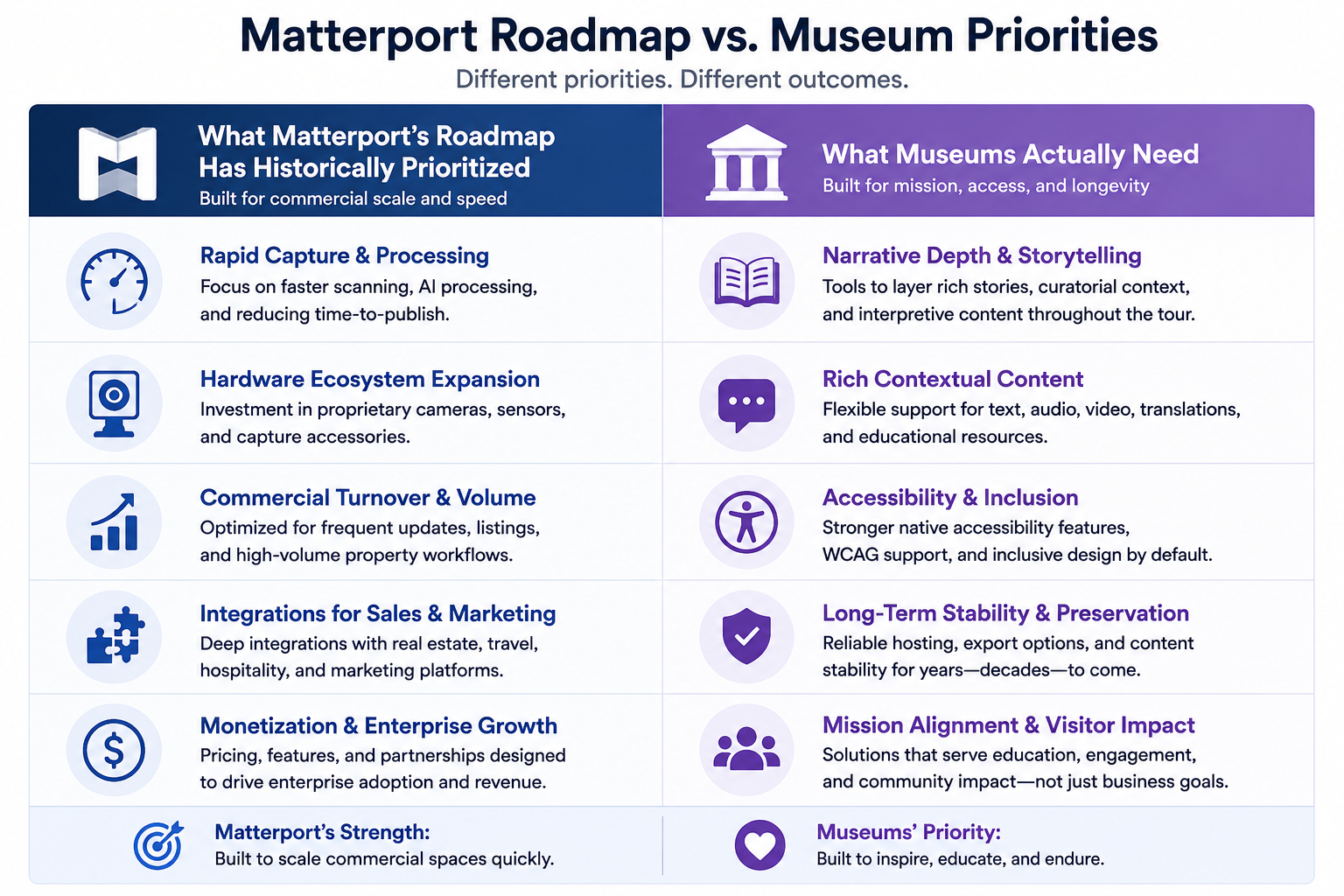
Matterport's core product decisions — hardware ecosystem, rendering approach, feature prioritization — were shaped by commercial buyers who want tours built quickly and replaced often. A museum wants close to the opposite: a tour built carefully once, maintained accurately for years, with room for rich contextual and educational content that a commercial listing never needs. This isn't a case of Matterport doing anything wrong — it's a case of a platform optimized for one purpose being asked to serve a genuinely different one, and institutions increasingly noticing the gap once they've tried to build something more ambitious than a simple walkthrough.
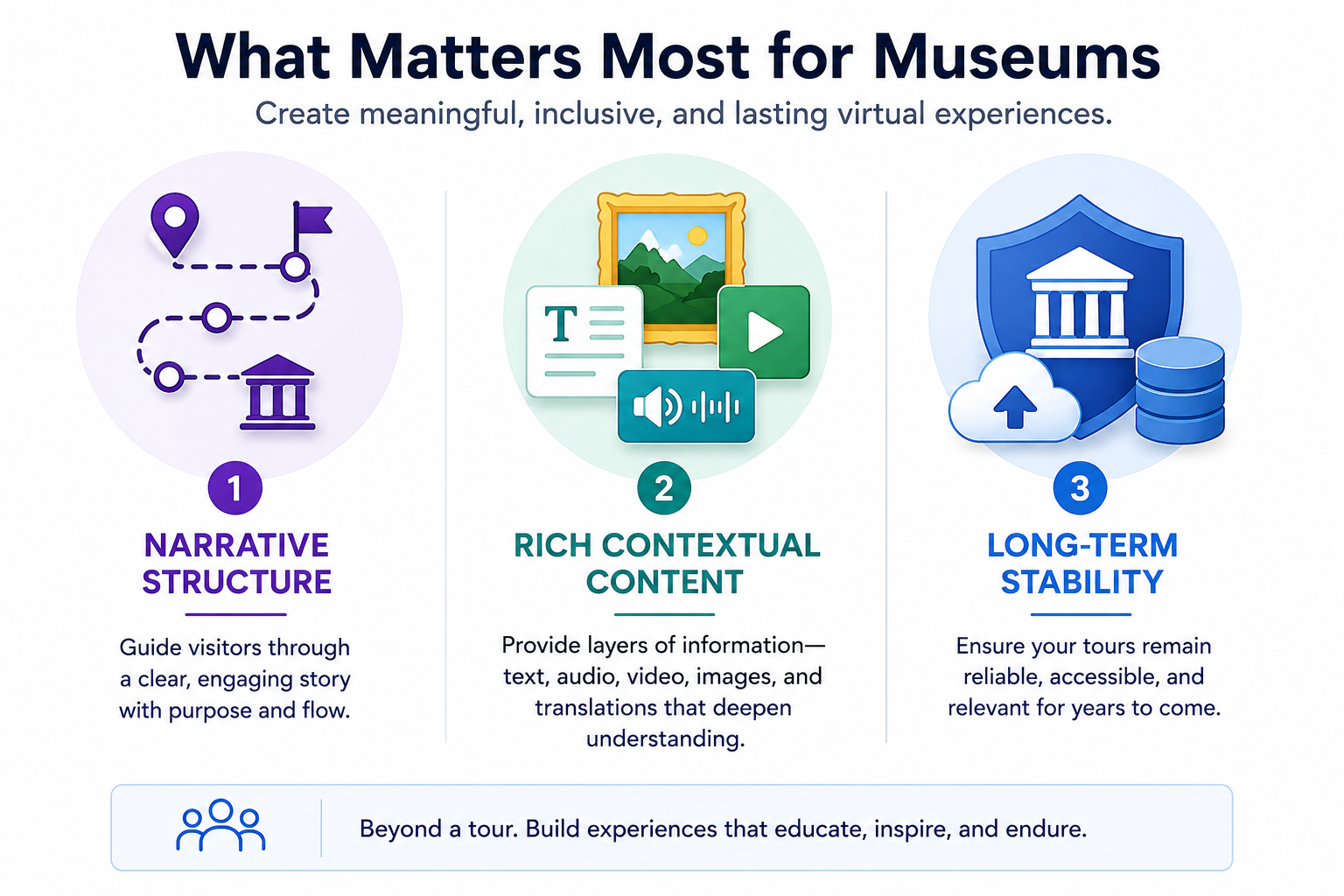
Effective museum 3D tours need qualities that sit outside Matterport's typical commercial feature set: narrative structure that guides a visitor through a logical sequence rather than a purely spatial walkthrough, support for rich contextual content (object descriptions, historical background, curator notes) embedded directly alongside the visual tour, and long-term stability, since a museum tour is often built once and needs to remain accurate and functional for years. An alternative worth considering should support these directly, not require workarounds bolted onto a commercially-oriented feature set.
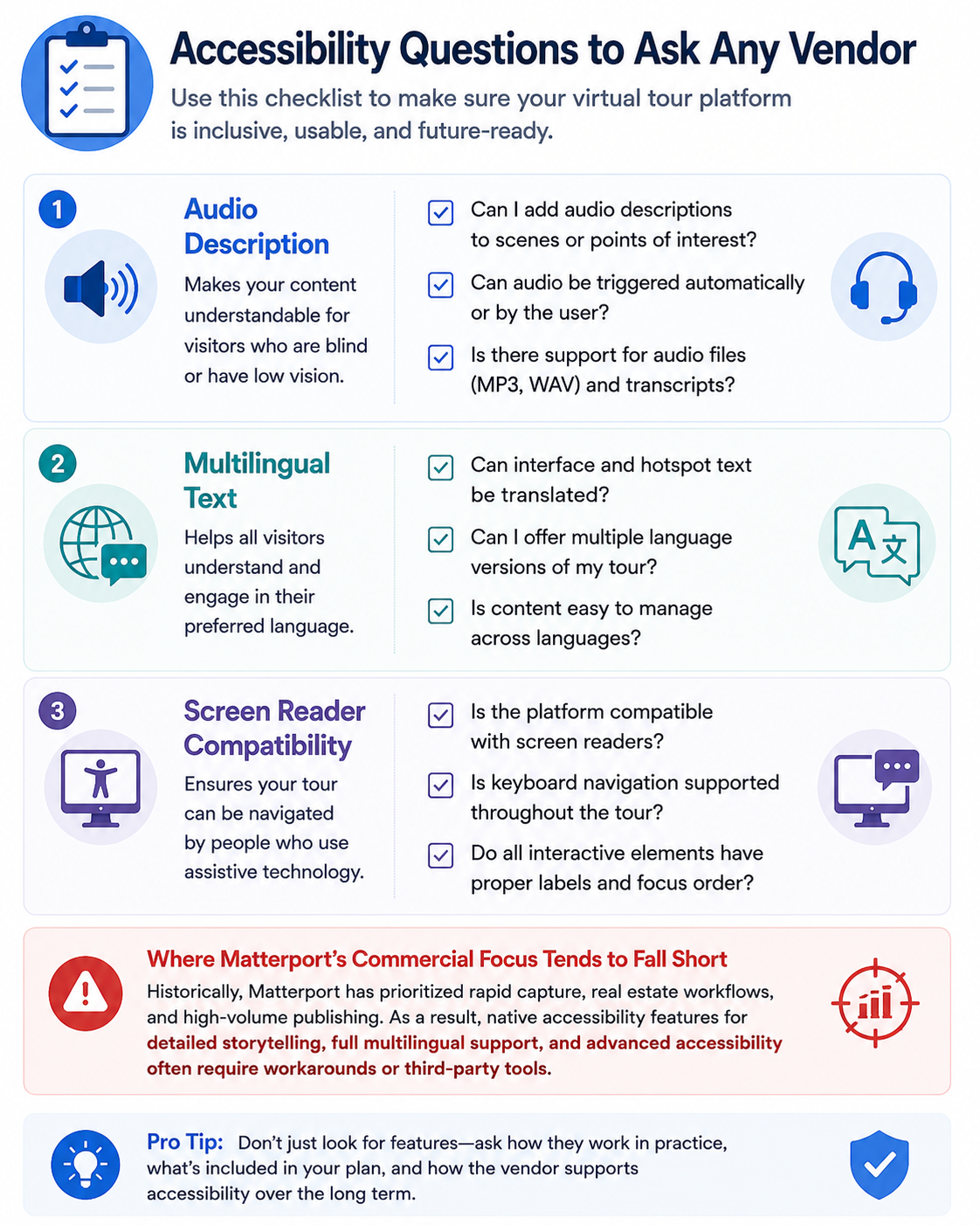
Cultural heritage virtual tours carry an accessibility responsibility most commercial tours don't — making content genuinely usable for visitors with visual, auditory, or mobility considerations who may be relying entirely on the virtual experience. This is an area where Matterport's commercial-first design shows real limits: audio description support, multilingual text options, and compatibility with assistive technology aren't priorities that a real estate or retail-focused roadmap tends to invest in heavily, and many institutions report needing to look elsewhere specifically for this reason.
This is worth confirming directly and specifically with any alternative under consideration too, since accessibility feature sets vary significantly across the entire category and aren't always front and center in general marketing materials.
It's worth acknowledging directly that many museums and cultural institutions, particularly smaller ones, operate under tighter and less flexible budgets than Matterport's typical commercial customer. Grant funding, limited operating budgets, and nonprofit status often mean a platform's ongoing subscription cost needs to be weighed more carefully against available funds. This is worth factoring into how you shop for virtual tour software for museums specifically — it's not just about which alternative has the best feature set, but which one's pricing structure and institutional accommodations (nonprofit discounts, longer-term contract flexibility) actually work for your budget reality.
None of this means sacrificing the accessibility and stability priorities discussed above — it means asking directly about institutional pricing arrangements, since these aren't always advertised prominently and may only surface if you ask.
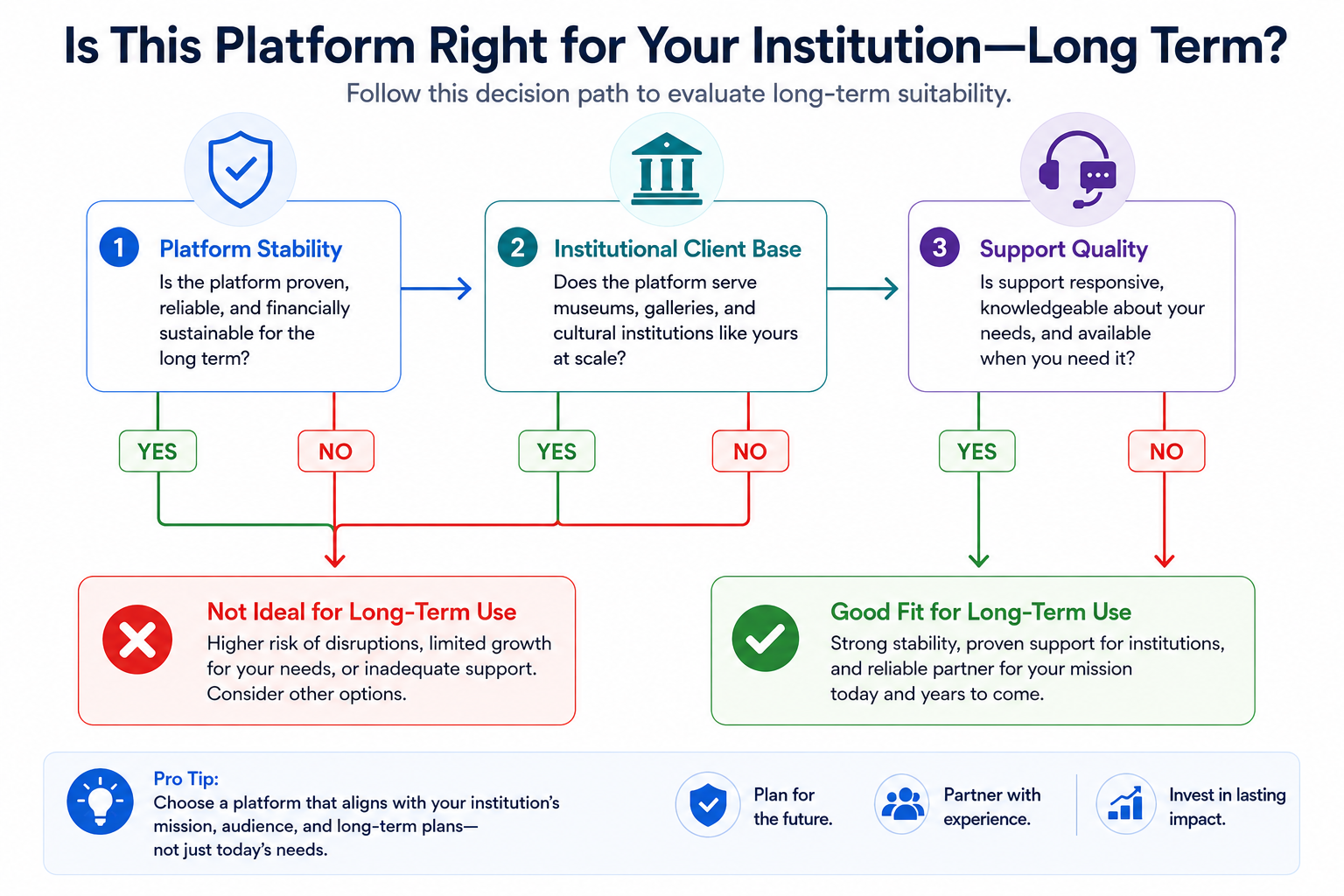
Virtual exhibit software for a museum needs to be evaluated with a longer time horizon than Matterport's typical commercial customer considers. A commercial tour might be rebuilt within a year as a listing turns over; a museum exhibit tour may need to remain live and accurate for many years, representing a permanent collection or a site that changes very slowly. This means platform stability and long-term support quality matter more here than for a business planning to refresh content regularly anyway — and it's worth asking any alternative directly about their institutional client base and long-term support track record, not just their commercial feature list.
Museum technology decisions often involve more stakeholders than a typical commercial software purchase — curators concerned with content accuracy and presentation, accessibility coordinators focused on compliance and genuine usability, and administrators weighing budget against institutional priorities. Involving these different perspectives early, rather than making a purely technical decision and presenting it afterward for approval, tends to surface concerns a single decision-maker might miss, particularly around accessibility and content presentation standards that a curator or accessibility specialist would notice more readily than someone evaluating primarily on cost.
This is worth building into your evaluation timeline explicitly if you're seriously considering a move away from Matterport, since gathering input from multiple institutional stakeholders naturally takes longer than a single-person decision, and it's better to plan for that time upfront than to rush a switch and revisit it later after a concern surfaces post-migration.
On G2's virtual tour software category page, reviewers identifying with cultural or educational institutions are less common than commercial reviewers, but their feedback tends to focus specifically on narrative and accessibility gaps rather than production speed — a pattern that shows up more in Matterport's reviews specifically than in reviews of platforms built with broader flexibility in mind.
Museum and cultural sector publications occasionally cover digital accessibility and virtual exhibit technology within this sector's specific context, which is a more directly relevant source than a general commercial software review for understanding why institutions look past the market leader.
Given the budget and stakeholder considerations discussed above, a small, deliberate pilot — one gallery, one exhibit, one collection rather than the entire institution — is a particularly sensible approach when evaluating a switch away from Matterport. It lets curators, accessibility coordinators, and administrators all evaluate the real experience with a manageable scope before committing budget and effort to migrating an entire collection, and it gives you concrete, institution-specific evidence to bring back to any stakeholders who weren't directly involved in the initial evaluation.
"Isn't Matterport still the most recognized name, even for museums?"
Brand recognition in commercial real estate doesn't transfer to institutional credibility the same way — museum visitors and funders generally care about the quality and accessibility of the experience itself, not which platform's name is attached to it. It's worth separating "well-known in a different sector" from "well-suited to our specific mission."
"Is it worth paying more for a platform with better accessibility support?"
For most museums and cultural institutions, yes — accessibility is often core to the institution's mission, not a nice-to-have. This is worth weighing as a primary reason to look at alternatives, not an afterthought considered only if everything else is equal.
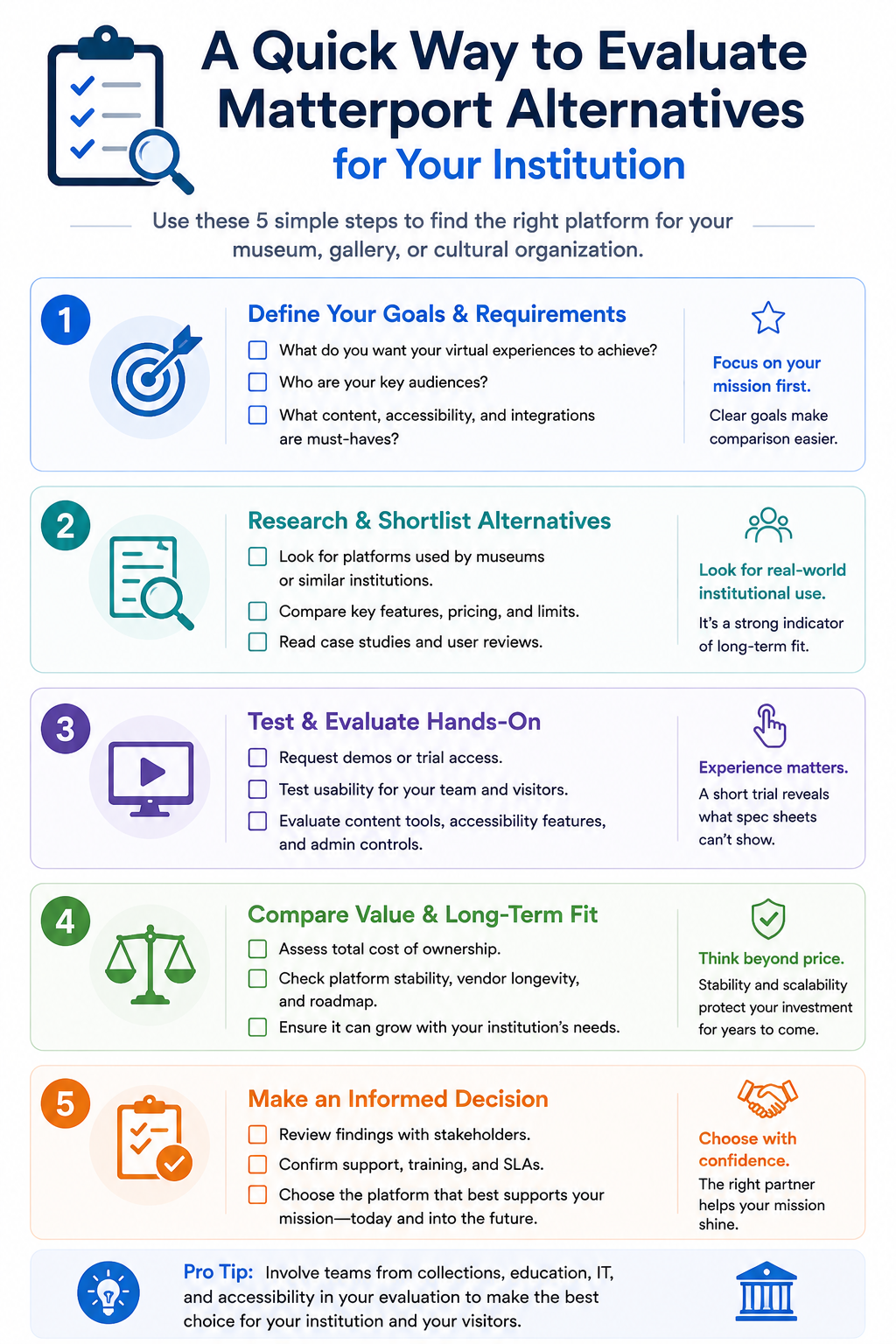
Matterport's commercial-first design leaves real gaps for museums and cultural sites — narrative depth, genuine accessibility, and long-term stability aren't priorities a real estate-driven roadmap tends to serve well. Evaluating alternatives against these sector-specific needs, rather than assuming the market leader is automatically the right fit, is the only way to find a platform that actually serves your institution's mission.
If long-term stability, flexible content support, and broader hardware compatibility matter for your collection, it's worth testing CloudPano directly with a small section of your content first. And if you want the broader industry-by-industry framework this article builds on, our guide on choosing virtual tour software by industry covers that ground in full. Whatever platform you ultimately choose, evaluating deliberately against your institution's actual mission-driven priorities — rather than defaulting to whichever platform is most recognized in an entirely different sector — is what will serve your visitors, and your collection, well for years to come.


Compact, ready to go anywhere
Interchangeable lens that’s upgradeable
Dual 1-inch sensors for improved clarity and low light performance
Dynamic range and 6K 360° capture
360° photo resolution at 21MP

8K 360° video recording for ultra-detailed visuals.
4K single-lens mode for traditional wide-angle shots.
Invisible selfie stick effect for drone-like perspectives.
2.5-inch touchscreen with Gorilla Glass protection.
Waterproof up to 33ft for underwater shooting.

360° photo resolution in 23MP
Slim design at 24 mm thick
Built-in image stabilization for smooth video capture.
Internal 19GB storage for photo and video storage.
Wireless connectivity for remote control and sharing.

60MP 360° still images for high-resolution photography.
5.7K 360° video recording at 30fps.
2.25-inch touchscreen for intuitive control.
USB Type-C port for fast charging and data transfer.
MicroSD card slot for expandable storage.
.png)

.png)

Try it free. No credit card required. Instant set-up.





.svg)


.svg)