


.png)


A virtual tour platform designed for university admissions can be worth the investment when it expands remote campus access, supports recruitment, reduces or redirects some production and staff costs, and generates measurable engagement or leads. Universities should calculate ROI using their own software costs, staff time, media expenses, tour engagement, inquiries, applications, and enrollment data.
Every admissions office eventually has to defend its budget line by line, and virtual tour software is no exception. A campus visit coordinator or VP of enrollment marketing evaluating a virtual tour subscription wants to know one thing: Does this actually pay for itself, or is it just another tool competing for attention on the website?
The answer depends largely on your institution's numbers — including applicant volume, current campus-visit costs, staff time, media-production expenses, and the number of prospective students who may never set foot on campus before deciding where to enroll.
This article provides a practical framework for running that calculation yourself, using virtual tour software built specifically for higher-ed admissions as a reference point rather than relying on industry-wide statistics that may not reflect your institution.
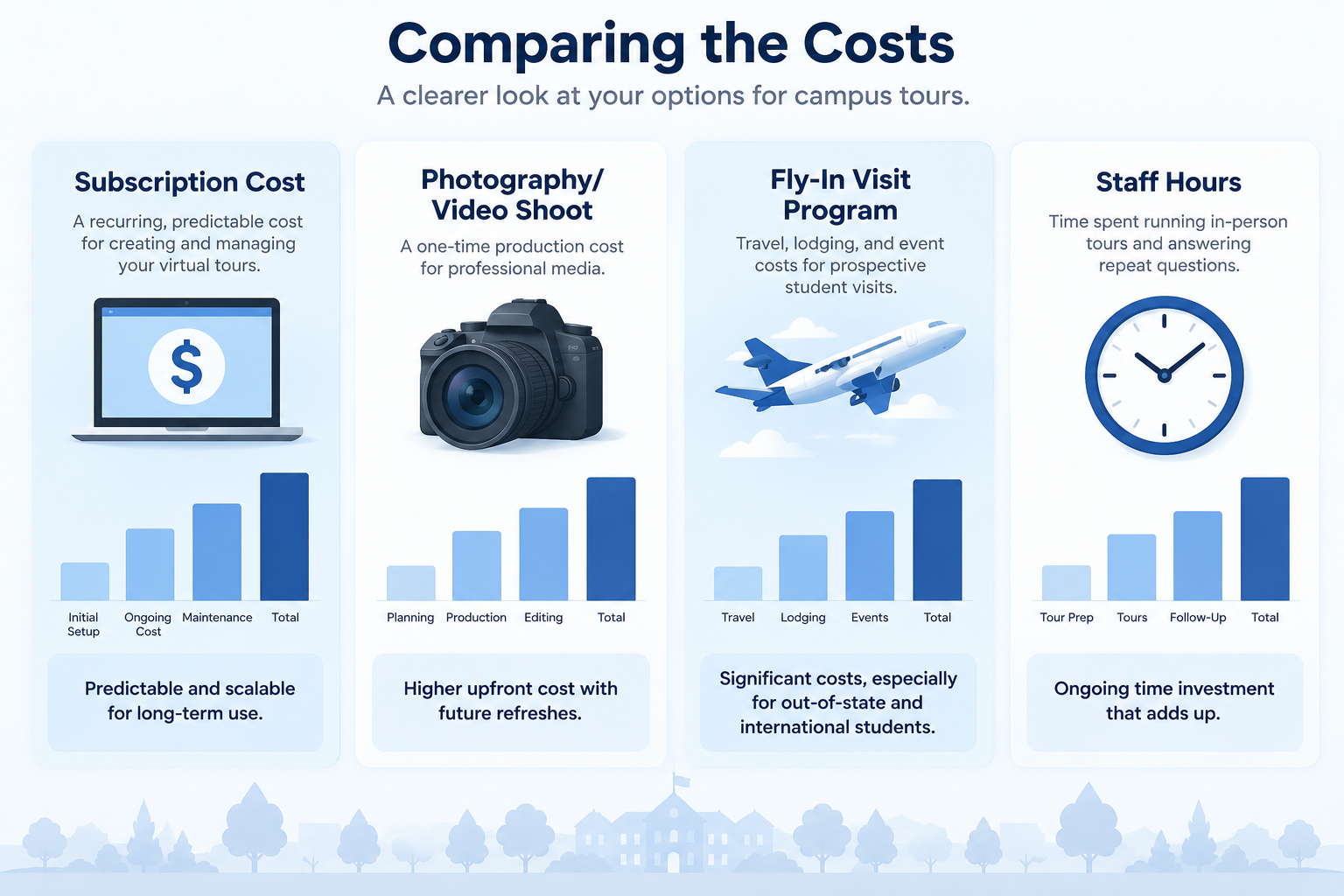
Return on investment for a virtual tour program isn't necessarily a single number. It can be evaluated through three separate comparisons.
First, there's the direct cost comparison: what you pay for virtual tour software versus what you currently spend on photography, videography, and one-off campus media projects.
Second, there's the labor comparison: how many staff hours are spent running repeat in-person tours, answering basic campus questions, or coordinating visits that a self-guided 360° experience could partially supplement.
Third — and perhaps the hardest to quantify — there's the reach comparison: prospective students who might never physically visit campus but can still explore it virtually. Understanding whether that additional engagement influences inquiries, applications, or enrollment requires tracking your institution's own data.
These numbers can vary significantly from one institution to another. A large regional university fielding thousands of inquiries each year has a very different cost-per-visitor calculation from a small private college with a few hundred serious applicants.
The framework below is designed to be filled in with your own figures rather than treated as a universal benchmark.
CloudPano offers several subscription options designed for different publishing, branding, collaboration, and virtual-tour needs.
For a smaller admissions office, a lower-tier plan may be sufficient for publishing a limited number of campus experiences. Institutions that need more projects, white-label branding, custom domains, or live 360° video chat may benefit from a higher-tier plan.
Larger admissions and enrollment marketing teams may need multi-user access so staff across departments — such as housing, athletics, individual colleges, and admissions — can collaborate on campus tours.
Enterprise options may also be appropriate for larger university systems that need additional users or manage virtual experiences across multiple campuses.
When evaluating ROI, calculate the annual cost of the plan your institution would actually need. That gives you a realistic figure to compare with your current media-production, travel, and staffing expenses.
If a free plan or trial is available, it can also provide an opportunity to test the platform and gather initial engagement data before committing to a larger budget.
Universities that want a polished virtual campus experience generally have two options: create and maintain it internally using a 360° camera and virtual tour software, or hire an outside production company to capture and produce it.
A professionally produced campus tour may involve location planning, photography, stitched 360° panoramas, editing, and the development of an interactive experience.
Those costs may also recur when buildings are renovated, new residence halls open, facilities change, or existing imagery becomes outdated.
When calculating ROI, compare those recurring production and refresh costs with the cost of software that allows authorized staff to update and republish scenes internally when appropriate.
Another cost to consider is travel and campus-visit programming.
Some admissions offices operate fly-in programs, overnight visit weekends, travel assistance programs, or other initiatives designed to make campus visits more accessible. These programs may involve transportation, lodging, meals, event expenses, and staff time.
A virtual tour shouldn't be viewed as a replacement for high-value in-person experiences. Instead, it can provide a lower-cost way to give prospective students who cannot visit campus an opportunity to explore important spaces remotely.
For ROI purposes, the question isn't necessarily, "Can the virtual tour eliminate our visit program?"
A more useful question is:
"Can the virtual tour expand access or reduce some costs while allowing us to reserve in-person resources for the students who benefit most from them?"
Campus visit coordinators know the routine: similar walking routes, buildings, and talking points repeated throughout peak visit season.
A self-guided virtual tour can supplement some of that work.
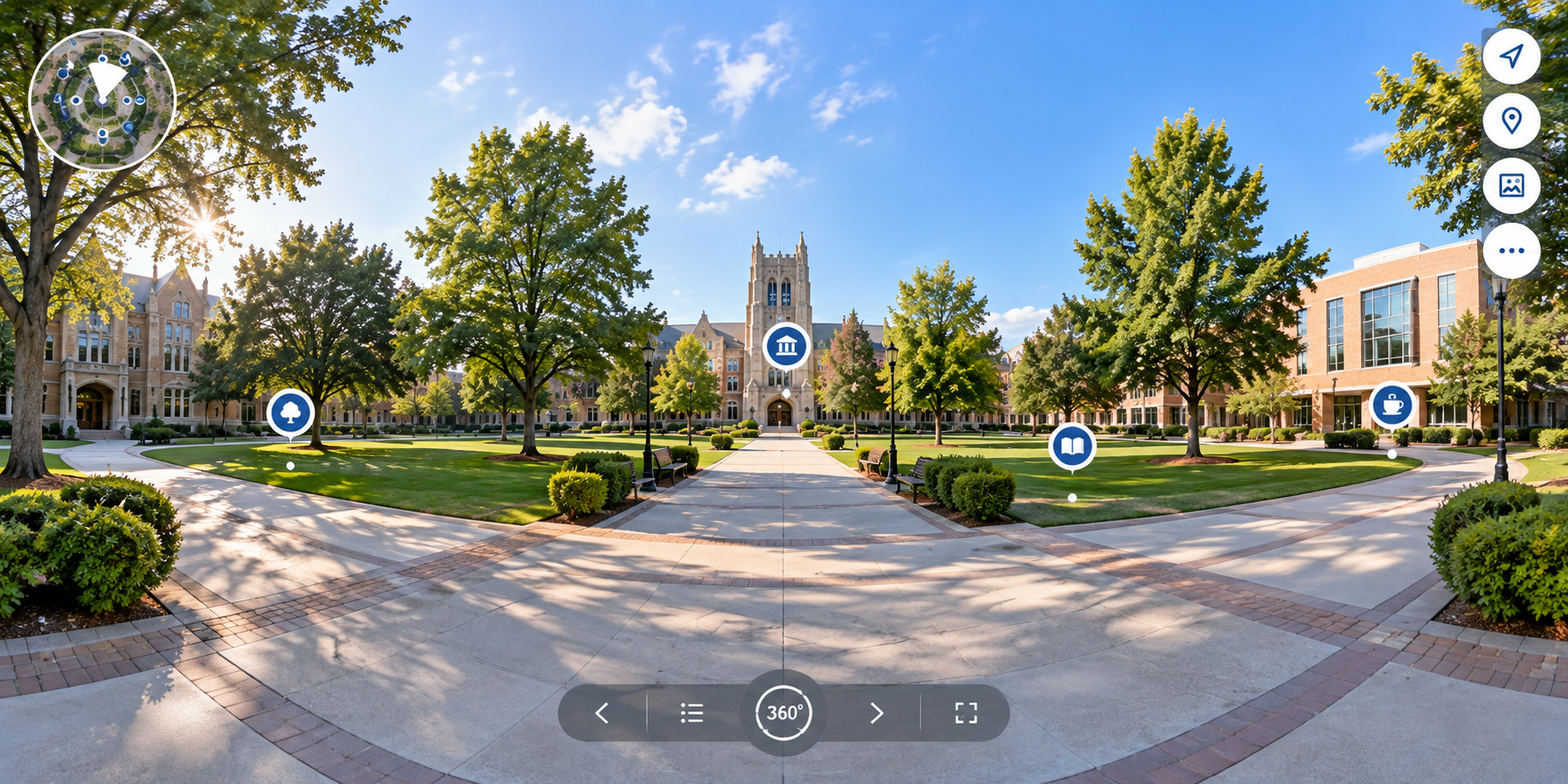
Prospective students can explore a 360° tour of the library, residence halls, lecture halls, and other campus spaces before speaking with an admissions counselor or arriving for an in-person visit. Hotspot navigation and 3D floor plans can also help visitors understand how spaces connect.
Students who have already explored campus virtually may arrive with more specific questions and greater familiarity with the institution.
Rather than assuming that virtual tours will eliminate staff-led visits, estimate whether they could shorten, supplement, or reduce the need for some repeat introductory experiences.
For example, calculate:
Staff hours per tour × number of tours per month × estimated percentage of hours that could realistically be reduced or redirected
That gives you a potential labor-cost offset based on your institution's actual operations rather than an industry assumption.
The hardest part of the ROI calculation to quantify may also be one of the most valuable: reaching prospective students who would never physically visit campus.
Distance, travel costs, visa considerations for international applicants, work schedules, accessibility needs, and family obligations can all make an in-person campus visit difficult.
A 360° tour that can be embedded directly on admissions, program, housing, or department pages gives these students another way to explore the institution remotely.
If appropriate campus imagery can also be published to Google Street View, the university may gain an additional discovery channel for prospective students researching the campus and surrounding area.
The value here isn't limited to cost savings. Virtual tours can also become another touchpoint during the research and consideration stages of the admissions journey.
The exact effect on applications or enrollment shouldn't be assumed, however. Institutions should track their own engagement and conversion data to determine whether virtual-tour visitors behave differently from other prospective students.

Lead-generation features can make a virtual tour easier to evaluate as part of a broader admissions marketing strategy.
If your virtual tour platform supports in-tour lead forms and analytics integrations, admissions teams may be able to track tour traffic, form submissions, and other engagement events depending on how analytics are configured.
From there, you can calculate a basic cost per lead (CPL):
Monthly virtual tour cost ÷ qualified leads attributed to the tour = cost per lead
For example, rather than assuming that a particular subscription will automatically generate a favorable CPL, compare the actual number of qualified inquiries attributed to your tour with what your institution currently pays through search advertising, social campaigns, recruitment events, or other acquisition channels.
This turns the virtual tour from a difficult-to-measure marketing asset into something that can be evaluated against your existing enrollment marketing metrics.
Rather than relying on outside benchmarks, build a simple worksheet using your institution's own figures:
Compare your current costs with the cost of the virtual-tour program, then monitor lead and enrollment data over time.
This gives you a much stronger basis for deciding whether the software is delivering enough value to justify the investment.
There's no universal ROI figure for virtual tour software because every admissions office starts with a different combination of production costs, travel budgets, staff resources, applicant volume, and recruitment goals.
The most useful approach is to evaluate the investment deliberately: software costs against production and visit-related expenses, staff time against self-guided exploration, and attributable leads or applications against your existing acquisition benchmarks.
Once you've built that framework using your own numbers, evaluating the right virtual tour solution for your campus becomes a much more straightforward budget decision.
No. A virtual tour is better viewed as a complement to an in-person visit.It can extend access to prospective students who cannot easily travel while allowing students who plan to visit in person to familiarize themselves with the campus beforehand.
That depends on how many tours you need to publish and whether your institution requires features such as white-label branding, custom domains, live video functionality, or multiple user accounts.Compare the features of CloudPano's current plans with your team's actual requirements rather than choosing a tier based solely on price.
Start by tracking attributable inquiries and lead-form submissions. If your analytics and CRM setup allows it, follow those prospects further through the admissions funnel to determine whether they eventually apply or enroll.You can then compare virtual-tour leads, applications, and enrollments with your software costs and other recruitment channels.
Potentially, but it depends on the institution.A smaller school with a geographically dispersed applicant pool may find significant value in providing remote campus access. Conversely, an institution serving primarily local students with relatively low campus-visit costs may calculate ROI differently.That's why using your own applicant, staffing, production, and recruitment data is more useful than relying on a universal ROI figure.
Universities should measure performance across a meaningful admissions cycle rather than judging ROI from a short launch period. Track software and production costs alongside tour engagement, qualified inquiries, applications, and enrollments where reliable attribution is available. Comparing multiple recruitment periods can also help account for seasonal changes in prospective-student behavior.


Compact, ready to go anywhere
Interchangeable lens that’s upgradeable
Dual 1-inch sensors for improved clarity and low light performance
Dynamic range and 6K 360° capture
360° photo resolution at 21MP

8K 360° video recording for ultra-detailed visuals.
4K single-lens mode for traditional wide-angle shots.
Invisible selfie stick effect for drone-like perspectives.
2.5-inch touchscreen with Gorilla Glass protection.
Waterproof up to 33ft for underwater shooting.

360° photo resolution in 23MP
Slim design at 24 mm thick
Built-in image stabilization for smooth video capture.
Internal 19GB storage for photo and video storage.
Wireless connectivity for remote control and sharing.

60MP 360° still images for high-resolution photography.
5.7K 360° video recording at 30fps.
2.25-inch touchscreen for intuitive control.
USB Type-C port for fast charging and data transfer.
MicroSD card slot for expandable storage.
.png)

.png)

Try it free. No credit card required. Instant set-up.






.svg)


.svg)