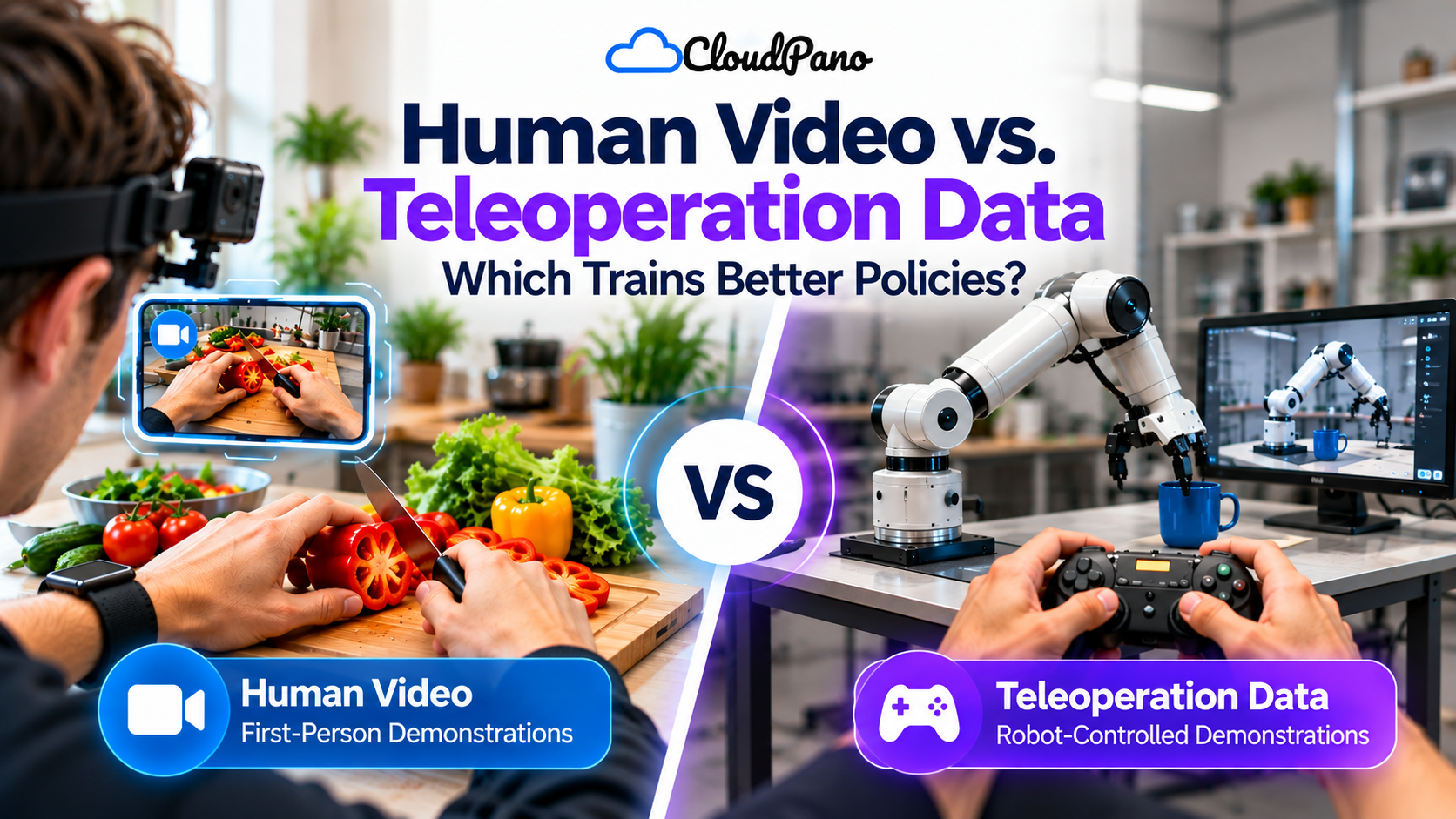
Neither wins alone. Teleoperation gives exact robot actions but is slow, costly and narrow. Human video is cheaper, faster and far more diverse. Recent studies show human video can match or beat teleop for pretraining, and that 1 hour of human data can be worth more than 1 hour of robot data. The strongest recipe pretrains on human video, then adds a small amount of robot data.
If you are building a robot policy, the hardest question is often not the model. It is where the demonstrations come from. The large-scale DROID dataset took 50 collectors 12 months to gather 76,000 teleoperated trajectories, or 350 hours of robot interaction data.
That pace is why so many teams are now asking whether human demonstration data for robots, recorded as first-person video, can replace or support teleoperation. This guide compares both fairly, walks through what recent studies actually measured, and explains how leading teams combine them.
Teleoperation data is recorded when a human operator drives a robot directly, and the robot logs its own camera views and joint actions. Because the data comes from the same robot that will run the policy, every frame has precise action labels and no embodiment gap.
This is why teleoperation has been the default. The HumanScale authors describe teleoperated robot trajectories as the dominant pretraining source for embodied foundation models, thanks to their exact action supervision and embodiment alignment.
A typical teleoperation data collection setup needs:
Human video demonstration data is first-person footage of people doing real tasks with their own hands, usually from a head, chest or glasses-mounted camera. It shows what the hands, tools and objects do from the actor's point of view, but it does not record robot joint commands.
To make it usable for robots, teams add labels such as 3D hand pose and action segments. EgoMimic, for example, paired egocentric video from Project Aria glasses with 3D hand tracking, then treated human and robot data equally as demonstration data. For a deeper look at why labs want this footage at scale, see why robotics labs are buying egocentric video.
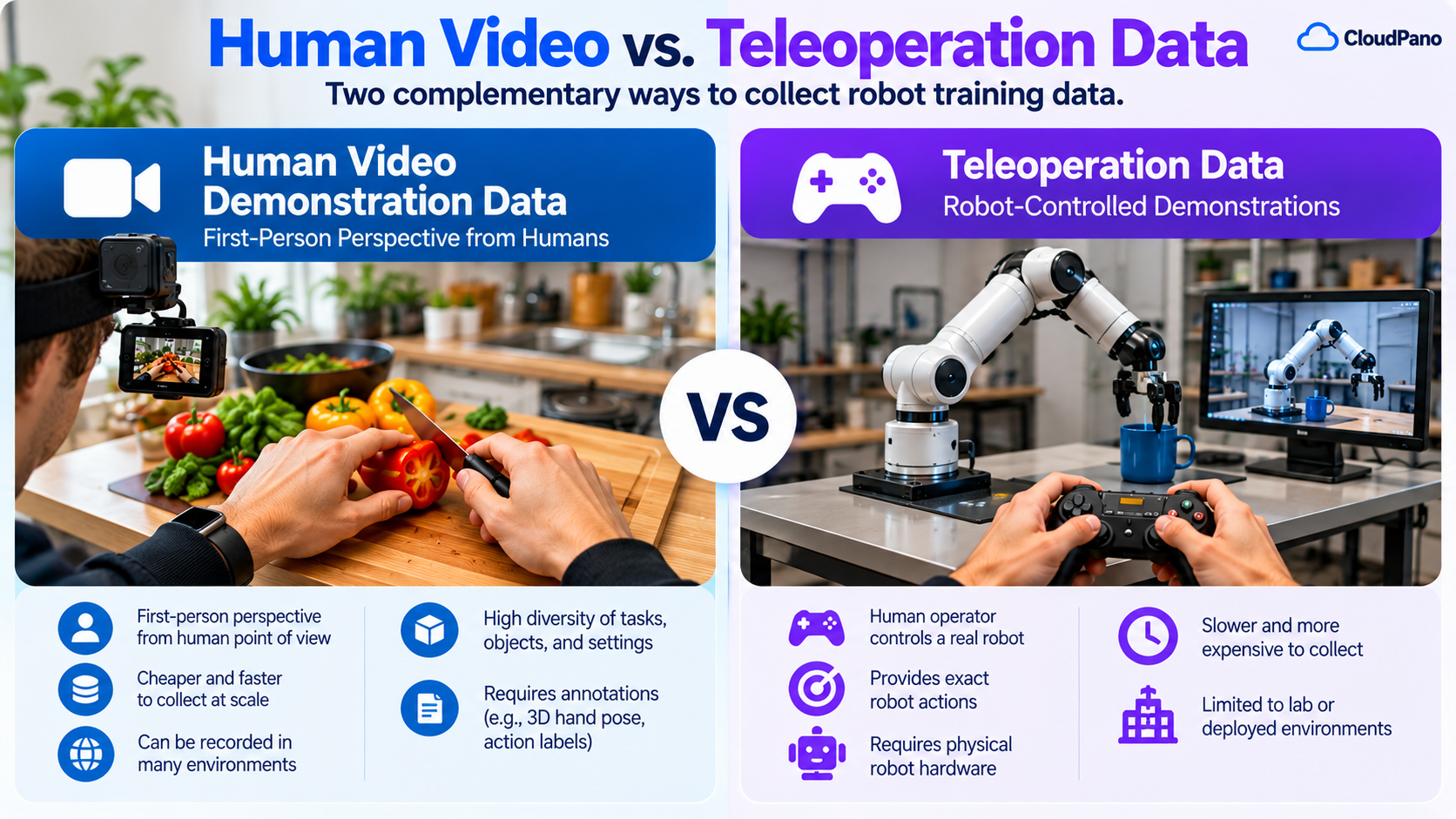
Teleoperation is hard to scale because it is tied to a robot, a place and real time. You cannot record faster than the operator works, and you can only record where a robot is installed.
Skild AI makes this argument directly. Its team says teleoperation faces two problems:
The HumanScale paper lists the same limits: high collection cost, difficult acquisition, and low behavioral and environmental diversity in teleoperated real-robot trajectories.
Human video lacks the robot's own action signals. It shows what happened, not the exact motor commands a robot should send.
Skild names two gaps:
Physical Intelligence adds that past methods often needed manual alignment, such as masking parts of the image or turning human hands into robot hands with generative models. Those tricks can help transfer but tend to cost generality.
Recent studies show human video can match or beat teleoperation data for pretraining, as long as it is processed well and paired with some robot data. Here is what each study measured.
Two caveats matter. HumanScale's result depended on a carefully designed filtering and labeling pipeline, not raw footage. And these are different models, tasks and robots, so the numbers are not directly comparable to each other.
No. The evidence points to human video as the scaling layer and robot data as the alignment layer, not to dropping robot data altogether.
Physical Intelligence found the benefit of human video grew as robot pretraining grew. On its egg-sorting task, adding more robot pretraining stopped helping the robot-only model after about 60% of the dataset, but kept helping the model fine-tuned with human video. In other words, more robot data made the model better at absorbing human data.
HumanScale reaches a similar recipe: pretrain on egocentric human video to learn diverse world representations, then adapt with a small amount of labeled real-robot data for action-space alignment.
Choose based on what your policy is missing. Most teams need both, in very different amounts.
If you are planning for a humanoid specifically, our guide to what training data a humanoid robot actually needs breaks down each data type in more detail.
Firsthand collects the human side of this recipe. Its egocentric video data collection service offers three capture tiers: a chest-mounted phone, a head rig with IMU, and a multi-camera rig with synchronized head, wrist and depth streams. Footage can be annotated for actions, hand pose, objects and transcripts, anonymized, and delivered in RLDS, LeRobot, WebDataset or MP4 + JSONL.
Here is what we can't do:
Teleoperation data is precise but slow, expensive and narrow. Human video is abundant, diverse and cheaper, but needs good labeling and some robot data to close the embodiment gap. The latest evidence says the best policies come from both: human video for scale, teleoperation for alignment.
Teleoperation in robotics means a human operator controls a robot remotely or directly in real time. For AI training, the robot logs its camera views and joint actions while the operator works, which produces precise, robot-native demonstration data. The trade-off is that collection is slow, needs hardware on site, and is limited to places a robot is installed.
Many robots learn manipulation through imitation learning, which means copying demonstrations. Those demonstrations can come from teleoperation, where a person drives the robot, or from human video, where people perform tasks on camera. Recent research increasingly combines both: large, diverse human video for pretraining, then a smaller amount of robot data to align actions.
Yes. Robot models can learn useful skills from human video when it is labeled well, for example with 3D hand pose. Physical Intelligence reported about a 2x gain on tasks shown only in human video, and Skild AI reports teaching new skills from video plus under 1 hour of robot data.
Three things stand out in recent studies: data quality, diversity and pairing with robot data. HumanScale's gains depended on careful filtering and labeling. Diverse first-person footage helps policies generalize to new scenes. And Physical Intelligence found human data helped more as robot pretraining grew, so most teams combine human demonstrations with some robot data.
Robots learn in a narrower sense than people. A robot policy learns patterns from many demonstrations and improves with more varied, well-labeled data. In EgoMimic, one policy learned from both human and robot demonstrations and generalized to entirely new scenes, showing that learned skills can carry beyond the exact examples it was shown.


Compact, ready to go anywhere
Interchangeable lens that’s upgradeable
Dual 1-inch sensors for improved clarity and low light performance
Dynamic range and 6K 360° capture
360° photo resolution at 21MP

8K 360° video recording for ultra-detailed visuals.
4K single-lens mode for traditional wide-angle shots.
Invisible selfie stick effect for drone-like perspectives.
2.5-inch touchscreen with Gorilla Glass protection.
Waterproof up to 33ft for underwater shooting.

360° photo resolution in 23MP
Slim design at 24 mm thick
Built-in image stabilization for smooth video capture.
Internal 19GB storage for photo and video storage.
Wireless connectivity for remote control and sharing.

60MP 360° still images for high-resolution photography.
5.7K 360° video recording at 30fps.
2.25-inch touchscreen for intuitive control.
USB Type-C port for fast charging and data transfer.
MicroSD card slot for expandable storage.


Try it free. No credit card required. Instant set-up.