


.png)



The modern real estate market doesn't just move fast; it moves at the speed of an algorithmic scroll. Today, real estate marketing success isn't defined solely by the size of your local network or the depth of your print portfolio. Instead, it is increasingly dictated by short-form video performance across platforms like Instagram, TikTok, and YouTube Shorts.
According to comprehensive marketing research by HubSpot, short-form video remains the highest-ROI format for digital marketers, yielding unmatched engagement metrics when compared to traditional static imagery or text-based updates. Yet, for the average Realtor, maintaining a consistent video publishing schedule presents a significant operational hurdle.
The modern agent is caught in an unsustainable content paradox. On one side, social media platforms demand an aggressive content velocity. To stay visible within local feeds, real estate agents are expected to publish daily high-quality vertical videos. On the other side lies the grueling reality of asset production: filming schedules, expensive videography gear, unpredictable property lighting, and complex editing software like Adobe Premiere or Final Cut Pro.
This traditional production pipeline is broken. Outsourcing single-property walkthroughs to professional videographers easily costs hundreds of dollars per shoot and introduces a multi-day lag time from listing activation to social media publication. Attempting to manage production in-house often leads to severe content fatigue, forcing agents to abandon their social media consistency altogether.
Meanwhile, platform algorithms explicitly deprioritize static property photos. As detailed in the Meta for Business guidelines, their recommendation engines aggressively favor vertical video formats that maximize user session duration and retention. When agents post flat, unoptimized static images of an open house or a new listing, they are actively fighting a losing battle against platform algorithms engineered for motion.
To bridge the gap between production complexity and algorithmic demand, forward-thinking agents are turning to real estate reels automation software. At the forefront of this shift is PhotoAIVideo.com, a specialized AI-powered photo-to-video short-form marketing automation engine designed specifically for the real estate ecosystem.
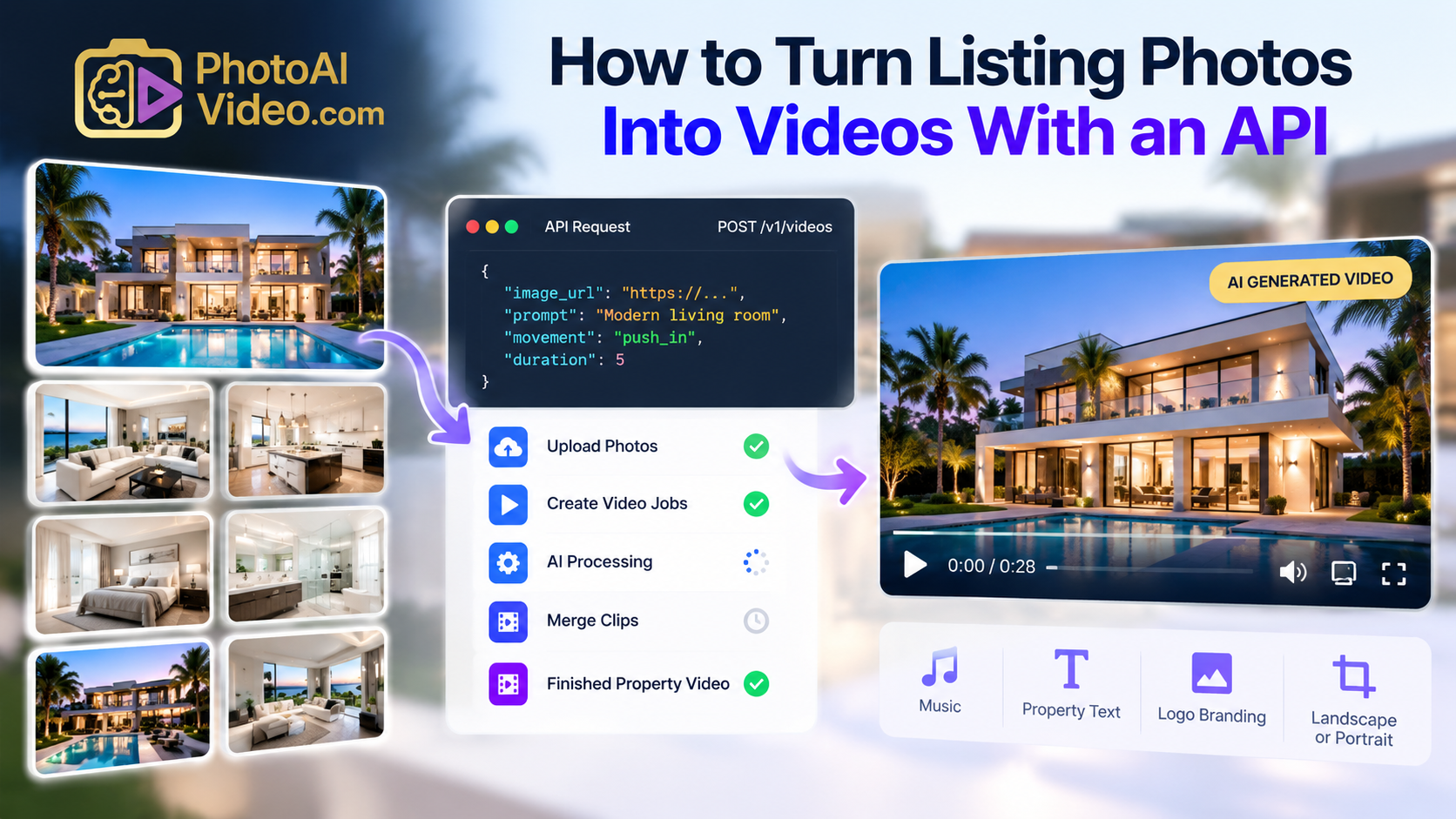
Rather than forcing real estate professionals to learn non-linear editing or invest in costly camera rigs, PhotoAIVideo.com utilizes a proprietary computer vision and motion-synthesis engine. The platform ingests standard, high-resolution listing photographs and automatically transforms them into fluid, cinematic vertical videos. By programmatically injecting dynamic pan-and-zoom sequences, spatial transitions, and high-conversion structural layouts, it turns static assets into high-performance automated real estate social media videos.
The core value proposition centers on structural optimization for the modern mobile layout. Every asset is natively rendered in a 9:16 aspect ratio, perfectly tuned to meet the upload criteria of an AI real estate reels app, an AI TikTok videos for real estate workflow, or programmatic AI Facebook video ads for real estate.
How PhotoAIVideo.com transforms standard real estate assets

Behind the high-performance outputs of a real estate reels generator AI lies a structured technical framework that differs fundamentally from traditional automated slideshow utilities. Traditional video editors simply apply linear pan movements across an image canvas, often resulting in jagged pixelation or unnatural structural skewing.
PhotoAIVideo.com uses an advanced semantic interpolation model. When a real estate agent uploads a property photo, the AI parses the structural composition of the room or exterior layout. It identifies key architectural anchors—such as kitchen islands, structural beams, window frames, and focal lighting fixtures—to understand spatial depth.
Once the spatial topography of the photograph is mapped, the AI property reels software calculates continuous sub-pixel camera movements. Whether executing a sweeping cinematic dolly zoom across a luxury master suite or generating a slow, upward crane shot that reveals vaulted ceilings, the AI maintains geometric consistency.
This deep architectural processing ensures that the resulting short-form video reads to the human eye as an authentic camera movement, directly matching the premium aesthetic required by upscale brokerages.
Integrating an AI real estate reels app into your team’s workflow requires no foundational changes to your existing photography collection methods. It turns a fragmented multi-day editing process into an automated, four-step production pipeline.
Publishing video content consistently is only half the battle; the real test lies in optimizing for human engagement mechanics. In the digital product landscape, user research firms like the Nielsen Norman Group have long established that user attention spans on modern digital interfaces are fleeting, dropping off significantly within the first few seconds of exposure. This human behavior is even more pronounced on rapid-fire discovery feeds like Instagram Reels and TikTok.
To beat this pattern, your content must hook the viewer instantly. Traditional video walkthroughs often start with slow, cinematic drone footage of the neighborhood or the home's exterior. While visually impressive, these slow openings fail to capture attention on mobile feeds, leading users to scroll past before ever seeing the property's key selling points.
An optimized real estate Instagram video maker approach flips this script. PhotoAIVideo.com structures its outputs around data-driven attention patterns:
Beyond just aesthetics, using an AI listing reels for Realtors strategy provides measurable business utility. Social discovery platforms are increasingly functioning as local search engines. Prospective homebuyers regularly look up neighborhoods and properties directly through search bars on Instagram and TikTok.
By using optimized terms in your automated video captions—such as local neighborhood names, pricing brackets, and target search phrases—you build a highly discoverable video portfolio. This strategy directly addresses the modern consumer journey, helping individual agents and multi-office brokerages scale their organic digital reach without proportional increases in ad spend.
While real estate video automation tools can dramatically streamline your production, maintaining high-quality outputs requires following key asset management standards.
Avoid these common mistakes to keep your content performance high:
AI video engines rely heavily on the quality of the input data. Uploading blurry, low-resolution, or poorly lit images limits the engine's ability to cleanly map spatial depths, which can lead to pixelated or distorted final video renders. Always use high-resolution, professionally shot listing photos as your starting material.
Every social platform places user interface elements—such as usernames, captions, and interaction buttons—over the right and bottom edges of the screen. If you place key text overlays like pricing or open house dates too close to these borders, they will be cut off or obscured. Ensure all vital information stays inside the central safe zones of the 9:16 layout.
The goal of dynamic camera motion is to make property images feel alive and cinematic. Setting motion transitions to be too fast or using overly flashy filters can distract viewers and make the listing feel cheap. Lean toward smooth, steady movements that match the natural pace of walking through a luxury home.
As search algorithms and social discovery platforms continue to shift toward video-first experiences, static real estate marketing approaches will continue to lose visibility. Relying solely on manual video editing or intermittent photo uploads makes it incredibly difficult to maintain a competitive presence in local markets.
By using an automated AI real estate reels app workflow through PhotoAIVideo.com, real estate professionals can break free from production bottlenecks. The solution allows you to scale your content output, control production expenses, and consistently generate high-performing vertical videos that capture buyer attention and drive meaningful pipeline growth.


Compact, ready to go anywhere
Interchangeable lens that’s upgradeable
Dual 1-inch sensors for improved clarity and low light performance
Dynamic range and 6K 360° capture
360° photo resolution at 21MP

8K 360° video recording for ultra-detailed visuals.
4K single-lens mode for traditional wide-angle shots.
Invisible selfie stick effect for drone-like perspectives.
2.5-inch touchscreen with Gorilla Glass protection.
Waterproof up to 33ft for underwater shooting.

360° photo resolution in 23MP
Slim design at 24 mm thick
Built-in image stabilization for smooth video capture.
Internal 19GB storage for photo and video storage.
Wireless connectivity for remote control and sharing.

60MP 360° still images for high-resolution photography.
5.7K 360° video recording at 30fps.
2.25-inch touchscreen for intuitive control.
USB Type-C port for fast charging and data transfer.
MicroSD card slot for expandable storage.
.png)

.png)

Try it free. No credit card required. Instant set-up.






.svg)


.svg)