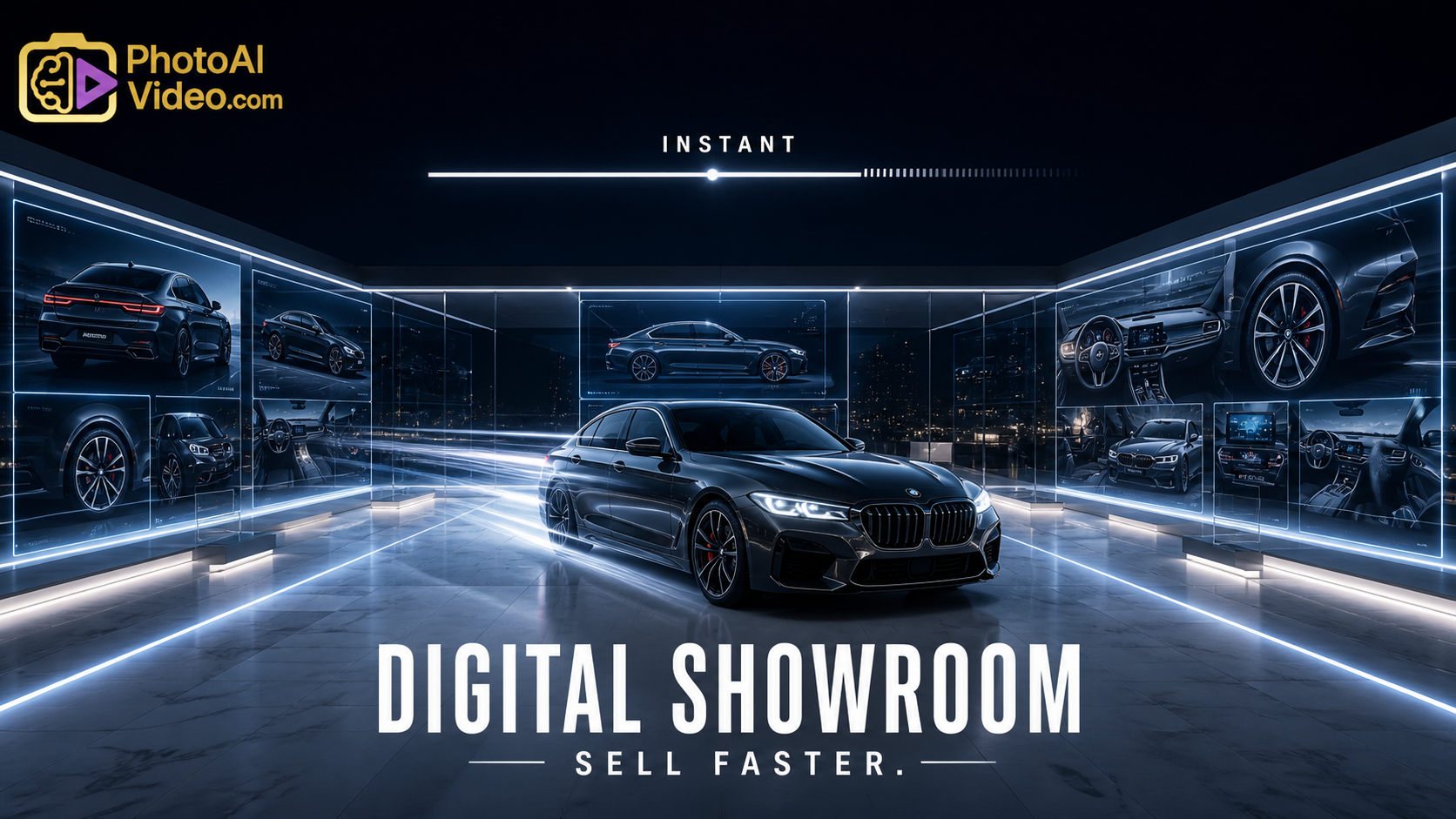
How to Sell Cars Faster Online by Building a High-Velocity Digital Showroom

Cloudpano
May 2, 2026
5 min read
Share this post

How to Sell Cars Faster Online by Building a High-Velocity Digital Showroom

The traditional automotive retail model is being dismantled by a single metric: Inventory Velocity. In an era where vehicle depreciation begins the second a car hits your lot, the delay between acquisition and digital publication is the "silent killer" of dealership profitability.

To understand how to market car inventory online , one must stop viewing the dealership website as a brochure and start viewing it as a high-performance conversion engine. A "High-Velocity Digital Showroom" isn't just about listing cars; it’s about using automation and buyer psychology to move metal faster than the competition.

1. The Strategy: Why "Fast" is the Only Competitive Advantage

In the automotive sector, time is literally money. According to research by McKinsey & Company, the modern car buyer's journey has compressed. Shoppers are no longer visiting five dealerships; they are visiting 1.5. This means the sale is won or lost on the Vehicle Detail Page (VDP) before a single phone call is made.

The "Why" behind high-velocity showrooms is rooted in Information Gain. Google and other search engines now prioritize unique, high-density content. If your car looks exactly like every other listing on a third-party portal, you have zero leverage. By automating the creation of high-fidelity assets—like studio-grade backdrops and interactive 360 spins—you provide the "trust signals" that convert a passive scroller into a high-intent lead.

4.2 Days Avg. Faster Turn Time
62% VDP-to-Lead Lift
28% Increase in Organic SEO

2. The How: Technical Execution of the High-Velocity Workflow

Most dealerships suffer from a "Merchandising Bottleneck." A car arrives, goes to detail, waits for the photographer, waits for the upload, and finally hits the web 4-7 days later. In that time, the vehicle has already lost hundreds of dollars in market value.

To learn how to sell cars faster online, you must decentralize the capture process. Using AI-powered mobile apps, anyone—from the porter to the detailer—can capture professional-grade imagery the moment the car is "front-line ready."

Step 1: Capture Anywhere

You no longer need a $100,000 photo booth. Automated backdrop technology allows you to shoot a car in the wash bay, the service drive, or the back lot. The AI segments the vehicle and replaces the messy environment with a clean, branded studio.

Step 2: Instant Background Synthesis

The AI doesn't just "cut out" the car; it performs tone mapping and shadow reconstruction. This ensures the car doesn't look like a flat sticker. It maintains the reflections of the environment while placing the car in a premium context.

Step 3: Automated Asset Syndication

Once the image is processed, it should be pushed via API directly to your Inventory Management System (IMS). This removes the manual "uploading" step entirely.

Capture

Mobile AR-guided photography on the lot.

Transform

AI background removal & shadow synthesis.

Publish

Instant syndication to all sales portals.

3. Merchandising Psychology: Converting Trust into Leads

The question of how to get more leads for a car dealership is often answered by "spending more on ads." This is a mistake. Ads only drive traffic; the content creates the lead.

Digital trust is fragile. According to the Harvard Business Review, consumers associate visual quality with organizational competence. If your photos are blurry or the background is a cluttered service bay, the buyer subconsciously assumes the vehicle's mechanical maintenance is equally sloppy.

The Power of 360° Interaction

Static images are the bare minimum. A high-velocity showroom utilizes 360-degree exterior spins and interior panoramas. This keeps users on the VDP longer, which signals to search engines like Google that your page is highly relevant, boosting your organic SEO rankings.

Feature Standard Listing High-Velocity Showroom
Background Messy Lot/Street Branded AI Studio
Time to Web 3-5 Days < 2 Hours
Interactive Static Photos Only 360° Interior/Exterior
Trust Level Low (Informal) Enterprise/Professional

4. Scaling the Lead Machine: Beyond the VDP

Once your inventory is optimized, you must feed the machine. Scaling your reach requires a multi-channel approach that leverages the high-quality assets you've created.

Dynamic Social Retargeting

If a user views a specific F-150 on your site, they should see that exact truck—clean, in its studio backdrop—on their Facebook or Instagram feed within hours. Using AI-generated backdrops makes your social ads look like premium brand content rather than a "used car ad."

AI-Driven Google Business Profile

Google Business Profiles are the "New Homepage" for local car dealerships. Regularly updating your profile with high-velocity imagery signals to Google's local algorithm that you are an active, relevant business, improving your "map pack" rankings.

Impact of Studio Quality on Lead Submissions

Raw Lot Photos
35% Lead Rate
Cleaned Natural Shots
55% Lead Rate
AI Studio Backdrops
92% Lead Rate

5. Real-World Use Cases: Turning Strategy into Profit

Large dealership groups like AutoNation and digital disruptors like Carvana have already validated this model. They don't just sell cars; they sell an "image" of perfection and transparency.

Scenario A: The Independent DealerAn independent dealer in a crowded metro area implemented automated backdrops. They reduced their "days-to-turn" from 42 days to 31 days. This 11-day improvement saved them thousands in floor-plan interest and allowed them to reinvest that capital into more inventory.

Scenario B: The Franchise GroupA 5-rooftop franchise group used AI-driven capture to standardize their look. Regardless of which store the car was at, the digital showroom looked identical. This "Clean Enterprise" look allowed them to centralize their BDC (Business Development Center), as the leads were coming in at a much higher frequency and quality.

6. Mistakes to Avoid: The Pitfalls of Digital Merchandising

Even with automation, there are traps. To maintain a high-velocity showroom, avoid these common errors:

  • Inconsistent Lighting: AI can fix a background, but it can't fix a car that was shot in a dark tunnel. Ensure your capture areas have decent, even lighting.
  • Ignoring the "Hotspots": Buyers want to see the imperfections. Use "Condition Hotspots" to highlight a small scratch or a premium feature. Transparency sells.
  • Slow Site Speed: High-quality images must be optimized for web. According to Google’s Web Vitals, a 1-second delay in mobile load time can impact conversion rates by up to 20%.

7. The Future: Multi-Dimensional AI Merchandising

As we look forward, the "High-Velocity Digital Showroom" will move into Generative Video. Imagine an AI that takes your 20 static photos and creates a 15-second TikTok-style video with a professional voiceover, music, and text overlays—all within minutes of the car being shot.

The dealerships that adopt these technologies now aren't just selling cars faster; they are building a moat around their business that traditional dealers won't be able to cross.

Final Thoughts: The Path Forward

Building a high-velocity digital showroom is no longer a luxury—it is a requirement for survival. By focusing on speed, visual consistency, and automated syndication, you solve the two biggest problems in automotive retail: high turn times and low lead quality.

The technology exists to put your dealership on a level playing field with national online giants. The only question is: how fast will you move?

Stop Losing Money on Slow Inventory

Every day your car isn't online is a day it's losing value. Build your High-Velocity Digital Showroom today and dominate your local market.

Audit Your Inventory Workflow

🚀 Your All-In-One Virtual Experience Stack Starts Here

Share this post
Cloudpano

Choose The Right 360° Camera

Insta360 ONE RS 1-Inch 360 Edition

  • Compact, ready to go anywhere

  • Interchangeable lens that’s upgradeable

  • Dual 1-inch sensors for improved clarity and low light performance

  • Dynamic range and 6K 360° capture

  • 360° photo resolution at 21MP

Learn More

Insta360 X4

  • 8K 360° video recording for ultra-detailed visuals.

  • 4K single-lens mode for traditional wide-angle shots.

  • Invisible selfie stick effect for drone-like perspectives.

  • 2.5-inch touchscreen with Gorilla Glass protection.

  • Waterproof up to 33ft for underwater shooting.

Learn More

Ricoh Theta Z1

  • 360° photo resolution in 23MP

  • Slim design at 24 mm thick

  • Built-in image stabilization for smooth video capture.

  • Internal 19GB storage for photo and video storage.

  • Wireless connectivity for remote control and sharing.

Learn More

Ricoh Theta X

  • 60MP 360° still images for high-resolution photography.

  • 5.7K 360° video recording at 30fps.

  • 2.25-inch touchscreen for intuitive control.

  • USB Type-C port for fast charging and data transfer.

  • MicroSD card slot for expandable storage.

Learn More
Property Marketing
Allows potential buyers to explore properties in detail from anywhere, enhancing the real estate marketing process.
Automotive Spins
Create an interactive virtual showroom and engage affluent digital buyers with live 360º video calls, all through the CloudPano mobile app for a complete automotive sales solution.
Interactive Floor Plans
Create 2D and 3D floor plans with measurements in 4 minutes or less, all from your phone. Download the Floor Plan Scanner app and get your first scan free.

360 Virtual Tours With CloudPano.com. Get Started Today.

Try it free. No credit card required. Instant set-up.
Try it free
Latest posts

See our other posts

Interviews, tips, guides, industry best practices, and news.

Property Manager Video Hub: Scaling Rental Visibility with AI Photo-to-Video Workflows

This article explains how property managers can use PhotoAIVideo to build a property manager video hub: a repeatable system for turning rental photos, amenity images, floor plans, exterior shots, and neighborhood visuals into reusable rental marketing videos. The main idea is that property managers do not just need more listing exposure. They need clearer visual answers that help renters decide whether to schedule a tour. PhotoAIVideo is positioned as a practical tool for creating: Unit availability videos Amenity highlight videos Neighborhood videos Tour reminder clips Leasing follow-up videos Owner marketing proof videos Social media rental teasers Application or availability reminder videos Key takeaways: Property managers already have the media they need; the challenge is organizing it and turning it into reusable video assets. A video hub helps teams create consistent videos across units, floor plans, amenities, communities, and owner updates. Rental videos can reduce friction by answering renter questions about layout, condition, amenities, parking, pet features, and community feel. One rental photo set can become multiple video outputs for listings, social media, email, text follow-up, tour reminders, and owner reporting. Photographers can sell AI rental video packages to property managers as an upsell. Brokerages with property management divisions can use the same workflow to standardize leasing content. The article ends with a step-by-step process, video hub framework, mistakes to avoid, visual recommendations, FAQs, and a CTA encouraging readers to use PhotoAIVideo to turn rental photos into a scalable video system for rental visibility.
Read post

YouTube Shorts Listing Teasers: The 3-Scene Structure for Higher Property Clicks

This article explains how real estate agents, photographers, brokerages, and property managers can use YouTube Shorts listing teasers to drive more property clicks and showing requests. The main idea is that a YouTube Short should not try to show the entire house. Instead, it should use a simple 3-scene structure: Scene 1: Hook — stop the scroll with the strongest property feature. Scene 2: Proof — show the visuals that support the hook. Scene 3: Click Path — tell the viewer what to do next. The article positions PhotoAIVideo as a practical tool for turning listing photos into short vertical videos for YouTube Shorts, Reels, open house promotion, and listing campaigns. Key takeaways: YouTube Shorts should create curiosity, not replace the full listing video. The strongest property feature should appear first, not necessarily the front exterior. Agents should build each Short around one click reason, such as backyard, kitchen, layout, neighborhood, open house, or price point. One listing can become multiple Shorts instead of one generic video. Photographers can offer YouTube Shorts teaser packs as a video upsell. Brokerages can standardize the 3-scene structure across agents. Property managers can use the same structure to promote rentals and tours. The article ends with practical scripts, visual recommendations, FAQs, a visual placement guide, and a CTA encouraging readers to use PhotoAIVideo to create YouTube Shorts listing teasers from property photos.
Read post

Video Retargeting for Listings: Turning Photo-Based AI Videos into Appointment Follow-Up

This article explains how Realtors, photographers, brokerages, and property managers can use photo-based AI videos as follow-up assets after someone shows interest in a listing. The main idea is that most real estate marketing focuses on getting the first click, but many buyers and sellers need multiple touchpoints before booking a showing or appointment. Video retargeting helps agents re-engage people who already clicked a listing, watched a Reel, opened an email, attended an open house, asked about a property, or went quiet after showing interest. PhotoAIVideo is positioned as a practical tool for turning listing photos into short follow-up videos, including: Feature reminder videos Layout explainer videos Neighborhood fit videos Open house recap videos Price update videos Seller proof videos Showing request videos Rental tour recovery videos Key takeaways: A first-touch listing video introduces the property, while a retargeting video answers the next likely question. Follow-up videos should be short, usually 10–30 seconds, and focused on one action. Agents should send different videos based on behavior, such as email clicks, open house attendance, listing views, or showing interest. A good video follow-up feels helpful, not pushy. Photographers can package retargeting video clips as an upsell. Brokerages can standardize video retargeting workflows across agents. Property managers can use the same strategy to recover rental leads and book tours. The article ends with a simple retargeting sequence, visual recommendations, FAQs, and a CTA encouraging readers to use PhotoAIVideo to turn listing photos into appointment-driving follow-up videos.
Read post