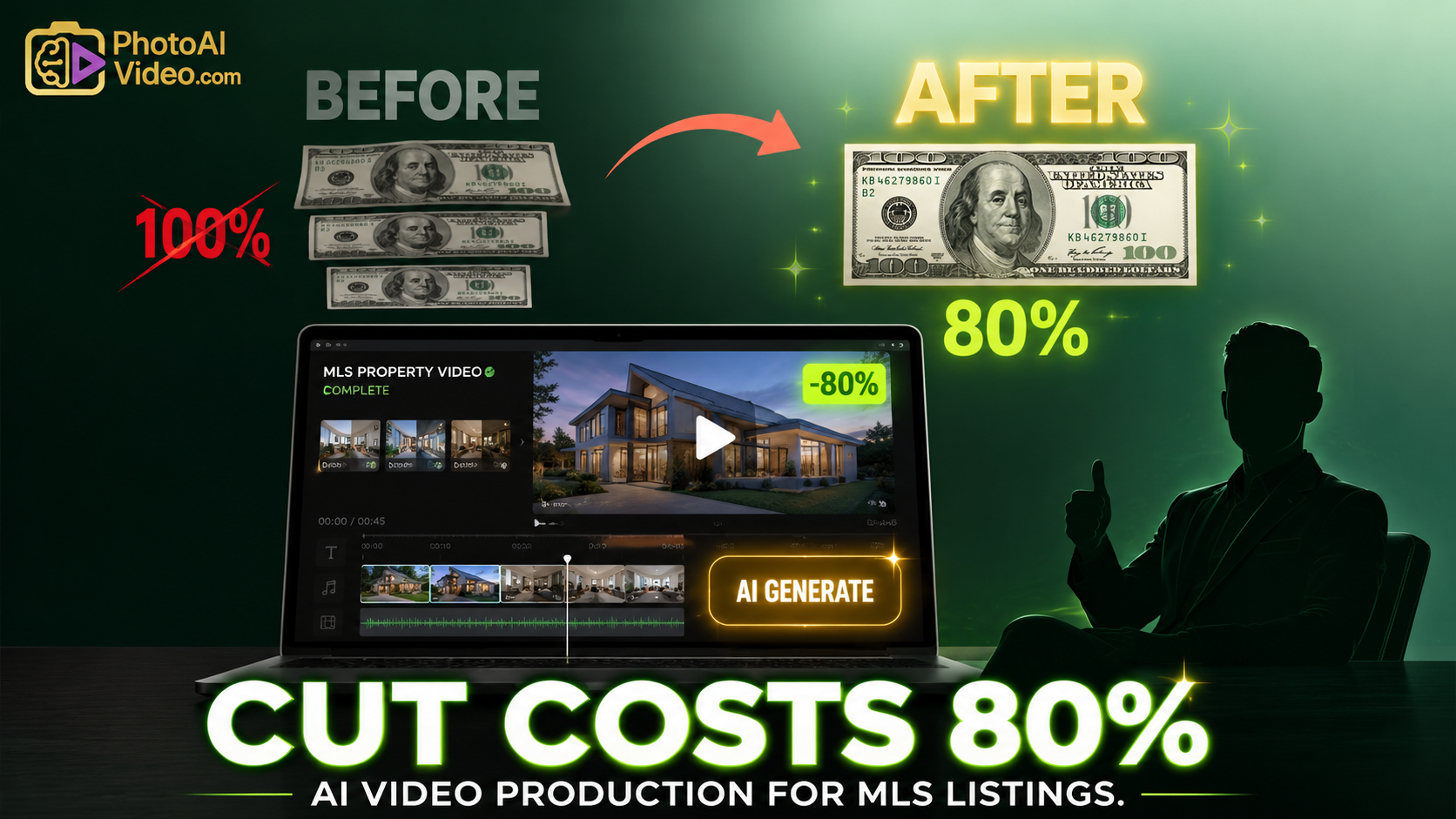
How to Cut MLS Real Estate Video Production Costs by 80% with AI

Cloudpano
May 19, 2026
5 min read
Share this post

How to Cut MLS Real Estate Video Production Costs by 80% with AI

Look at your marketing ledger for the last twelve months. If you are running a growing brokerage or managing a busy local team, a massive chunk of your operational cash flow is likely leaking directly into multimedia production. You are paying premium retainers to specialized media crews, managing scheduling conflicts with residential stagers, and watching transaction margins dry up before you even lock down an initial offer.

The industry has harbored a hidden rule for years: to win premium listings, you must present premium video walkthroughs.

But the economic model supporting traditional on-site video production is collapsing under its own weight. High-end video production is too slow, too rigid, and far too expensive to deploy across your entire inventory. If you restrict high-end footage only to your luxury residential accounts, your mid-tier family listings, multi-family flats, and neighborhood commercial spaces are left out.

When you post flat imagery, major consumer platforms downrank your items. Data patterns updated by Meta for Business reveal that modern feed systems give heavy priority to active motion files. Unmoving graphic uploads get penalized with low organic distribution because mobile browsers naturally skim right past them.

You are trapped in a tight operational corner. You cannot afford to shell out hundreds of dollars per house to send a physical film crew to every listing on your board. Yet, if you rely entirely on stale photo arrays, your assets disappear from the market completely.

Restructuring Your Content Machine: Animating Existing Materials

To rescue your marketing margins and scale up your inventory reach, you have to treat asset creation as an automated software system. Stop viewing video design as a slow, manual craftsmanship task that requires continuous hardware deployment. Instead, take an inventory of the data assets you already own.

Your business is already spending significant capital to secure clean, high-resolution interior and exterior architectural photography arrays for standard database indexing. Leaving those premium photo folders static inside an index table means you are abandoning massive organic reach.

This is where PhotoAIVideo.com modifies your daily operational speed. Functioning as a lightweight, browser-based web hub, it serves your office as a highly efficient real estate video ad maker AI pipeline built to clear out production logjams.

Your listing manager does not need to master complex multi-track desktop software or arrange localized media bookings. You drop a single high-resolution architectural photograph straight into the cloud processing dashboard.

The software processes the image data instantly, converting flat 2D lines into an immersive 9:16 portrait file engineered to secure high visibility across mobile streaming applications. By shifting media assembly to an automated cloud engine, your agency can scale short-form video delivery across your entire listing catalog on autopilot. This adds an engaging visual edge to your property promos without adding a single dollar of camera crew overhead.

MLS Image Activation Matrix

Render Core: Online
Flat Property Input
Static MLS File

Unmoving two-dimensional image. Suppressed by social recommendations due to lack of visual pattern interrupts.

AI Generated Parallax Output
3D Parallax Video

Calculated multi-plane computer vision creates deep cinematic camera drift patterns to maximize user attention.

Deconstructing the Engine: How Monocular Grids Simulate Depth

The computational reason this presentation style anchors the focus of house shoppers comes down to an automated execution loop called monocular depth mapping. Traditional digital apps try to simulate energy by zooming into a flat photo layer uniformly. This creates a generic, unnatural stretch effect that modern consumers flag as cheap automation.

When you supply a property photo to this specialized short-form real estate video AI pipeline, the software calculates pixel depth coordinates across the entire composition grid. The engine evaluates color gradients, shadow configurations, and structural boundaries to isolate what elements sit in the immediate foreground—such as custom marble island tops, polished stonework, or modern staging furniture—and splits them apart from distant background areas like hillside horizons or patio windows.

Once these distinct structural fields are isolated, the system runs a precise parallax motion sequence. By shifting the foreground objects at a slightly quicker pace than the deep background layer, it perfectly recreates the visual cues of a moving tracking shot.

The resulting clip serves your business as a premium social asset that looks like it was captured by a heavy stabilizer slider or an indoor drone. Because room scales and boundaries remain entirely accurate, browsers receive an authentic impression of layout and scale, building instant consumer trust before they ever submit an inquiry form.

The Scale System: From Image Folders to Active Campaigns in Minutes

Sustaining a healthy lead pipeline requires consistent publishing frequency across all team channels. Integrating an automated AI listing reels for Realtors production model into your weekly routine lets your team convert unmoving listing folders into active ad sets in fewer steps than it takes to pull up a morning property review:

  1. Asset Selection: Gather 3 to 5 clear, high-resolution interior master perspectives or front facade views from your property folders. Compositions with prominent foreground objects produce the deepest parallax effects.
  2. Instant Processing: Drag the files directly into the cloud-based dashboard module. The system maps the geometric coordinates and exports full vertical loops in under a minute.
  3. Distribution Matching: Upload your newly generated assets directly into your primary ad account interface, choosing high-intent vertical placement nodes like Instagram Reels or Facebook Mobile Feed Video.
  4. Contextual Configuration: Connect your 3D parallax video assets to low-friction instant form captures. Craft simple, clear copy highlighting local financing parameters or upcoming walkthrough dates to collect clean client records.
Step 01
MLS Data Load

Drop high-resolution staging or exterior photos directly into the browser panel window.

Step 02
Depth Isolation

The system maps geometry values and breaks pixel layouts into background and foreground layers.

Step 03
HD Rendering

Instant vertical 9:16 export compiles clean cinematic tracking paths automatically.

Step 04
Ad Campaign Sync

Launch the processed video creative directly across broad geographic targeting layers.

Overcoming Social Stream Filters: Conquering the 3-Second Hook Rule

Smartphone browsing behavior across modern visual streams is remarkably ruthless. Interface navigation analytics compiled by the Nielsen Norman Group establish that mobile home hunters read digital environments using rapid pattern matching loops, throwing away standard brand templates inside milliseconds to protect their cognitive attention. Within a highly competitive mobile channel feed, your creative asset has precisely three seconds to achieve a clear visual thumb-stop and earn focused attention.

If your ad campaigns launch with slow fading brand marks, stationary graphic blocks, or static introduction photos, you are burning your media capital. System auction landscapes score this rapid user exit with zero tolerance. When targets skip past your creative inside the initial two seconds, data networks flag your content quality weight as poor, which automatically drops your delivery priority and spikes your baseline cost-per-click levels.

Deploying optimized AI social media videos for Realtors entirely neutralizes this algorithmic drop-off block. Because the 3D parallax transformation applies deep drifting movement from the literal first frame, you trigger a primal tracking reflex in the human eye.

The viewer slows their swipe because their brain requires an extra moment to process the changing dimensional perspectives. This visual hold window preserves attention long enough for prospects to digest your property parameters and click your lead generation links, optimizing your ad performance while lowering target lead costs.

Account Performance Metrics

Live API Sync
+185%
vs Static Graphics
-42%
Auction Scale Maxed
3.4x
Verified CRM Leads

Real Business Economics: Scaling Volume Without Overhead Creep

Scaling up regional real estate transactions demands absolute control over asset exhaustion metrics. Comprehensive lead-generation logs published directly by HubSpot establish that localized real estate target segments suffer visual saturation and creative exhaustion faster than nearly any other consumer demographic.

If your agency framework relies on slow manual videography schedules or expensive corporate video retainer teams, your ad testing agility remains locked. You end up serving identical listing previews to your geographic target audiences for weeks, driving up your lead acquisition costs as consumer response flatlines.

Transitioning your asset production tasks to automated cloud rendering systems completely decouples your creative variant volume from your marketing payroll. Your growth coordinator can instantly produce 15 distinct, high-motion parallax variations from a single residential image set in an afternoon, verifying separate interior perspectives and camera tracking tracks to identify exactly what triggers high local click-through depth.

This systematic visual velocity feeds a reliable client acquisition funnel built to scale:

  • Top-of-Funnel Reach (Discovery): Immersive 3D parallax vertical video ads run across wide regional geographic filters, maximizing organic and paid impressions while building retargeting pools.
  • Middle-of-Funnel Nurture (Consideration): Home searchers who visit your optimized profile interact with targeted highlights showing alternative home spaces—such as a gourmet kitchen panorama or custom patio layout—paired with direct copy clues.
  • Bottom-of-Funnel Conversion (Direct Action): High-intent local leads navigate past your optimized profile bio routing links to fill out verified telephone profiles or confirm exclusive positions for private tours.
1. Discovery Layer (TOFU)

Automated short-form visual tracks dominate broad algorithmic discovery networks.

2. Intent Capture (MOFU)

Prospects analyze multi-plane spatial structures and property configurations.

3. CRM Direct Lead Inbound (BOFU)

High-intent buyers complete verified forms to secure open house invitations.

Layout Formatting Boundaries: Evading Common Design Drops

Deploying high-speed processing scripts awards your business a massive tactical advantage, but you must still monitor fundamental visual guardrails to maintain elite brand equity inside local territories:

  • Sourcing Stretched or Low-Res Photography: The background layer estimation math requires high-contrast pixel information to track boundary contours cleanly. Sourcing compressed phone frames can generate jagged artifact edges along moving shapes. Insist that your agents upload uncompressed, master-grade architectural shots.
  • Overcrowding Content Frames with Text Lines: Plastering heavy text boxes, bold promotional badges, agent telephone numbers, and flashing emojis directly over your properties ruins the premium aesthetic. It blocks the parallax movement and triggers an ad-blindness response in buyers. Keep text modifications minimal and out of native player boundaries.
  • Ignoring the Native Vertical Viewport Format: Avoid dropping landscape 16:9 shots into vertical short-form placement channels. Wide files leave large, empty black gaps above and below your content on mobile devices, cutting down your visual presence. Stick exclusively to native 9:16 portrait parameters to dominate the viewport.

Claim Your Region with High Content Velocity

The production groups locking down the highest volume of qualified transactions across modern local landscapes aren't winning purely on brute financial spend. They rule their territories because they choose high creative velocity—the capacity to turn raw photographic inventories into dozens of moving, conversion-optimized video ads while competitor offices are still waiting for an outside videography firm to clear an edit queue slot.

Instead of burning valuable capital on heavy agency margins or wasting agent production time on complex timeline tracking software, move your design pipeline straight to automated cloud rendering tools. Introduce true dimensional scale to your listings, capture high-retention consumer blocks, and expand your business by injecting cinematic 3D motion into your standard property folders.

The AI Listing Video Advantage

Stop selling static listing photos and start creating high-converting AI real estate videos. PhotoAIVideo transforms property images into cinematic reels, social ads, and listing videos optimized for TikTok, Instagram Reels, Facebook, and YouTube Shorts — helping Realtors scale content creation and generate more engagement from every listing.

Turn every MLS listing into a marketing asset with AI-powered video automation designed for modern real estate marketing.

🎬 Book Your Demo Now! →

🚀 Your All-In-One Virtual Experience Stack Starts Here

Share this post
Cloudpano

Choose The Right 360° Camera

Insta360 ONE RS 1-Inch 360 Edition

  • Compact, ready to go anywhere

  • Interchangeable lens that’s upgradeable

  • Dual 1-inch sensors for improved clarity and low light performance

  • Dynamic range and 6K 360° capture

  • 360° photo resolution at 21MP

Learn More

Insta360 X4

  • 8K 360° video recording for ultra-detailed visuals.

  • 4K single-lens mode for traditional wide-angle shots.

  • Invisible selfie stick effect for drone-like perspectives.

  • 2.5-inch touchscreen with Gorilla Glass protection.

  • Waterproof up to 33ft for underwater shooting.

Learn More

Ricoh Theta Z1

  • 360° photo resolution in 23MP

  • Slim design at 24 mm thick

  • Built-in image stabilization for smooth video capture.

  • Internal 19GB storage for photo and video storage.

  • Wireless connectivity for remote control and sharing.

Learn More

Ricoh Theta X

  • 60MP 360° still images for high-resolution photography.

  • 5.7K 360° video recording at 30fps.

  • 2.25-inch touchscreen for intuitive control.

  • USB Type-C port for fast charging and data transfer.

  • MicroSD card slot for expandable storage.

Learn More
Property Marketing
Allows potential buyers to explore properties in detail from anywhere, enhancing the real estate marketing process.
Automotive Spins
Create an interactive virtual showroom and engage affluent digital buyers with live 360º video calls, all through the CloudPano mobile app for a complete automotive sales solution.
Interactive Floor Plans
Create 2D and 3D floor plans with measurements in 4 minutes or less, all from your phone. Download the Floor Plan Scanner app and get your first scan free.

360 Virtual Tours With CloudPano.com. Get Started Today.

Try it free. No credit card required. Instant set-up.

Try it free
Latest posts

See our other posts

Interviews, tips, guides, industry best practices, and news.

Property Manager Video Hub: Scaling Rental Visibility with AI Photo-to-Video Workflows

This article explains how property managers can use PhotoAIVideo to build a property manager video hub: a repeatable system for turning rental photos, amenity images, floor plans, exterior shots, and neighborhood visuals into reusable rental marketing videos. The main idea is that property managers do not just need more listing exposure. They need clearer visual answers that help renters decide whether to schedule a tour. PhotoAIVideo is positioned as a practical tool for creating: Unit availability videos Amenity highlight videos Neighborhood videos Tour reminder clips Leasing follow-up videos Owner marketing proof videos Social media rental teasers Application or availability reminder videos Key takeaways: Property managers already have the media they need; the challenge is organizing it and turning it into reusable video assets. A video hub helps teams create consistent videos across units, floor plans, amenities, communities, and owner updates. Rental videos can reduce friction by answering renter questions about layout, condition, amenities, parking, pet features, and community feel. One rental photo set can become multiple video outputs for listings, social media, email, text follow-up, tour reminders, and owner reporting. Photographers can sell AI rental video packages to property managers as an upsell. Brokerages with property management divisions can use the same workflow to standardize leasing content. The article ends with a step-by-step process, video hub framework, mistakes to avoid, visual recommendations, FAQs, and a CTA encouraging readers to use PhotoAIVideo to turn rental photos into a scalable video system for rental visibility.
Read post

YouTube Shorts Listing Teasers: The 3-Scene Structure for Higher Property Clicks

This article explains how real estate agents, photographers, brokerages, and property managers can use YouTube Shorts listing teasers to drive more property clicks and showing requests. The main idea is that a YouTube Short should not try to show the entire house. Instead, it should use a simple 3-scene structure: Scene 1: Hook — stop the scroll with the strongest property feature. Scene 2: Proof — show the visuals that support the hook. Scene 3: Click Path — tell the viewer what to do next. The article positions PhotoAIVideo as a practical tool for turning listing photos into short vertical videos for YouTube Shorts, Reels, open house promotion, and listing campaigns. Key takeaways: YouTube Shorts should create curiosity, not replace the full listing video. The strongest property feature should appear first, not necessarily the front exterior. Agents should build each Short around one click reason, such as backyard, kitchen, layout, neighborhood, open house, or price point. One listing can become multiple Shorts instead of one generic video. Photographers can offer YouTube Shorts teaser packs as a video upsell. Brokerages can standardize the 3-scene structure across agents. Property managers can use the same structure to promote rentals and tours. The article ends with practical scripts, visual recommendations, FAQs, a visual placement guide, and a CTA encouraging readers to use PhotoAIVideo to create YouTube Shorts listing teasers from property photos.
Read post

Video Retargeting for Listings: Turning Photo-Based AI Videos into Appointment Follow-Up

This article explains how Realtors, photographers, brokerages, and property managers can use photo-based AI videos as follow-up assets after someone shows interest in a listing. The main idea is that most real estate marketing focuses on getting the first click, but many buyers and sellers need multiple touchpoints before booking a showing or appointment. Video retargeting helps agents re-engage people who already clicked a listing, watched a Reel, opened an email, attended an open house, asked about a property, or went quiet after showing interest. PhotoAIVideo is positioned as a practical tool for turning listing photos into short follow-up videos, including: Feature reminder videos Layout explainer videos Neighborhood fit videos Open house recap videos Price update videos Seller proof videos Showing request videos Rental tour recovery videos Key takeaways: A first-touch listing video introduces the property, while a retargeting video answers the next likely question. Follow-up videos should be short, usually 10–30 seconds, and focused on one action. Agents should send different videos based on behavior, such as email clicks, open house attendance, listing views, or showing interest. A good video follow-up feels helpful, not pushy. Photographers can package retargeting video clips as an upsell. Brokerages can standardize video retargeting workflows across agents. Property managers can use the same strategy to recover rental leads and book tours. The article ends with a simple retargeting sequence, visual recommendations, FAQs, and a CTA encouraging readers to use PhotoAIVideo to turn listing photos into appointment-driving follow-up videos.
Read post