


.png)


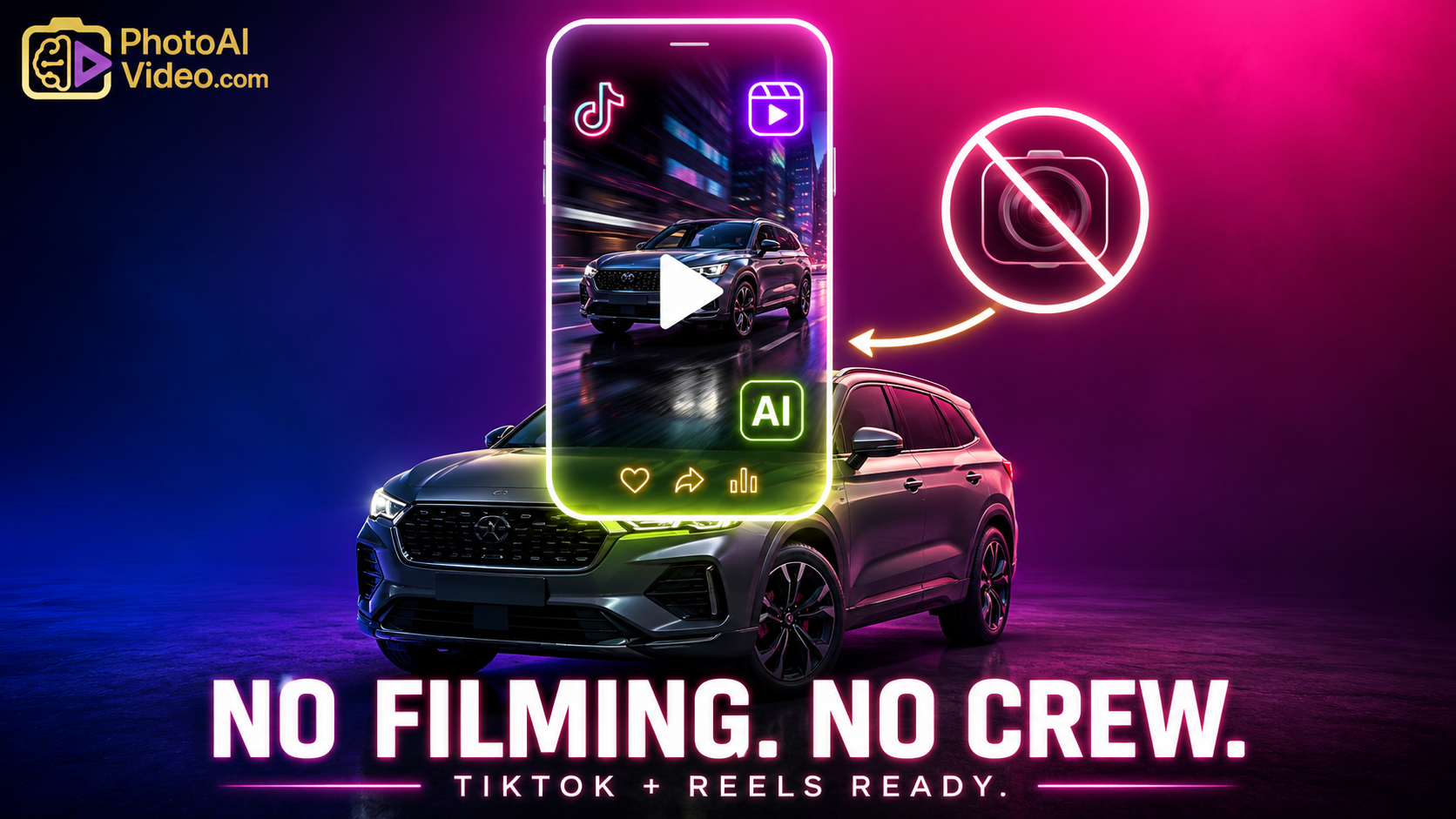
In the hyper-accelerated world of digital automotive retail, the "first look" has migrated from the physical lot to the vertical scroll of a smartphone. As consumer attention spans compress to mere seconds, static imagery is rapidly becoming a liability. However, for most dealership managers, the logistical nightmare of manually filming every VIN on the lot—dealing with weather, lot rot, and labor turnover—is a barrier to scaling.
The industry is currently witnessing a structural pivot: the move from manual production to automated content orchestration. By leveraging an AI tool to make car reels for Instagram and TikTok, forward-thinking dealerships are now able to produce cinematic walkarounds for their entire inventory without ever picking up a camera.
The transition to automated video isn't just a trend; it is rooted in buyer psychology and the Information Gain model. When a shopper sees a video, they aren't just looking at a car; they are experiencing it through "sight, sound, motion, and emotion."
According to research from McKinsey & Company, the digital-first journey is now the baseline for 80% of car buyers. High-conversion dealerships are moving away from "gallery-style" listings toward "narrative-style" listings. Automated software allows you to achieve this at scale by stitching high-quality stills into cinematic walkarounds, complete with AI-generated voiceovers and dynamic specifications.
Manual filming requires a dedicated videographer, significant hours of capture time, and high logistical coordination. Automated software, however, requires zero additional labor, pulling directly from your existing DMS and photo feeds to generate videos in under 60 seconds.
To understand how to create car walkaround videos without filming, one must understand Image-to-Video (I2V) technology. This isn't a simple slideshow; it is a neural engine that interprets 2D data and projects it into a 3D-simulated space.
The software to turn car listings into video connects directly to your Inventory Management System (e.g., vAuto, Homenet). Every time a new VIN is floor-planned and photographed, the software pulls the high-resolution stills.
One of the greatest distractions in car listings is the "lot noise"—messy backgrounds, power lines, and service bays. AI strips the background and replaces it with a clean, branded virtual studio or a professional dealership environment.
The software applies "Ken Burns" effects combined with 3D parallax. It understands the vehicle's geometry, applying cinematic pans and zooms that mimic a $5,000 drone or gimbal setup.
According to data from Harvard Business Review, consumers process visual information 60,000 times faster than text, but motion triggers a primitive orienting response that static images cannot replicate. However, TikTok and Reels demand a specific UX philosophy: Vertical, Fast-Paced, and Captioned.
Automated software ensures that the first 3 seconds of the walkaround feature a "high-dopamine" angle—usually the front 3/4 or a dramatic interior dashboard shot. This prevents the "scroll-past" and keeps engagement high.
Because 80% of users watch social video with sound on (but 20% do not), your AI tool to make car reels for Instagram must use high-fidelity neural voices to narrate the vehicle’s specific features (e.g., "Apple CarPlay," "Adaptive Cruise Control") while simultaneously displaying dynamic text overlays.
The fundamental problem with manual filming is that it doesn't scale. If a dealership group grows from one rooftop to ten, they need ten videographers. Automation, however, is a force multiplier.
Research from McKinsey & Company suggests that digital-first retail models are seeing a 15–20% increase in marketing ROI when they integrate automated video into their social funnels. By adopting a "Non-Filmed" strategy, dealerships reclaim thousands of hours in labor costs while ensuring 100% of their inventory is working to capture leads 24/7.
While automation is a superpower, it must be governed by quality standards.
For a 15-store group, manual content is impossible. By implementing an automated pipeline, the group saves $30k+ per month in labor while achieving 100% VIN coverage on social feeds.
Used cars move fast. By the time a videographer films a trade-in, it might already be sold. Automated video ensures the "speed to market" is near-instant, capturing the initial heat of the listing.
Automated video can be used to showcase service specials or "Vehicle of the Week" features, turning a static service page into an engaging media channel.
The goal of modern automotive marketing is consistency. Manual filming is inherently inconsistent. Automated walkarounds provide a "perfect" presentation 24 hours a day, regardless of the weather or staffing levels.
By leveraging AI and I2V technology, your dealership moves from being a "seller of cars" to a "provider of high-fidelity information." In the eyes of the consumer, the dealer who provides the best information wins the lead.


Compact, ready to go anywhere
Interchangeable lens that’s upgradeable
Dual 1-inch sensors for improved clarity and low light performance
Dynamic range and 6K 360° capture
360° photo resolution at 21MP

8K 360° video recording for ultra-detailed visuals.
4K single-lens mode for traditional wide-angle shots.
Invisible selfie stick effect for drone-like perspectives.
2.5-inch touchscreen with Gorilla Glass protection.
Waterproof up to 33ft for underwater shooting.

360° photo resolution in 23MP
Slim design at 24 mm thick
Built-in image stabilization for smooth video capture.
Internal 19GB storage for photo and video storage.
Wireless connectivity for remote control and sharing.

60MP 360° still images for high-resolution photography.
5.7K 360° video recording at 30fps.
2.25-inch touchscreen for intuitive control.
USB Type-C port for fast charging and data transfer.
MicroSD card slot for expandable storage.
.png)

.png)

Try it free. No credit card required. Instant set-up.






.svg)


.svg)