


.png)



Most real estate professionals approach paid traffic all wrong. They log into Meta Ads Manager, select a single flat photo of a newly listed property, slap a generic "Call Me" caption on it, and dump a couple hundred dollars into a broad geographical radius. When the budget runs dry and the lead pipeline stays empty, they blame the ad system.
The problem isn't the ad platform. The problem is that static imagery has lost its punch.
Running paid campaigns on social media has become an aggressive battle for human attention. Meta’s auction system actively monitors user behavior. If users consistently swipe past your unmoving, single-frame imagery, your quality scores tank and your cost-per-click skyrockets. According to ongoing platform breakdowns published by Meta for Business, video elements capture significantly longer user hold times and better downstream intent signals than text or graphics alone.
This leaves agents caught in a stressful production cycle. Booking a premium videography crew for every single home listing takes massive chunk out of your upfront marketing budget. Between scheduling, waiting on first drafts, and begging for edits, your listing loses its initial momentum before the first ad campaign even goes live. Wrestling with heavy, non-intuitive desktop editing software isn't an option when you need to be out closing deals. You need an automated framework to spin out cinematic, converting ad assets right from the text and images sitting inside your MLS account.
To lower your customer acquisition costs, you need to abandon the idea that creating premium video requires a physical lens. Look at your asset library. You are already paying professional real estate photographers to shoot stunning, high-resolution architectural images for your local MLS profiles. Instead of letting those premium assets sit flat on a listing portal, you need to active them into your active ad campaigns.
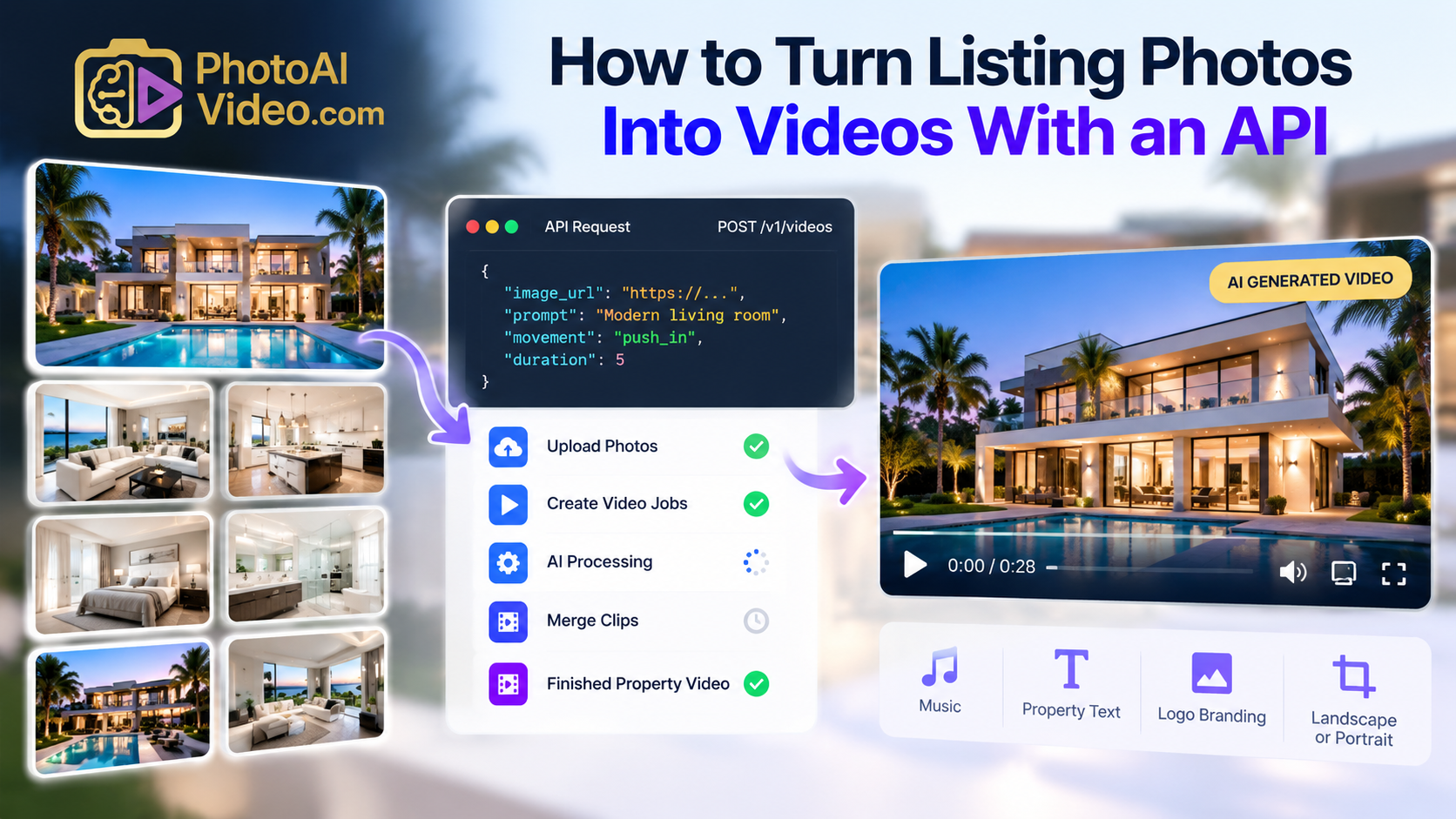
This is exactly why PhotoAIVideo.com is built. It acts as an agile, browser-based real estate video ad maker AI that removes the friction from your weekly marketing creation process. Instead of managing complex editing software timelines, you upload a single high-quality property photo.
The application handles everything in the cloud, rendering the flat file into a sweeping, cinematic 9:16 vertical video asset ready for full-screen mobile deployment. It changes the cost structure of your lead generation. Now, you can run high-performing video ads for your properties across your entire market region without draining your margins on production retainers.
Static MLS Photo: Flat, unmoving 2D frame. Rapidly skipped by social algorithms and scrolling buyers.
3D Parallax Video: Immersive depth mapping creates a sweeping cinematic camera movement instantly.
The conversion process works by altering the underlying structure of your file, not just adding a fast filter. To choose photographs that transform cleanly, it helps to look at how computer vision evaluates space.
When you slide an architecture photo into the cloud processing queue, the tool executes monocular depth mapping across the entire pixel landscape. The neural network reviews geometric lines and lighting falloff to isolate foreground spatial points—like a clean marble countertop or designer iron light fixtures—from deep background assets, such as outdoor landscaping visible through floor-to-ceiling windows.
Once the system separates the photo into distinct layered fields, it implements parallax motion. Because the immediate foreground elements move along a slightly faster camera path than the remote background data, the viewer's brain experiences accurate depth cues.
The resulting layout acts as an optimized short-form real estate video AI output that mirrors a physical slide camera. It doesn't look like a lazy digital crop or a cheap panning trick; it preserves real room scales, giving prospective buyers an authentic sense of walking through the front door.
Speed matters when you're managing multiple live listings across competitive markets. Building out an agile AI Facebook video ads for real estate pipeline means you can assemble, refine, and launch high-converting multi-stage ad sets in less time than it takes to map out your open house routes:
Consumer browsing habits are remarkably fast. Data collection tracking from the Nielsen Norman Group establishes that mobile web visitors skim visual mediums with immediate pattern recognition, dismissing standard presentation templates in a fraction of a second. Inside a paid social stream, you have exactly three seconds to hook a user's attention before they scroll past.
If your ad account kicks off with generic branding boards, slow introduction sweeps, or unmoving title frames, your audience is gone. Meta’s machine learning tools track this early drop-off rate with zero leniency. If users swipe away in under three seconds, the platform labels your ad quality as low. This forces your placement into a more expensive auction category, killing your return on investment.
An automated AI property reels software engine reverses this drop-off curve entirely. By embedding clean, three-dimensional drifting movement into the very first frame of your video, you trigger a natural tracking reflex in the human eye.
The user pauses because their brain instinctively takes a moment to process the depth shift. This visual hook holds them long enough to read your copy and interact with your call-to-action, boosting your retention metrics and lowering your lead costs.
Paid client generation requires an eye on asset lifespan. If your workflow depends on slow, heavy production pipelines, you cannot perform proper split-testing. Your campaign variants stay locked, leading to rapid audience exhaustion and decaying metrics.
By standardizing your ad design around an agile cloud engine, you can deploy distinct, creative funnels that guide prospects from passive scrolling to scheduled calls:
Scaling up your visual asset production speed is incredibly powerful, but you must still obey proper technical and presentation constraints to ensure your campaigns get approved and convert:
The real estate marketing machines securing the highest volume of qualified inbound transactions aren't winning through brute force spend. They dominate because they operate with high creative velocity—testing diverse structural options and maintaining an engaging presence while other agents wait for external editing queues to clear.
Instead of burning out over manual script tracking or draining your acquisition capital on high-cost video retainers, shift your creation tasks straight to automated cloud systems. Give your properties true dimensional scale, capture hyper-local audience blocks, and build an enduring lead engine by driving cinematic 3D motion into your standard photo portfolios.


Compact, ready to go anywhere
Interchangeable lens that’s upgradeable
Dual 1-inch sensors for improved clarity and low light performance
Dynamic range and 6K 360° capture
360° photo resolution at 21MP

8K 360° video recording for ultra-detailed visuals.
4K single-lens mode for traditional wide-angle shots.
Invisible selfie stick effect for drone-like perspectives.
2.5-inch touchscreen with Gorilla Glass protection.
Waterproof up to 33ft for underwater shooting.

360° photo resolution in 23MP
Slim design at 24 mm thick
Built-in image stabilization for smooth video capture.
Internal 19GB storage for photo and video storage.
Wireless connectivity for remote control and sharing.

60MP 360° still images for high-resolution photography.
5.7K 360° video recording at 30fps.
2.25-inch touchscreen for intuitive control.
USB Type-C port for fast charging and data transfer.
MicroSD card slot for expandable storage.
.png)

.png)

Try it free. No credit card required. Instant set-up.






.svg)


.svg)