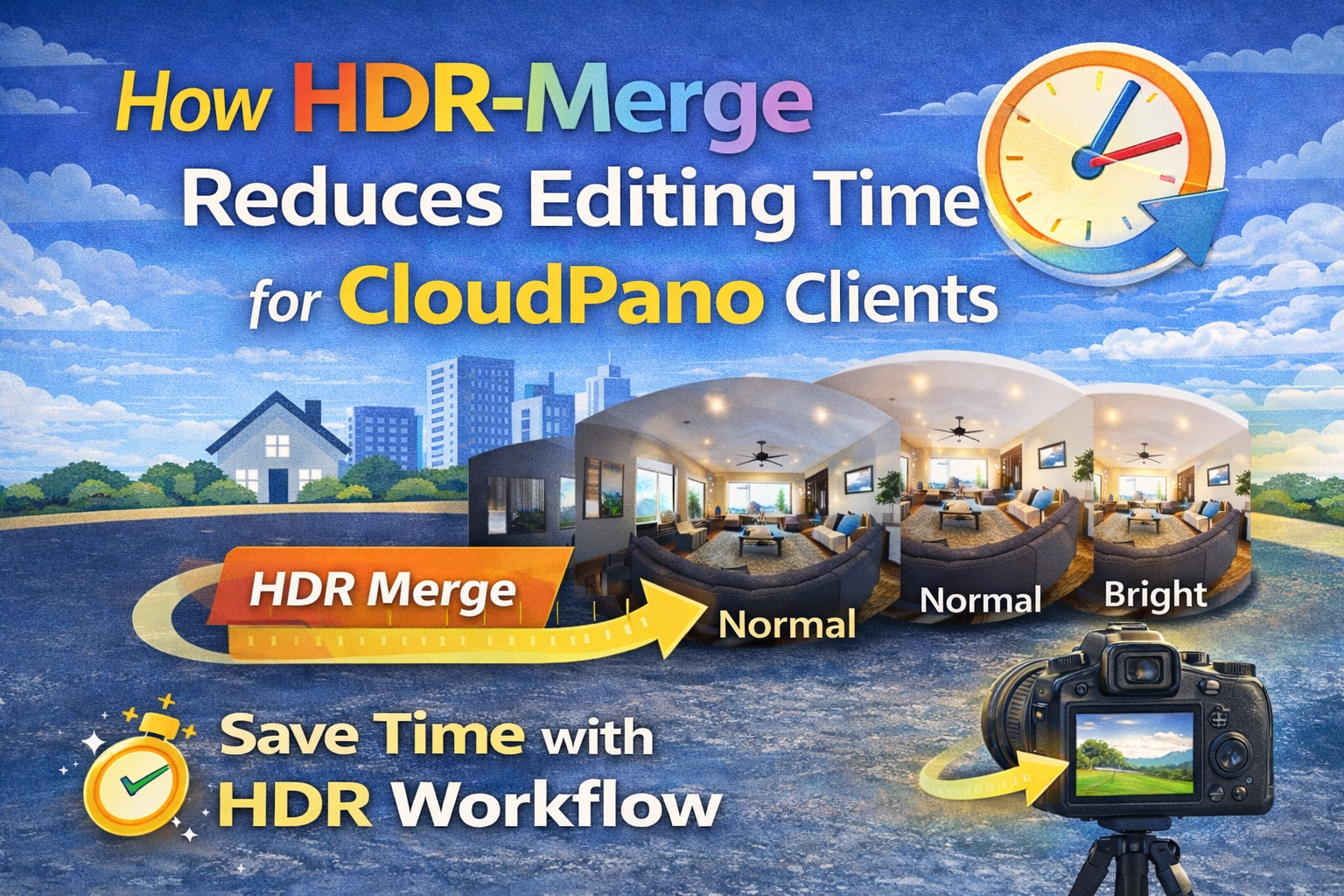
How HDR-Merge Reduces Editing Time for CloudPano Clients

Cloudpano
February 3, 2026
5 min read
Share this post

How HDR-Merge Reduces Editing Time for CloudPano Clients ⏱️📸

Speed matters in virtual tour production. Whether you’re delivering tours for real estate, hospitality, retail, or commercial spaces, clients expect fast turnaround without sacrificing quality. That’s where HDR-Merge CloudPano workflows make a huge difference.

By using a smart HDR process, photographers can dramatically Reduce Editing Time HDR while still producing bright, natural, professional panoramas. This article explains how HDR merging improves HDR Workflow Efficiency, supports scalable production, and helps streamline CloudPano HDR Editing from capture to delivery.

If you’re looking for Virtual Tour Photography Tips that save hours in post-production, this guide is for you. 🚀

Why Editing Time Is a Major Bottleneck in Virtual Tours 🖥️

Virtual tours involve more than just taking a few photos. Each space may require multiple panoramas, and each panorama often needs:

  • Exposure correction
  • Color balancing
  • Highlight recovery
  • Shadow lifting
  • Noise reduction
  • Perspective adjustments

Multiply that across an entire property or business location, and editing can quickly become the most time-consuming part of the job.

The key to speeding up delivery isn’t cutting corners — it’s improving workflow. That’s where HDR-Merge CloudPano techniques shine.

What Is HDR-Merge in Virtual Tour Photography? 🌗

HDR (High Dynamic Range) merge combines multiple exposures of the same scene into a single balanced image. Instead of choosing between bright windows or interior details, HDR blending captures both.

For virtual tours, this means:

☀️ Window views stay visible
💡 Interiors look evenly lit
🎨 Colors remain natural
🏠 Spaces feel realistic and inviting

More importantly, HDR merging reduces the need for heavy manual corrections later. That’s the foundation of Reduce Editing Time HDR strategies.
How HDR-Merge CloudPano Workflows Save Time ⏳

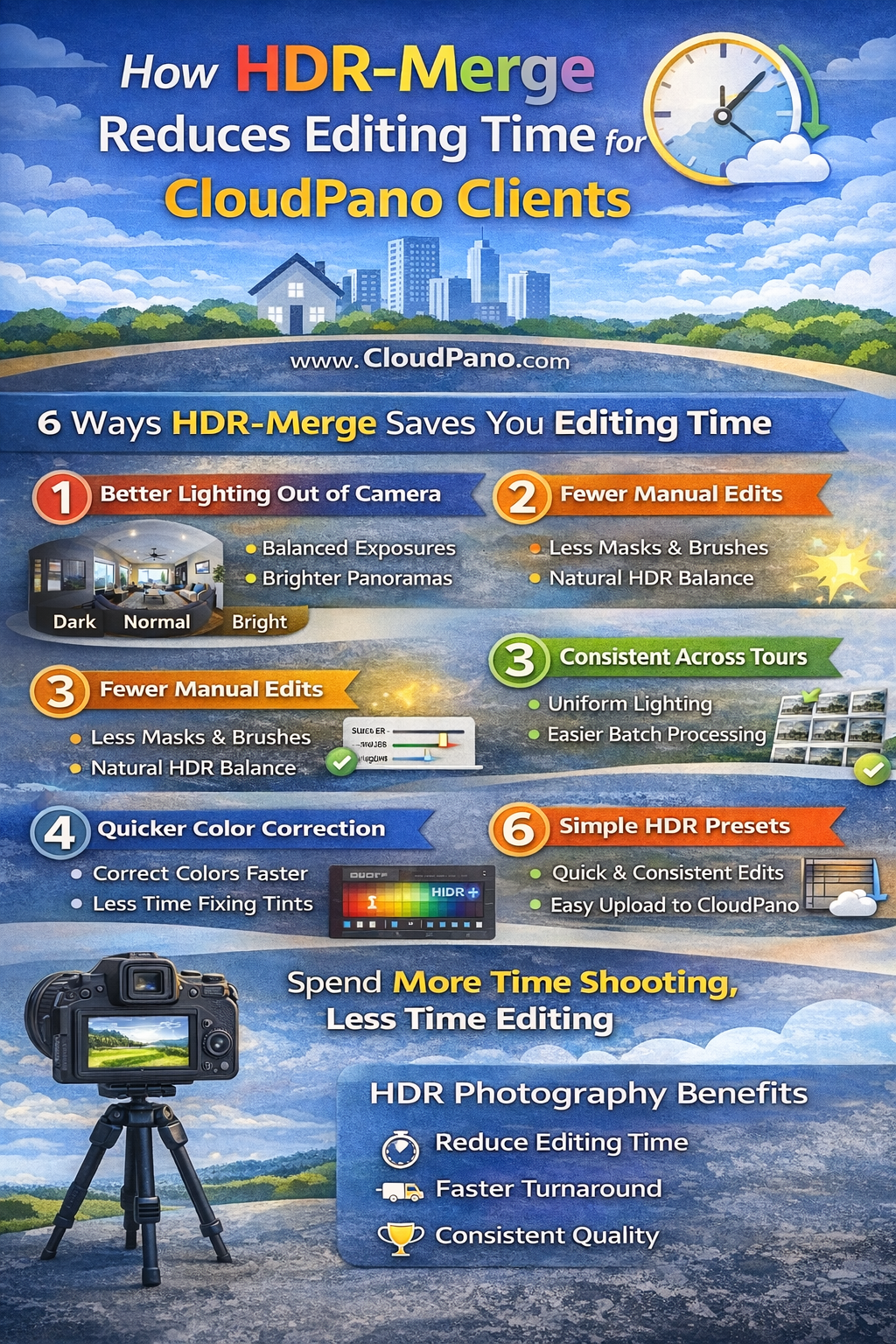
1. Better Lighting Straight Out of the Camera

When bracketed exposures are merged properly, most lighting adjustments are already handled.

Without HDR, editors often spend time:

  • Lifting dark shadows
  • Recovering blown highlights
  • Masking windows manually

With HDR-Merge CloudPano techniques, those corrections are built into the merge. This means less time pushing sliders and more time delivering finished tours.

2. Fewer Local Adjustments Needed 🎯

Manual masking and brush edits are some of the biggest time drains in photo editing.

HDR merging naturally balances:

  • Bright exterior windows
  • Dark corners
  • Uneven interior lighting

Because the dynamic range is already expanded, editors rarely need detailed local exposure fixes. That’s a major boost to HDR Workflow Efficiency.

3. Consistent Results Across Panoramas 🔄

Virtual tours often include many rooms. If lighting varies wildly between panoramas, editing becomes more complex.

HDR merging creates a more consistent base exposure across all scenes. That makes batch editing easier and helps maintain consistent brightness, contrast, and tone throughout the tour.

Consistency is a key advantage in CloudPano HDR Editing because it allows presets and synchronized adjustments to work more effectively.

4. Reduced Need for Flash Blending ⚡

Flash photography can deliver excellent results, but it often requires advanced blending techniques that take time to perfect.

HDR-Merge CloudPano workflows offer a faster alternative for most environments. Natural ambient HDR captures:

  • Balanced interior lighting
  • Clean window views
  • Realistic color tones

This reduces reliance on complex flash composites and speeds up production for high-volume virtual tour photographers.

5. Streamlined Color Correction 🎨

Color correction becomes faster when exposures are balanced from the start.

Poorly exposed images often produce color shifts that take extra time to fix. HDR merging evens out tonal ranges, making global white balance and color adjustments more effective.

This simplifies CloudPano HDR Editing and contributes to Reduce Editing Time HDR benefits.

The Role of Presets in HDR Workflow Efficiency 🧠

Once HDR panoramas are merged, they respond well to consistent editing presets.

Because lighting and exposure are already balanced, presets can handle:

  • Contrast
  • Clarity
  • Subtle color refinement
  • Sharpness

Applying presets across multiple panoramas dramatically improves HDR Workflow Efficiency. Instead of editing each image individually, photographers can batch-process entire scenes in minutes.

How HDR Improves CloudPano Upload Readiness ☁️

CloudPano is designed for smooth virtual tour creation and publishing. Clean HDR images upload faster, require fewer corrections, and display more consistently across devices.

Benefits include:

📸 Fewer re-exports
🎯 Less need for last-minute fixes
⚡ Faster turnaround to clients
🌐 Better overall Virtual Tour Image Quality

When images are prepared properly during HDR merging, the entire HDR-Merge CloudPano workflow becomes more efficient from start to finish.

Real-World Time Savings with HDR Merge ⏰

Photographers who adopt HDR merging often report:

  • Shorter editing sessions per property
  • Faster turnaround for clients
  • More time available for shooting new projects

By reducing the need for heavy corrections, HDR merges allow professionals to scale their businesses without increasing editing hours.

That’s the practical advantage of focusing on Reduce Editing Time HDR strategies.

Virtual Tour Photography Tips for Faster HDR Editing 📷

Here are a few workflow tips that maximize time savings:

Use a Tripod

Stable images merge cleaner, reducing alignment errors and ghosting fixes.

Lock White Balance

Consistent color reduces correction time later.

Shoot Enough Brackets

More exposure data means smoother merges and fewer adjustments.

Avoid Movement

Moving objects cause ghosting, which requires manual cleanup.

These Virtual Tour Photography Tips help ensure HDR merges work efficiently and predictably.

When HDR Merge Saves the Most Time 🏠

HDR workflows are especially effective in:

  • Real estate interiors with bright windows
  • Commercial spaces with mixed lighting
  • Hotels and hospitality environments
  • Retail locations with strong contrast

In these high-dynamic-range environments, HDR dramatically reduces editing complexity.

When Manual Editing May Still Be Needed 🛠️

HDR is powerful, but not perfect. Some situations may still require extra editing:

  • Extreme color casts
  • Motion ghosting
  • Strong reflections
  • Very low-light scenes

However, even in these cases, HDR merging provides a better starting point and reduces overall workload.

The Long-Term Benefits of HDR Workflow Efficiency 📈

As your business grows, efficiency becomes more valuable than ever.

An optimized HDR-Merge CloudPano process allows you to:

  • Handle more projects per week
  • Maintain consistent quality
  • Reduce burnout from long editing sessions
  • Deliver faster results to clients

Time saved in post-production can be reinvested in marketing, shooting, or client communication.

Why Clients Benefit from Faster HDR Workflows 🤝

Faster editing doesn’t just help photographers. Clients benefit too:

📅 Quicker tour delivery
🏠 Listings go live sooner
💼 Businesses update online presence faster
📈 Improved engagement from well-lit visuals

Efficient CloudPano HDR Editing supports both sides of the virtual tour process.

Final Thoughts: Work Smarter with HDR-Merge CloudPano 🎯

HDR merging isn’t just about better lighting — it’s about smarter workflow.

By using HDR techniques effectively, photographers can Reduce Editing Time HDR, improve HDR Workflow Efficiency, and streamline CloudPano HDR Editing from capture to publication.

The formula is simple:

📷 Capture clean bracketed exposures
🌗 Merge naturally for balanced lighting
🎨 Apply light, consistent edits
☁️ Upload smoothly to CloudPano

Follow this approach and you’ll spend less time behind a screen — and more time growing your virtual tour business.

🚀 Your All-In-One Virtual Experience Stack Starts Here

Share this post
Cloudpano

Choose The Right 360° Camera

Insta360 ONE RS 1-Inch 360 Edition

  • Compact, ready to go anywhere

  • Interchangeable lens that’s upgradeable

  • Dual 1-inch sensors for improved clarity and low light performance

  • Dynamic range and 6K 360° capture

  • 360° photo resolution at 21MP

Learn More

Insta360 X4

  • 8K 360° video recording for ultra-detailed visuals.

  • 4K single-lens mode for traditional wide-angle shots.

  • Invisible selfie stick effect for drone-like perspectives.

  • 2.5-inch touchscreen with Gorilla Glass protection.

  • Waterproof up to 33ft for underwater shooting.

Learn More

Ricoh Theta Z1

  • 360° photo resolution in 23MP

  • Slim design at 24 mm thick

  • Built-in image stabilization for smooth video capture.

  • Internal 19GB storage for photo and video storage.

  • Wireless connectivity for remote control and sharing.

Learn More

Ricoh Theta X

  • 60MP 360° still images for high-resolution photography.

  • 5.7K 360° video recording at 30fps.

  • 2.25-inch touchscreen for intuitive control.

  • USB Type-C port for fast charging and data transfer.

  • MicroSD card slot for expandable storage.

Learn More
Property Marketing
Allows potential buyers to explore properties in detail from anywhere, enhancing the real estate marketing process.
Automotive Spins
Create an interactive virtual showroom and engage affluent digital buyers with live 360º video calls, all through the CloudPano mobile app for a complete automotive sales solution.
Interactive Floor Plans
Create 2D and 3D floor plans with measurements in 4 minutes or less, all from your phone. Download the Floor Plan Scanner app and get your first scan free.

360 Virtual Tours With CloudPano.com. Get Started Today.

Try it free. No credit card required. Instant set-up.
Try it free
Latest posts

See our other posts

Interviews, tips, guides, industry best practices, and news.

Property Manager Video Hub: Scaling Rental Visibility with AI Photo-to-Video Workflows

This article explains how property managers can use PhotoAIVideo to build a property manager video hub: a repeatable system for turning rental photos, amenity images, floor plans, exterior shots, and neighborhood visuals into reusable rental marketing videos. The main idea is that property managers do not just need more listing exposure. They need clearer visual answers that help renters decide whether to schedule a tour. PhotoAIVideo is positioned as a practical tool for creating: Unit availability videos Amenity highlight videos Neighborhood videos Tour reminder clips Leasing follow-up videos Owner marketing proof videos Social media rental teasers Application or availability reminder videos Key takeaways: Property managers already have the media they need; the challenge is organizing it and turning it into reusable video assets. A video hub helps teams create consistent videos across units, floor plans, amenities, communities, and owner updates. Rental videos can reduce friction by answering renter questions about layout, condition, amenities, parking, pet features, and community feel. One rental photo set can become multiple video outputs for listings, social media, email, text follow-up, tour reminders, and owner reporting. Photographers can sell AI rental video packages to property managers as an upsell. Brokerages with property management divisions can use the same workflow to standardize leasing content. The article ends with a step-by-step process, video hub framework, mistakes to avoid, visual recommendations, FAQs, and a CTA encouraging readers to use PhotoAIVideo to turn rental photos into a scalable video system for rental visibility.
Read post

YouTube Shorts Listing Teasers: The 3-Scene Structure for Higher Property Clicks

This article explains how real estate agents, photographers, brokerages, and property managers can use YouTube Shorts listing teasers to drive more property clicks and showing requests. The main idea is that a YouTube Short should not try to show the entire house. Instead, it should use a simple 3-scene structure: Scene 1: Hook — stop the scroll with the strongest property feature. Scene 2: Proof — show the visuals that support the hook. Scene 3: Click Path — tell the viewer what to do next. The article positions PhotoAIVideo as a practical tool for turning listing photos into short vertical videos for YouTube Shorts, Reels, open house promotion, and listing campaigns. Key takeaways: YouTube Shorts should create curiosity, not replace the full listing video. The strongest property feature should appear first, not necessarily the front exterior. Agents should build each Short around one click reason, such as backyard, kitchen, layout, neighborhood, open house, or price point. One listing can become multiple Shorts instead of one generic video. Photographers can offer YouTube Shorts teaser packs as a video upsell. Brokerages can standardize the 3-scene structure across agents. Property managers can use the same structure to promote rentals and tours. The article ends with practical scripts, visual recommendations, FAQs, a visual placement guide, and a CTA encouraging readers to use PhotoAIVideo to create YouTube Shorts listing teasers from property photos.
Read post

Video Retargeting for Listings: Turning Photo-Based AI Videos into Appointment Follow-Up

This article explains how Realtors, photographers, brokerages, and property managers can use photo-based AI videos as follow-up assets after someone shows interest in a listing. The main idea is that most real estate marketing focuses on getting the first click, but many buyers and sellers need multiple touchpoints before booking a showing or appointment. Video retargeting helps agents re-engage people who already clicked a listing, watched a Reel, opened an email, attended an open house, asked about a property, or went quiet after showing interest. PhotoAIVideo is positioned as a practical tool for turning listing photos into short follow-up videos, including: Feature reminder videos Layout explainer videos Neighborhood fit videos Open house recap videos Price update videos Seller proof videos Showing request videos Rental tour recovery videos Key takeaways: A first-touch listing video introduces the property, while a retargeting video answers the next likely question. Follow-up videos should be short, usually 10–30 seconds, and focused on one action. Agents should send different videos based on behavior, such as email clicks, open house attendance, listing views, or showing interest. A good video follow-up feels helpful, not pushy. Photographers can package retargeting video clips as an upsell. Brokerages can standardize video retargeting workflows across agents. Property managers can use the same strategy to recover rental leads and book tours. The article ends with a simple retargeting sequence, visual recommendations, FAQs, and a CTA encouraging readers to use PhotoAIVideo to turn listing photos into appointment-driving follow-up videos.
Read post