


.png)


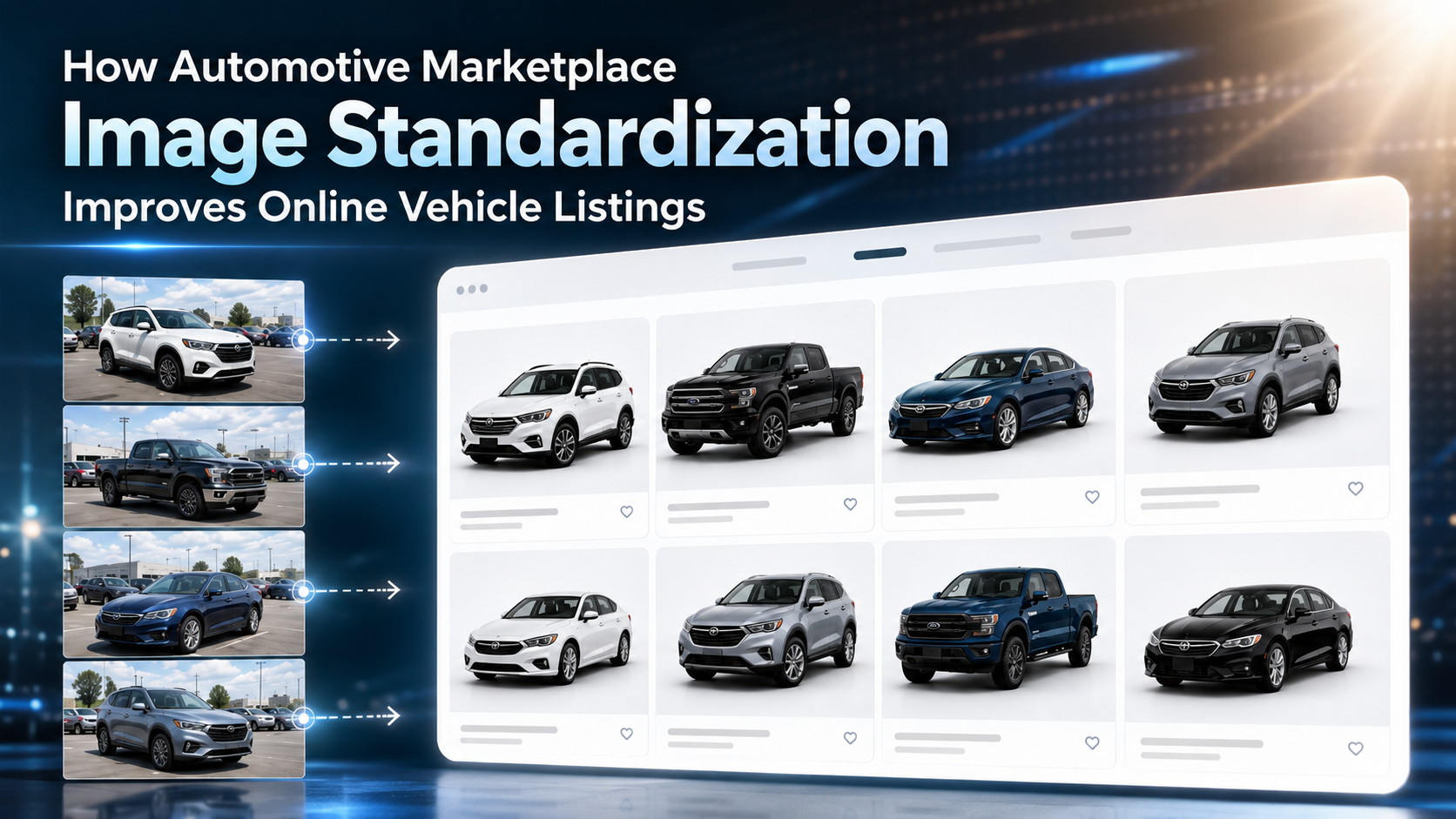
Online vehicle shoppers often make their first decision before reading a description, checking the mileage, or comparing financing options.
They look at the photos.
For dealerships, automotive marketplaces, auctions, and vehicle listing platforms, that makes image quality more than a design concern. Photography directly affects how inventory is presented, how quickly shoppers can evaluate vehicles, and how consistent a marketplace feels from one listing to the next.
The challenge is that vehicle images rarely arrive in a standardized format.
One dealership may photograph vehicles outdoors on a crowded lot. Another may use a photo booth. A third may have employees capture inventory with smartphones throughout the day. Backgrounds, lighting, vehicle position, image dimensions, camera angles, and resolution can all vary.
Automotive marketplace image standardization creates a more consistent presentation by transforming those different source images into marketplace-ready assets using defined visual rules.
Instead of requiring every dealership to capture perfect photography, a marketplace can improve much of the presentation after images are uploaded.
The result is cleaner inventory pages, more predictable listing layouts, and a better visual experience for shoppers.
Automotive marketplace image standardization is the process of applying consistent visual requirements to vehicle photos before they appear on a marketplace, dealer website, vehicle detail page, advertising platform, or inventory feed.
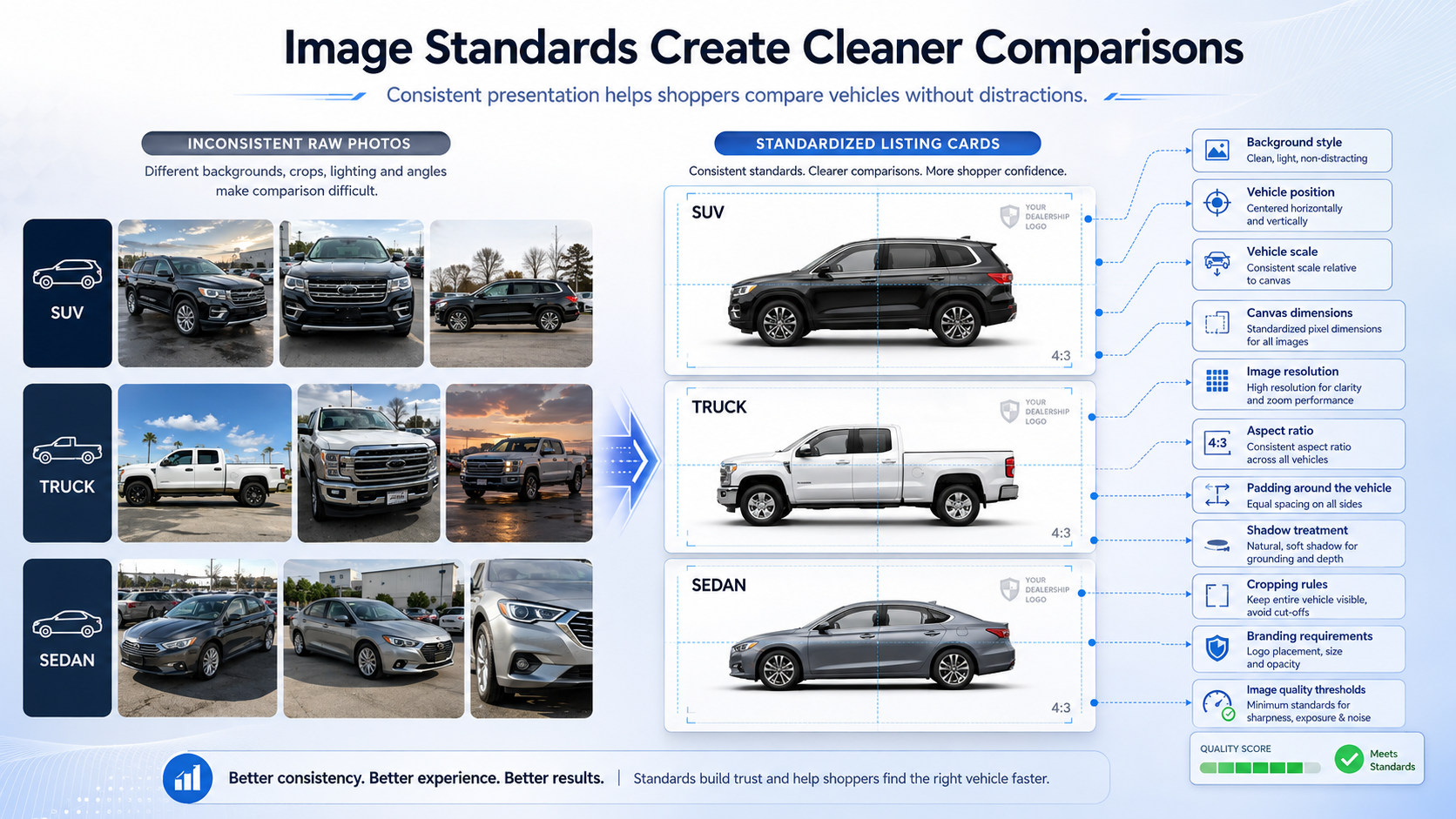
These standards can define elements such as:
The goal is not necessarily to make every photograph identical.
It is to create enough consistency that vehicles can be compared without unnecessary visual distractions.
A shopper looking at ten SUVs should feel like those vehicles belong in the same shopping experience, even when the original photography came from ten different dealerships.
Automotive inventory photography happens in real-world environments.
That means conditions change constantly.
A dealership may photograph one vehicle on a sunny morning and another during an overcast afternoon. Cars may be positioned differently depending on available parking space. Employees may use different phones, cameras, focal lengths, or photography techniques.
The background can also change dramatically.
A source photo might contain:
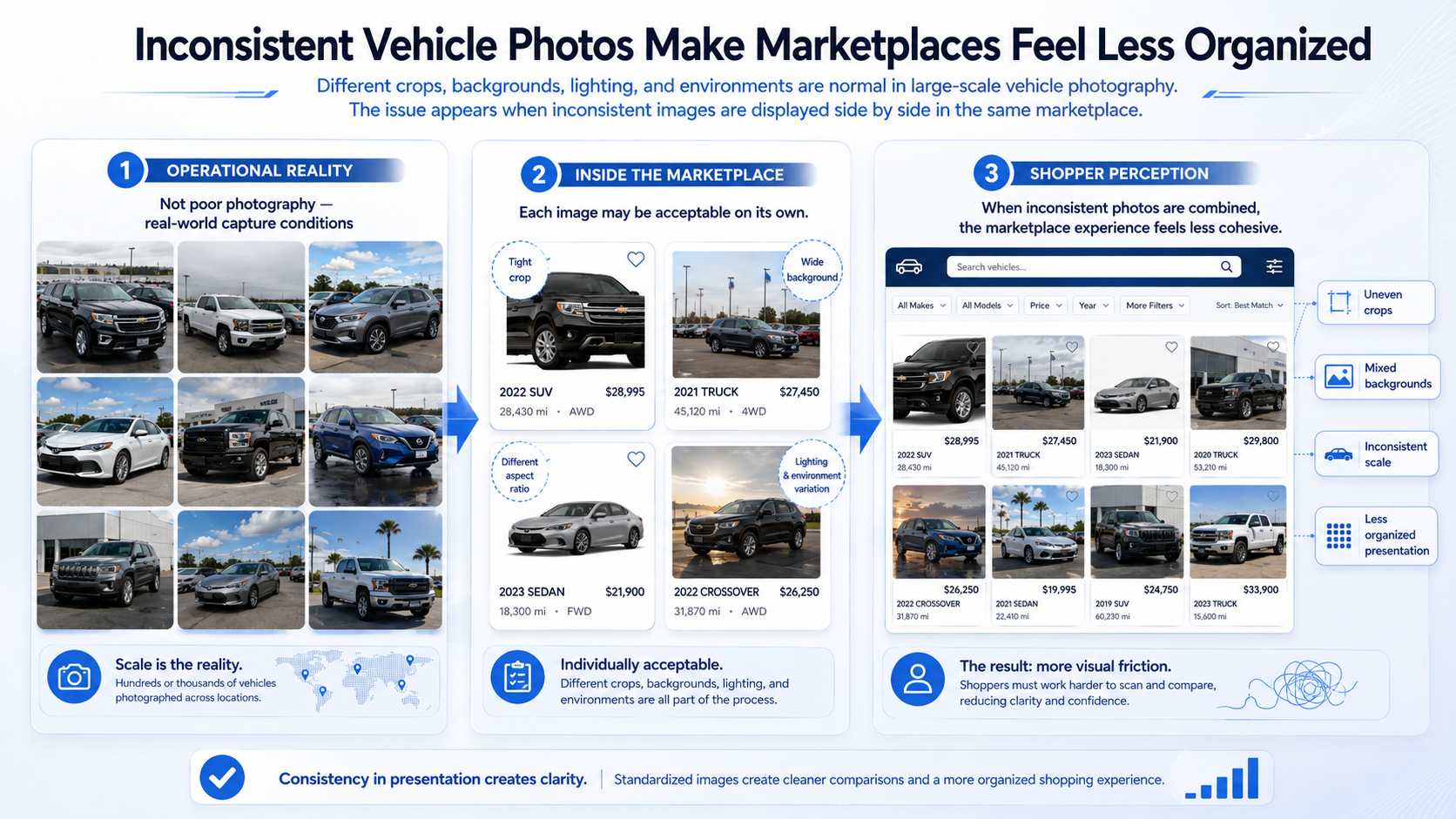
None of these details necessarily indicate poor photography.
They simply reflect the reality of photographing hundreds or thousands of vehicles in operational environments.
The problem appears when those inconsistent images are combined inside a marketplace.
One listing may show a tightly cropped vehicle against a white background while the next shows a small vehicle surrounded by a busy parking lot.
That inconsistency can make the marketplace itself feel less organized.
Vehicle marketplaces are comparison environments.
Shoppers rarely examine only one vehicle.
They may open several listings, compare trims, switch between similar models, filter by price, or move between dealerships.
Consistent photography reduces unnecessary visual differences between those listings.
When vehicles occupy approximately the same amount of space in each image, shoppers can more easily compare:
Instead of being distracted by differences in photography, the shopper can concentrate on differences between the vehicles themselves.
This is one of the most important benefits of automotive marketplace image standardization.
The photography becomes part of the interface rather than competing with it.
Busy dealership backgrounds can contain significant visual noise.
Imagine two identical trucks.
One is photographed beside several parked cars, a light pole, a dealership sign, and a service entrance.
The other appears against a clean neutral background with a subtle natural shadow.
The vehicle itself has not changed.
The presentation has.
Background processing allows marketplaces to reduce distractions while preserving the original vehicle.
Depending on the platform's merchandising strategy, a standardized background might be:
There is no single background that is correct for every marketplace.
The important part is consistency.
A standardized background system gives the marketplace control over presentation instead of allowing the original photography location to determine the appearance of every listing.
Background replacement alone does not solve every problem.
Vehicle position matters too.
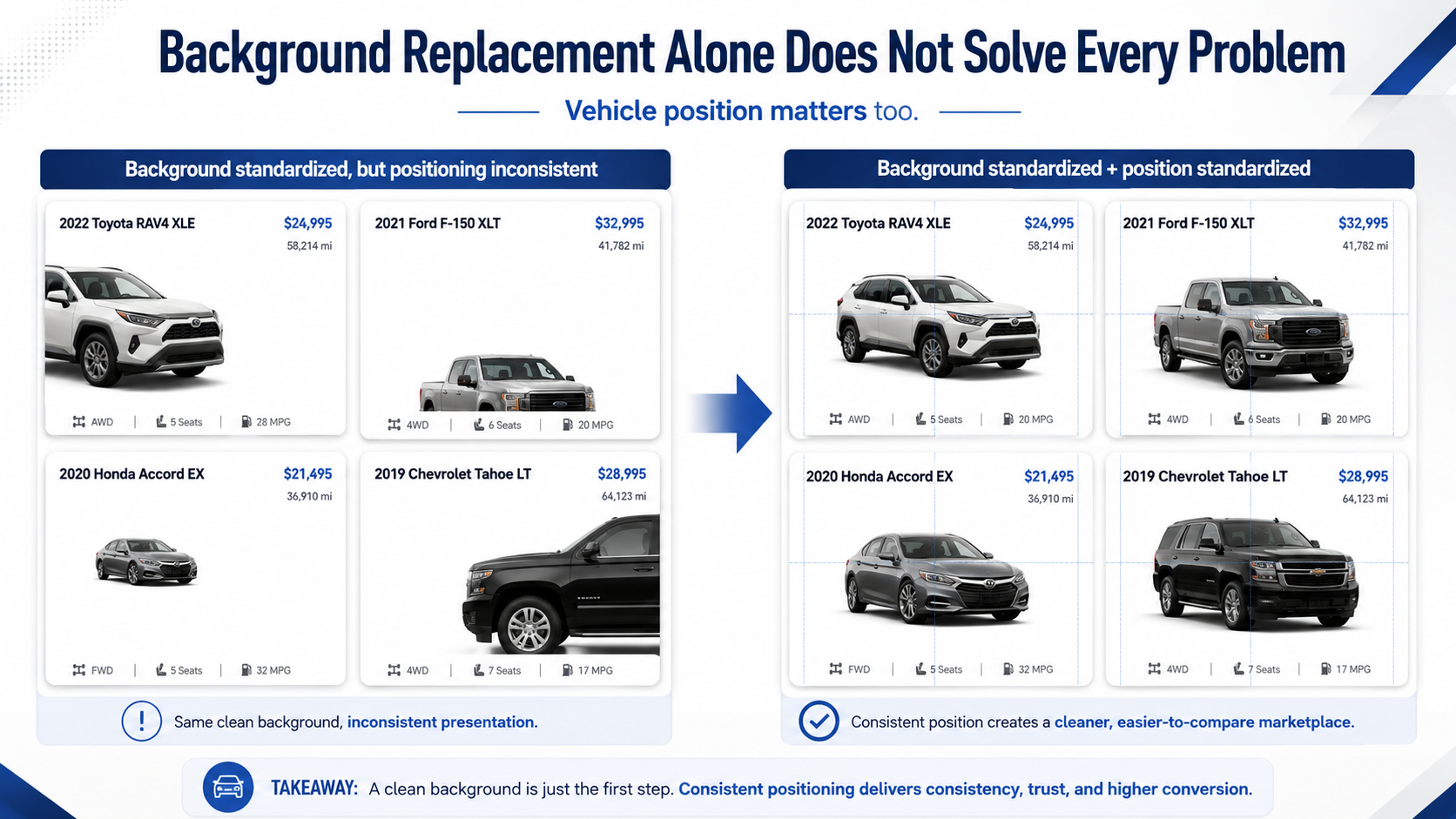
Some source images may place the vehicle near the left edge of the frame. Others may contain excessive empty space. A photographer may capture one vehicle close to the camera and another farther away.
Automated processing can detect the vehicle and reposition it inside a standardized canvas.
For example, a marketplace might define that the vehicle should:
These rules create more predictable thumbnails and hero images.
When customers scroll through inventory, vehicles appear more visually aligned instead of jumping around from card to card.
That small interface improvement becomes significant when a marketplace displays thousands or millions of listings.
A vehicle can technically be centered while still looking inconsistent.
If one SUV fills 85% of the image and another fills only 45%, the listings will still feel visually uneven.
Standardization can apply a target vehicle scale based on the detected vehicle boundaries.
The platform might determine how much of the canvas a vehicle should occupy while maintaining enough padding around important exterior features.
This is especially useful for marketplaces processing photography from many different sources.
The system can normalize differences caused by:
Instead of manually training every photographer to frame vehicles identically, the marketplace can correct many of those differences automatically.
A single vehicle image may eventually appear in many places.
The original photo might need to support:
Each destination may prefer a different image format.
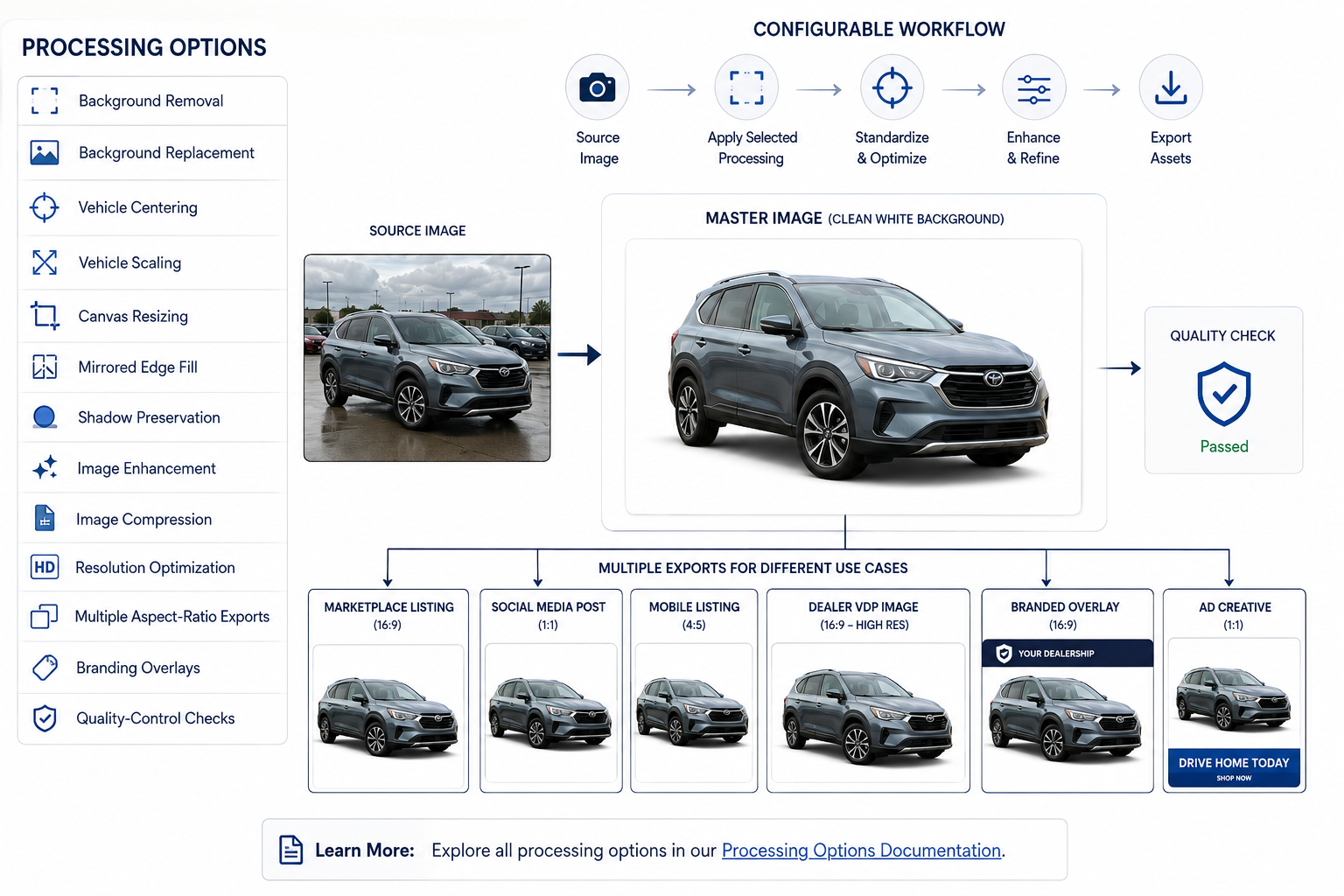
A strong automotive marketplace image standardization workflow can preserve a clean master image and generate multiple approved derivatives.
For example:
Useful for vehicle detail pages, website galleries, and desktop inventory displays.
Useful for certain marketplace grids, ad placements, and social platforms.
Useful for mobile-first advertising and social content.
Optimized for fast-loading inventory search pages.
Instead of repeatedly editing the same photo for different channels, the marketplace can generate the required formats automatically.
A marketplace does not need to apply every image transformation to every vehicle.
Different inventory programs may require different levels of processing.
This is where configurable processing options become valuable.
A marketplace might offer processing rules for:
This flexibility allows the same image-processing infrastructure to support different use cases.
For example, a marketplace could generate a clean white-background master for its primary listing while creating a square image for advertising and a high-resolution landscape version for the dealer's VDP.
Platforms building automated workflows should define these processing options before scaling implementation.
Internal link opportunity: Link this section to your Processing Options documentation so technical teams, marketplace operators, and dealership partners can explore the available image-processing configurations in greater detail.
Manual photo editing may work when processing a small number of vehicles.
It becomes difficult when inventory grows.
Consider a marketplace receiving images for:
Each vehicle may contain 20, 30, 40, or more photographs.
At that scale, manually cropping, centering, resizing, and replacing backgrounds becomes an operational bottleneck.
Automated processing allows visual standards to become infrastructure.
Instead of asking someone to review every image manually, software can apply predefined rules immediately after upload.
The workflow might include vehicle detection, background segmentation, positioning, scaling, resizing, and automated quality checks before the final assets are published.
Human review can then focus on exceptions rather than every image.
Marketplaces often receive inventory from dealerships using different photography systems.
Strict capture requirements can create friction.
If a platform requires every dealership to purchase specific cameras, build photo booths, change its photography workflow, or retrain employees, onboarding becomes more difficult.
Post-capture processing provides another approach.
Dealers can continue using relatively familiar photography workflows while the marketplace standardizes the resulting images.
The marketplace still needs minimum capture standards, of course.
A severely blurred image, partially photographed vehicle, or extremely low-resolution source cannot always be repaired automatically.
But the marketplace may no longer need every dealership to produce identical finished photography.
That distinction can make expansion easier.
A marketplace's visual identity is influenced by the inventory displayed inside it.
If every listing has drastically different photography, the brand experience becomes fragmented.
Consistent image treatment creates a more controlled environment.
That does not necessarily mean adding large logos, promotional graphics, or watermarks.
In many cases, the strongest marketplace presentation is simply a clean vehicle image with predictable spacing, scale, and background treatment.
Brand consistency can come from restraint.
A marketplace can maintain a standardized visual system while allowing the vehicle to remain the primary subject.
Automation does not eliminate the need for quality control.
It changes where quality control happens.
Instead of manually editing every photo, marketplaces can define conditions that trigger review.
Examples might include:
Images that pass the automated checks can continue through the publishing workflow.
Images that fail can be routed for review.
This type of exception-based workflow is usually more scalable than treating every image as a manual editing project.
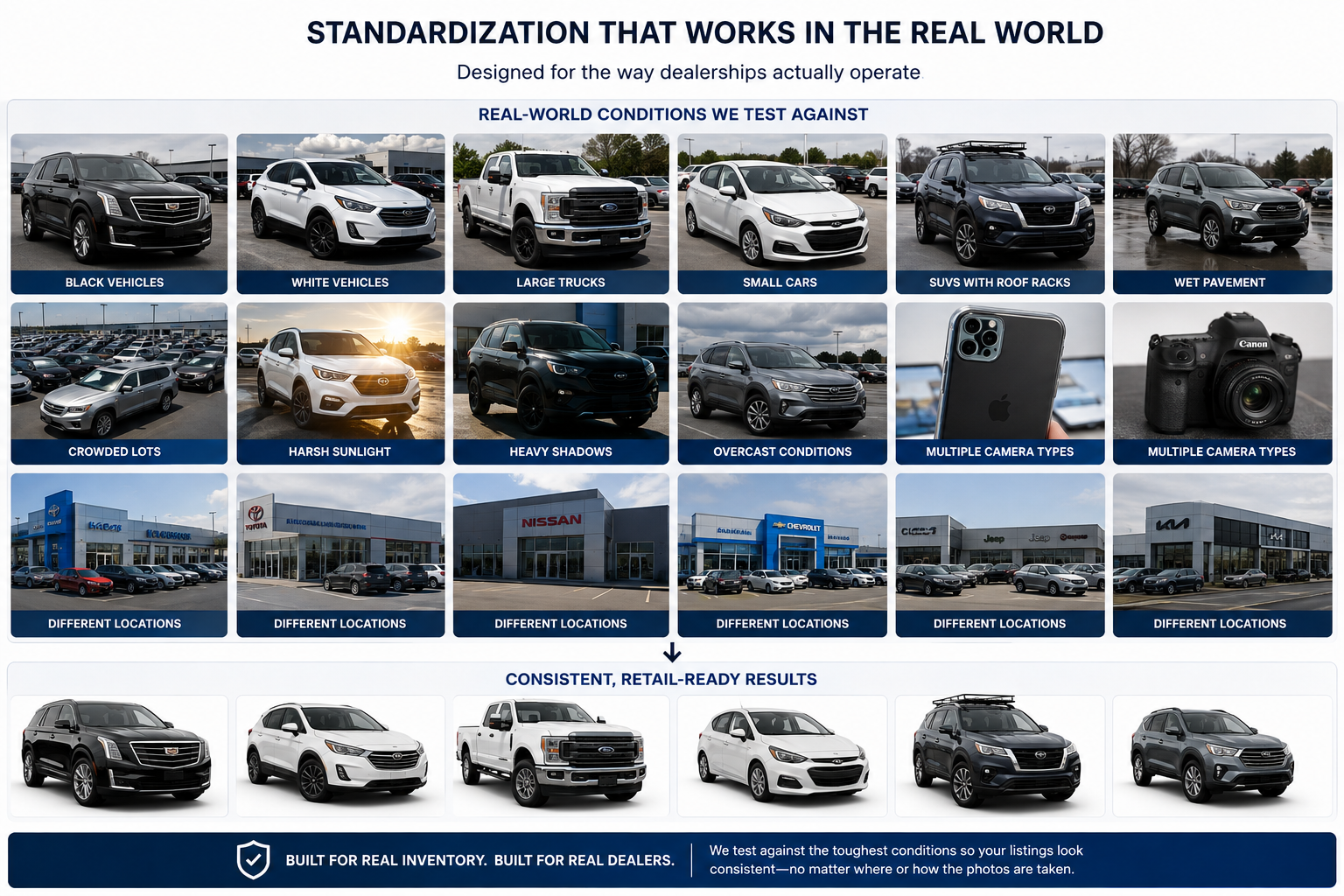
A processing standard should not be designed only around perfect example images.
Real dealership inventory is messy.
Before deploying automotive marketplace image standardization at scale, test the workflow against difficult photography.
Test:
A standard that performs well only in ideal conditions will struggle once deployed across a large dealer network.
The strongest systems are designed around the environments dealerships actually operate in.
The biggest opportunity goes beyond making vehicle photos look better.
Standardized imaging can become part of the marketplace's underlying merchandising infrastructure.
Once the platform understands where the vehicle is located inside an image, it can create assets for multiple downstream workflows.
That can support:
One source photograph can become a reusable asset rather than a single fixed image.
That is where standardization becomes especially powerful.
Vehicle photography does not need to come from identical studios to produce a consistent marketplace experience.
With the right processing workflow, marketplaces can accept photography from different dealerships, cameras, employees, and environments while still creating predictable retail-ready assets.
Automotive marketplace image standardization can help remove distracting backgrounds, normalize vehicle position, control scale, generate channel-specific aspect ratios, improve inventory presentation, and automate work that would otherwise require extensive manual editing.
Most importantly, it shifts image consistency from a dealership-by-dealership responsibility into a scalable marketplace system.
As automotive shopping continues moving toward digital-first experiences, the platforms that treat vehicle imagery as infrastructure—not merely uploaded photos—will have more control over how inventory is presented across every channel.
If your marketplace, dealer network, or automotive platform processes large volumes of vehicle photography, now is the time to define your image standards and build them directly into the workflow.
Explore the available Processing Options to see how automated vehicle image processing can transform inconsistent source photography into clean, standardized, retail-ready assets at scale.


Compact, ready to go anywhere
Interchangeable lens that’s upgradeable
Dual 1-inch sensors for improved clarity and low light performance
Dynamic range and 6K 360° capture
360° photo resolution at 21MP

8K 360° video recording for ultra-detailed visuals.
4K single-lens mode for traditional wide-angle shots.
Invisible selfie stick effect for drone-like perspectives.
2.5-inch touchscreen with Gorilla Glass protection.
Waterproof up to 33ft for underwater shooting.

360° photo resolution in 23MP
Slim design at 24 mm thick
Built-in image stabilization for smooth video capture.
Internal 19GB storage for photo and video storage.
Wireless connectivity for remote control and sharing.

60MP 360° still images for high-resolution photography.
5.7K 360° video recording at 30fps.
2.25-inch touchscreen for intuitive control.
USB Type-C port for fast charging and data transfer.
MicroSD card slot for expandable storage.
.png)

.png)

Try it free. No credit card required. Instant set-up.






.svg)


.svg)