


.png)


AI is changing real estate video editing by automating tasks such as camera-style motion, transitions, pacing, branding, voiceovers, and multi-format exports. This allows agents and photographers to turn existing listing photos into polished property videos faster, while traditional videography remains valuable for live walkthroughs and highly customized productions.
Not long ago, adding video to a listing often meant booking a videographer, scheduling a shoot, and paying an editor to turn the footage into something polished enough to publish. For solo agents and smaller teams, the additional time and expense could make video difficult to justify for every property.
Real estate video editing has since undergone a significant shift, and one of the technologies driving that change isn't a cheaper camera—it's artificial intelligence.
Today, agents can use the same still photos they already have for a listing to create a branded walkthrough-style video without organizing a separate video shoot. Platforms like PhotoAIVideo are built around this idea: automate much of the technical production work so agents can spend less time editing and more time marketing their listings. PhotoAIVideo's current tools include AI-generated camera motion, branding, multiple export formats, and, on eligible plans, AI voiceovers.
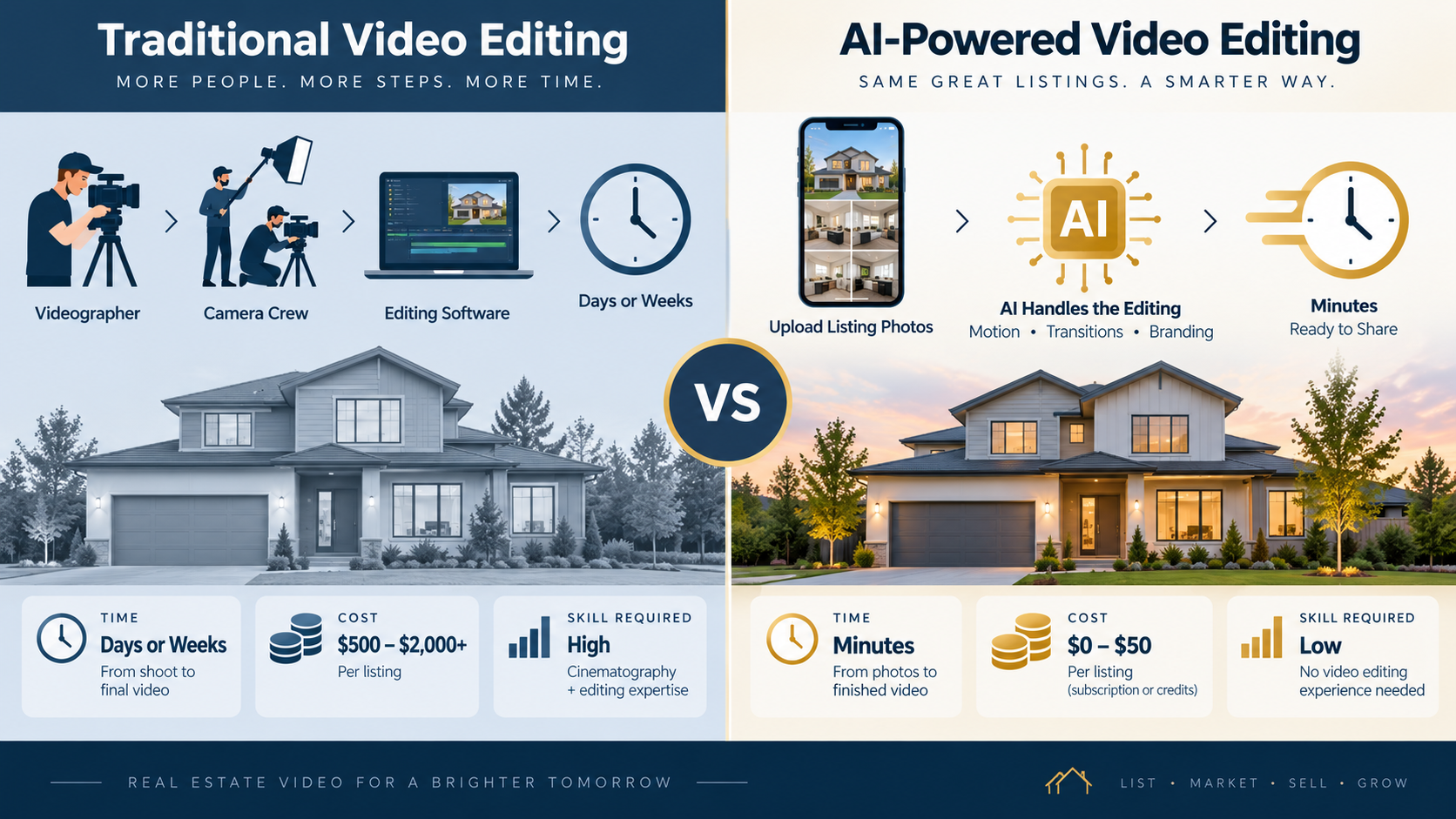
Traditional real estate video editing is a craft with a learning curve. Someone has to import footage, trim clips, correct colors, add music, create transitions, layer in text or branding, and export the finished video in the appropriate format.
And that's after the property has already been filmed.
AI-powered photo-to-video tools change what "editing" can mean in this context. Instead of starting with raw video clips, these platforms can begin with the photos an agent already has and apply motion to them.
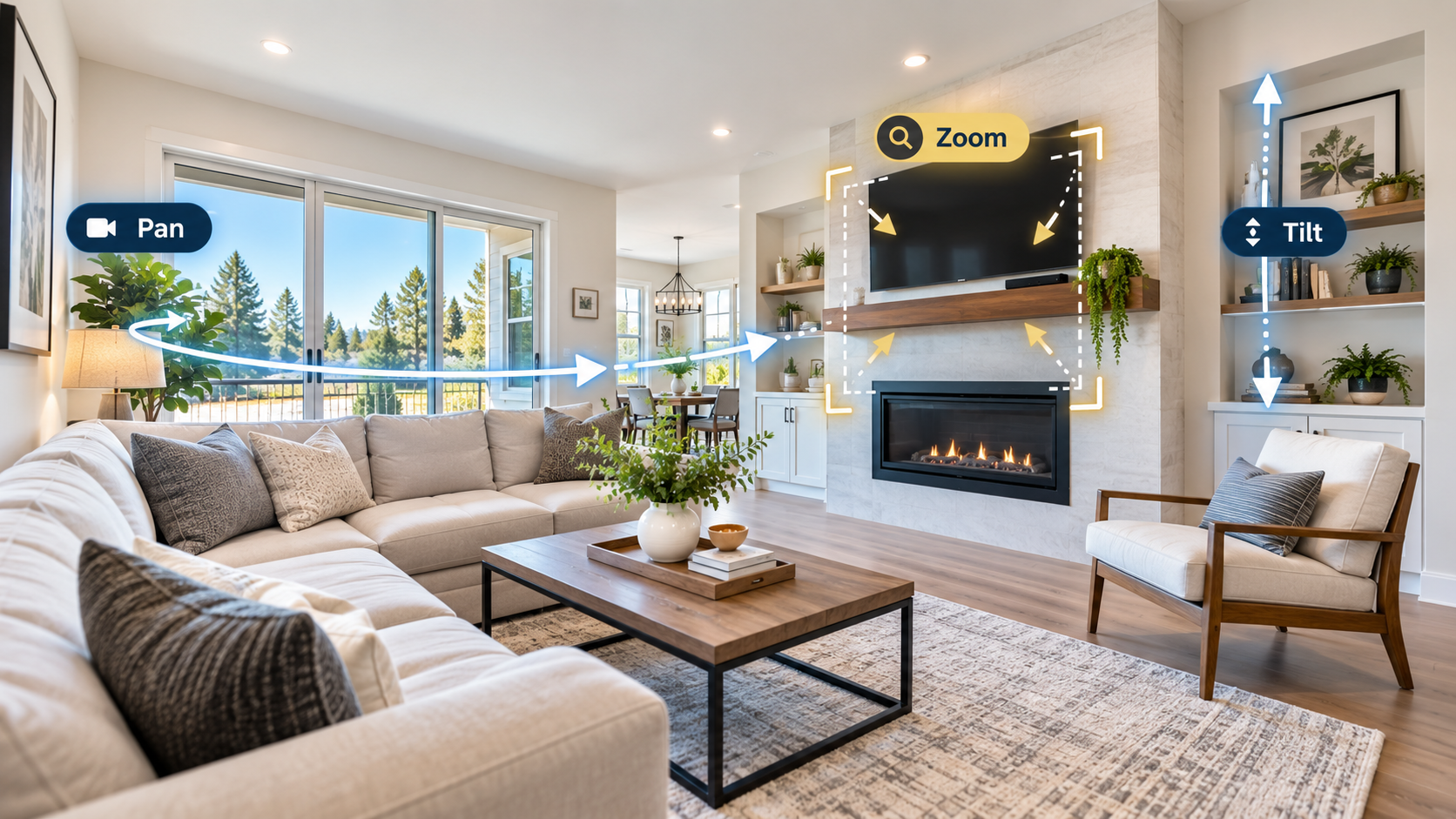
A slow pan across a kitchen island, a gentle zoom into a primary bedroom, or a subtle push into a living space can give a still image a greater sense of movement and depth. PhotoAIVideo, for example, demonstrates how standard listing photos can be transformed into cinematic-style property videos without a separate film shoot.
These effects don't replace actual camera movement in every situation, but they offer another way to turn existing listing photography into dynamic marketing content.
This matters because prospective buyers increasingly begin their home search online. According to Zillow's Consumer Housing Trends Report, 94% of surveyed buyers used at least one online resource—such as a website, mobile site, or app—when searching for a home.
Photos remain essential, but video provides another format for presenting a property and guiding viewers through its spaces. AI has made creating that additional content more accessible to agents who may not have the time, equipment, or budget for a separate video production.
It's worth breaking down what's being automated because "AI video" can otherwise sound like a vague catch-all.
Depending on the platform and features available, AI-powered real estate video tools can automate several tasks that traditionally required manual production:
Tasks that once required a combination of cinematography, editing, graphic design, narration, and social media formatting can increasingly be handled within a more streamlined workflow.
The practical impact of this shift comes down to two things agents care about: time and money.
Traditional video production involves multiple stages. A property needs to be scheduled and filmed, footage needs to be transferred and edited, and the finished video may need to go through review and revisions.
AI-generated photo-to-video content removes the separate filming stage. Once listing photography is available, agents can move directly into video generation and customization.
The exact amount of time saved will depend on the platform, number of photos, processing requirements, and amount of customization or revision involved. PhotoAIVideo currently advertises some listing-video generations from photos in under three minutes, although actual production time can naturally vary depending on the project and workflow.
Cost can follow a similar pattern.
Professional videography typically involves per-property production expenses, while AI-driven tools may use subscription or credit-based pricing. This can make it easier to incorporate video across a larger number of listings rather than reserving it only for properties with larger marketing budgets.
Agents considering this approach can review PhotoAIVideo's current pricing and plans and compare those costs with their existing video-production workflow. PhotoAIVideo currently offers Free, Creator, Pro, and custom Enterprise options, with different project limits and feature sets.
Perhaps one of the most meaningful changes isn't technical at all—it's about access.
Creating polished listing video once required either production skills or the budget to hire someone who had them. AI-powered tools lower that barrier by allowing agents to start with assets they already have.
For a solo agent, that can mean adding video to more listings without coordinating a separate production team.
For real estate photographers, photo-to-video technology can provide an opportunity to expand their services beyond still photography by offering video generated from the same listing images.
For brokerages and teams, automation can make it easier to create a more consistent visual approach across listings without requiring every individual agent to become a video editor. PhotoAIVideo, for example, currently offers team collaboration and custom branding capabilities for higher-volume workflows.
That scalability can be particularly useful in a housing market where conditions change over time. The Redfin Data Center tracks metrics ranging from home prices and sales to price drops, cancellations, financing trends, and regional market conditions, illustrating just how dynamic housing markets can be.
A more streamlined production workflow gives agents and marketing teams greater flexibility to create and update visual content as needed.
For all that's changed, it's important to recognize the limitations.
AI photo-to-video generation can create polished, consistent content from still photography, but it isn't a complete replacement for every kind of real estate video.
A highly customized creative concept—a director's specific artistic choices, an unconventional narrative structure, or a video built around a property's unique architecture—may still benefit significantly from human creative direction and purpose-shot footage.
Live-action walkthroughs are another example.
A video showing an agent physically walking through a property, interacting naturally with the space, or presenting features on location requires actual filmed footage. AI avatars and generated voiceovers can provide another presentation option, but they're not the same as filming a real person inside the property.
For some luxury, architectural, or lifestyle-focused listings, traditional production may therefore remain the better choice.
The practical approach doesn't have to be AI or traditional videography. Agents can use AI-powered production when speed, consistency, and scalability are the priority, while reserving traditional or hybrid production for listings that benefit from a more customized creative approach.
AI video technology continues to evolve, and several areas are likely to improve further.
Simulated camera movements may become more natural and responsive to the architecture and composition of individual images. Automated pacing may become better at adapting to different rooms and property types rather than relying on broadly similar sequences.
AI-generated voiceovers and avatars are also likely to become increasingly natural, while branding and personalization tools may give brokerages greater control over maintaining consistent visual standards across teams.
At the same time, the distinction between automated and traditionally produced video may become less important to agents than the practical question:
Does the finished content present the property accurately, professionally, and effectively for the intended audience?
As the technology improves, AI-powered video is likely to become another increasingly accessible option within the broader real estate marketing toolkit.
Real estate video editing is no longer limited to agents who have professional editing skills or the budget to commission a separate video production for every listing.
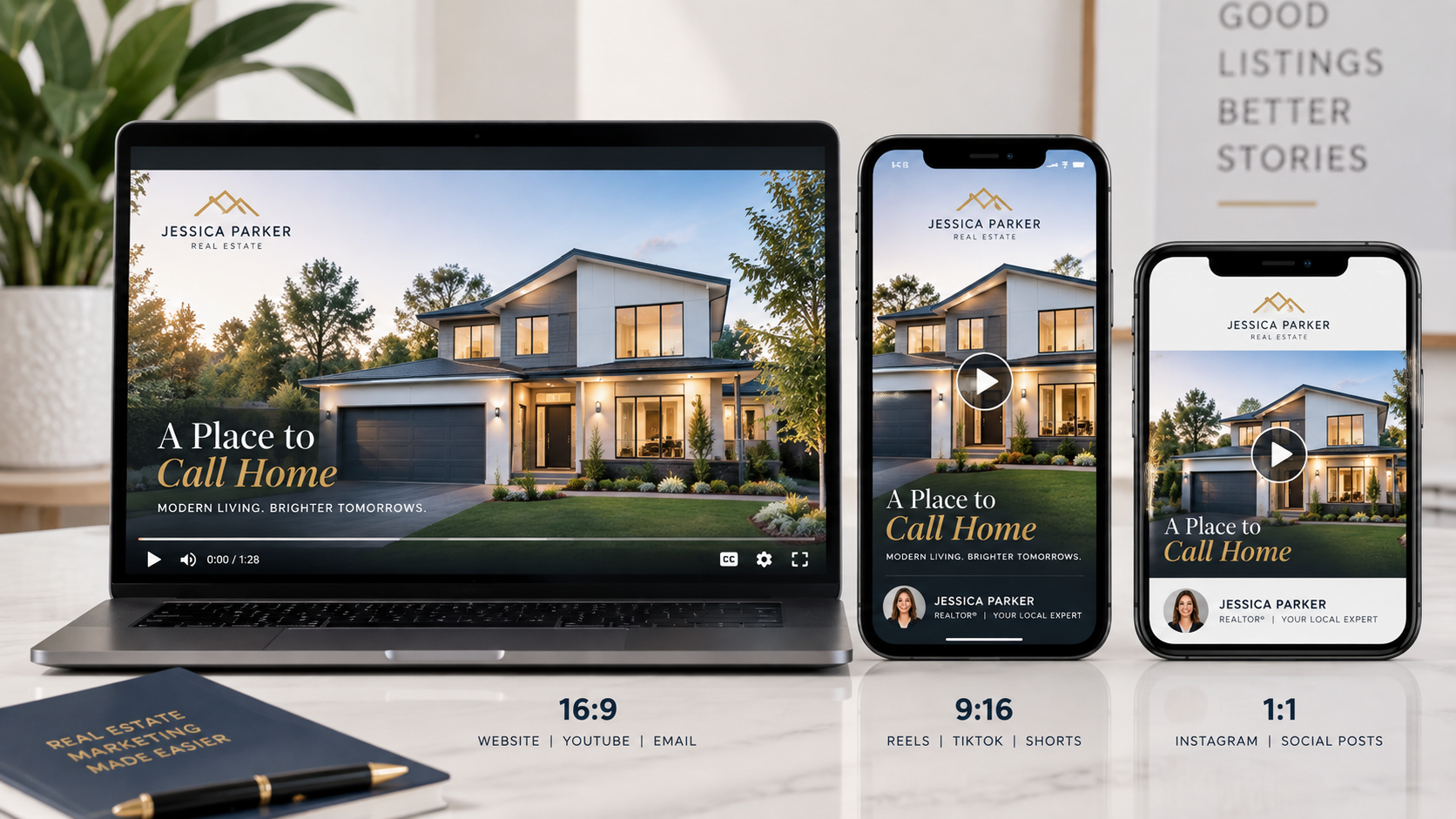
AI can now automate tasks such as simulated camera movement, pacing, branding, formatting, and—in some platforms—voiceover or avatar generation. That makes it possible to turn existing listing photography into dynamic video content through a much more streamlined workflow.
Traditional videography still has an important role, particularly when a listing calls for custom cinematography or a live-action approach. But AI-powered photo-to-video tools give solo agents, teams, brokerages, and photographers another practical way to incorporate video into their marketing.
For agents curious about what that looks like in practice, the easiest next step is to browse real-world AI real estate video examples from PhotoAIVideo and compare the results with the production approach you're already using.
It depends on the source photography, the AI platform, the movement applied, and the amount of customization involved.Modern tools can create pans, zooms, tilts, push-ins, and other simulated camera movements that make still photographs feel more dynamic than a basic slideshow.If you'd like to see the difference yourself, PhotoAIVideo's real estate video examples show before-and-after examples of static listing photography transformed into AI-generated property videos. Reviewing the finished video is still important to make sure the movement looks natural and accurately represents the property.
Not necessarily.One of the main advantages of photo-to-video platforms is that they can automate many traditional editing tasks. Instead of manually working with an editing timeline, agents can typically start with existing listing photos and let the platform handle much of the movement, sequencing, and formatting.The exact workflow and level of customization will vary by platform.
Depending on the platform, yes.PhotoAIVideo's current paid offerings include custom branding and logo options, while its Pro plan includes AI voiceovers. The company also offers an AI Avatar add-on with personal avatar clones and AI voice options.
No.AI photo-to-video tools and traditional videography serve different needs. Automated video can be useful when speed, scalability, and cost efficiency are priorities, while traditional filming may be better suited to properties that require custom cinematography, live-action presentation, or a highly specific creative concept.


Compact, ready to go anywhere
Interchangeable lens that’s upgradeable
Dual 1-inch sensors for improved clarity and low light performance
Dynamic range and 6K 360° capture
360° photo resolution at 21MP

8K 360° video recording for ultra-detailed visuals.
4K single-lens mode for traditional wide-angle shots.
Invisible selfie stick effect for drone-like perspectives.
2.5-inch touchscreen with Gorilla Glass protection.
Waterproof up to 33ft for underwater shooting.

360° photo resolution in 23MP
Slim design at 24 mm thick
Built-in image stabilization for smooth video capture.
Internal 19GB storage for photo and video storage.
Wireless connectivity for remote control and sharing.

60MP 360° still images for high-resolution photography.
5.7K 360° video recording at 30fps.
2.25-inch touchscreen for intuitive control.
USB Type-C port for fast charging and data transfer.
MicroSD card slot for expandable storage.
.png)

.png)

Try it free. No credit card required. Instant set-up.





.svg)


.svg)