


.png)


The future of virtual tour platforms designed for admissions teams will likely center on more immersive experiences, better engagement analytics, personalization, live interaction, and closer integration with admissions workflows. Rather than replacing campus visits, virtual tours can expand digital access and help institutions create more connected experiences for prospective students throughout the recruitment journey.
Prospective students and their families increasingly expect to explore a campus before they ever set foot on it. What began as a novelty—a clickable 360° walkthrough of a student union or residence hall—has become another useful part of the admissions journey, sitting alongside campus visits, information sessions, videos, and traditional viewbooks.
As more institutions adopt this technology and families become more comfortable exploring campuses digitally, admissions offices are asking a reasonable next question: Where is virtual tour software headed, and how should enrollment marketing teams prepare for what comes next?
No one can predict the exact features that will define the next decade of higher-ed marketing technology. However, several trends are already visible in how institutions are using tools such as virtual tour software designed for university admissions.
This article explores five areas admissions leaders should watch and explains why developing a strong virtual-tour strategy today can help institutions prepare for future developments.
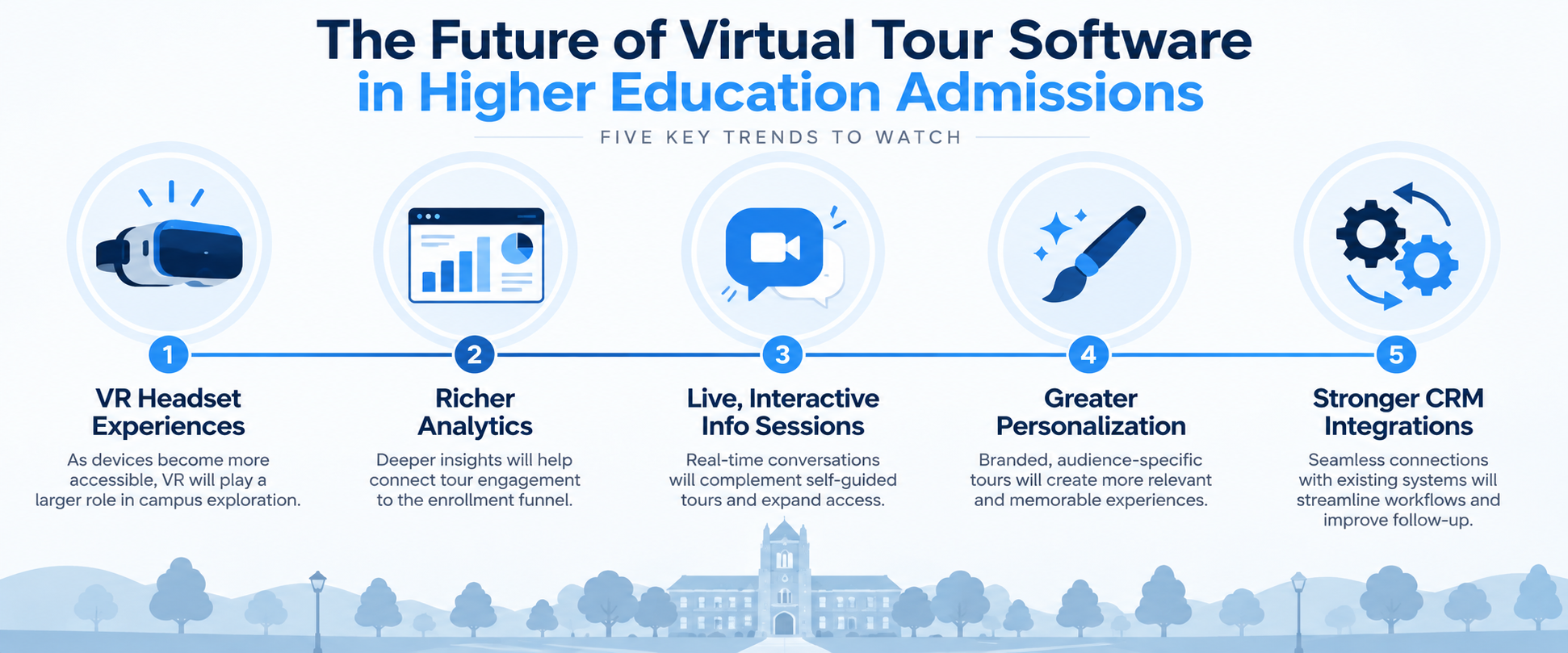
Virtual reality headsets have historically been a more specialized option for admissions offices—useful for recruitment fairs, open houses, and other events but less practical as the primary way prospective students explore a campus from home.
As VR hardware continues to evolve, headset-based viewing may become more accessible and convenient for a broader range of prospective students.
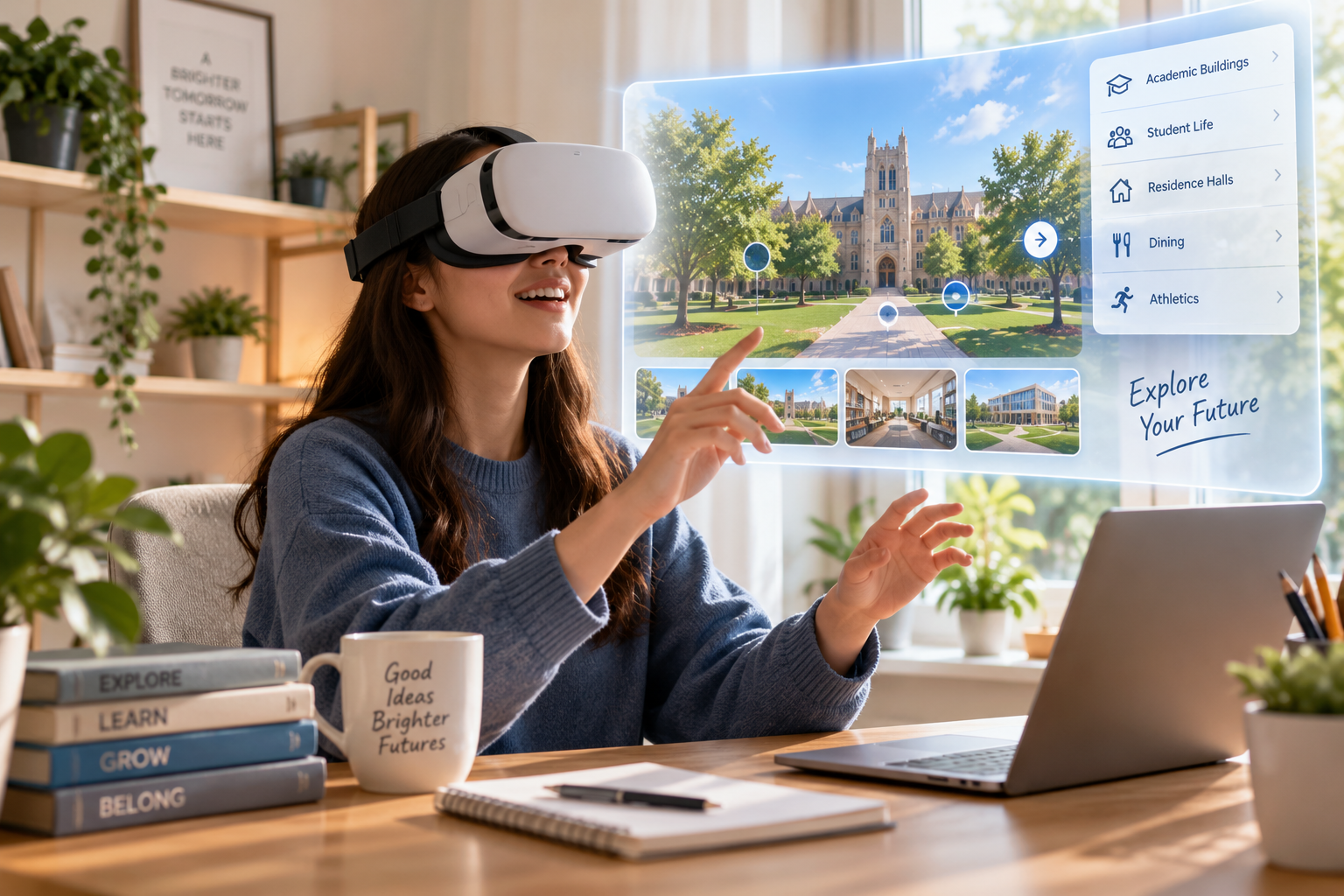
For admissions offices, this is more likely to represent a gradual evolution than an overnight shift. Tours built with 360° scenes and hotspot navigation can already support immersive viewing experiences, depending on the platform and device.
This means institutions that build a strong library of high-quality 360° campus imagery today may be better positioned to take advantage of expanded VR capabilities in the future without recreating all of their visual content from scratch.
Rather than waiting for VR to become a dominant recruitment channel, enrollment marketing teams can consider VR compatibility as one factor when evaluating virtual tour platforms.
The priority should remain creating an accessible experience that works well on the devices prospective students already use, while maintaining flexibility for emerging viewing formats.
Admissions offices have long faced the challenge of connecting top-of-funnel marketing activity with eventual enrollment outcomes.
Traditional marketing materials can be difficult to measure once they reach prospective students. Digital virtual tours, however, can provide measurable engagement signals when appropriate analytics and event tracking are configured.
Depending on the platform and analytics implementation, admissions teams may be able to track activity such as tour visits, scene interactions, hotspot clicks, and lead-form submissions.
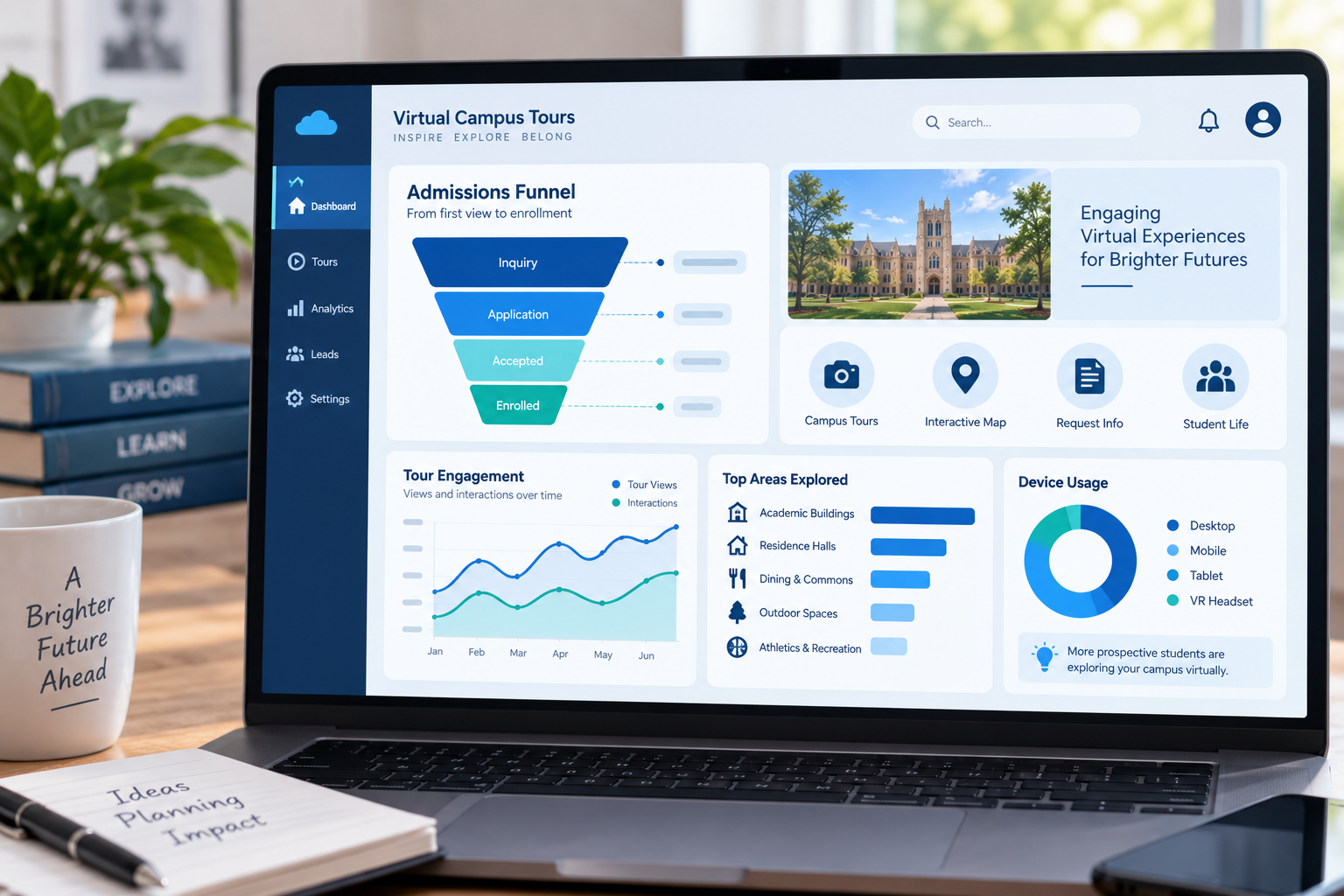
The next stage of maturity for virtual-tour analytics may involve not simply collecting more data, but making that information easier to connect with the broader enrollment funnel—from initial inquiry to application, deposit, and enrollment.
Analytics integrations can provide a foundation for this type of analysis, while future platform and CRM integrations may make it easier for admissions teams to interpret engagement without relying on disconnected dashboards or extensive manual analysis.
This matters because enrollment marketing teams increasingly need to demonstrate the value of their recruitment investments. Virtual-tour analytics can become another source of information within a broader data-informed admissions strategy.
Self-guided tours are useful for answering the question, "What does this campus look like?"
But they can't always answer the specific questions a prospective student or family may have about financial aid, academic programs, residence life, or the student experience.
Live 360° video functionality available through some virtual tour platforms points toward a more interactive model in which self-guided campus exploration and conversations with admissions staff can complement one another.
For example, a prospective student could explore a residence hall virtually and then participate in a scheduled conversation with an admissions counselor or student ambassador who can answer questions about housing.
This doesn't need to replace the in-person campus visit or traditional information session. Instead, interactive virtual experiences can extend access to prospective students who cannot easily travel because of distance, cost, scheduling, or other barriers.
Virtual experiences are most useful when viewed as an additional recruitment channel rather than a universal substitute for visiting campus.
They can be particularly valuable during early-stage research, for international and out-of-region recruitment, and for admitted students who want to revisit campus virtually while comparing their options.
Prospective students often compare several institutions during their college search. In that environment, a generic virtual-tour experience can miss an opportunity to reinforce what makes a particular institution distinctive.
Custom branding, white-label domains, and tours organized around particular programs or audiences can help create a more cohesive experience.
For example, an institution might create different pathways or emphasize different scenes for prospective nursing students, international applicants, student-athletes, or honors-program candidates.
Personalization may eventually extend beyond visual branding into how tour content itself is presented. A prospective student entering through a nursing-program page, for instance, could be directed toward relevant laboratories, classrooms, simulation spaces, and student facilities.
This type of personalization doesn't necessarily require futuristic technology. It can build on existing capabilities such as hotspot navigation, embedded tours, dedicated landing pages, and audience-specific content.
One of the most practical areas of future development is integration.
Admissions offices already rely on CRMs and marketing automation systems to manage inquiries, applications, communications, event registrations, and prospective-student engagement. A virtual tour that operates entirely outside those systems can create another isolated source of information for staff to manage.
Lead-generation forms within virtual tour platforms designed for admissions teams can help bridge that gap by capturing prospective-student information during the tour experience.
Over time, deeper integrations could make it easier for tour engagement data to become part of the same recruitment workflows institutions already use for counselor outreach, email campaigns, event invitations, and other communications.
For enrollment marketing teams evaluating platforms today, this provides a useful question to ask: How easily can the platform's lead-generation and analytics capabilities work alongside the systems our admissions office already uses?
It can be tempting to look at emerging technology and decide to wait—wait for broader VR adoption, more sophisticated analytics, or deeper CRM integrations.
But institutions don't necessarily need to wait for every future capability before developing the foundation.
Building a useful library of 360° campus scenes, training staff to maintain those experiences, deciding how analytics will be reviewed, and determining where virtual tours fit within admissions communications all take time.
Institutions that already have these processes in place may find it easier to adopt new capabilities as they become relevant. Instead of starting from zero, they can add new functionality to an established virtual-tour strategy.
This is one reason to think of virtual tour software as part of an institution's broader digital recruitment infrastructure rather than simply a one-time marketing project.
Regardless of which technologies develop fastest, admissions offices that establish a process for creating, maintaining, promoting, and evaluating virtual-tour content will have a stronger foundation for adapting to what comes next.
No. A virtual tour should first provide a strong experience across commonly used devices such as smartphones, tablets, and computers.VR compatibility can provide an additional immersive viewing option, particularly for recruitment events or users who already have access to compatible hardware, but it isn't necessary for a virtual tour to be useful.
Start with the engagement metrics your virtual tour and analytics setup can reliably track, such as tour visits, lead-form submissions, and other configured interactions.Where possible, connect that information with inquiry, application, and enrollment data in your existing admissions systems.The goal is to evaluate virtual-tour engagement alongside other recruitment metrics rather than treating it as an isolated measurement.
No. Virtual tours are better viewed as a complement to in-person campus visits.They extend access to prospective students who cannot easily travel, support early-stage exploration before a family commits to visiting, and give students another way to revisit campus while comparing institutions.
There isn't a universal answer, but a sensible starting point is to build strong tour content covering the buildings and spaces prospective students most want to see.From there, institutions can add appropriate analytics tracking and gradually develop deeper integrations based on their recruitment workflows and data needs.
Admissions teams should consider mobile accessibility, 360° navigation, branding, analytics, lead capture, privacy controls, embedding options, and compatibility with existing admissions workflows. VR support can be useful, but institutions should prioritize an accessible experience that works well on the smartphones and computers prospective students already use.


Compact, ready to go anywhere
Interchangeable lens that’s upgradeable
Dual 1-inch sensors for improved clarity and low light performance
Dynamic range and 6K 360° capture
360° photo resolution at 21MP

8K 360° video recording for ultra-detailed visuals.
4K single-lens mode for traditional wide-angle shots.
Invisible selfie stick effect for drone-like perspectives.
2.5-inch touchscreen with Gorilla Glass protection.
Waterproof up to 33ft for underwater shooting.

360° photo resolution in 23MP
Slim design at 24 mm thick
Built-in image stabilization for smooth video capture.
Internal 19GB storage for photo and video storage.
Wireless connectivity for remote control and sharing.

60MP 360° still images for high-resolution photography.
5.7K 360° video recording at 30fps.
2.25-inch touchscreen for intuitive control.
USB Type-C port for fast charging and data transfer.
MicroSD card slot for expandable storage.
.png)

.png)

Try it free. No credit card required. Instant set-up.




.svg)


.svg)