FAA Part 107 & Drone Insurance Explained: The Guide for Safe and Legal Flying

Cloudpano
December 11, 2025
5 min read
Share this post

FAA Part 107 & Drone Insurance Explained: The Guide for Safe and Legal Flying 🚀

Flying drones for fun is exciting—but flying them for business opens up a whole new world of opportunity. Whether you want to shoot real estate videos, capture weddings, or provide aerial inspections, there’s one thing every commercial pilot must know: compliance.  To make sure you’re fully prepared, watch this drone compliance and FAA Part 107 guide on YouTube before you launch your business. ✅

The rules are clearer than ever: to legally fly drones for profit in the United States, you need to be set up properly with an LLC, insurance, and your FAA Part 107 certification. This guide will break down each step so you’re confident, protected, and ready to profit.

Why Compliance Matters for Drone Pilots🛡️

Imagine this: you’re flying a drone over a wedding venue, and suddenly a gust of wind knocks it into a parked car—or worse, the cake. Without the right setup, you could be personally liable for thousands of dollars in damages.

That’s why your business structure, insurance coverage, and FAA licensing are so important. They don’t just keep you safe—they open the door to bigger contracts with enterprise clients who require professionalism.

Let’s walk through the three pillars of drone business compliance:

1. Forming an LLC: Protect Your Assets 🏢

The first step in your drone business setup is creating an LLC (Limited Liability Company).

  • An LLC separates your personal finances from your business.
  • If something goes wrong, the LLC is liable—not you personally.
  • With an LLC, you can open a business bank account, keep clean records, and qualify for larger contracts.

💡 Pro Tip: Apply directly through your state’s Secretary of State website (ex: Texas Secretary of State). While third-party services like LegalZoom exist, they often charge extra fees.

Once your LLC is formed:

  • Get an EIN (Employer Identification Number) from the IRS—it’s free.
  • Open a business bank account to keep income and expenses separate.
  • Be ready to submit W-9 forms when working with large clients.

👉 Check out how to form an LLC for drone pilots for a step-by-step breakdown.

2. Insurance: Cover Your Drone and Business ✈️

Next, let’s talk about insurance. This is non-negotiable if you’re serious about flying drones commercially.

Two types of coverage you’ll need:

  1. General Liability Insurance – Protects you if your drone damages property or injures someone.
  2. Hull Insurance – Covers your drone itself, so if it crashes, you can file a claim and replace it.

Most enterprise clients will ask for a COI (Certificate of Insurance) before hiring you. Without it, you won’t even get considered.

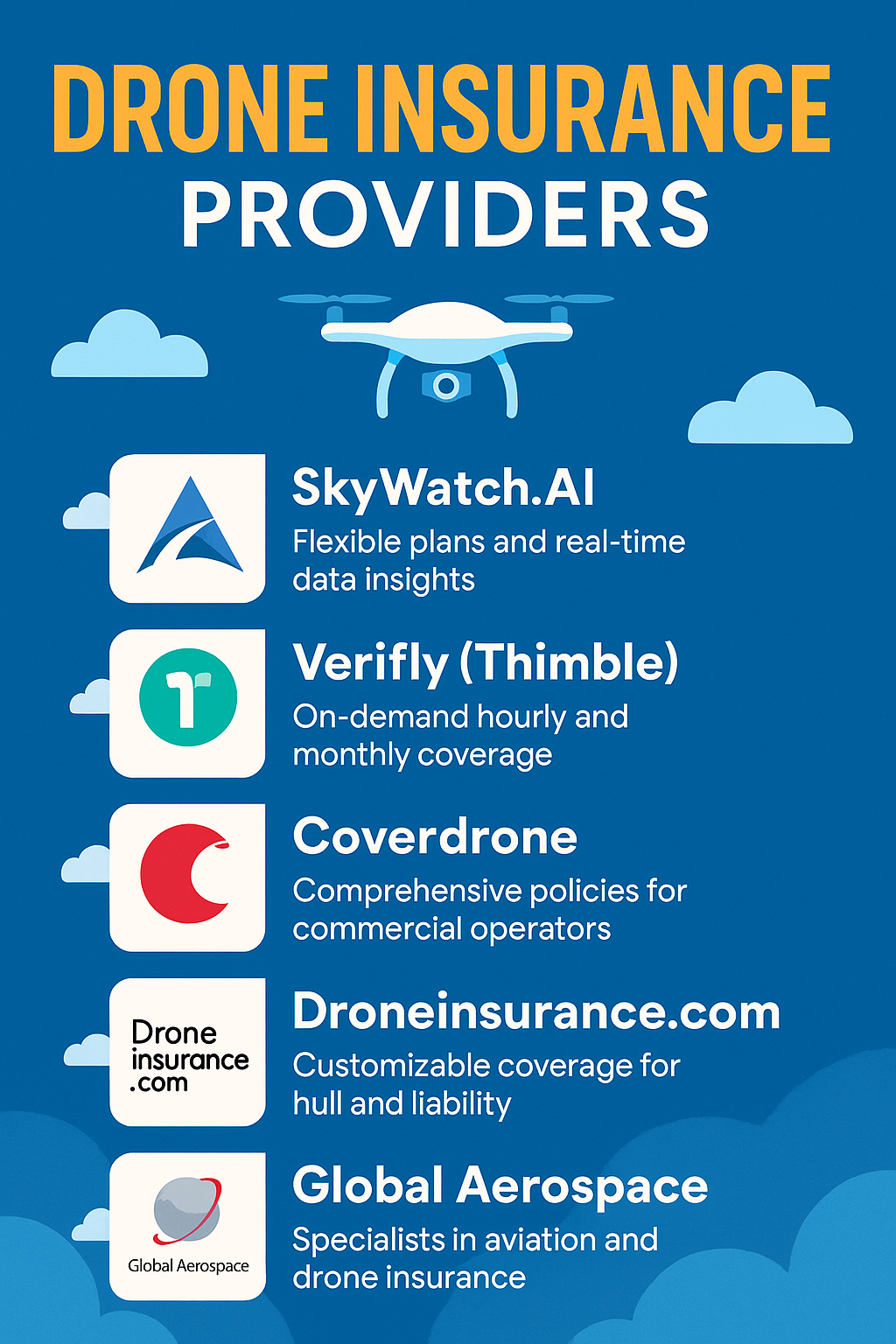
📌 Companies like Next Insurance make it simple and affordable to get general liability coverage online. For hull insurance, providers like SkyWatch.AI offer drone-specific plans.

👇Infographic showing top drone insurance providers for FAA Part 107 pilots
3. FAA Part 107 Certification: Your License to Fly 📜

The FAA Part 107 is the golden ticket for drone pilots. Without it, you can’t legally fly drones commercially in the U.S.

What you need to know:

  • The test has 60 multiple-choice questions.
  • You must score 70% or higher to pass.
  • Topics include weather, airspace classifications, drone regulations, and emergency procedures.
  • You must renew your certification every 24 months with an online refresher.

To prepare:

  • Study FAA resources or use a structured prep course.
  • Schedule your exam at an FAA-approved testing center.
  • Carry your Part 107 license whenever you fly—authorities can and do ask to see it.

👉 Become a Certificated Remote Pilot

Bonus: Safety & Professionalism in the Field 👷‍♂️

Beyond the legal setup, professionalism goes a long way. When flying on a commercial site:

  • Wear reflective gear that clearly marks you as a drone operator.
  • Carry your Part 107 certificate and proof of insurance.
  • Keep a copy of your contract or scope of work in case you’re questioned.

This not only builds trust with clients but also protects you if you’re approached by law enforcement or property managers.

The Smart Order: Customers First, Setup Second 💰

Here’s a strategy most beginners overlook: get your first customer before completing your entire setup.

  • If you land a paying client quickly, you’ll know how fast you need to move on LLCs, insurance, and licensing.
  • You can subcontract a licensed pilot for your first jobs while you work on passing your Part 107.
  • Once you have income flowing, investing in compliance feels like a natural next step.

👉 Want to start pitching? Use platforms like CloudPano Virtual Tours to create demo projects that wow clients.

Putting It All Together: The Drone Pilot Roadmap 🚁

  1. Form Your LLC → Protect your personal assets.
  2. Get Insured → Liability + hull insurance = peace of mind.
  3. Pass Part 107 → Earn your FAA license to fly commercially.
  4. Book Your First Client → Start with small businesses, real estate, or events.
  5. Scale With Systems → Use tools like CloudPano for virtual tours and PhotoAIVideo for automated property videos.

By setting yourself up the right way, you’re not just a hobbyist—you’re a professional pilot positioned for six-figure opportunities.

🎙Read More

Final Thoughts 🌟

Drones are more than flying cameras—they’re business machines. The demand for drone services is booming across real estate, construction, inspections, and marketing. But without the right setup—LLC, insurance, and Part 107—you’re flying blind.

So take the time to build a solid foundation. With compliance in place, you’ll not only stay safe but also unlock bigger contracts, higher fees, and long-term business growth.

👉 Ready to scale your drone business? Start with CloudPano Virtual Tours and transform your flying into profit.

👑 Get Started

Share this post
Cloudpano

Choose The Right 360° Camera

Insta360 ONE RS 1-Inch 360 Edition

  • Compact, ready to go anywhere

  • Interchangeable lens that’s upgradeable

  • Dual 1-inch sensors for improved clarity and low light performance

  • Dynamic range and 6K 360° capture

  • 360° photo resolution at 21MP

Learn More

Insta360 X4

  • 8K 360° video recording for ultra-detailed visuals.

  • 4K single-lens mode for traditional wide-angle shots.

  • Invisible selfie stick effect for drone-like perspectives.

  • 2.5-inch touchscreen with Gorilla Glass protection.

  • Waterproof up to 33ft for underwater shooting.

Learn More

Ricoh Theta Z1

  • 360° photo resolution in 23MP

  • Slim design at 24 mm thick

  • Built-in image stabilization for smooth video capture.

  • Internal 19GB storage for photo and video storage.

  • Wireless connectivity for remote control and sharing.

Learn More

Ricoh Theta X

  • 60MP 360° still images for high-resolution photography.

  • 5.7K 360° video recording at 30fps.

  • 2.25-inch touchscreen for intuitive control.

  • USB Type-C port for fast charging and data transfer.

  • MicroSD card slot for expandable storage.

Learn More
Property Marketing
Allows potential buyers to explore properties in detail from anywhere, enhancing the real estate marketing process.
Automotive Spins
Create an interactive virtual showroom and engage affluent digital buyers with live 360º video calls, all through the CloudPano mobile app for a complete automotive sales solution.
Interactive Floor Plans
Create 2D and 3D floor plans with measurements in 4 minutes or less, all from your phone. Download the Floor Plan Scanner app and get your first scan free.

360 Virtual Tours With CloudPano.com. Get Started Today.

Try it free. No credit card required. Instant set-up.
Try it free
Latest posts

See our other posts

Interviews, tips, guides, industry best practices, and news.

The Psychology of AI Avatar Listing Presentations

This article explores the psychology behind AI avatar listing presentations and why face-driven video remains one of the most persuasive tools in real estate marketing. It explains how combining AI video persuasion with face-to-camera real estate video principles helps agents build trust, authority, and brand consistency at scale. Readers learn how AI avatars preserve authenticity while reducing production time, enabling agents and teams to deliver professional, repeatable listing presentations without constant recording.
Read post

How to Scale Real Estate Video Marketing Without Recording Every Time

This article explains how to scale real estate video marketing without constantly recording new content. It outlines a step-by-step system to automate listing videos using AI video creation for agents, including automated scripts, AI avatars, and AI voiceovers. The post highlights how automation saves time, improves branding consistency, and allows agents and teams to publish more video content without burnout. Readers learn how to build a repeatable workflow that increases visibility, efficiency, and long-term marketing scalability.
Read post

How to Create AI Voiceovers for Real Estate Videos

This article explains how to create an AI voiceover for real estate videos using simple automation tools. It walks agents through turning listing descriptions into professional AI listing narration and generating an automated property voiceover in minutes. The post highlights how AI voice technology improves consistency, saves time, strengthens branding, and increases engagement across listing walkthroughs, social media videos, and virtual tours. Realtors and teams will learn how to build a scalable voiceover system that enhances professionalism without requiring constant recording.
Read post