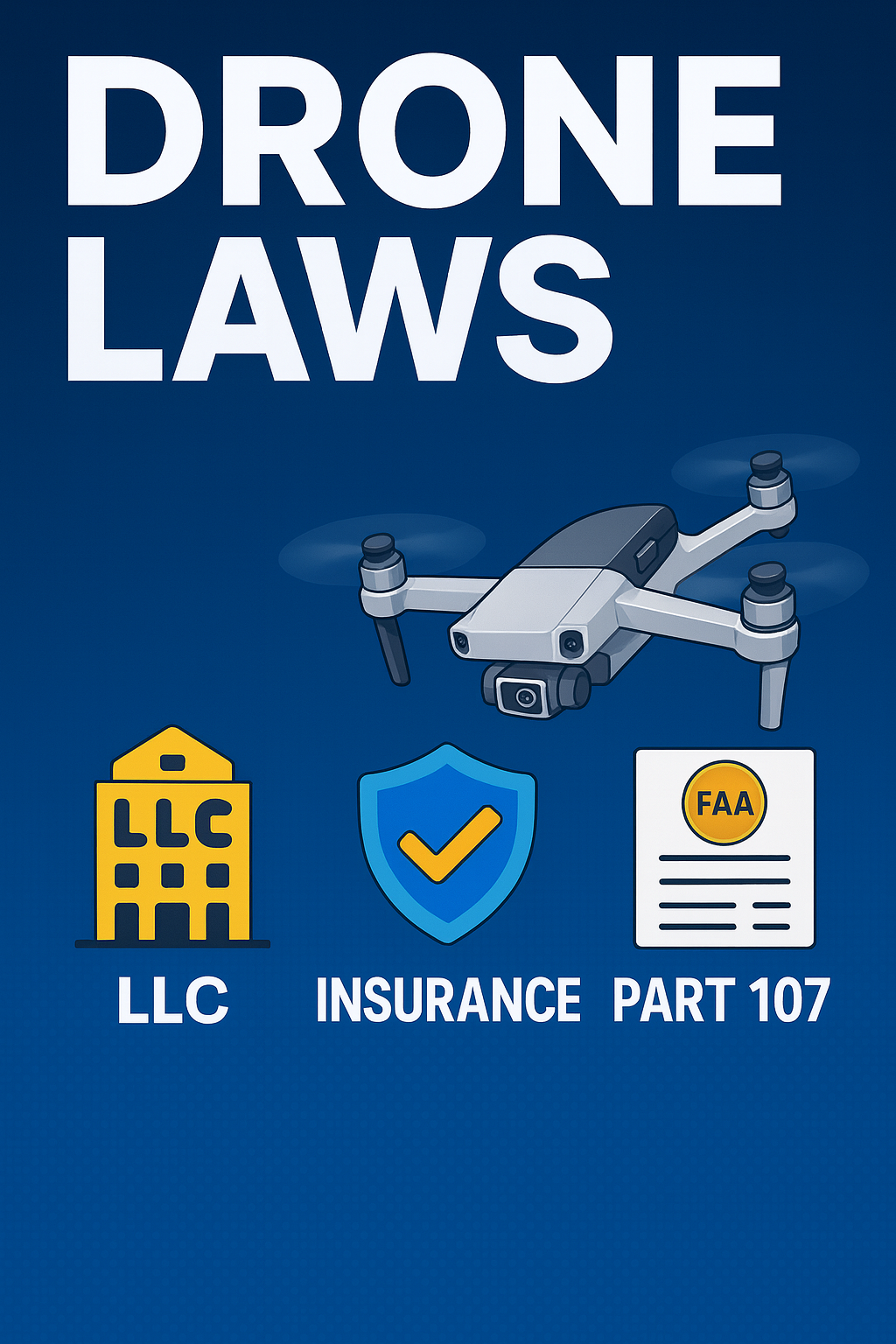
Drone Laws: What Every Pilot Must Know About Part 107 and Insurance Before Flying

Cloudpano
December 11, 2025
5 min read
Share this post

🚁 Drone Laws: What Every Pilot Must Know About Part 107 and Insurance Before Flying

Launching your drone business? ✨ Before you take flight, you must understand the legal setup, insurance requirements, and FAA Part 107 rules that govern commercial drone operations. Skipping these steps can land you in serious trouble (think hefty fines, liability issues, and even grounded opportunities). To help you avoid these pitfalls, check out this drone business startup guide on YouTube that walks you through the essentials.

In this updated guide, I’ll walk you through:
✅ Why you need an LLC for your drone business
✅ The right insurance coverage (general liability + hull insurance)
✅ Everything about the FAA Part 107 license
✅ Practical tips to stay compliant while scaling your drone services
✅ How to protect your profits while keeping clients confident

Let’s dive in. 🌟

🏢 Step 1: Form Your LLC (Limited Liability Company)

Starting your drone business without an LLC is like flying without propellers—you’ll crash sooner than later.

An LLC (Limited Liability Company) protects your personal assets (like your home, car, or savings) if something goes wrong while you’re flying commercially. Imagine this: your drone accidentally crashes into a wedding cake 🎂 or damages a client’s car 🚗. Without an LLC, you personally are liable. With an LLC, your business is liable—not you.

👉 How to set up an LLC:

  • Apply directly with your state’s Secretary of State website. (In Texas, for example, you can file directly online.)
  • Or, use services like LegalZoom if the government forms feel overwhelming.
  • Costs vary by state, but typically you’ll pay a filing fee and possibly an annual report fee.

Once you have your LLC:

  • Open a business bank account 🏦
  • Get your EIN (Employer Identification Number)—it’s free!
  • Start keeping your business finances separate for clean bookkeeping and taxes

Pro Tip: An LLC also makes you more professional. Many clients and enterprises require vendors to have one before working on large projects.

🛡️ Step 2: Get the Right Drone Insurance

Flying uninsured is a rookie mistake. 🚫 Insurance not only protects you but also gives clients peace of mind that you’re a legitimate professional.

Types of Insurance You Need:

  1. General Liability Insurance
    • Covers accidents or damages caused by your drone operations.
    • Example: Your drone crashes into a client’s roof. Liability insurance covers repairs.
    • Popular providers: Next Insurance (affordable, all online), Hiscox, State Farm.
  2. Hull Insurance (a.k.a. Drone Insurance)
    • Covers damage to your drone itself.
    • Example: A gust of wind knocks your drone into a tree 🌳. Hull insurance pays for repairs or replacement.
    • Providers include SkyWatch, Avion Insurance, and others.

👉 Why it matters:

  • Many enterprise clients (like construction firms, real estate developers, or government contracts) require proof of insurance.
  • You’ll need a Certificate of Insurance (COI) 📝 to show them you’re covered.

💡 Pro Tip: Even if your local projects don’t require insurance, carrying it makes you look more credible and helps close deals faster.

📢 Best Cameras and Drones for Oilfield Virtual Tours in 2025

📢How To Sell $100K Of Drone Services Step by Step. Just Copy Me

🎓 Step 3: Pass the FAA Part 107 Exam

Now for the cornerstone of drone laws: the FAA Part 107 Certification.

This certification is what legally separates hobbyists from professionals. If you want to fly drones for money, you must pass the test. Period.

📘 What is the FAA Part 107?

  • It’s an exam that covers airspace rules, weather, safety procedures, and drone regulations.
  • The test has about 60 questions, and you need at least 70% to pass.
  • You must renew every 24 months to stay compliant.

📝 How to Get Certified:

  1. Schedule your exam at an FAA-approved testing center.
  2. Study FAA Part 107 materials, including airspace maps, weather patterns, and drone safety rules.
  3. Take and pass the exam.
  4. Get your license in the mail.

👉 Anchor Guide: Check out our FAA Part 107 Study Guide 📚 to prepare quickly and pass on your first attempt.

🚨 Why it’s critical:

  • Flying without Part 107 while taking money for drone services = illegal.
  • Fines can reach thousands of dollars 💸.
  • Authorities or clients may ask to see your license at any time while you’re flying.

👷 Bonus: Compliance Tips for Drone Pilots

Beyond the big three (LLC, insurance, and Part 107), here are extra steps to stand out and stay safe:

  • Wear reflective gear 🦺 while flying. This makes you look professional and signals to onlookers that you’re legit.
  • Carry contracts & scope of work 📑 with you when flying commercially—if anyone questions your activity, you can show documentation.
  • Stay updated on drone laws. The FAA regularly tweaks regulations. Follow official FAA updates to stay compliant.
  • Subcontract when needed. If you’re just starting and don’t yet have Part 107, partner with a licensed pilot until you pass your exam.

🔔 What Kind of Drone Services Make The Most Money Fast - What Should Drone Photographers Sell?

🔔 How to Leverage Drone Services to Make Money in Your Local Market

💼 Protecting Profits While Flying Safe

Setting up your LLC, insurance, and FAA license isn’t just about compliance—it’s about building a professional brand that attracts bigger clients.

Here’s the profit logic:

  • LLC = Protect personal wealth + access to larger contracts
  • Insurance = Close enterprise deals faster + peace of mind
  • Part 107 = Legal compliance + ability to scale services

With these in place, you’re ready to market yourself as a professional drone business owner.

🚀 Final Thoughts

Starting a drone business is exciting—but if you skip the legal and compliance steps, you’re setting yourself up for failure.

The three must-haves are clear:

  1. 🏢 Form an LLC
  2. 🛡️ Get Insurance
  3. 🎓 Pass the FAA Part 107 exam

Once you’ve secured those, you can fly commercially, land high-paying contracts, and scale your drone business with confidence.

👉 Want to make drone tours even more profitable? Check out CloudPano to create immersive 360° virtual tours that businesses pay top dollar for.

Stay safe, fly smart, and build your drone profits the right way. ✨

💎 Get Started

Share this post
Cloudpano

Choose The Right 360° Camera

Insta360 ONE RS 1-Inch 360 Edition

  • Compact, ready to go anywhere

  • Interchangeable lens that’s upgradeable

  • Dual 1-inch sensors for improved clarity and low light performance

  • Dynamic range and 6K 360° capture

  • 360° photo resolution at 21MP

Learn More

Insta360 X4

  • 8K 360° video recording for ultra-detailed visuals.

  • 4K single-lens mode for traditional wide-angle shots.

  • Invisible selfie stick effect for drone-like perspectives.

  • 2.5-inch touchscreen with Gorilla Glass protection.

  • Waterproof up to 33ft for underwater shooting.

Learn More

Ricoh Theta Z1

  • 360° photo resolution in 23MP

  • Slim design at 24 mm thick

  • Built-in image stabilization for smooth video capture.

  • Internal 19GB storage for photo and video storage.

  • Wireless connectivity for remote control and sharing.

Learn More

Ricoh Theta X

  • 60MP 360° still images for high-resolution photography.

  • 5.7K 360° video recording at 30fps.

  • 2.25-inch touchscreen for intuitive control.

  • USB Type-C port for fast charging and data transfer.

  • MicroSD card slot for expandable storage.

Learn More
Property Marketing
Allows potential buyers to explore properties in detail from anywhere, enhancing the real estate marketing process.
Automotive Spins
Create an interactive virtual showroom and engage affluent digital buyers with live 360º video calls, all through the CloudPano mobile app for a complete automotive sales solution.
Interactive Floor Plans
Create 2D and 3D floor plans with measurements in 4 minutes or less, all from your phone. Download the Floor Plan Scanner app and get your first scan free.

360 Virtual Tours With CloudPano.com. Get Started Today.

Try it free. No credit card required. Instant set-up.
Try it free
Latest posts

See our other posts

Interviews, tips, guides, industry best practices, and news.

Using AI Avatars for Real Estate Listing Presentations and Property Walkthrough Videos

This article explains how real estate professionals are using AI avatars for listing presentations and property walkthrough videos to scale their marketing and stay competitive in a video-first industry. It covers how AI avatars work, why they are becoming popular among agents, and how they help create professional listing videos without constant filming. The post also highlights how tools like PhotoAI allow agents to upload a headshot, generate a digital avatar, and quickly produce polished video content for property tours, seller presentations, and social media marketing. By leveraging AI avatars, agents can maintain consistent branding, create more content, and showcase listings more effectively while saving time.
Read post

AI Avatar Compliance and Best Practices for Real Estate Marketing

This article explores how real estate professionals can responsibly use AI avatars in property marketing while maintaining transparency and trust. It explains the importance of AI real estate compliance, including how agents should implement proper disclosure for AI videos and follow ethical AI marketing practices when using AI-generated presenters in listing videos. The guide walks through how AI avatars are created, how they can automate listing presentations, and how agents can integrate them into their marketing workflow without misleading buyers or violating advertising standards. By following clear best practices—such as accurate scripts, transparent disclosures, and consistent review of generated content—real estate teams can scale video marketing while protecting their reputation and building long-term client trust.
Read post

Managing Multiple AI Clones Inside One Real Estate Team

This article explains how real estate teams can successfully manage AI avatars across multiple agents to scale their marketing and listing presentations. It walks through the process of creating AI avatar clones, organizing them into a structured team avatar management system, and integrating them into a streamlined real estate AI workflow. The guide demonstrates how listing descriptions can quickly be converted into scripts, allowing AI avatars to present properties automatically in listing videos. By combining automation with personalization, brokerages can maintain individual agent branding while producing high-quality marketing content faster than ever. The article also highlights how photographers and real estate media companies can resell AI avatar presentations as an additional service, creating new revenue streams while helping agents generate engaging listing videos without filming themselves.
Read post