Drone Laws and Insurance: How to Stay Compliant with FAA Part 107

Cloudpano
December 11, 2025
‱
5 min read
Share this post

Drone Laws and Insurance: How to Stay Compliant with FAA Part 107 🚁📜

Introduction

Flying drones is no longer just a hobby—it’s a booming industry that creates opportunities for photographers, real estate pros, surveyors, and content creators. If you want to turn your drone into a profitable business, watch this Drone Business & FAA Part 107 Compliance Guide on YouTube to learn the legal and insurance steps you can’t skip.🌍 But before you launch your drone business, you must understand the FAA Part 107 rules and insurance requirements that keep you compliant, safe, and profitable.

In this guide, we’ll cover:

  • ✅ Why forming an LLC matters for drone pilots
  • ✅ The different types of insurance every pilot should have
  • ✅ How to pass and maintain your FAA Part 107 certification
  • ✅ Tips for avoiding costly mistakes while scaling your drone services

Whether you’re brand new or already running a drone business, thiis update will help you avoid fines, protect your assets, and stay ahead of competitors.

Step 1: Form an LLC for Your Drone Business 🏱

One of the first things you should do is create a Limited Liability Company (LLC). Why? Because an LLC separates your personal assets (like your house, car, and bank accounts) from your business activities. If your drone crashes into a car, building, or wedding cake 🎂, it’s your business—not you personally—that’s liable.

Benefits of an LLC for Drone Pilots:

  • Legal Protection – Shields your personal assets from lawsuits or claims.
  • Professional Credibility – Clients trust registered businesses more.
  • Tax Flexibility – Access to write-offs for expenses like drone gear, insurance, travel, and software.
  • Business Banking – Open a separate account to keep your finances clean and organized.

💡 Pro tip: In Texas and many other states, you can apply directly at the Secretary of State website. Or, you can use services like LegalZoom if you want an easier process.

Once your LLC is formed, apply for an EIN (Employer Identification Number)—it’s free and allows you to set up a business bank account, sign contracts, and get on vendor lists for larger projects.

👉 Related resource: [How to Form an LLC for Drone Pilots]

Step 2: Secure Drone Insurance đŸ›Ąïž

Even the best pilots face unexpected crashes, accidents, or equipment malfunctions. That’s why drone insurance is a must.

Two Types of Drone Insurance You Need:

  1. General Liability Insurance
    • Covers accidents that happen during flights.
    • Protects you if your drone injures someone or damages property.
    • Often required by big clients before signing contracts.
    • Proof is given through a COI (Certificate of Insurance).
  2. Hull Insurance
    • Covers your drone itself.
    • If you crash or lose your equipment, hull insurance helps cover repair or replacement.

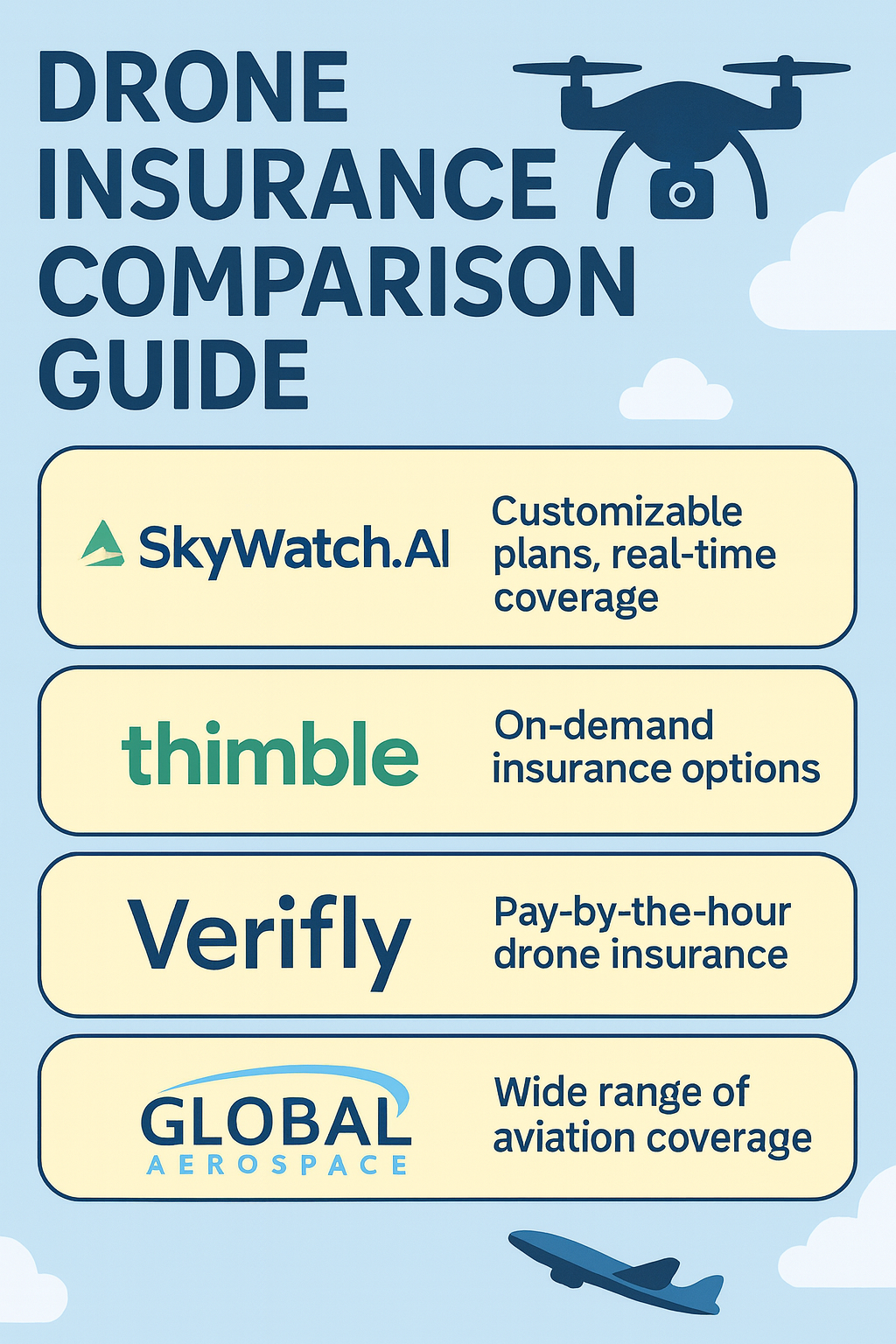
Popular Providers:

  • Next Insurance – Affordable, easy-to-set-up business liability.
  • SkyWatch.AI – Flexible drone insurance tailored to pilots.
  • Verifly – On-demand hourly drone coverage for small jobs.

💡 Pro tip: Always keep a digital copy of your COI on your phone or tablet in case a client or authority asks to see it.

👇 Related resource:
Step 3: Pass the FAA Part 107 Test ✈

The FAA Part 107 certification is your license to fly drones commercially in the U.S. Without it, you risk hefty fines and losing contracts.

What the Part 107 Covers:

  • Drone operation limits (max altitude 400 ft)
  • Airspace classifications and flight restrictions
  • Weather requirements and effects on drones
  • Preflight checklists and safety protocols
  • Drone maintenance rules
  • Emergency procedures

Steps to Get Certified:

  1. Schedule your test at an FAA-approved testing center.
  2. Study using Part 107 prep courses and FAA study guides.
  3. Pass the test (70% or higher is required).
  4. Receive your license in the mail.

Your license must be renewed every 24 months to stay valid.

💡 Pro tip: Always carry your Part 107 license when flying. If approached by local authorities or clients, you’ll want to prove you’re compliant.

👉 Related resource: [FAA Part 107 Study Guide for 2025]

Avoiding Costly Mistakes❌💾

Many new drone pilots rush to buy gear and start flying without the proper setup. That can lead to serious mistakes like:

  • Flying commercially without Part 107 – Leads to fines of up to $32,666 per violation.
  • Not having insurance – A single accident can wipe out your business.
  • Mixing personal and business finances – Creates tax headaches and legal risks.
  • Ignoring safety gear – Always wear reflective vests and follow local laws.

Instead, follow this 3-step compliance checklist:

  1. ✅ Get your LLC set up.
  2. ✅ Buy insurance (general + hull).
  3. ✅ Pass your Part 107 exam and renew every two years.

Real-World Example: Protecting Your Business đŸ§‘â€âœˆïž

Imagine you’re hired to shoot aerial footage of a luxury wedding venue. Halfway through the event, a strong gust of wind crashes your drone into a decorative arch, causing thousands of dollars in damage. Without insurance and an LLC, you’d be personally liable. With both in place, your business is covered, and your personal assets remain safe.

That’s the difference between a hobbyist and a professional drone pilot.

Conclusion: Stay Compliant, Stay Profitable đŸ’ŒđŸš

The drone industry is full of opportunities—but only if you stay compliant with FAA Part 107 rules and protect yourself with business insurance and an LLC.

By taking these steps, you’ll:

  • Build credibility with clients
  • Avoid costly fines and legal issues
  • Protect your gear, business, and personal assets
  • Position yourself as a professional in the growing drone services market

So, before you launch your next drone mission, make sure you’ve got your LLC filed, insurance in place, and Part 107 license secured.

👉 Ready to scale your drone business? Start with the right legal and compliance setup today.

🔔 Get Started

Share this post
Cloudpano

Choose The Right 360° Camera

Insta360 ONE RS 1-Inch 360 Edition

  • Compact, ready to go anywhere

  • Interchangeable lens that’s upgradeable

  • Dual 1-inch sensors for improved clarity and low light performance

  • Dynamic range and 6K 360° capture

  • 360° photo resolution at 21MP

Learn More

Insta360 X4

  • 8K 360° video recording for ultra-detailed visuals.

  • 4K single-lens mode for traditional wide-angle shots.

  • Invisible selfie stick effect for drone-like perspectives.

  • 2.5-inch touchscreen with Gorilla Glass protection.

  • Waterproof up to 33ft for underwater shooting.

Learn More

Ricoh Theta Z1

  • 360° photo resolution in 23MP

  • Slim design at 24 mm thick

  • Built-in image stabilization for smooth video capture.

  • Internal 19GB storage for photo and video storage.

  • Wireless connectivity for remote control and sharing.

Learn More

Ricoh Theta X

  • 60MP 360° still images for high-resolution photography.

  • 5.7K 360° video recording at 30fps.

  • 2.25-inch touchscreen for intuitive control.

  • USB Type-C port for fast charging and data transfer.

  • MicroSD card slot for expandable storage.

Learn More
Property Marketing
Allows potential buyers to explore properties in detail from anywhere, enhancing the real estate marketing process.
Automotive Spins
Create an interactive virtual showroom and engage affluent digital buyers with live 360Âș video calls, all through the CloudPano mobile app for a complete automotive sales solution.
Interactive Floor Plans
Create 2D and 3D floor plans with measurements in 4 minutes or less, all from your phone. Download the Floor Plan Scanner app and get your first scan free.

360 Virtual Tours With CloudPano.com. Get Started Today.

Try it free. No credit card required. Instant set-up.

Try it free
Latest posts

See our other posts

Interviews, tips, guides, industry best practices, and news.

Scaling Your Real Estate Business with AI Property Video Automation from MLS Listings

This analytical guide outlines a scalable operational model for real estate brokerages looking to eliminate creative bottlenecks inside their paid traffic channels. It details how expanding agencies leverage PhotoAIVideo.com—functioning as a dedicated short-form real estate video AI—to dynamically animate existing high-resolution MLS photography archives into native, full-screen vertical loops (9:16 format) on autopilot. The article clarifies the core computer vision principles behind monocular depth estimation, mapping out how the engine splits flat images into multi-plane geometric layers to simulate authentic physical camera slider movements. By replacing stagnant listing carousels with programmatic 3D parallax motion, teams can successfully bypass the massive overhead of manual filming crews, master mobile feed recommendation tracks by conquering the 3-second hook threshold, combat rapid creative fatigue across local zip codes, and fuel a predictable, multi-tier lead acquisition funnel.
Read post

TikTok for Real Estate: How Agents Are Winning Client Listings with AI Shorts from MLS Data

This high-growth tactical guide examines how modern real estate professionals use short vertical clips to gain a competitive edge on TikTok. It highlights PhotoAIVideo.com as an agile web application that functions as a highly efficient real estate Reels app, removing the time constraints of manual editing by instantly animating flat MLS photography portfolios into full-screen, native portrait (9:16) loops. The article clarifies the technology behind monocular depth estimation, showing how the cloud engine calculates spatial data to isolate foreground architectural elements from deep background lines to build real 3D parallax motion. By swapping out stationary media for instant pattern interrupts, agents can hook scrolling home buyers within the critical 3-second mobile feed window, satisfy platform delivery algorithms, defend their ad budget against creative fatigue, and generate high-intent inbound client leads on autopilot.
Read post

How to Build a Consistent Personal Brand as a Realtor Using Automated Social Media Videos from MLS Listings

This editorial guide maps out how budget-conscious real estate agents can generate high-intent buyer inquiries without wasting their commission margins on high-cost video production crews. It breaks down an automated workflow utilizing PhotoAIVideo.com—a browser-based short-form real estate video AI—to effortlessly transform static, high-resolution MLS listing photos into stunning 3D parallax vertical videos (9:16 format) built for mobile environments. The guide explains the operational mechanics of monocular depth mapping, where flat photos are broken into background and foreground layers to simulate true cinematic fluid-head camera tracking. By replacing static grids with immediate visual movement, agents can capture user attention inside the critical 3-second hook window, satisfy strict ad network auction algorithms, lower cost-per-click metrics, and seamlessly scale multi-stage retargeting funnels on any marketing budget.
Read post